
 [01]
[01]Discovery & Platform Blueprint
Architecture and governance are defined with clear non-functional requirements and measurable success criteria.
WordPress DXP architecture
Run a focused Health Check to uncover multisite governance gaps, delivery bottlenecks, integration risk, and performance issues across your platform.
Built for enterprise WordPress platforms managing multiple sites, brands, and release workflows.
No login required. Takes 2–3 minutes.
WordPress can become a true WordPress digital experience platform when it is treated as a product platform—not a collection of pages and plugins. WordPress DXP engineering focuses on multi-brand growth, structured content, reliable releases, and integrations across marketing and business systems, while still keeping the editorial team productive.
A scalable enterprise WordPress platform should be built around predictable content models, strict plugin governance, and WordPress performance engineering. When the platform is modernized with CI/CD, infrastructure automation, and an integration-first approach, content teams are enabled to ship faster and more consistently across sites, markets, and campaigns.
PathToProject supports WordPress DXPs across traditional and WordPress headless architecture options, including headless/hybrid DXP implementation patterns, multisite ecosystems, and enterprise-grade deployments. Delivery is aligned with measurable goals: faster releases, improved Core Web Vitals, reduced operational risk, and stable long-term ownership.
Platform Focus
Architecture Types
Enterprise Integrations
Delivery & Operations
Best Fit For
WordPress platforms often grow quickly through plugin accumulation, one-off theme changes, and ad-hoc infrastructure decisions. Over time, the platform becomes fragile: releases get riskier, performance becomes unpredictable, and editorial workflows start to depend on manual steps or tribal knowledge. These issues compound as traffic increases and more teams contribute to the same codebase and content model.
A typical scaling issue is governance. Without clear rules for plugins, content types, and deployment workflows, teams end up shipping changes inconsistently across environments and sites. In a WordPress multisite DXP context, that inconsistency spreads across brands and regions—creating duplicated configurations, uneven security posture, and uneven performance. The result is higher maintenance overhead, slower approvals, and more time spent troubleshooting regressions instead of improving experiences.
Architecture fragmentation is another common failure mode. When integrations (analytics, forms, search, CRM/CDP) are added opportunistically, data contracts drift and tracking becomes unreliable. Teams also struggle to choose between traditional rendering and a WordPress headless architecture approach, which can lead to partial implementations that increase complexity without improving delivery. As the platform grows, these gaps create operational risk, delivery bottlenecks, and escalating technical debt.
A full review is performed across theme, plugins, hosting, and workflows to identify stability, security, and performance bottlenecks.
Structured content types and repeatable components are introduced so new pages and campaigns can be built consistently.
A lifecycle is defined for plugin selection, updates, patching, and replacements to avoid platform drift.
Caching, assets, database patterns, and rendering strategy are optimized to improve Core Web Vitals and reduce time-to-interactive.
CRM/CDP, analytics, search, forms, and other systems are integrated in a controlled, observable way.
Automated builds and deployments are introduced to enable safe releases, consistent environments, and predictable rollbacks.
This service focuses on the engineering capabilities required to run WordPress as an enterprise WordPress platform and digital experience system. It emphasizes multisite governance, reusable content architecture, and WordPress headless architecture readiness (headless or hybrid) when needed. WordPress performance engineering, security discipline, and operational controls help keep delivery predictable as sites, teams, and integrations scale.

A scalable multisite foundation is established so brands and regions can be managed consistently without duplicating effort.

Reusable components and predictable content types are implemented to support campaign speed and long-term maintainability.
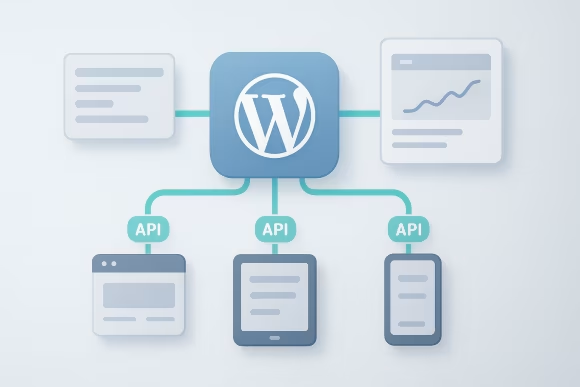
WordPress is prepared to act as a content hub for web and mobile, supporting API-first delivery when required.

Caching layers, asset strategy, and backend bottlenecks are optimized to sustain fast experiences under real traffic.

A hardened platform approach is applied to plugin governance, patch strategy, and safe WordPress core upgrades.

Integrations are engineered with reliability in mind—analytics, forms, CDP, CRM, search, and commerce workflows.

Logs, monitoring, and deployment signals are introduced so incidents are detected early and releases are measurable.

WordPress is positioned as a product platform that can evolve with modular services rather than monolithic customization.
Use the Health Check to pinpoint where multisite sprawl, plugin drift, and inconsistent deployment practices are creating risk.
Delivery follows an engineering sequence from discovery and platform blueprinting through modernization, capability buildout, and operational hardening. Work is planned to support multisite governance, integrations, and WordPress performance engineering, with clear environments and release workflows for long-term evolution.
[01]Architecture and governance are defined with clear non-functional requirements and measurable success criteria.
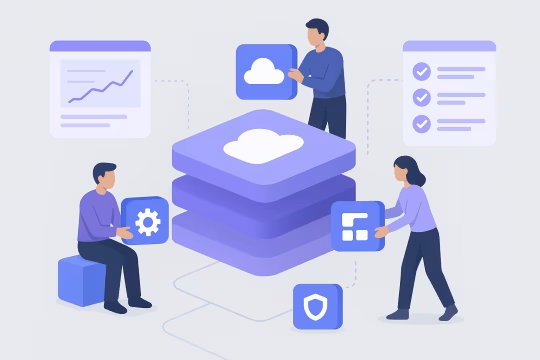 [02]
[02]Foundational improvements are delivered quickly to stabilize releases and remove immediate platform risks.
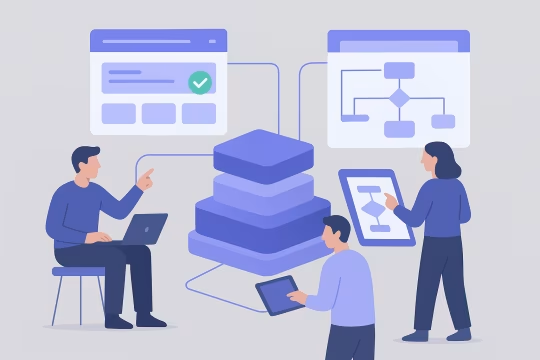 [03]
[03]Core DXP features are implemented in planned increments to reduce disruption for editorial teams.
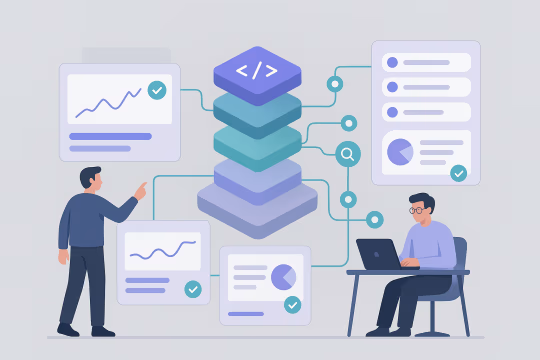 [04]
[04]Data flows and marketing integrations are introduced with predictable contracts and observability.
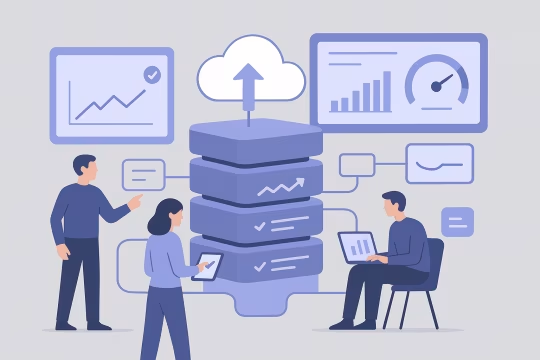 [05]
[05]The platform is tuned for real traffic patterns, content growth, and safe upgrade cycles.
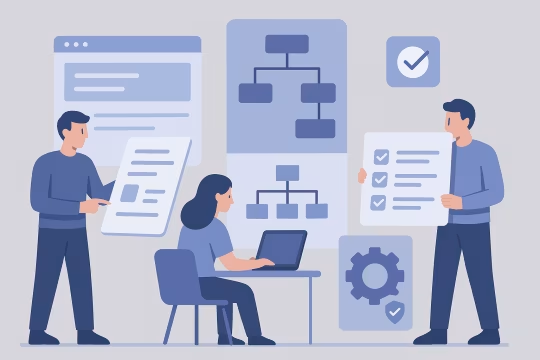 [06]
[06]Documentation, workflows, and operational practices are delivered so the platform can be owned long-term.
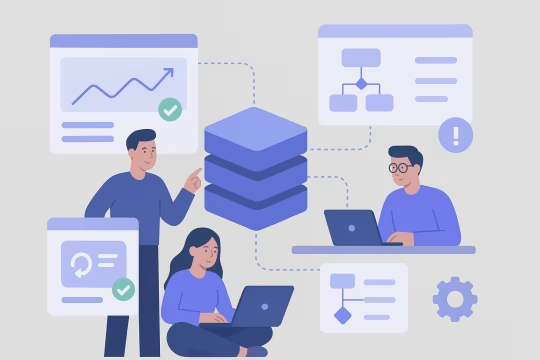 [07]
[07]Release support, monitoring, and iterative improvements can be provided based on the client’s cadence.
A WordPress digital experience platform approach improves delivery speed and reduces operational risk by making releases, governance, and integrations more predictable across sites. With stronger multisite controls and WordPress performance engineering, teams can scale campaigns and new properties while keeping Core Web Vitals, security posture, and maintenance effort under control.
Marketing updates are released more frequently without risky manual steps.
Governed plugins and automated deployments reduce the chance of production regressions.
Core Web Vitals improvements support better user experience and conversion outcomes.
New brands, regions, or microsites can be launched without rebuilding the platform each time.
Analytics and tracking become reliable, consistent, and easier to evolve.
The platform is stabilized so upgrades and changes cost less over time.
WordPress platform review
Identify the architectural fixes that improve release reliability, performance consistency, and operational control across sites and teams.
No login required. Takes 2–3 minutes.
These services extend WordPress DXP engineering into adjacent areas—multisite architecture, content and plugin governance, API development, analytics, and CRM/CDP integration—so the platform can evolve as a cohesive enterprise WordPress platform.
Enterprise WordPress network design for multi-site ecosystems
WordPress content architecture design for content models, taxonomies, and editorial structure
Enterprise WordPress extensibility with controlled dependencies
GA4 event tracking WordPress with governed measurement
WordPress REST API engineering and GraphQL API design
WordPress lead contact sync with secure lead capture
WordPress integration services for secure API connections
Custom WordPress REST endpoints, schemas, and authentication patterns
Upgrade-ready architecture, WordPress CI/CD and DevOps, and operational hardening
These case studies showcase scalable multisite governance, structured content modeling, and platform modernization aligned with enterprise WordPress and Drupal digital experience platforms. They highlight real-world delivery of multisite ecosystems, migration from legacy systems, integration governance, and performance optimization that directly reinforce the WordPress DXP service capabilities. The selected work demonstrates measurable improvements in release predictability, operational stability, and content scalability across complex, multi-brand environments.
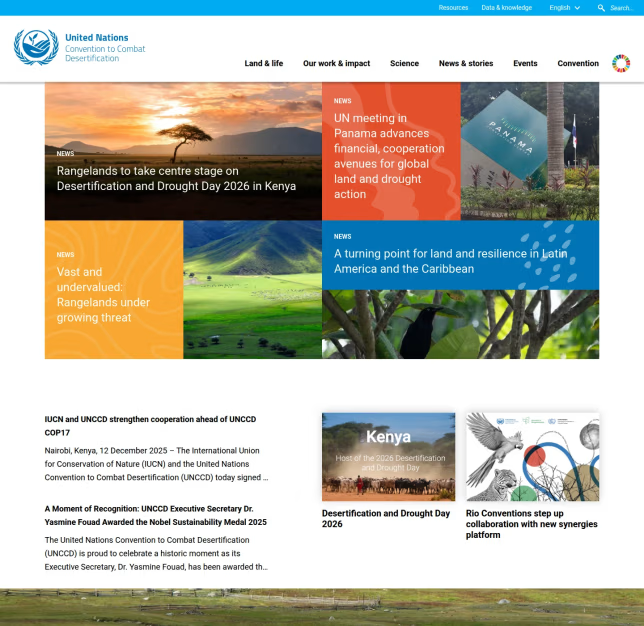
UNCCD operated four separate websites (two WordPress, two Drupal), leading to inconsistencies in design, content management, and user experience. A unified, scalable solution was needed to support a large-scale CMS migration project and improve efficiency and usability.
The modernization effort resulted in a cohesive, user-friendly, and scalable website, improving content management efficiency and long-term digital sustainability.
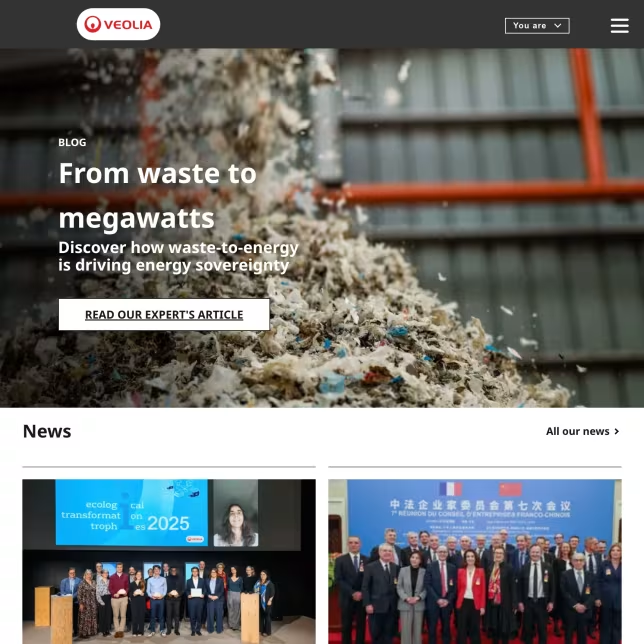
With Drupal 7 reaching end-of-life, Veolia needed a Drupal 7 to Drupal 10 enterprise migration for its Acquia Site Factory multisite platform—preserving region-specific content and multilingual capabilities across more than 200 sites.
The platform was modernized into a stable, scalable multisite foundation with improved performance, maintainability, and long-term upgrade readiness.
It was my pleasure working with Oleksiy (PathToProject) on a new Drupal website. He is a true full-stack developer—the ideal mix of DevOps expertise, deep front-end knowledge, and the structured thinking of a senior back-end developer.
He is well-organized and never lets anything slip. Oleksiy understands what needs to be done before being asked and can manage a project independently with minimal involvement from clients, product managers, or business analysts.
One of the best consultants I’ve worked with so far.

Andrei Melis
Technical Lead at Eau de Web
As Dev Team Lead on my project for 10 months, Oleksiy (PathToProject) demonstrated excellent technical skills and the ability to handle complex Drupal projects. His full-stack expertise is highly valuable.

Laurent Poinsignon
Domain Delivery Manager Web at TotalEnergies
Oleksiy (PathToProject) was the Lead Developer on a number of client projects which I managed. He is highly skilled and incredibly hardworking. When assigning work to him, I could always rely on it being completed to a high quality and on time.
His technical expertise was valued across the team and he was often our 'go to' for technical challenges, which he loved to get stuck into. Oleksiy is proactive and engaged in a professional manner with our clients.
I have no hesitation in recommending him.

Daniela Graf
Senior Project Manager | Change Mgmt Practitioner | Process Improvement Geek
These articles expand on the architecture and governance choices that shape an enterprise WordPress DXP. They cover multisite control, content and integration design, and the migration decisions that affect delivery risk and long-term operability.
If WordPress is becoming harder to ship, scale, or govern, a DXP approach can be applied without losing editorial speed.