Technologies

Drupal DXP
React Micro Apps
GA4 + Google Tag Manager
A/B Testing Framework
CI/CD Automation

Industry

Retail / E-Commerce

Scale

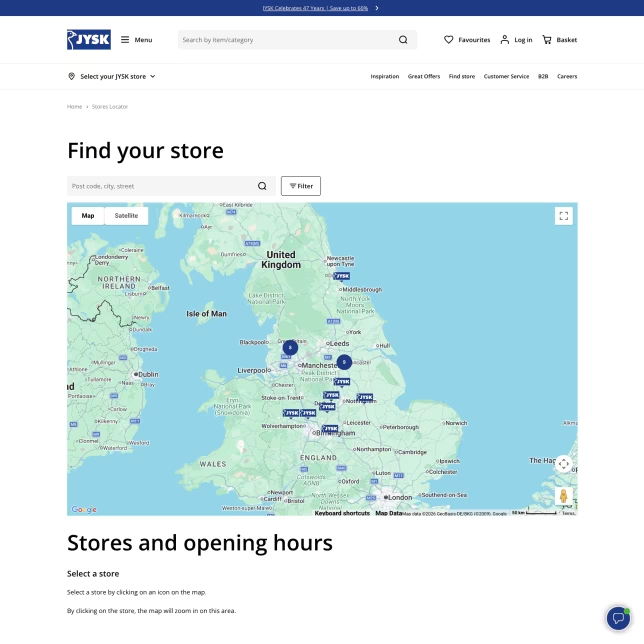
  • 25+ Local Markets
  • Multi-Language Delivery

Architecture

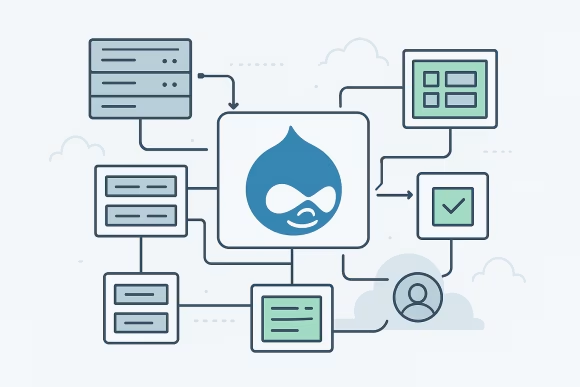
  • Drupal Server-Rendered Skeleton Pages
  • React Client-Side Micro Applications
  • Shared Styling Rules for UX Consistency

Platforms / Infrastructure

  • JYSK Private Cloud (Global Markets)
  • Alibaba Cloud Delivery (China Region)

Teams Collaboration

Engineering, DevOps, In-House Development, Marketing, and Content Stakeholders

Results

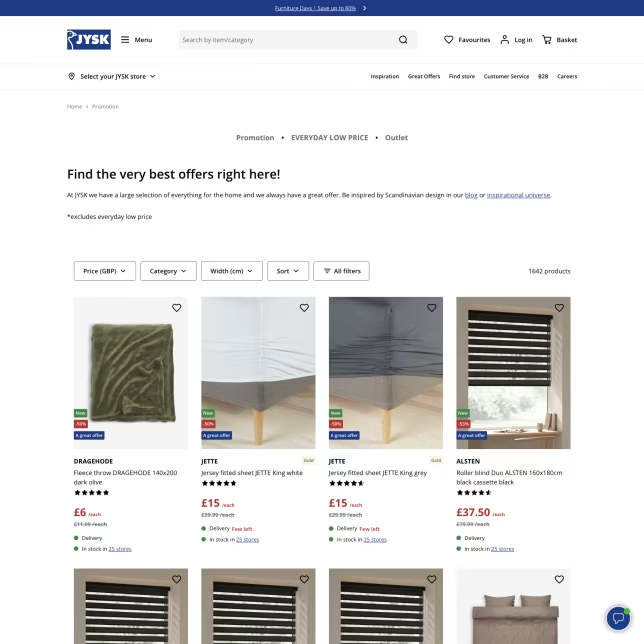
  • 20% Conversion Increase
  • 4x Faster Page Loading (2–3s → 0.2–0.5s)
  • Lighthouse Improvement (50 → 70–90)

The Challenge

JYSK required a scalable architecture that could support multi-market e-commerce delivery while improving performance and enabling continuous optimization. The platform had to maintain consistent UX across regions, provide strong governance, and allow rapid updates driven by marketing and content teams—without sacrificing stability.

  • 25+ local markets with multi-language delivery requirements
  • Dynamic e-commerce journeys required high-performance interactive functionality
  • Design consistency had to be maintained across Drupal-rendered pages and React modules
  • Analytics and experimentation were required as a core delivery capability
  • A dedicated delivery model was required for China infrastructure (Alibaba Cloud) while supporting other markets on private cloud

The Solution (Drupal Retail Platform + React Micro Frontends)

Drupal DXP Foundation for Global Markets

A scalable Drupal-based DXP was established as the global backbone for content and commerce experience delivery across 25+ local markets. It provided a structured localization model and governance so regional teams could publish quickly without fragmenting the overall UX. This created a stable platform layer for ongoing modernization while keeping market-specific needs manageable.

React Micro Apps Embedded Into Drupal Pages

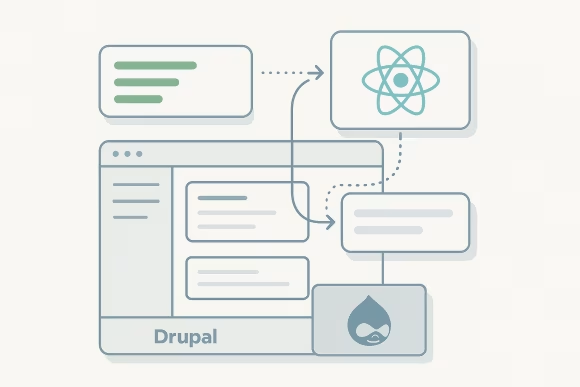
High-interactivity journeys were implemented as React micro apps embedded into Drupal-rendered skeleton pages, covering Search, Shopping Cart, Wishlist/Favorites, and Login flows. Drupal handled the page structure and server-side delivery, while React loaded only where dynamic behavior was required. This split reduced frontend coupling and enabled iterative improvements to key commerce features without reworking the entire page stack.

Hybrid Rendering and Cache-First Delivery

The solution used a hybrid rendering approach to keep most pages cacheable while still supporting dynamic commerce interactions. Server-rendered Drupal pages maximized cache hit rates and time-to-first-byte, and client-side modules hydrated only the necessary interactive areas. This architecture improved perceived performance and protected platform stability during traffic peaks and campaign activity.

Unified Styling and Component Governance

A shared styling system and component rules were applied across both Drupal templates and React micro apps to ensure visual and interaction consistency. Governance patterns reduced drift between teams and markets by standardizing how UI elements were built and reused. This made it easier to scale changes across regions while maintaining brand and design integrity.

Standardized Analytics Instrumentation (GA4 + GTM)

A consistent tracking architecture was implemented using GA4 and Google Tag Manager to capture behavior, funnel progression, and content performance. Standardized event definitions and tagging patterns ensured comparable data across markets and page types. This provided a reliable measurement foundation for optimization and stakeholder reporting.

Experimentation Enablement as a Platform Capability

A/B testing was enabled across most key content sections so teams could validate changes with real user behavior rather than assumptions. The experimentation setup was designed to work with the hybrid Drupal + React architecture, allowing tests on both content and interactive elements. This supported continuous conversion optimization while keeping rollout risk controlled.

CI/CD for Global + China Delivery

Automated CI/CD pipelines were implemented to support releases across JYSK’s private cloud and a dedicated China deployment on Alibaba Cloud. The delivery model accounted for regional infrastructure constraints while keeping build and release practices consistent. This improved release reliability and reduced the operational overhead of maintaining parallel deployment targets.

Core Features

A modernized Drupal Digital Experience Platform was delivered to support consistent e-commerce experiences across 25+ local markets while enabling fast iteration for marketing and content teams. The solution combined Drupal-rendered pages with embedded React micro apps for high-interactivity journeys without sacrificing cache efficiency and performance. Standardized analytics and experimentation (GA4, GTM, and A/B testing) were implemented as first-class capabilities to support continuous optimization. The delivery model also accounted for region-specific infrastructure needs, including a dedicated deployment approach for China.

Implementation

The delivery modernized JYSK’s Drupal-based DXP to support consistent e-commerce experiences across 25+ local markets while keeping performance and governance central. A hybrid architecture combined Drupal-rendered skeleton pages with embedded React micro apps for high-interactivity journeys without losing cache efficiency. Analytics and experimentation were implemented as first-class capabilities through a standardized GA4/GTM setup and A/B testing across key content areas. The rollout was supported by CI/CD pipelines designed to handle both global hosting and a dedicated China deployment on Alibaba Cloud.

DXP Modernization & Multi-Market Foundation

Drupal was upgraded and structured as a global DXP foundation with patterns that scale across markets, languages, and regional requirements. Content models, templates, and governance conventions were aligned to keep experiences consistent while enabling local flexibility. This created a stable baseline for ongoing iteration without fragmenting the platform across countries.

Hybrid Rendering Architecture (Drupal + React Micro Apps)

Drupal delivered cache-friendly skeleton pages while React micro apps handled dynamic features such as Search, Cart, Wishlist/Favorites, and Login flows. Integration focused on clear boundaries between server-rendered content and client-side interactivity to avoid performance regressions. This approach kept critical journeys responsive while preserving high cache hit rates and operational simplicity.

Unified Styling & Component Governance

A shared styling approach was applied across Drupal-rendered pages and React modules to maintain a consistent UI across markets and features. Component conventions and reusable patterns reduced drift between teams and codebases. This ensured new functionality could be added without breaking brand consistency or accessibility expectations.

Performance Engineering & Cache Strategy

Performance work prioritized fast initial render and predictable behavior under multi-market traffic patterns. Server-side caching was optimized around Drupal page delivery, while micro apps were loaded only where needed to limit client-side overhead. This mattered for conversion-critical flows where latency and layout instability directly impact user completion.

Analytics Instrumentation (GA4 + GTM)

A standardized tracking setup was implemented using GA4 and Google Tag Manager to capture comparable behavior data across markets. Event and tagging conventions were aligned so teams could trust cross-country reporting and funnel analysis. This provided the measurement foundation required for reliable optimization and experimentation.

Experimentation Enablement (A/B Testing)

A/B testing capability was introduced across most key content sections with implementation patterns that work across Drupal and embedded React modules. Experiments were designed to be measurable through the analytics layer and safe to roll back when needed. This enabled continuous improvement based on observed user behavior rather than assumptions.

CI/CD for Global + China Infrastructure

Automated delivery pipelines were established to support both the primary private cloud setup and a dedicated China deployment on Alibaba Cloud. Build, test, and release steps were structured to keep environments aligned while respecting regional infrastructure constraints. This reduced release risk and enabled consistent rollout practices across all markets.

Testimonials

Oleksiy (PathToProject) worked with me on a specific project over a period of three months. He took full ownership of the project and successfully led it to completion with minimal initial information.

His technical skills are unquestionably top-tier, and working with him was a pleasure. I would gladly collaborate with Oleksiy again at any opportunity.

Photo: Nikolaj Stockholm Nielsen

Nikolaj Stockholm Nielsen

Strategic Hands-On CTO | E-Commerce Growth

Business Outcomes

JYSK modernized its e-commerce DXP to support consistent, high-performance experiences across 25+ local markets while enabling faster iteration for marketing and content teams. A Drupal foundation with embedded React micro apps improved critical shopping journeys without sacrificing cache efficiency and operational stability. Standardized analytics and experimentation (GA4, GTM, A/B testing) enabled continuous optimization based on real customer behavior. The delivery model also supported region-specific infrastructure needs, including dedicated deployment for China.

Outcome illustration for Higher conversion through faster, smoother journeys[01]

Higher conversion through faster, smoother journeys

Key e-commerce interactions were rebuilt as React micro apps (Search, Cart, Wishlist/Favorites, Login) embedded into Drupal pages. This reduced friction in high-intent flows while keeping the broader page delivery stable and cacheable. The result was a reported conversion uplift driven by improved responsiveness and usability in critical steps.

Outcome illustration for Significant page-load performance gains[02]

Significant page-load performance gains

Server-side delivery was optimized for high cache efficiency, while only the necessary interactive modules were loaded in the browser. This architecture reduced perceived and measured load times across core pages. Faster delivery improved user experience and reduced the performance risk of adding new features over time.

Outcome illustration for Improved Lighthouse and SEO readiness[03]

Improved Lighthouse and SEO readiness

Performance improvements translated into stronger Lighthouse scores, improving the platform’s technical quality signals. Better Core Web Vitals readiness supported organic discoverability and reduced the likelihood of performance regressions impacting SEO. The outcome provided a more reliable baseline for ongoing content and campaign activity.

Outcome illustration for Scalable multi-market localization with consistent UX[04]

Scalable multi-market localization with consistent UX

The Drupal DXP foundation supported multi-language, multi-market delivery across 25+ locales with shared governance and reusable components. Unified styling ensured consistent UX across Drupal-rendered pages and React modules. This reduced fragmentation between markets while still enabling local adaptation where required.

Outcome illustration for Experimentation and analytics as standard capabilities[05]

Experimentation and analytics as standard capabilities

GA4 and Google Tag Manager were implemented to establish a consistent tracking foundation across markets and key content areas. A/B testing was enabled across most major content sections to support measurable experimentation. Teams could validate changes using behavioral data rather than relying on assumptions or isolated market feedback.

Outcome illustration for Reliable delivery across global and China infrastructure[06]

Reliable delivery across global and China infrastructure

CI/CD automation supported deployments to private cloud environments while also accommodating a dedicated China setup on Alibaba Cloud. This reduced operational overhead and improved release reliability across differing infrastructure constraints. The approach lowered delivery risk for regional rollouts and enabled more predictable iteration cycles.

Used Services

The project leveraged a suite of Drupal-centric services to modernize and scale JYSK's e-commerce platform across multiple markets. Enterprise Drupal Architecture provided a robust foundation for multisite and headless delivery, ensuring consistent governance and performance. Drupal CDP Integration enabled seamless connection with customer data platforms for analytics and personalization, while Drupal Analytics Integration established reliable tracking and measurement across Drupal and React components. Drupal DevOps & CI/CD supported automated, region-specific deployments including China infrastructure, ensuring operational reliability. React Frontend Architecture and Next. js Development services facilitated the integration of React micro apps within Drupal pages, optimizing frontend performance and maintainability. Together, these services formed a cohesive architecture that supported scalable localization, high-performance interactive features, and data-driven optimization capabilities.

Drupal DXP and Multimarket Digital Experience Case Studies

These case studies showcase advanced Drupal Digital Experience Platform implementations with a focus on scalable multi-market delivery, performance optimization, and integrated analytics. They reinforce themes of hybrid rendering architectures, component governance, and experimentation enablement in retail and enterprise environments. Together, they provide insights into managing complex localization, marketing-driven updates, and global infrastructure challenges.

Further reading on Drupal platform governance and CDP delivery

These articles expand on the platform and operating-model choices behind this multi-market Drupal transformation. They help explain how to standardize delivery across regions without blocking local teams, why Drupal remains a strong fit for governed enterprise platforms, and how customer data programs need activation ownership and implementation discipline to produce measurable results at scale.

Oleksiy (Oly) Kalinichenko

Oleksiy (Oly) Kalinichenko

CTO at PathToProject

Do you want to start a project?