Support Coverage

Incident response & emergency fixes
Ongoing operational Drupal support
Performance & stability monitoring
Security & dependency updates

Supported Platforms

  • Drupal 6, 7 (Legacy Drupal)
  • Drupal 8, 9, 10, 11+
  • Headless & decoupled Drupal
  • Multisite & multi-brand setups
  • Legacy and modern Drupal architectures

Best Fit For

  • Business-critical Drupal websites
  • Enterprise & public-sector platforms
  • Teams without in-house Drupal experts
  • Organizations needing predictable support

Why Drupal Support Becomes a Challenge

Drupal platforms grow complex over time. Custom modules, integrations, multisite architectures, and evolving content requirements introduce technical debt and operational risk.

When incidents occur, internal teams often struggle with unclear ownership, limited Drupal expertise, or slow response times. Small issues quickly escalate into outages, broken features, or stalled content operations.

Without a structured support model, organizations face unpredictable downtime, rising maintenance costs, and increased pressure on internal teams.

Our Support Approach

Rapid Incident Triage

We quickly assess impact, identify root causes, and stabilize affected systems.

Experienced Drupal Engineers

Support handled by senior Drupal specialists — not generic helpdesk staff.

Platform-Aware Fixes

We fix issues with full awareness of your architecture, integrations, and workflows.

Clear Communication

Transparent updates during incidents and clear post-incident summaries.

Preventive Maintenance

Reducing future incidents through proactive fixes and improvements.

Flexible Engagement Models

Support delivered via retainer, 24/7 SLA-based Drupal support, or hybrid models.

What Our Drupal Support Covers

Drupal Support & Incident Response is structured to maintain platform stability under real-world operational pressure. The service combines rapid incident triage, controlled hotfix deployment, performance diagnostics, and disciplined security update management within governed workflows. Multisite coordination and dependency oversight ensure consistency across environments without introducing cross-system risk. Beyond reactive fixes, the focus is on root-cause analysis, controlled remediation, and long-term platform resilience. This approach supports reliable operations while preserving architectural integrity and compliance standards.

Our Drupal Support Capabilities
  • Incident response & root-cause analysis
  • Drupal core & contributed modules
  • Custom module debugging
  • CI/CD & deployment pipelines
  • Hosting platforms (Acquia, Pantheon, AWS, custom)
Who This Service Is For
  • Enterprises running Drupal at scale
  • Public-sector & NGO platforms
  • Marketing teams relying on Drupal daily
  • Organizations without dedicated Drupal ops teams
Technology Ecosystem
  • Drupal Core & Contrib
  • PHP & Symfony
  • MySQL / PostgreSQL
  • Redis / Varnish / CDNs
  • CI/CD & Cloud Infrastructure

How Support Is Delivered

Our Drupal Support & Incident Response delivery model is structured to provide stability, clarity, and operational confidence. We begin with a technical baseline assessment, define a transparent scope of coverage, and establish structured communication channels for rapid issue handling. Every incident is approached methodically — diagnosed, stabilized, documented, and followed by actionable recommendations to prevent recurrence. The result is not just reactive support, but a controlled and continuously improving operational environment for your Drupal platform.

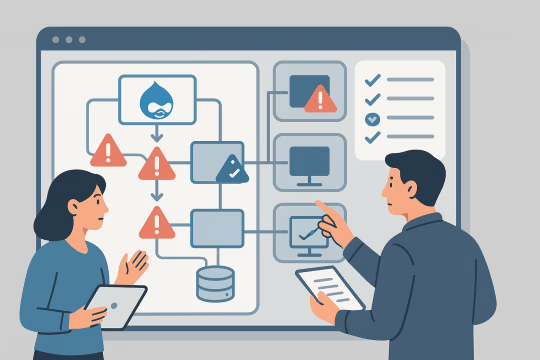
Delivery card for Initial Platform Assessment[01]

Initial Platform Assessment

We perform a structured review of your Drupal architecture, infrastructure setup, module landscape, and known operational risks. This includes identifying performance bottlenecks, outdated components, security exposure, and recurring issue patterns. The outcome is a clear technical baseline that guides future support and incident response decisions.

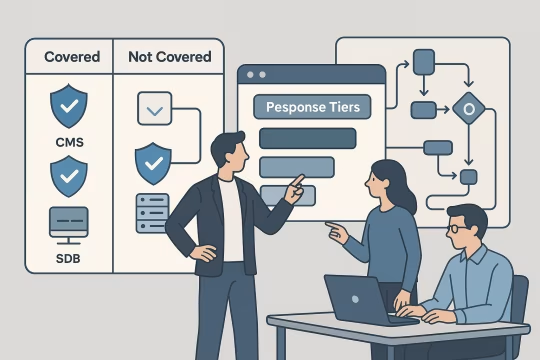
Delivery card for Defined Support Scope[02]

Defined Support Scope

We clearly define what is covered under support — including response levels, maintenance activities, incident handling procedures, and escalation paths. This ensures shared expectations, eliminates ambiguity, and creates a predictable support model aligned with your business priorities.

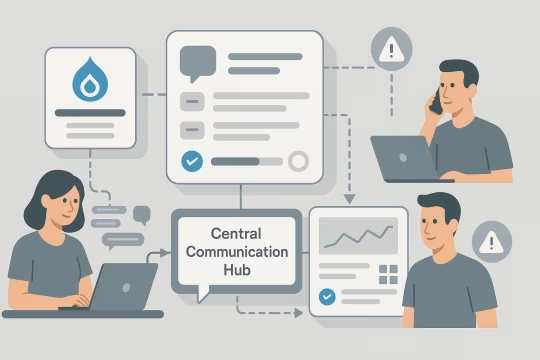
Delivery card for Structured Communication[03]

Structured Communication

We establish transparent communication channels for incidents, updates, and follow-ups. Whether via ticketing system, Slack, email, or direct engineer access, all issues are tracked, prioritized, and documented. You always know the status, next steps, and resolution timeline.

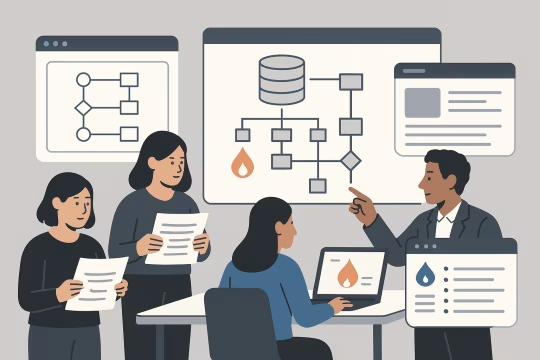
Delivery card for Documentation & Knowledge Sharing[04]

Documentation & Knowledge Sharing

All investigations, fixes, and recommendations are documented to reduce repeat incidents and institutionalize knowledge. We create actionable technical notes, improvement recommendations, and process documentation so your internal team benefits long-term.

Business Impact

Reliable incident response directly protects revenue, reputation, and operational continuity. Faster stabilization reduces downtime costs and limits the impact of outages on customers and internal teams. Structured support processes lower the risk of recurring failures and uncontrolled fixes that create long-term instability. By offloading high-pressure troubleshooting to experienced Drupal engineers, internal teams can remain focused on strategic initiatives rather than crisis management. Over time, this results in improved platform predictability, stronger governance, and measurable reductions in operational risk.

Reduced Downtime

Structured triage and rapid remediation shorten recovery time, minimizing revenue loss, reputational damage, and operational disruption during critical incidents.

Operational Confidence

Clear response processes and experienced engineering oversight provide leadership teams with assurance that incidents are handled in a controlled, accountable manner.

Lower Internal Pressure

Dedicated support reduces the burden on internal development teams, allowing them to focus on roadmap delivery rather than emergency fixes.

Improved Platform Stability

Root-cause analysis and controlled remediation decrease recurring issues, improving system reliability and long-term technical health.

Related Services

Operational Drupal support is most effective when supported by strong architecture, secure infrastructure, and structured platform governance. These related services help organizations maintain stability, improve resilience, and continuously evolve their Drupal platforms while reducing operational risk and technical debt.

Operational & Technical FAQ

Drupal Support & Incident Response requires more than reactive fixes. It demands structured governance, predictable response processes, and deep architectural awareness of complex Drupal environments. The following questions address operational stability, security management, engagement models, and long-term maintainability. They reflect how enterprise-grade Drupal support is structured to reduce downtime, control risk, and maintain platform reliability under real-world pressure.

What is included in your Drupal Support service?

The service covers emergency incident response, production issue triage, controlled hotfix deployment, performance diagnostics, security and dependency updates, and structured root-cause analysis.

Support extends beyond isolated fixes. Each incident is investigated within the broader architectural context of your Drupal platform, including integrations, custom modules, infrastructure, and deployment workflows. The goal is not only to restore functionality quickly but to prevent recurrence and reduce systemic risk over time.

How quickly do you respond to critical Drupal incidents?

Response times depend on the selected engagement model and agreed support level. For SLA-based support agreements, response and escalation windows are clearly defined based on incident severity.

Critical production outages are prioritized immediately. Triage focuses on stabilizing the platform first, followed by structured investigation and remediation. This controlled approach ensures rapid stabilization without introducing additional instability or unverified fixes.

Do you support legacy Drupal versions such as Drupal 6 and Drupal 7?

Yes. We support legacy Drupal environments, including Drupal 6 and Drupal 7, while also maintaining modern Drupal 8, 9, 10, and 11+ platforms.

For legacy systems, support often includes stabilization, security patching where feasible, dependency management, and structured planning for modernization or migration. The objective is to reduce operational risk while preparing for a controlled transition to supported Drupal versions when appropriate.

How do you handle complex custom modules and integrations?

Custom modules and integrations are analyzed within their architectural and business context. We review code quality, dependency structure, configuration management, and integration touchpoints before implementing fixes.

Changes are applied through controlled workflows to avoid regressions. Where recurring issues are identified, we recommend structural improvements rather than repeated temporary fixes. This ensures long-term maintainability and reduces accumulated technical debt.

How do you reduce recurring incidents and operational instability?

Each incident is followed by structured root-cause analysis. Beyond resolving the immediate issue, we identify systemic weaknesses such as outdated dependencies, fragile custom logic, caching misconfiguration, or infrastructure bottlenecks.

Preventive measures may include configuration hardening, performance optimization, improved deployment controls, or dependency updates. The objective is to move from reactive firefighting toward a stable and predictable Drupal operational model.

What engagement models are available for Drupal support?

Drupal Support & Incident Response can be delivered through retainer-based support, 24/7 SLA-based coverage, or hybrid models tailored to platform criticality.

Retainer models provide predictable engineering availability for ongoing support and maintenance. SLA-based models define response guarantees and escalation structures for business-critical environments. Engagement structure is aligned with system complexity, traffic levels, and operational risk tolerance.

Can you support multisite and multi-brand Drupal environments?

Yes. Multisite environments require coordinated change management to avoid cross-site disruption. We ensure consistency across shared codebases while protecting site-specific configurations.

Updates, hotfixes, and security patches are validated in staging environments before controlled rollout. This approach reduces risk of cascading failures and maintains operational continuity across interconnected Drupal properties.

How do you manage Drupal security updates and dependency patches?

Security and dependency updates are applied through structured release workflows. Each update is evaluated for compatibility with custom modules, integrations, and hosting environments.

Updates are tested in controlled environments before deployment to production. This disciplined process minimizes regression risk while reducing exposure to known vulnerabilities. Ongoing dependency management is critical for long-term platform resilience and compliance readiness.

How do you collaborate with internal development or IT teams?

Support workflows are integrated with existing communication and ticketing systems. Incidents, updates, and investigations are documented and tracked transparently.

We operate either as an extension of your internal engineering team or as an external specialist layer focused on Drupal-specific expertise. Clear scope definition and communication protocols ensure accountability without disrupting established internal processes.

How does the onboarding process for Drupal support begin?

Engagement begins with a structured platform assessment. We review architecture, infrastructure setup, module landscape, security posture, and known operational risks.

Based on this assessment, we define a transparent support scope, response model, and communication framework. This ensures shared expectations and establishes a controlled support structure from the outset, enabling predictable incident handling and long-term stability.

Relevant Projects & Experience

What Clients Say About Our Drupal Platforms

Need Reliable Drupal Support?

Whether you need ongoing support or guaranteed response times, we help you keep your Drupal platform stable and reliable.

Oleksiy (Oly) Kalinichenko

Oleksiy (Oly) Kalinichenko

CTO at PathToProject

Do you want to start a project?