Digital transformation is no longer a future ambition — it is an operational reality. Over the past decade, the pace of digitalization has accelerated across industries, fundamentally reshaping how businesses communicate, sell, and deliver value. Organizations that once relied primarily on offline channels now operate within digital ecosystems where customer expectations are shaped by speed, convenience, and personalization.
With more than 20 years of experience in IT and digital development, I have observed how online commerce and digital platforms evolved from experimental initiatives into core business infrastructure. Internet penetration continues to expand globally, mobile-first usage dominates consumer behavior, and customers increasingly expect seamless online interactions across devices.
Today, the website is not just a digital brochure. It is a transactional environment, a customer acquisition channel, a data collection interface, and often a direct revenue driver. Businesses that fail to treat their digital presence as infrastructure risk losing competitive positioning in increasingly saturated markets.
See where platform speed is costing conversionsRun a quick Drupal Platform Health CheckDigitalizat ion as a Structural Shift
The growth of online business is not accidental. Research consistently shows that online purchasing behavior continues to increase worldwide. Consumers value convenience, accessibility, and real-time interaction. The ability to compare products instantly, access services remotely, and receive deliveries efficiently has redefined purchasing habits.
Digitalization is not limited to eCommerce. It affects internal processes, communication workflows, analytics capabilities, and operational efficiency. Companies that adopt structured digital platforms — supported by strong Drupal architecture — can respond to market changes faster and scale more sustainably.
The shift from offline to online also reduces friction in customer journeys. Clear navigation, optimized performance, and intuitive user interfaces directly influence conversion rates. In high-competition environments, even small delays in page loading or complex checkout processes can negatively impact revenue.
UX, Speed, and Customer Expectations
Modern digital platforms must prioritize performance and usability. If a page takes more than a few seconds to load, users are likely to abandon it. If navigation is confusing, users disengage. If information is difficult to find, trust decreases.
This is where Drupal performance optimization becomes critical. Multi-layer caching, optimized database queries, CDN integration, and frontend asset refinement ensure predictable responsiveness under scale.
The rise of mobile browsing has reinforced this expectation. Responsive design, structured content, and simplified interaction models are no longer optional — they are standard requirements. Large-scale implementations such as JYSK demonstrate how performance and delivery architecture directly influence digital platform effectiveness.
Visual storytelling techniques, including dynamic layouts and interactive elements, have replaced long static text blocks. The goal is clarity and speed of understanding. A website must guide the user toward action efficiently while maintaining credibility and consistency.

Find the performance issues behind slow digital journeys
Assess speed, responsiveness, and delivery risks that affect UX, mobile engagement, and conversion flow.
- Check load bottlenecks
- Spot UX friction fast
- Prioritize performance fixes
Trends in Platform Management
Another key trend is decentralization of control within organizations. Modern CMS platforms allow marketing teams and administrators to update content, adjust layouts, and launch campaigns without depending entirely on developers.
This flexibility reduces operational delays and improves responsiveness. Structured content management systems enable modular updates, scalable architecture, and integration with CRM and analytics tools. Through properly designed Drupal integrations, digital platforms connect seamlessly with CRM, ERP, payment systems, and marketing automation tools.
Digital platforms are increasingly integrated into broader ecosystems. This interconnected structure allows businesses to automate repetitive processes and maintain data consistency. In more distributed delivery models, content platform architecture becomes essential for defining clear boundaries between content, APIs, and downstream services.
Automation as a Competitive Advantage
Automation has become a defining element of modern digital operations. Businesses can automate reporting, customer notifications, task synchronization, and integration between multiple systems.
When repetitive processes are automated, organizations reduce operational errors and improve efficiency. Automation enables teams to focus on strategy rather than routine maintenance. Structured Drupal Experience Platform Strategy and DevOps & CI/CD pipelines ensure controlled deployments, automated testing, and release stability.
Digitalization therefore affects not only customer-facing experiences but also internal productivity. Automated CRM synchronization, lead scoring, and analytics tracking improve decision-making accuracy.
Sustainability & Digital Responsibility
Digital transformation also introduces environmental and social considerations. Online documentation reduces paper consumption. Digital business cards, online forms, and remote workflows minimize resource waste.
Responsible digital development requires secure implementation and long-term maintainability. A well-governed platform strategy protects business continuity while maintaining compliance expectations.
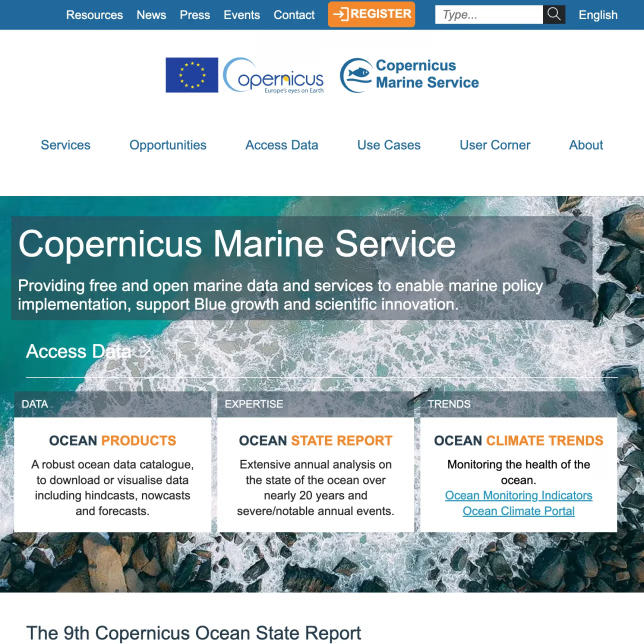
Organizations operating on outdated platforms often face structural limitations and security exposure. In such cases, structured Drupal migration & modernization initiatives provide a pathway toward a scalable and maintainable architecture, as seen in consolidation programs like Copernicus Marine Service and broader Drupal DXP consolidation.
Sustainability is not only environmental — it also refers to architectural resilience and upgrade readiness.
Conclusion
Digitalization is not simply a technological upgrade — it is a structural evolution of how businesses operate. Organizations that embrace structured digital architecture, automation, performance optimization, and integration governance strengthen their competitive position.
Drupal performance
Benchmark platform speed before it impacts growth
Use a focused Health Check to uncover delivery gaps, frontend drag, and architecture issues affecting customer experience.
The future belongs to companies that treat their digital platforms as core infrastructure. Digital transformation is not only our future — it is our present reality.
Tags: Digital Transformation, Online Trends, Business Digitalization, UX & Performance, Automation, CRM Integration, Ecommerce Strategy, Enterprise CMS, Digital Strategy