In today’s digital landscape, a website is no longer just a marketing asset — it is an operational platform that connects content, commerce, customer data, and enterprise systems. As organizations grow, digital platforms must evolve from simple publishing tools into structured ecosystems that support automation, governance, scalability, and long-term innovation. Choosing the right content management system (CMS) therefore becomes a strategic architectural decision rather than a purely technical one.
Drupal consistently stands out as a platform designed for complexity. While many CMS solutions prioritize rapid deployment and visual simplicity, Drupal focuses on structural integrity, extensibility, and enterprise-grade governance. For organizations managing multiple brands, regions, integrations, or compliance requirements, this architectural depth is often a decisive advantage.
See how your Drupal architecture holds upRun a quick Drupal Platform Health Check1. Structured Architecture Built for Complexity
One of Drupal’s strongest differentiators is its content modeling flexibility. Instead of treating pages as isolated content blocks, Drupal allows teams to define structured entities, taxonomies, reusable components, and relationships between data objects. This structured approach ensures that content is reusable across multiple channels and use cases.
For enterprises operating across multiple markets or product lines, this level of structure reduces duplication and improves long-term maintainability. When combined with a well-designed Enterprise Drupal Architecture, organizations can create a scalable content foundation that supports both current and future business models.
This architectural strength becomes even more critical in headless or API-driven environments, where content must be delivered to websites, mobile applications, portals, or third-party systems simultaneously. Drupal’s structured backend makes such multi-channel distribution reliable and predictable, especially within a well-defined headless CMS architecture.
2. Enterprise-Grade Security & Governance
Security is often a non-negotiable requirement, particularly in healthcare, finance, education, and government sectors. Drupal has built a reputation for its proactive security community and structured vulnerability management process. Regular core updates, transparent advisories, and well-documented patch workflows make it a trusted choice for regulated industries.
Beyond patch management, Drupal provides granular role-based access control. Permissions can be precisely configured across editorial, administrative, and technical users. Workflows, content moderation states, and environment separation add additional governance layers.
Organizations seeking stronger operational control often align their platforms with formal Drupal governance architecture strategies. This ensures that configuration hardening, environment isolation, and structured update governance are embedded into the platform rather than applied reactively.
The result is a CMS environment that supports compliance expectations while maintaining editorial agility.
3. Performance & Scalability at Scale
As traffic increases and content volume expands, performance bottlenecks often emerge across multiple layers: frontend rendering, database queries, caching strategies, and infrastructure configuration. Drupal’s flexibility allows performance optimization at each of these layers.
Multi-layer caching (Drupal cache, Redis, Varnish, CDN), optimized database indexing, and infrastructure tuning can be aligned to traffic patterns and growth projections. High-traffic campaigns, seasonal peaks, or international expansion can be managed without fundamentally restructuring the platform.
When supported by structured Drupal Performance Optimization, Drupal platforms can achieve significant improvements in Core Web Vitals, SEO performance, and overall responsiveness. Complex examples such as LSHTM illustrate how performance and data synchronization can be stabilized together in demanding Drupal environments.
This layered performance engineering approach ensures that scalability is not an afterthought but an integrated capability.

Assess architectural fit before complexity grows
Review how your Drupal setup supports governance, scalability, integrations, and long-term maintainability.
- Check content structure
- Assess governance gaps
- Validate scaling readiness
4. Integration-Ready by Design
Modern organizations rarely operate within a single system. CRM platforms, CDPs, ERP systems, payment gateways, marketing automation tools, identity providers, and analytics environments all need to exchange data reliably.
Drupal’s API-first capabilities — including REST, JSON:API, and custom endpoints — allow it to operate as a central orchestration layer rather than an isolated content repository. Structured data contracts and event-driven architectures enable secure, bi-directional data exchange.
Through properly designed Drupal integrations, businesses can eliminate data silos and reduce manual processes. Real-time lead synchronization, product data updates, subscription management, and behavioral tracking become part of a cohesive ecosystem.
In this model, Drupal becomes a reliable system-of-record component within a broader enterprise architecture.
5. Multisite & Multi-Brand Governance
As organizations expand into new regions or launch new brands, digital fragmentation often follows. Independent codebases, duplicated modules, inconsistent security policies, and divergent content models create operational inefficiencies and long-term technical debt.
Drupal’s multisite architecture enables multiple websites to operate from a shared codebase while preserving regional flexibility. Configuration splits, environment-aware deployments, and shared design systems allow centralized governance without limiting market-specific adaptation.
When implemented strategically through a Drupal Multisite approach, this architecture significantly reduces maintenance overhead while ensuring consistency across the ecosystem.
Updates are applied once. Security policies are unified. Innovation cycles accelerate without compromising architectural integrity.
6. Modernization & Migration Capabilities
Many organizations operate legacy Drupal installations (such as Drupal 7) or outdated platform versions due to perceived upgrade complexity. However, delaying modernization often increases long-term risk, security exposure, and maintenance cost.
Drupal provides structured migration pathways that support content transformation, module refactoring, and dependency modernization. Instead of patching outdated systems, businesses can transition toward a maintainable and upgrade-ready foundation.
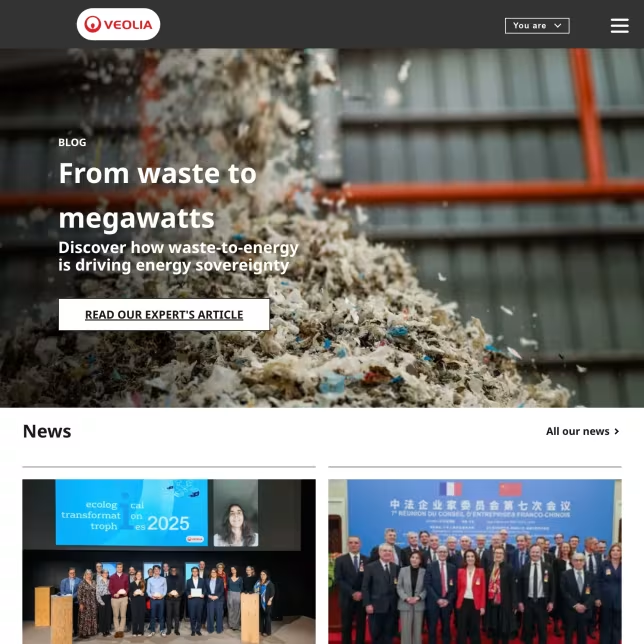
A structured Drupal Migration or Drupal Upgrade initiative ensures that modernization strengthens architecture rather than simply updating version numbers. Large-scale examples such as Veolia show how this can be approached safely even in complex multisite environments, while broader legacy system modernization can reduce risk across older Drupal estates.
This approach replaces accumulated technical debt with standardized configuration management, Composer-based dependency control, and clean modular design.
7. DevOps & Delivery Reliability
Digital platforms evolve continuously. Without structured deployment pipelines, environment consistency, and automated testing, releases become risky and unpredictable.
Drupal aligns well with modern DevOps practices. Containerized environments, Git-based workflows, CI/CD pipelines, infrastructure-as-code provisioning, and automated testing frameworks integrate naturally into enterprise engineering processes.
Through structured Drupal DXP, organizations can eliminate configuration drift, reduce manual deployment errors, and implement zero-downtime release strategies. Programs such as JYSK demonstrate how delivery reliability, performance, and multi-market platform evolution can be aligned at enterprise scale.
This operational maturity transforms Drupal from a static publishing system into a continuously evolving digital platform.
8. Long-Term Sustainability & Upgrade Path
A major advantage of Drupal lies in its forward compatibility philosophy. Clean code practices, standardized configuration management, and modular architecture reduce upgrade friction between major versions.
Organizations that invest in architectural discipline early benefit from smoother transitions in the future. Rather than rebuilding every few years, the platform evolves incrementally.
This sustainability makes Drupal particularly suitable for long-term digital ecosystems where governance, integration, and compliance requirements increase over time.
Drupal as a Strategic Digital Foundation
Choosing Drupal is not simply about selecting a CMS. It is about selecting a platform capable of supporting structured growth, integration complexity, and enterprise governance.
Drupal’s strengths lie in:
- Architectural flexibility
- Security and compliance alignment
- Performance engineering capability
- Integration readiness
- Multisite governance
- DevOps compatibility
- Long-term sustainability
For organizations operating beyond basic marketing websites, these capabilities represent tangible operational advantages.
When aligned with structured architectural strategy and engineering discipline, Drupal becomes more than a publishing tool — it becomes a controlled digital foundation capable of evolving alongside business objectives.
Final Perspective
Every digital platform decision carries long-term implications. Short-term simplicity can lead to long-term fragmentation, while structured architectural foundations require thoughtful planning but deliver sustained value.
Drupal architecture
Find architectural risks before they slow growth
Use the Health Check to evaluate platform structure, integration readiness, governance controls, and upgrade resilience across your Drupal estate.
For enterprises seeking scalability, integration flexibility, compliance alignment, and operational resilience, Drupal remains one of the most capable and strategically sound choices available today.
Tags: Drupal, Drupal CMS, Drupal DXP, Enterprise CMS