Core Focus

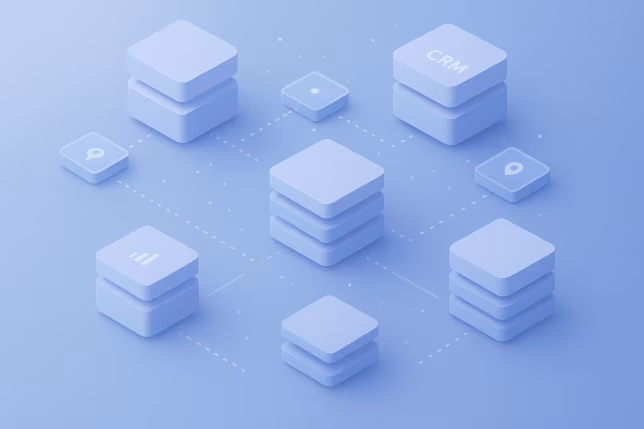
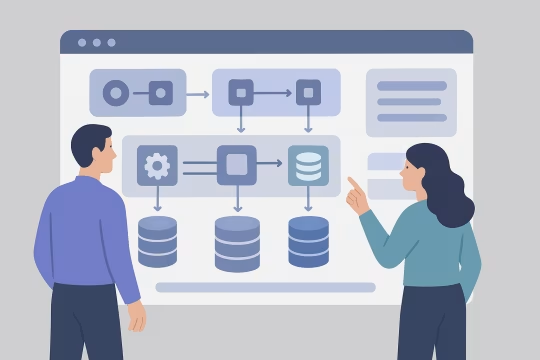
Identity graph data modeling
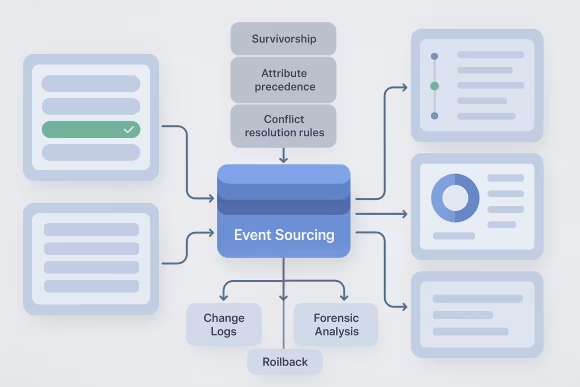
Resolution rules and scoring
Entity relationships and hierarchies
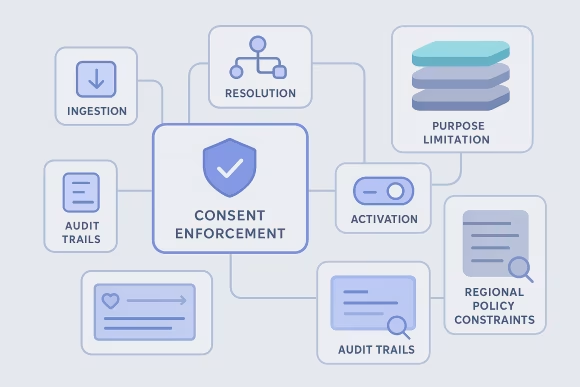
Consent-aware profile linking

Best Fit For

  • Multi-channel customer platforms
  • Multiple CRMs and CDPs
  • High-volume event streams
  • Complex consent requirements

Key Outcomes

  • Higher match transparency
  • Reduced duplicate profiles
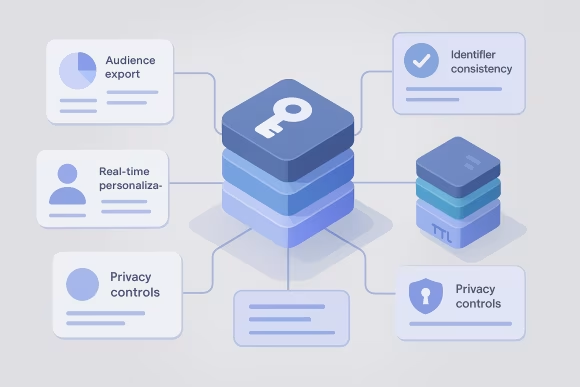
  • Consistent activation identifiers
  • Auditable identity decisions

Technology Ecosystem

  • CDP identity services
  • Graph databases
  • Streaming and batch pipelines
  • Metadata and lineage tooling

Platform Integrations

  • CRM and marketing automation
  • Web and mobile analytics
  • Customer support platforms
  • Paid media destinations

Fragmented Identity Data Breaks Cross-Channel Profiles

As customer platforms expand, identifiers multiply across web analytics, mobile apps, CRM records, email systems, support tools, and paid media. Teams often implement identity stitching locally within each tool, using different keys, different merge rules, and different assumptions about what constitutes a person, household, or account. Over time, the platform accumulates duplicate profiles, conflicting attributes, and inconsistent linkage between devices and known users.

These inconsistencies create architectural drag. Data engineers spend time reconciling identity logic across pipelines, while product and marketing teams lose confidence in segmentation and measurement. Without a shared identity model, integrations become brittle: a new source system introduces another identifier type, merge behavior changes unexpectedly, and downstream consumers cannot interpret why profiles were linked or separated. The lack of clear survivorship and confidence rules also makes it difficult to reason about profile correctness and to debug regressions.

Operationally, identity becomes a risk surface. Consent and preference enforcement is harder when identity is ambiguous, and auditability suffers when linkage decisions are not traceable to inputs and rules. Activation performance degrades as audiences contain duplicates or missing joins, and analytics diverges from operational truth, slowing delivery and increasing the cost of platform change.

Identity Graph Architecture Methodology

Platform Discovery

Review current CDP identity capabilities, source systems, identifier inventory, and activation use cases. Map where identity decisions are made today, what keys exist, and where duplicates or conflicts occur. Establish baseline metrics such as match rate, merge rate, and profile completeness.

Domain Modeling

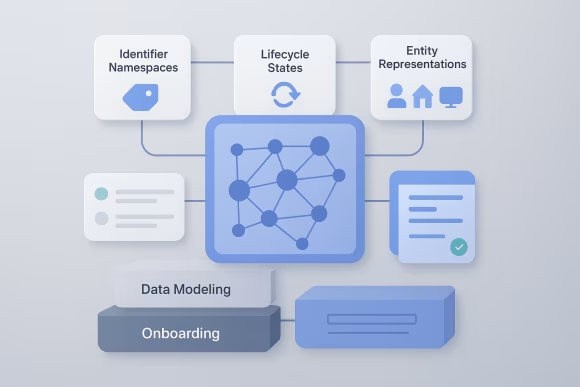
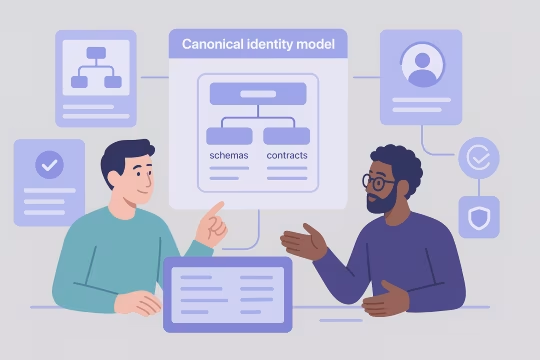
Define the identity domain: entities (person, account, household, device), relationships, and cardinalities. Specify identifier types, namespaces, and lifecycle states. Align the model with business semantics and downstream consumption patterns to avoid ambiguous merges.

Resolution Strategy

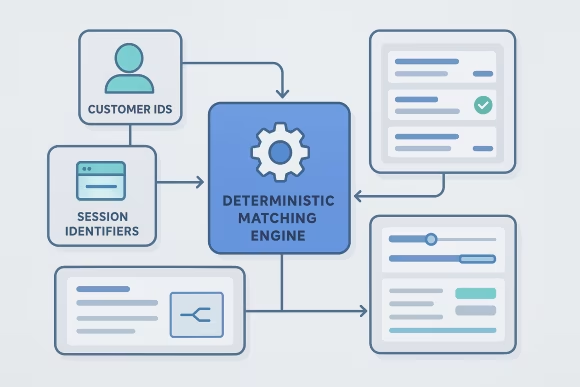
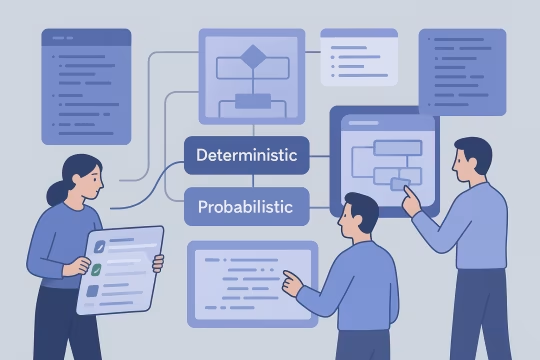
Design deterministic and probabilistic matching approaches, including rule ordering, confidence scoring, and explainability requirements. Define survivorship rules for attributes, conflict handling, and temporal logic for event-time updates. Document how links are created, updated, and revoked.

Data Contracts

Specify source-to-graph contracts: required fields, identifier normalization, event schemas, and quality thresholds. Define how late-arriving data and corrections are handled. Establish versioning and compatibility rules so new sources can be onboarded without breaking existing consumers.

Graph Storage Design

Select and design the persistence approach (native graph, relational adjacency, or CDP-managed identity store). Define indexing, partitioning, and query patterns for resolution and activation. Plan for scale, latency targets, and cost controls across batch and streaming workloads.

Integration Patterns

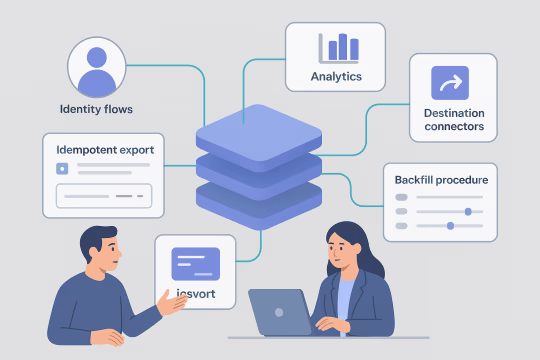
Design ingestion and propagation paths for identity signals across streaming and batch pipelines. Define how resolved identifiers are exposed to analytics, personalization, and activation systems. Establish idempotency, replay strategies, and backfill procedures for historical reconciliation.

Governance Controls

Implement lineage and decision traceability for merges, splits, and attribute survivorship. Define access controls, consent enforcement points, and retention policies. Establish operational runbooks for incident response, data quality issues, and rule changes.

Validation and Evolution

Create test datasets and monitoring to validate match behavior, drift, and regressions. Establish a change process for rules and model extensions, including impact analysis on audiences and reporting. Plan iterative improvements based on observed data and new channels.

Core Identity Graph Capabilities

This service establishes the technical foundations required to build and operate identity graphs inside CDP ecosystems. The focus is on explicit data modeling, resolution logic, and integration patterns that remain stable as sources and channels change. Capabilities include explainable matching, governed merge and split behavior, and operational controls that support privacy requirements and platform observability. The architecture is designed to be activation-ready while remaining auditable and maintainable over time.

Capabilities and Deliverables
  • Identity graph reference architecture
  • Entity and identifier data model
  • Resolution rules and scoring design
  • Merge, split, and survivorship policies
  • Source system data contracts
  • Consent and governance controls
  • Integration patterns for activation
  • Monitoring and validation framework
Who This Is For
  • Data Architects
  • Platform Engineers
  • Marketing Technology Teams
  • CDP Product Owners
  • Analytics Engineering Teams
  • Security and Privacy Stakeholders
  • Enterprise Architecture Functions
Technology Stack
  • Identity graph services
  • CDP platforms
  • Graph databases
  • Event streaming pipelines
  • Batch processing frameworks
  • Data quality and observability tools
  • Metadata catalog and lineage
  • Consent and preference management

Delivery Model

Engagements are structured to align identity architecture with real platform constraints: data availability, latency targets, governance requirements, and activation dependencies. Work is delivered as implementable architecture, data contracts, and operational controls that teams can build and run.

Delivery card for Discovery and Baseline[01]

Discovery and Baseline

Run workshops to inventory identifiers, sources, and current stitching logic. Establish baseline quality metrics and define priority use cases for analytics and activation. Identify constraints such as latency, regional policy, and system ownership.

Delivery card for Target Architecture[02]

Target Architecture

Define the identity graph target state, including entities, relationships, and resolution boundaries. Select storage and processing patterns appropriate for the CDP ecosystem. Produce architecture diagrams and decision records that clarify trade-offs.

Delivery card for Data Modeling and Contracts[03]

Data Modeling and Contracts

Design the canonical identity model and source data contracts, including normalization and validation rules. Define schema versioning and onboarding patterns for new sources. Align contracts with downstream consumers and governance requirements.

Delivery card for Resolution Implementation Support[04]

Resolution Implementation Support

Translate resolution strategy into implementable logic for the chosen platform, including deterministic rules and optional probabilistic components. Define rule configuration, explainability outputs, and change management. Support engineering teams with reference implementations and test fixtures.

Delivery card for Integration and Activation Paths[05]

Integration and Activation Paths

Design how resolved identities flow to analytics, personalization, and destination connectors. Define idempotent exports, refresh schedules, and backfill procedures. Ensure consistent identifiers across reporting and activation.

Delivery card for Testing and Validation[06]

Testing and Validation

Create validation datasets and acceptance criteria for match behavior, merges, and splits. Implement monitoring for drift and regressions tied to rule versions. Establish a repeatable process for evaluating rule changes before production rollout.

Delivery card for Governance and Operations[07]

Governance and Operations

Define operational runbooks, access controls, and audit logging for identity decisions. Implement consent enforcement points and retention policies. Establish ownership and escalation paths for incidents and data quality issues.

Delivery card for Continuous Evolution[08]

Continuous Evolution

Plan iterative improvements based on observed match performance and new channels. Introduce controlled experimentation for rule tuning with measurable impact. Maintain architecture documentation and decision logs as the platform evolves.

Business Impact

A well-architected identity graph reduces ambiguity in customer profiles and makes activation and measurement more reliable. The impact is primarily realized through improved data consistency, lower operational risk, and faster onboarding of new sources and channels.

More Reliable Audiences

Consistent identity resolution reduces duplicate and fragmented profiles in segments. Activation lists become more stable across channels and refresh cycles. Teams can interpret audience composition changes with traceable identity decisions.

Faster Source Onboarding

Clear data contracts and identifier namespaces reduce the effort to add new systems. Engineering teams avoid re-implementing stitching logic per integration. New channels can be connected with predictable impact on identity behavior.

Reduced Operational Risk

Governed merge and split semantics prevent unexpected downstream changes when rules evolve. Monitoring and traceability shorten incident investigation time. Controlled change management lowers the risk of breaking analytics or activation pipelines.

Improved Measurement Consistency

A shared identity foundation aligns reporting joins across analytics and marketing platforms. Attribution and experimentation analysis becomes less sensitive to tool-specific stitching. Stakeholders can compare performance across channels with fewer reconciliation steps.

Better Privacy and Consent Control

Consent-aware linkage and purpose-based enforcement reduce the chance of activating non-consented profiles. Audit logs support compliance reviews and internal governance. Retention and access controls can be applied consistently across linked identifiers.

Lower Identity Maintenance Overhead

Centralized rules, versioning, and observability reduce ad hoc fixes across pipelines. Teams spend less time debugging mismatched keys and inconsistent merges. Identity improvements can be prioritized using measurable quality signals.

Scalable Platform Evolution

A stable identity model supports new entity types, regions, and products without redesigning the entire CDP. Architectural boundaries make it easier to refactor components independently. The platform can evolve while maintaining continuity for consumers.

FAQ

Common questions about designing, implementing, and operating identity graphs within CDP ecosystems, including architecture, integrations, governance, and engagement models.

How do you define the identity model (person, account, household, device) for an enterprise CDP?

We start from the platform’s primary use cases and the systems that will consume identity: segmentation, personalization, measurement, and customer operations. From there we define explicit entities (for example person, account, household, device, cookie, mobile advertising ID) and the relationships between them, including cardinalities and lifecycle states. A key architectural decision is where to draw boundaries: what constitutes a “person” in your organization, when an account is the primary anchor, and how to represent shared identifiers (household email, shared devices). We also define identifier namespaces and normalization rules so the same identifier type is not ingested in multiple incompatible formats. Finally, we specify how the model evolves: versioned schemas, backward-compatible changes, and how new entity types are introduced without forcing downstream consumers to rewrite queries or activation mappings. The goal is a stable contract that supports growth while keeping merge behavior predictable and auditable.

Do we need a graph database, or can identity graphs run on CDP-native storage?

Not every identity graph requires a dedicated graph database. Many CDP platforms provide identity services that can store identifier links and compute resolved profiles, which may be sufficient when your resolution logic fits the platform’s capabilities and your query patterns are primarily “resolve this identifier to a profile” and “export audiences.” A graph database or graph-oriented storage becomes more relevant when you need richer relationship traversal (for example multi-hop household/account relationships), complex explainability, or custom resolution logic that is difficult to express in CDP-native tooling. It can also help when you need to support multiple consumers with different latency and query requirements. We evaluate this as an architectural trade-off: operational complexity, cost, latency, governance, and vendor constraints. In many enterprises, a hybrid approach works well: CDP-native identity for activation paths, with a governed graph representation in the data platform for analytics, auditing, and advanced modeling.

What operational metrics should we monitor for identity resolution quality?

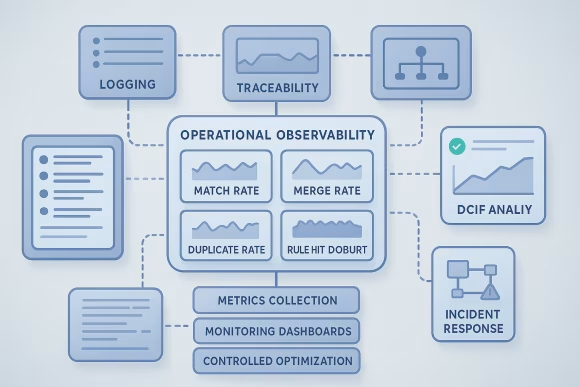
Operational monitoring should cover both quality and stability. Common quality metrics include match rate by identifier type, duplicate rate (multiple profiles representing the same person), merge rate over time, and profile completeness for attributes required by activation and analytics. These should be segmented by source system and region to detect localized issues. Stability metrics help detect regressions when rules or inputs change: distribution of rule hits, changes in confidence score distributions, spikes in merges or splits, and drift in the number of active profiles. For streaming systems, you also monitor lag, replay events, and idempotency failures that can create inconsistent linkage. We also recommend traceability metrics: percentage of identity decisions with explainability payloads, rule version coverage, and audit log completeness. Together, these metrics support incident response, controlled rule tuning, and governance reporting without relying on manual sampling.

How do you decide between batch and real-time identity resolution?

The decision is driven by latency requirements and the nature of identity signals. Real-time resolution is useful when personalization or fraud/risk decisions must happen within seconds, and when the identifiers used for matching are available at event time (for example authenticated IDs or stable device identifiers). Batch resolution is often sufficient for analytics, audience building, and reconciliation of complex merges that require broader context. Architecturally, many enterprises implement a two-tier approach: a real-time “fast path” that performs deterministic resolution for immediate use, and a batch “truth path” that performs deeper reconciliation, probabilistic stitching (if used), and backfills. The key is to define how the two paths converge and how corrections propagate. We design idempotent processing, replay strategies, and clear semantics for when a profile is considered final for a given purpose. This prevents downstream systems from seeing inconsistent identifiers across refresh cycles.

What does onboarding a new source system into the identity graph require?

Onboarding starts with a data contract: which identifiers the source provides, how they are normalized, and what quality thresholds must be met. We define required fields, allowed formats, null handling, and how to represent identifier provenance so downstream consumers can reason about trust and recency. Next we map the source identifiers into namespaces and decide whether they create new nodes, attach to existing entities, or both. We also define how late-arriving events and corrections are handled, including backfill procedures and how to avoid creating duplicate links during replays. Finally, we validate impact before production: expected match behavior, merge/split rates, and any changes to activation mappings. The goal is predictable integration where adding a source improves coverage without destabilizing existing profiles or breaking reporting joins.

How do you expose resolved identities to activation and analytics tools safely?

We define a clear contract for “activation-ready identifiers,” typically including a stable internal profile key plus destination-specific identifiers or mappings. The architecture avoids leaking sensitive internal identifiers to external systems and supports destination constraints such as hashing requirements, TTLs, and refresh semantics. For analytics, we ensure that resolved identifiers can be joined consistently across event data, CRM extracts, and campaign data. This often requires publishing mapping tables with effective dates and rule versions so analysts can reproduce results and understand changes. Safety and governance are built in: consent and purpose checks at export time, access controls on identity mappings, and audit logs for what was exported and why. This reduces the risk of inconsistent activation, accidental over-sharing, or irreproducible measurement.

How do you govern changes to identity rules without breaking downstream consumers?

We treat identity rules as versioned configuration with a controlled release process. Changes are proposed with an impact assessment: which identifiers and entities are affected, expected changes in match/merge rates, and which audiences or reports may shift. Rules are tested against representative datasets and compared to baseline metrics before rollout. In production, we recommend staged deployment: run new rules in shadow mode, compare outputs, and only then promote to active resolution. Where feasible, we keep a change log of merges and splits attributable to a rule version so downstream teams can explain shifts in KPIs. We also define communication and ownership: who approves rule changes, what constitutes an emergency rollback, and how to coordinate with marketing operations and analytics. This governance model reduces surprise changes and supports continuous improvement without destabilizing the platform.

What level of lineage and auditability is realistic for identity decisions?

A practical target is decision traceability at the level of merges, splits, and attribute survivorship. For each identity decision, you want to record the inputs (identifiers and source events), the rule or model version applied, the confidence score (if applicable), and the resulting link changes. This enables debugging, compliance reviews, and reproducibility. Lineage should also capture provenance for key attributes: where an email, phone, or address came from, when it was last updated, and what precedence rules selected it. Without this, teams cannot explain why a profile contains a value or why it changed. We design audit logs and metadata so they are operationally sustainable: partitioned storage, retention policies, and sampling where full fidelity is too expensive. The goal is “enough auditability to operate and govern,” not an unbounded logging system that becomes cost-prohibitive.

How do you reduce the risk of over-merging identities?

Over-merging is primarily controlled through conservative deterministic rules, clear entity boundaries, and guardrails around probabilistic signals. We define which identifiers are considered high-trust (for example authenticated customer IDs) versus low-trust (shared emails, device signals), and we restrict which combinations can create a merge. We also implement explainability and thresholds: merges should be attributable to specific rules, and probabilistic links should carry confidence and be consumable differently from deterministic links. Where risk is high, we design “soft links” that inform analytics but do not drive activation. Operationally, we monitor merge spikes, rule hit distributions, and downstream anomalies (for example sudden audience growth). We also define split mechanisms and rollback strategies so incorrect merges can be corrected without manual rework across multiple systems.

What are the main privacy and compliance risks in identity graph implementations?

The main risks are purpose creep, insufficient consent enforcement, and uncontrolled sharing of identity mappings. Identity graphs make it easy to connect data across contexts, which can violate policy if consent and purpose are not enforced at the right points in the pipeline. We address this by designing explicit enforcement points: what can be linked, what can be activated, and what can be exported, based on consent state and regional policy. We also define access controls for identity mappings and ensure that exports use destination-appropriate identifiers (for example hashed emails) with retention and TTL controls. Another risk is poor auditability. Without traceable identity decisions, it is difficult to respond to data subject requests or internal reviews. We design logging, retention, and deletion propagation so identity links and derived profiles can be managed in a controlled, reviewable way.

What roles do we need on our side to implement and operate an identity graph?

At minimum, you need a data architect or lead who owns the identity domain model and its evolution, plus platform engineers or data engineers who implement pipelines, storage, and integrations. Marketing technology or CDP operations stakeholders are important to validate activation requirements and to manage destination constraints. You also benefit from privacy/security stakeholders who can define consent and access requirements, and analytics engineering or BI stakeholders who validate measurement joins and reporting semantics. Identity touches many systems, so clear ownership and decision rights matter more than headcount. We typically define a RACI early: who approves rule changes, who owns incident response, and who maintains data contracts with source system teams. This reduces delays and prevents identity logic from fragmenting across tools again.

What is a typical timeline and output for an identity graph architecture engagement?

A common engagement runs 4–10 weeks depending on platform complexity and the number of source systems. Early weeks focus on discovery: identifier inventory, current stitching logic, baseline metrics, and priority use cases. Mid-phase work defines the target model, resolution strategy, governance, and integration patterns. Outputs are designed to be implementable: architecture diagrams, entity/relationship models, identifier namespaces, resolution rule specifications, data contracts, and operational monitoring requirements. Where helpful, we provide reference implementations or configuration examples aligned to your CDP and data platform. If implementation is in scope, we extend into build support with test datasets, validation harnesses, and rollout plans. The engagement is successful when teams can onboard sources predictably, explain identity decisions, and operate resolution with measurable quality and controlled change.

How does collaboration typically begin for identity graph architecture work?

Collaboration usually begins with a short alignment phase to confirm scope and constraints. We ask for a source system list, sample schemas or event payloads, current identity stitching rules (if any), and a small set of priority use cases for activation and measurement. We also identify stakeholders for data, MarTech/CDP operations, privacy, and analytics. Next, we run structured discovery workshops to build an identifier inventory and map where identity decisions occur today. From that, we define a target-state identity model and a resolution strategy with clear boundaries, governance requirements, and integration touchpoints. We then agree on an implementation plan: what will be delivered as architecture and specifications, what will be built by which team, and how success will be measured (match quality, stability, and operational readiness). This creates a shared baseline before any rule changes or platform work begins.

Define a scalable identity foundation

Let’s review your current identity resolution, data contracts, and activation dependencies, then define an implementable identity graph architecture with governance and operational metrics.

Oleksiy (Oly) Kalinichenko

Oleksiy (Oly) Kalinichenko

CTO at PathToProject

Do you want to start a project?