Enterprise CDP programs rarely fail because teams forgot to write down event names. They fail because the meaning, structure, and lifecycle of those events stop being governable once many teams begin shipping changes at once.
A spreadsheet-based tracking plan may work when one digital product, one analytics team, and one implementation pattern own most event production. But as soon as multiple applications, channels, vendors, and internal teams start contributing data, the challenge shifts. The real problem is no longer documentation alone. It is contract integrity.
Schema drift weakens activation fastRun Health CheckThat is where a CDP schema registry becomes useful.
A registry is not a magic fix for poor event design. It will not automatically resolve unclear business definitions, weak data modeling, or fragmented ownership. What it can do is provide a formal control point for how event payloads are defined, reviewed, versioned, validated, and trusted across the delivery lifecycle.
For enterprise digital platforms, that matters because event data is not consumed once. The same payload can influence analytics, customer identity, audience activation, personalization, experimentation, support workflows, and data science use cases. When one producer changes a field casually, many downstream consumers can break silently.
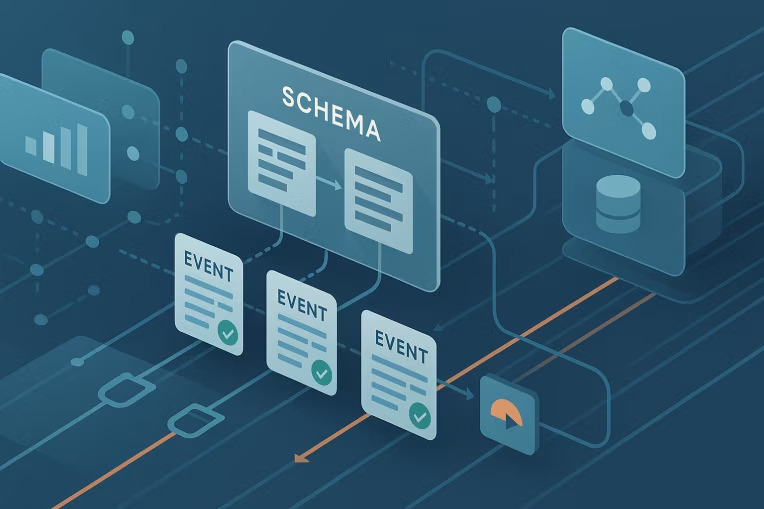
A schema registry helps teams treat events less like loosely managed instrumentation and more like governed shared interfaces.
Why tracking plans stop scaling in multi-team CDP programs
Tracking plans remain valuable. They help teams define event intent, field names, and business meaning. They are often the first place stakeholders align on what should be collected.
But tracking plans usually stop short of enforcing behavior.
In growing CDP environments, the limitations become predictable:
- documentation drifts away from production reality
- different teams reuse the same event name with different payload assumptions
- optional fields become unofficially required in downstream logic
- deprecated fields remain in use because nobody owns retirement
- web, mobile, backend, and batch producers implement the same concept differently
- activation teams build audiences on fields whose semantics are unstable
A spreadsheet can describe an intended payload. It usually cannot govern whether real producers are conforming to it, whether changes were approved, or whether consumers were notified about breaking changes.
This is why many enterprise teams eventually move from tracking plan management to an event contract governance model.
The key shift is conceptual. Instead of saying, "Here is the event spec we hope everyone follows," the organization says, "Here is the event contract that producers are expected to meet, and here is the operating model for changing it safely."
That distinction becomes especially important in customer data pipelines, where the cost of inconsistency compounds across systems. A field drift in collection can become identity fragmentation in the CDP, misclassification in the warehouse, and failed activation logic in downstream destinations.
What a schema registry actually governs beyond event names
When teams first hear "schema registry," they often think only about field definitions or JSON structure. In practice, a useful registry governs much more than syntax.
A mature registry can act as a system of record for several layers of meaning:
- Event identity: what the event is called, what business action it represents, and where it should be used
- Payload structure: what properties are expected, their data types, constraints, allowed values, and nested relationships
- Semantics: what each field means in business terms, not just technical terms
- Ownership: which team owns the event contract, who approves changes, and who is accountable for quality
- Lifecycle state: proposed, approved, active, deprecated, retired, or replaced
- Compatibility rules: which changes are safe, which are breaking, and how version transitions should be handled
- Lineage and usage context: where the event originates and which downstream systems depend on it
This matters because most CDP quality issues are not purely structural. A field can remain technically valid while becoming semantically unreliable.
For example, an event property called customer_type might remain a string across every release. But if one team uses values such as prospect and customer while another uses lead, trial, and active, downstream audience logic may degrade even though the schema still "passes."
That is why event schema governance must include controlled definitions, ownership, and usage expectations, not just serialization rules.
Registry scope: events, properties, versions, ownership, and approval states
A registry is most effective when teams define its scope explicitly. Otherwise it becomes another partial documentation layer that sits beside implementation rather than governing it.
At minimum, enterprise teams should decide that the registry covers five core units.
1. Events
Each event should have a stable identifier and a clear business purpose. The definition should answer basic questions:
- What user, system, or business action does this represent?
- Which channels or platforms are allowed to emit it?
- What is the canonical event name?
- Are aliases allowed for legacy compatibility, and if so, for how long?
2. Properties
Properties need more than a label and a type. Strong contracts often capture:
- data type
- nullability or required status
- enumerated values where appropriate
- formatting rules such as ISO timestamps or normalized IDs
- source expectations, such as client-derived versus server-authoritative
- sensitivity classification, especially when customer or identity data is involved
This is where the data layer contract model becomes important. If the web data layer, mobile payload, and backend event envelope all represent the same business concept, teams need a clear mapping model rather than assuming consistency will happen naturally.
3. Versions
Versioning should exist, but not as an excuse to accumulate unlimited drift.
A good version model helps teams answer:
- Is a property addition backward compatible?
- Is a rename treated as a break or an alias?
- When can a deprecated field be removed?
- How are downstream consumers informed of version changes?
The goal is controlled evolution, not permanent fragmentation.
4. Ownership
Every event contract should have a named accountable owner. In enterprise settings, ownership is often split in practical ways:
- product or domain team owns business meaning and producer implementation
- analytics or instrumentation team owns measurement quality and taxonomy consistency
- data engineering owns pipeline handling, transformation rules, and warehouse compatibility
- CDP or activation stakeholders validate downstream usability
Shared collaboration is healthy. Diffuse accountability is not.
5. Approval states
A registry should distinguish between ideas, approved standards, and retired contracts. Common states might include:
- draft
- under review
- approved
- active in production
- deprecated
- retired
Without approval states, teams often treat draft fields as production-safe or continue using deprecated payloads because there is no visible lifecycle control.
How registry workflows connect product, web, data, and activation teams
A schema registry is as much an operating model as a technical asset. Its value comes from how work moves through it.
In most enterprise CDP programs, event changes touch multiple roles:
- product teams define business actions worth measuring
- frontend and mobile teams implement collection and data layer behavior
- backend teams may emit authoritative transaction or identity events
- analytics teams validate naming, event intent, and measurement completeness
- data engineering teams enforce ingestion, transformation, and storage rules
- activation teams depend on stable attributes and events for segmentation and orchestration
If these groups interact only through tickets and spreadsheets, contract quality tends to degrade. A registry-backed workflow gives them a shared process for proposing, reviewing, and approving change.
A practical workflow often looks like this:
- A team proposes a new event or a change to an existing one.
- The proposal includes business purpose, producer context, required properties, downstream use expectations, and compatibility impact.
- Relevant reviewers assess it from their own perspective: analytics meaning, implementation feasibility, privacy handling, warehouse impact, and activation dependency risk.
- Once approved, the contract becomes the reference point for implementation and validation.
- Changes to production payloads are checked against approved contract definitions.
- Deprecations are tracked until consumers are migrated.
This does not need to become bureaucratic. The most effective operating models are tiered.
For example:
- low-risk additive changes may use lightweight review
- new canonical events may require cross-functional approval
- breaking changes may require migration planning and downstream sign-off
The point is not to slow delivery. It is to make change visible before it causes hidden downstream cost.

Test whether your event contracts support dependable activation
Assess how schema governance, validation, and ownership affect audience quality across channels.
- Check contract stability
- Spot activation risk
- Prioritize governance fixes
Validation patterns in collection, pipeline, warehouse, and downstream delivery
A registry delivers the most value when it is connected to validation across the event lifecycle. If it remains isolated as a passive documentation tool, teams still discover issues too late.
In enterprise customer data pipelines, validation can happen at several points.
Collection layer validation
At the collection edge, validation can check whether emitted payloads match approved contracts before or during transmission. This is useful for catching:
- missing required fields
- unexpected property names
- invalid enumerations
- malformed IDs or timestamps
- channel-specific payload drift
For web and app implementations, this often pairs naturally with data layer quality checks. If the data layer is treated as part of the contract model, teams can detect problems before analytics and CDP tools ingest them.
Pipeline validation
In transit, event processing services can enforce structural and compatibility rules. This may include:
- rejecting clearly invalid payloads
- quarantining suspect events for review
- annotating events with validation status
- routing contract violations into observability workflows
Not every invalid event should be hard-dropped. Some programs use graded responses depending on business criticality. High-value operational flows may prioritize continuity while still surfacing non-conformance for remediation.
Warehouse validation
Once data lands in the warehouse or lakehouse, contract-aware quality checks can detect drift that escaped earlier stages. This is especially important for:
- type coercion issues
- sparsity changes in once-stable fields
- value distribution shifts in controlled enumerations
- undocumented field aliases appearing in modeled datasets
Warehouse validation is not a substitute for upstream control. It is the safety net that helps teams see whether actual production behavior still aligns with the intended contract.
Downstream delivery validation
CDP and activation systems frequently depend on stable field semantics, not just event arrival. A contract-aware model helps downstream teams validate that:
- identity-relevant fields remain populated and normalized
- audience criteria still reference active properties
- personalization rules do not depend on deprecated attributes
- destination mappings still align to approved source definitions
This is where analytics schema validation intersects with operational trust. A field that is technically present but semantically unstable can still break reporting, segmentation, and orchestration.
Common failure modes: silent field drift, undocumented aliases, and broken activation dependencies
Many schema governance initiatives begin after teams experience recurring failures that are individually small but cumulatively expensive.
Three patterns appear often.
Silent field drift
A producer changes a payload without formal review. The event still arrives, dashboards continue to load, and no catastrophic error occurs. But the meaning has shifted.
Maybe a revenue field changes from gross to net. Maybe a page classification property starts using a new taxonomy. Maybe logged_in changes from a boolean to a string representation.
Because the break is semantic rather than purely technical, it can go unnoticed for weeks.
Undocumented aliases
Legacy implementations often introduce near-duplicate fields or event names to preserve compatibility under time pressure. Examples include:
account_idandcustomer_idrepresenting the same concept in different systemscheckout_startedandbegin_checkoutboth emitted for similar stepsplan_typeandsubscription_tierbeing used interchangeably downstream
Aliases may feel harmless in the moment, but over time they obscure lineage, complicate transformation logic, and increase ambiguity for activation teams.
A registry does not eliminate the need for transitional aliases. It does make them explicit, temporary, and governed.
Broken activation dependencies
Activation teams often build journeys and audiences on assumptions that are never formally represented in the source event contract. This creates hidden dependency chains.
For instance, a lifecycle audience may depend on a field becoming available within a certain latency window and carrying a small set of normalized values. If a producer changes that field without understanding the downstream dependency, the audience quietly degrades.
One of the practical benefits of a registry is that it can make those dependencies visible earlier in the change process. Even a lightweight record of downstream consumers can materially improve change decisions.
A phased rollout model for teams moving from spreadsheets to contract governance
Most enterprise teams should not attempt a fully centralized governance model overnight. That often produces resistance, inconsistent adoption, and a registry populated with theory rather than real delivery behavior.
A phased rollout is usually more effective.
Phase 1: Stabilize the canonical event inventory
Start by identifying the events and properties that matter most across analytics, identity, and activation workflows.
This is not the time to model every possible signal. Focus on:
- high-value business events
- shared customer and account identifiers
- core lifecycle and conversion events
- attributes frequently reused across reporting and activation
The main goal is to establish a small but trusted canonical inventory.
Phase 2: Formalize contract fields and ownership
Once the priority inventory exists, add governance depth:
- business definition
- type and constraint rules
- ownership and approvers
- lifecycle state
- channel scope
- compatibility expectations
This is the point where the registry begins to become more than a documentation asset.
Phase 3: Connect the registry to delivery workflows
Next, integrate schema review into the way teams already ship work. This might include:
- event change review during feature delivery
- release checklists tied to contract updates
- implementation acceptance criteria based on approved payloads
- observability alerts tied to contract violations
The registry becomes durable when it is part of operating rhythm, not a side repository that requires separate maintenance.
Phase 4: Add automated validation and drift detection
After the contract model is trusted, expand automation. Teams can validate payloads in collection, pipeline, and warehouse contexts, while monitoring for changes in field behavior over time.
The objective here is not perfection. It is earlier detection, clearer accountability, and reduced downstream surprise.
Phase 5: Govern change and retirement explicitly
Finally, mature teams operationalize deprecation and migration. They define:
- who can approve breaking changes
- required notice periods for downstream consumers
- how aliases are sunset
- when deprecated fields are removed from production contracts
This phase is often neglected, but it is essential. Without retirement discipline, the contract landscape grows continuously and governance overhead rises with it.
What good looks like in practice
A healthy schema registry strategy is usually recognizable even without a specific vendor or platform choice.
You will typically see that:
- event contracts are treated as shared production interfaces
- ownership is named, visible, and practical
- changes are reviewed based on compatibility and downstream impact
- validation occurs in more than one layer of the pipeline
- deprecated fields have a managed exit path
- teams can trace critical activation logic back to governed source definitions
Just as important, good governance does not freeze teams into a rigid model. It allows change, but makes that change legible.
That is the central benefit of a CDP schema registry for enterprise digital platforms. It creates enough structure to preserve trust while still supporting ongoing product and channel evolution.
A tracking plan remains useful. But once multiple teams and systems are producing customer data, documentation alone is no longer enough. Enterprise programs need a contract system: one that connects event design, producer accountability, validation, observability, and downstream compatibility.
In practice, that often sits within a broader CDP platform architecture and is reinforced by event tracking architecture decisions that standardize taxonomy, versioning, and change control across channels.
Activation readiness
See where event contract gaps are hurting downstream activation
Use the Health Check to uncover schema drift, unstable fields, and governance gaps that reduce audience trust and delivery quality.
When schema governance is approached that way, the registry becomes less about paperwork and more about protecting the reliability of the entire customer data ecosystem.
Tags: CDP, CDP schema registry, event contract governance, event schema governance, tracking plan management, customer data pipelines, analytics schema validation, data layer contract model