




 [01]
[01]Discovery and Audit
Assess current tracking implementations, tag configurations, and downstream dependencies. Identify critical journeys, data quality gaps, and architectural constraints such as SPA routing and consent management.
CDP tracking readiness
Use a CDP health check to review schema governance, event consistency, integration mapping, and release readiness before tracking issues spread downstream.
Built for teams managing SPA tracking, governed event contracts, and CDP ingestion alignment.
No login required. Takes 2–3 minutes.
A data layer is the contract between your digital experience and the systems that measure it. It defines what events exist, how they are named, and which attributes are required so enterprise analytics instrumentation, tag managers, and CDP event tracking pipelines can consume consistent signals across pages, apps, and releases.
Organizations need a structured data layer when tracking becomes fragile: multiple teams ship features, tags evolve independently, and reporting depends on undocumented assumptions. Without a clear JavaScript data layer specification for enterprise use, event payloads drift, breaking dashboards, attribution, and downstream activation.
Data Layer Implementation establishes a versioned event and entity model, implements it in the frontend, and aligns it with analytics and CDP ingestion requirements. The result is a maintainable measurement foundation that supports scalable platform architecture, reduces regressions during delivery, and enables reliable tag manager integration for analytics data layer workflows across the broader data ecosystem.
Core Focus
Best Fit For
Key Outcomes
Technology Ecosystem
Platform Integrations
As digital platforms grow, tracking often evolves as a set of incremental tag changes rather than an engineered interface. Different teams introduce events with inconsistent names, optional attributes, and conflicting definitions of core entities such as product, content, account, or conversion. In SPAs and component-driven frontends, route changes and dynamic rendering further complicate when and how events should fire.
These inconsistencies create architectural friction between frontend delivery and analytics operations. Engineers lack a stable contract for what must be emitted, analytics teams compensate with brittle parsing rules, and marketing teams see shifting dimensions that invalidate historical comparisons. Integrations with tag managers, analytics tools, and CDPs become tightly coupled to page structure instead of business semantics, increasing the cost of platform changes.
Operationally, tracking defects are hard to detect and expensive to fix. Regressions surface after releases, data quality issues propagate into dashboards and activation audiences, and governance becomes reactive. Over time, the platform accumulates measurement debt that slows delivery and reduces confidence in data-driven decisions.
Review current tracking, reporting requirements, and downstream consumers such as analytics, CDP, and experimentation. Identify critical journeys, key entities, and failure modes including SPA navigation, consent gating, and duplicate firing.
Define event types, required attributes, entity models, and naming conventions. Establish rules for identifiers, timestamps, context fields, and error handling so payloads are consistent and analyzable across products and channels.
Document the JavaScript data layer specification for enterprise teams as a versioned contract with examples and validation rules. Align the contract with analytics and CDP ingestion constraints, including field types, cardinality limits, and reserved dimensions.
Implement the data layer in the application runtime, integrating with routing, state management, and component lifecycles. Provide utilities for emitting events, enriching context, and enforcing required fields at build or runtime.
Enable tag manager data layer integration by mapping the data layer to tag manager variables, analytics events, and CDP ingestion endpoints. Ensure consistent transformation logic, handle consent states, and support environments such as staging and production with clear configuration boundaries.
Introduce automated checks and repeatable validation workflows, including payload inspection, schema conformance tests, and regression verification for key journeys. Define acceptance criteria and monitoring signals for ongoing data quality.
Plan incremental rollout with backward compatibility where required. Coordinate changes with reporting stakeholders, manage version transitions, and provide migration guidance for dashboards, audiences, and downstream pipelines.
Establish ownership, change control, and review processes for new events and schema updates. Maintain a backlog of measurement improvements and ensure the data layer evolves alongside product and platform architecture.
This service establishes a stable measurement interface between the frontend platform and downstream data consumers. It centers on JavaScript data layer design with explicit schemas, consistent semantics, and implementation patterns that survive platform change. Capabilities include versioned contracts, reliable event emission in modern frontends, and tag manager data layer integration mappings that reduce coupling to page structure. Governance and validation mechanisms are designed to keep tracking maintainable as teams and requirements scale.
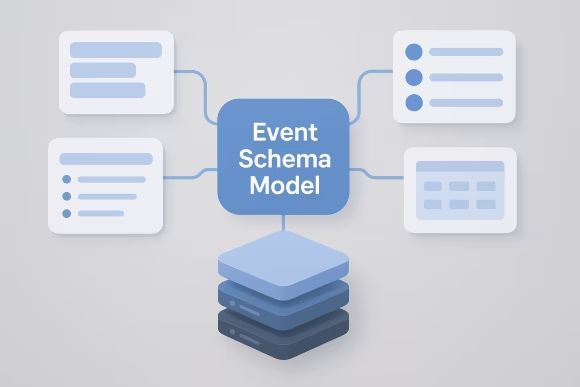
Define a structured event model with clear categories, actions, and required attributes. Schemas include field types, allowed values, and cardinality guidance to keep reporting stable and ingestion-compatible. The model is designed to represent business semantics rather than page-specific implementation details.

Model shared entities such as user, account, product, content, and transaction with consistent identifiers and lifecycle rules. Establish a context envelope for environment, consent state, experiment variants, and routing metadata. This enables consistent joins and segmentation across analytics and CDP pipelines.

Create a versioned contract for the data layer so changes are explicit, reviewable, and backward compatible when needed. Provide migration rules and deprecation paths for evolving events. This reduces breaking changes to dashboards, audiences, and activation logic during platform releases.

Implement event emission patterns that work reliably with client-side routing, hydration, and dynamic rendering. Ensure page view semantics, virtual navigation, and component-level interactions are captured without duplication. Instrumentation utilities are designed to be reusable across features and teams.

Translate data layer payloads into tag manager variables, analytics event formats, and CDP ingestion requirements. Keep transformations centralized and testable to avoid logic duplication across tags. Support environment-specific configuration and consent-aware routing of events.

Introduce schema validation and repeatable verification workflows to detect missing fields, invalid values, and unexpected payload changes. Provide guidance for automated checks in CI and lightweight runtime diagnostics in non-production environments. Define monitoring signals to detect drift after releases.

Establish processes for proposing, reviewing, and approving new events and schema changes. Define ownership, documentation standards, and acceptance criteria so measurement evolves with product delivery. Governance includes naming rules, required fields, and change logs to support auditability.
Identify where data layer design, governance controls, and integration dependencies are creating avoidable CDP risk across releases.
Engagements follow a clear engineering sequence: discovery and audit, measurement plan alignment, JavaScript data layer specification, implementation, and integration hardening. Work is delivered incrementally across priority journeys, with validation and change control to support reliable CDP event tracking and tag manager data layer integration as the platform evolves.
[01]Assess current tracking implementations, tag configurations, and downstream dependencies. Identify critical journeys, data quality gaps, and architectural constraints such as SPA routing and consent management.
 [02]
[02]Translate business questions into a measurable event and entity model. Define required attributes, naming conventions, and reporting expectations so stakeholders share a consistent interpretation of signals.
 [03]
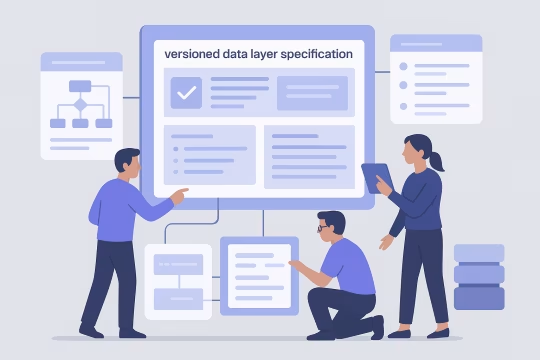
[03]Produce a versioned data layer specification with examples and validation rules. Define ownership, change control, and how new events are proposed and reviewed.
 [04]
[04]Implement the data layer and instrumentation utilities in the frontend codebase. Integrate with routing and state, and ensure events are emitted consistently across components and templates.
 [05]
[05]Map the data layer to tag manager variables and analytics/CDP ingestion formats. Centralize transformations and configuration to reduce coupling and simplify environment management.
 [06]
[06]Validate payloads against the schema and verify key journeys end-to-end. Introduce regression checks and define acceptance criteria for releases that change tracking behavior.
 [07]
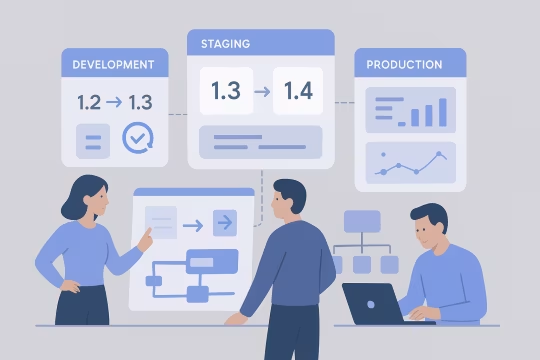
[07]Deploy incrementally with clear version transitions and backward compatibility where required. Coordinate updates to dashboards, audiences, and downstream pipelines to prevent reporting breaks.
 [08]
[08]Establish ongoing review routines and a backlog for measurement improvements. Monitor for drift, handle schema evolution, and support new product capabilities with controlled extensions.
A governed data layer reduces measurement volatility and makes enterprise analytics instrumentation and CDP event tracking more resilient to platform change. It improves the reliability of reporting and activation while lowering the operational cost of maintaining tag manager data layer integration across frequent releases.
Consistent event semantics reduce shifting dimensions and broken dashboards. Teams can compare performance over time with fewer rework cycles caused by tracking drift.
A versioned contract and validation workflow catch breaking changes earlier. Releases are less likely to introduce silent data loss or duplicated events that distort metrics.
Reusable utilities and clear schemas reduce the time needed to add new events. Engineers can implement tracking changes without reverse-engineering tag behavior or legacy conventions.
Downstream tools integrate to a stable data layer rather than page structure. This makes redesigns, component refactors, and routing changes less disruptive to analytics and CDP pipelines.
Cleaner identifiers and consistent context fields improve identity resolution and audience construction. Activation and personalization workflows rely on more predictable inputs.
Shared definitions for events and entities reduce interpretation conflicts between engineering, analytics, and marketing. Governance creates a clear path for requesting and approving measurement changes.
Standardization reduces the accumulation of one-off tags and undocumented events. Over time, maintenance effort decreases and platform evolution becomes less constrained by tracking complexity.
Before roadmap commitments
Review data layer architecture, governance coverage, upgrade exposure, and integration readiness so teams can fix the right tracking issues first.
These related services extend data layer implementation services into adjacent measurement planning, end-to-end instrumentation, governance, and analytics/CDP platform integration.
Enterprise CRM data synchronization and identity mapping
Event-driven journeys across channels and products
CDP audience activation with governed delivery to channels
Audience sync activation engineering for CDP activation
CDP real-time decisioning design for real-time experiences
Customer analytics platform implementation for governed metrics and behavioral analytics
Unified customer profile architecture and insight-ready datasets
Scalable enterprise audience segmentation models and cohort definition frameworks
Consistent experiment tracking, metrics, and attribution
Common architecture, operations, integration, governance, risk, and engagement questions for data layer work in enterprise web platforms.
A data layer is a structured, application-owned interface that exposes business events and context in a consistent format, typically as a JavaScript object or queue that downstream tooling can read. In practice, it becomes the contract between the frontend platform and systems like tag managers, analytics tools, and CDPs. The key distinction is that a data layer models business semantics (for example, “product viewed” with product identifiers, category, price, and currency) rather than page-specific DOM details. This reduces coupling: your analytics and CDP integrations depend on stable event payloads even as UI components, routes, or templates change. For enterprise platforms, a data layer also supports governance. It defines required fields, naming conventions, and versioning so multiple teams can instrument features without creating incompatible events. When implemented well, it becomes the foundation for reliable reporting, audience building, experimentation analysis, and privacy-aware data collection.
Scalable schemas start with a small set of event types and a consistent approach to entities and context. We typically separate (1) event intent, (2) entity payloads (product, content, account, transaction), and (3) shared context (environment, consent state, experiment variants, routing metadata). This structure keeps events readable while enabling consistent joins and segmentation. We define required versus optional fields, field types, and naming rules, and we explicitly manage identifiers (stable IDs, not display names). For SPAs, we define navigation semantics so “page view” and “screen view” are unambiguous. To scale across teams, the schema must be versioned and governed. That means a documented change process, examples, and validation rules. Teams can propose new events or extensions, but they do so within a controlled model that prevents duplication and conflicting definitions.
Stability comes from treating tracking as an engineered interface with tests and change control, not as a set of ad hoc tags. We establish a versioned data layer contract and define acceptance criteria for tracking changes in the same way you would for API changes. Operationally, we recommend three controls. First, centralized instrumentation utilities so event emission logic is consistent and not copied across components. Second, validation workflows: payload inspection in non-production, schema conformance checks, and regression verification for critical journeys. Third, monitoring signals that detect drops in event volume, missing required attributes, or unexpected spikes that indicate duplication. When releases change UI structure or routing, the data layer should remain stable because it is tied to business events and application state. If the schema must evolve, versioning and migration guidance reduce the risk of breaking dashboards, audiences, and downstream pipelines.
Maintainability requires documentation that is specific enough to implement and validate, and lightweight enough to keep current. At minimum, we document the event catalog (event names, intent, required/optional fields), entity definitions (identifiers and attribute meaning), and a shared context model. We also include examples of payloads for key journeys, rules for SPA navigation events, and a change log with versioning. For each event, it should be clear who owns it, when it should fire, and what constitutes a breaking change. Finally, we document integration mappings: how data layer fields map to tag manager variables, analytics parameters, and CDP ingestion fields. This prevents “hidden” transformations living only in tags. With these artifacts, new teams can add instrumentation without reverse-engineering legacy behavior, and analytics teams can trust that definitions are stable over time.
The data layer acts as the source of truth, while tag managers and analytics tools become consumers. We typically expose events and context in a predictable structure and then configure the tag manager to read those fields as variables. Analytics tags are triggered by specific event types and use the mapped variables to populate parameters. A key engineering principle is to keep transformation logic centralized. If you need to derive a field (for example, normalizing categories or computing a content hierarchy), it is usually better to do it in code or a shared mapping layer rather than duplicating logic across multiple tags. We also address operational needs: environment separation (staging vs production), consent-aware gating (only emitting or forwarding events when permitted), and SPA considerations (ensuring triggers reflect virtual navigation). The goal is predictable behavior across releases and consistent payloads across tools.
CDPs often have constraints around event naming, identity fields, attribute types, and cardinality. We align the data layer by defining a canonical event and entity model first, then mapping it to the CDP’s ingestion format with explicit rules. This avoids designing the entire frontend contract around a single vendor’s conventions. Identity is usually the most sensitive area. We define how anonymous and authenticated identifiers are represented, how transitions are handled, and how consent affects identity fields. We also define which attributes are stable identifiers versus descriptive fields to avoid polluting identity graphs. Where CDP schemas require specific fields, we include them in the contract or provide a mapping layer that enriches or transforms payloads before ingestion. The result is a data layer that remains platform-owned while still producing CDP-ready events with predictable quality.
Ownership should be shared but explicit. In most enterprise setups, a platform or frontend engineering group owns the implementation and the core schema mechanics (utilities, versioning, validation). Analytics engineering or a measurement lead typically owns the semantic definitions and ensures alignment with reporting and downstream consumers. We recommend a lightweight review process: new events and schema changes are proposed via a ticket or pull request that includes intent, payload example, and downstream impact. A small set of reviewers validates naming, required fields, and compatibility with analytics/CDP ingestion. This model prevents two common failure modes: engineering shipping events that analytics cannot use, and analytics creating tag-based workarounds that bypass platform standards. With clear ownership and review, the data layer evolves predictably and remains maintainable across teams and product lines.
We treat the data layer like an internal API. Versioning can be explicit (a version field in the payload) or managed through a documented contract with change logs and compatibility rules. The approach depends on how many consumers you have and how tightly coupled they are. For changes, we classify them as non-breaking (adding optional fields) versus breaking (renaming fields, changing meaning, changing required fields). Breaking changes should include a deprecation period where both old and new fields are emitted, or where mapping layers support both versions. We also recommend maintaining an event catalog with status flags (active, deprecated, removed) and clear timelines. Deprecations should be coordinated with dashboard owners, audience builders, and any downstream pipelines. This reduces operational surprises and prevents long-lived “temporary” fields from accumulating indefinitely.
The most common risks are scope creep, ambiguous definitions, and hidden dependencies in tags and reporting. Scope creep happens when every stakeholder request is treated as a schema requirement. We mitigate this by prioritizing critical journeys and establishing a core schema that can be extended incrementally. Ambiguous definitions create long-term instability. We mitigate this by documenting intent, required fields, and examples, and by enforcing naming and entity rules. If two teams mean different things by “conversion,” the schema must make that explicit. Hidden dependencies are addressed through an audit of existing tags, dashboards, and CDP pipelines. We map what currently consumes tracking signals and plan migrations. Finally, we reduce regression risk with validation workflows and monitoring so issues are detected quickly after releases rather than weeks later in reporting.
Privacy requirements affect both what you collect and when you are allowed to collect it. We incorporate consent state into the data layer context and define gating rules so events and attributes are emitted or forwarded only when permitted. This is especially important when tags and CDP ingestion are configured through multiple systems. We also review which identifiers and attributes are necessary for measurement goals. Where possible, we prefer stable, non-sensitive identifiers and avoid collecting unnecessary personal data. If certain attributes are required for activation, we define clear handling rules and ensure they are only present under appropriate consent. From an engineering perspective, the goal is deterministic behavior: the same user action should produce predictable payloads given the same consent state. This reduces compliance risk and prevents inconsistent datasets caused by partially gated implementations.
A typical engagement delivers a documented, versioned data layer contract; a prioritized event catalog for key journeys; frontend instrumentation utilities; and integration mappings for tag management, analytics, and CDP ingestion. We also deliver validation guidance and an operating model for governance. Timeline depends on platform complexity and how much existing tracking needs to be migrated. For a single web platform with a defined set of journeys, an initial contract and implementation for priority events is often achievable in a few weeks, followed by incremental rollout. Multi-site or multi-product ecosystems typically require phased delivery. We prefer to deliver value early: establish the core schema and implement it for a small set of high-impact journeys, then expand coverage. This approach reduces risk, keeps stakeholders aligned, and avoids large “big bang” migrations that are hard to validate.
Collaboration usually begins with a short discovery focused on current-state tracking and downstream dependencies. We review existing tags, analytics configurations, CDP ingestion, key dashboards, and the frontend architecture (including SPA routing, component structure, and consent management). We also align on the highest-value journeys and the decisions the organization needs to support with data. From there, we propose a measurement plan and a first version of the data layer contract, including event and entity definitions, required attributes, and naming conventions. We validate the contract with both engineering and analytics stakeholders to ensure it is implementable and useful. Once the contract is agreed, we implement instrumentation for a prioritized set of events, set up integration mappings, and establish validation and governance routines. This creates a stable foundation that can be extended incrementally as the platform evolves.
These case studies showcase implementations that align closely with data layer design, event tracking, and CDP integration. They highlight practical delivery of standardized event schemas, frontend instrumentation, and analytics mapping to ensure reliable data capture and governance across complex digital platforms. The selected work demonstrates measurable improvements in data consistency, tag management integration, and scalable analytics instrumentation relevant to the service focus.
Organogenesis faced operational challenges managing multiple brand websites on outdated platforms, resulting in fragmented workflows, high maintenance costs, and limited scalability across a multi-brand digital presence.
The transformation reduced time-to-deliver marketing updates by 20–25%, improved Lighthouse scores to ~90+, and delivered a scalable multi-brand foundation for long-term growth.
JYSK required a robust retail Digital Experience Platform (DXP) integrated with a Customer Data Platform (CDP) to enable data-driven design decisions, enhance user engagement, and streamline content updates across more than 25 local markets.
The modernized platform empowered JYSK’s marketing and content teams with real-time insights and modern workflows, leading to stronger engagement, higher conversions, and a scalable global platform.
Oleksiy (PathToProject) worked with me on a specific project over a period of three months. He took full ownership of the project and successfully led it to completion with minimal initial information.
His technical skills are unquestionably top-tier, and working with him was a pleasure. I would gladly collaborate with Oleksiy again at any opportunity.

Nikolaj Stockholm Nielsen
Strategic Hands-On CTO | E-Commerce Growth
Oleksiy (PathToProject) is demanding and responsive. Comfortable with an Agile approach and strong technical skills, I appreciate the way he challenges stories and features to clarify specifications before and during sprints.

Olivier Ritlewski
Ingénieur Logiciel chez EPAM Systems
As Dev Team Lead on my project for 10 months, Oleksiy (PathToProject) demonstrated excellent technical skills and the ability to handle complex Drupal projects. His full-stack expertise is highly valuable.

Laurent Poinsignon
Domain Delivery Manager Web at TotalEnergies
These articles expand on the contract, governance, and implementation choices that make enterprise tracking reliable. They cover how data layer ownership, schema control, and versioning affect measurement integrity and downstream activation. Together they provide practical context for building and maintaining a durable CDP-ready instrumentation layer.
Let’s review your current tracking signals, align on an event schema, and implement a governed data layer that remains reliable through platform change.