




 [01]
[01]Discovery Workshops
Run structured sessions to capture objectives, constraints, stakeholders, and current pain points. Establish a shared vocabulary for identities, events, profiles, and activation so later decisions are consistent.
CDP strategy readiness
Review CDP scope, governance, identity, and integration readiness before roadmap commitments create rework.
Built to surface architecture gaps, ownership risks, and upgrade blockers early.
No login required. Takes 2–3 minutes.
Customer data strategy defines how an organization collects, models, governs, and activates customer data across products and channels. In practice, customer data strategy consulting helps enterprise teams translate business objectives (measurement, personalization, lifecycle marketing, service optimization) into concrete platform requirements such as event design, identity resolution, customer profile schema, consent handling, and downstream activation patterns.
Organizations need this capability when CDP initiatives stall due to unclear ownership, inconsistent tracking, fragmented identity, or competing martech priorities. Without an explicit CDP strategy roadmap, teams often optimize locally (per channel or per product) and create incompatible data definitions that undermine cross-channel use cases.
A well-structured strategy provides a shared blueprint for enterprise customer data platform planning and delivery: what data is in scope, how it is captured and validated, how identities are linked, how audiences and attributes are exposed, and how governance is enforced. It also establishes decision-making and operating rhythms so the CDP can evolve without breaking integrations or eroding trust in customer profiles.
Core Focus
Best Fit For
Key Outcomes
Technology Ecosystem
Delivery Scope
As organizations expand channels, products, and regions, customer data tends to grow through incremental integrations and campaign-driven tracking. Different teams define events, identifiers, and attributes independently, resulting in multiple “versions” of the customer and inconsistent measurement. CDP selection or implementation may proceed before the organization has agreed on scope, ownership, or what “good” looks like for identity and activation.
These gaps create architectural strain. Identity resolution becomes a patchwork of ad hoc rules, profile schemas drift over time, and downstream systems consume data without stable contracts. Engineering teams spend cycles reconciling event payloads, debugging broken audiences, and managing exceptions caused by inconsistent consent signals or missing identifiers. Data teams face low trust in profiles and struggle to establish lineage and quality controls across sources.
Operationally, delivery slows because every new use case requires re-negotiating definitions and rebuilding pipelines. Governance becomes reactive, privacy risk increases when consent and retention are unclear, and platform costs rise due to duplicated integrations and repeated reprocessing. The result is a CDP program that cannot scale predictably with the organization’s digital roadmap.
Map business objectives, current platform constraints, and the teams producing and consuming customer data. Capture priority use cases, decision rights, and non-functional requirements such as latency, retention, and regulatory constraints.
Review existing tracking, identifiers, data flows, and martech integrations. Identify inconsistencies in event naming, profile attributes, consent propagation, and data quality controls that impact identity and activation.
Define a use-case portfolio with measurable outcomes and required data inputs. Separate foundational capabilities (identity, taxonomy, governance) from channel-specific activation needs to sequence delivery realistically.
Design the conceptual customer profile model, event taxonomy boundaries, and data contracts between producers, the CDP, and downstream consumers. Define environments, data zones, and interfaces for batch and streaming patterns.
Specify identifier strategy, matching rules, and merge/split policies aligned to business and privacy requirements. Define how anonymous-to-known transitions work and how identity decisions are audited and explained.
Establish stewardship roles, approval workflows, and change management for taxonomy and schema evolution. Define quality gates, documentation standards, and ownership for integrations and activation outputs.
Translate the strategy into milestones, dependencies, and resourcing assumptions. Define what is delivered in each phase, how success is measured, and how the program adapts as new channels and regulations emerge.
This service establishes the technical and operational foundations required to run an enterprise CDP program as a platform. It supports enterprise customer data platform planning by defining stable data contracts, customer profile semantics, and a clear identity resolution strategy for CDP use cases. The approach emphasizes first-party data strategy, governance, and activation-ready definitions so multiple teams can contribute and consume customer data safely as the platform evolves.
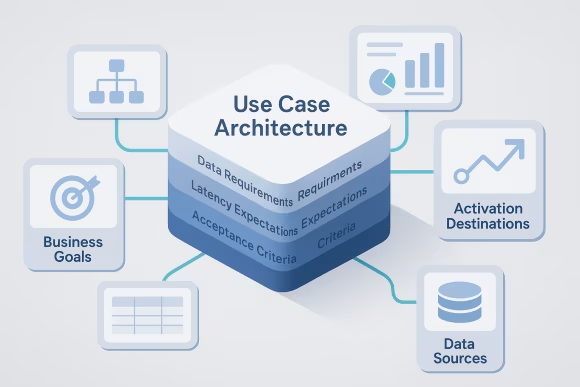
A structured use-case model that ties business goals to concrete data requirements, latency expectations, and activation destinations. This clarifies which events and attributes are needed, which systems are sources of truth, and which capabilities must be platform-level versus channel-specific. It also provides acceptance criteria for delivery and measurement.
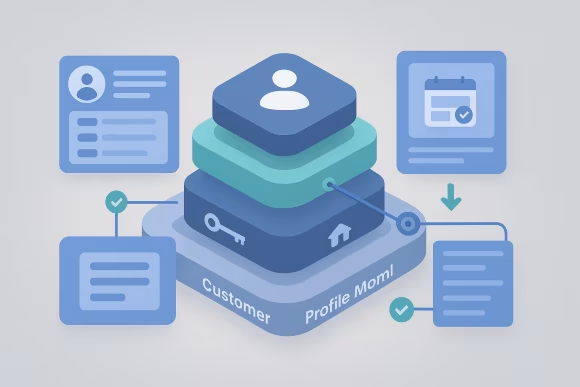
A conceptual and logical profile schema that defines entities, attributes, and relationships (person, account, household, device) relevant to the organization. The model includes attribute ownership, update semantics, and retention expectations so multiple producers can contribute without overwriting or duplicating meaning. It supports predictable downstream consumption.
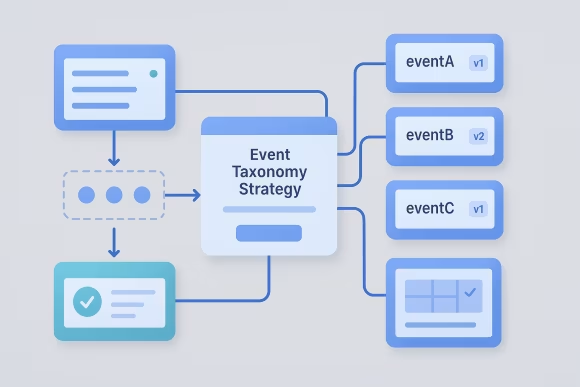
A taxonomy approach that defines event naming conventions, required properties, and versioning rules. It includes guidance for product instrumentation boundaries, shared event definitions across teams, and validation expectations. The result is a consistent behavioral dataset that can be trusted for segmentation, analytics, and experimentation.
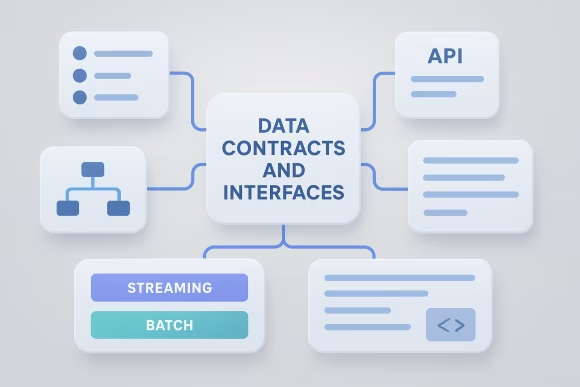
Explicit contracts for how data moves between sources, the CDP, and activation systems, including payload schemas, identifiers, and error handling. Contracts reduce integration ambiguity and support automated validation in pipelines. Interfaces are designed to accommodate both streaming and batch patterns depending on operational constraints.

A defined identifier strategy and matching approach that balances accuracy, explainability, and privacy constraints. This includes merge/split policies, confidence rules, and handling for anonymous-to-known transitions. The framework also specifies how identity decisions are logged and how exceptions are managed operationally.
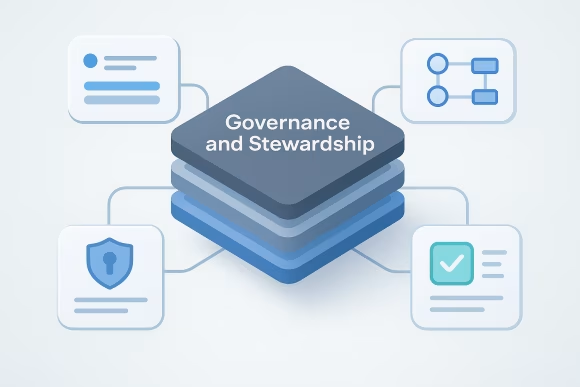
A governance model covering taxonomy changes, schema evolution, access controls, and data quality ownership. It defines decision rights, review workflows, and documentation requirements so changes are auditable and coordinated across teams. Governance is designed to be lightweight enough to support delivery while preventing drift.
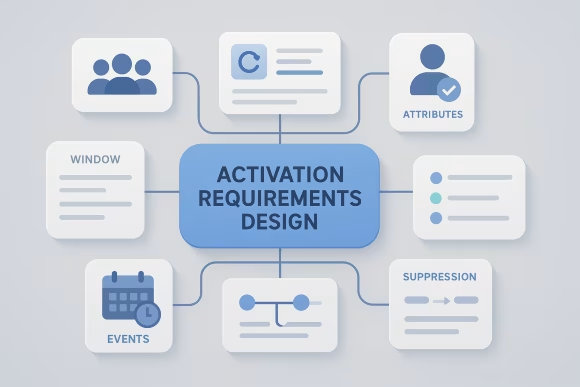
A specification of how audiences, attributes, and events are exposed to downstream tools, including refresh cadence, eligibility rules, and suppression logic. It defines activation-ready semantics (e.g., membership windows, consent constraints) to reduce reimplementation in each channel. This supports consistent cross-channel execution.
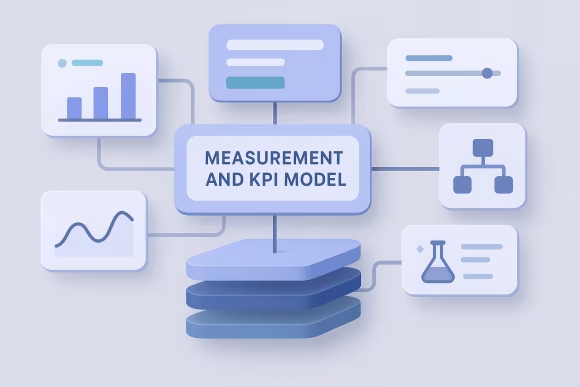
A measurement framework that aligns CDP outputs to KPIs, attribution constraints, and experimentation needs. It defines which metrics require event-level fidelity, which can be aggregated, and how data quality impacts reporting. This creates a shared reference for validating that the platform supports decision-making.
Pinpoint the strategy and architecture issues that create unstable profiles, weak governance, and costly downstream fixes.
Engagements follow a clear engineering sequence from discovery through target-state definition and roadmap sequencing. We collaborate with platform, data, marketing, and privacy stakeholders to produce an implementable CDP strategy roadmap: architecture decisions, operating model, governance, and activation requirements that engineering teams can execute and evolve.
[01]Run structured sessions to capture objectives, constraints, stakeholders, and current pain points. Establish a shared vocabulary for identities, events, profiles, and activation so later decisions are consistent.
 [02]
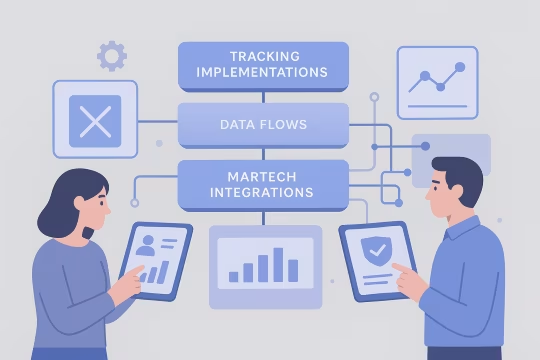
[02]Assess current tracking implementations, data flows, and martech integrations. Identify gaps in consent propagation, identifier coverage, data quality, and operational ownership that affect CDP feasibility.
 [03]
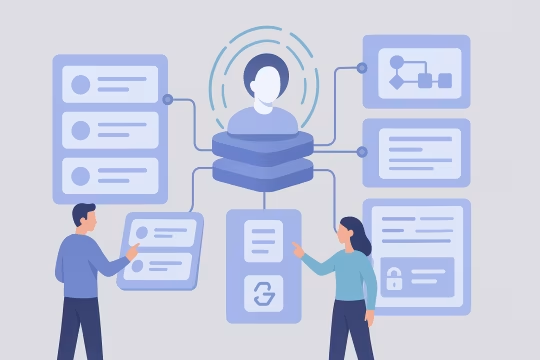
[03]Document and score candidate use cases by value, feasibility, and dependency on foundational capabilities. Define success metrics and the minimum data requirements for each use case to avoid over-instrumentation.
 [04]
[04]Define the target customer profile model, event taxonomy boundaries, and integration contracts. Specify non-functional requirements such as latency, retention, and access controls to guide implementation choices.
 [05]
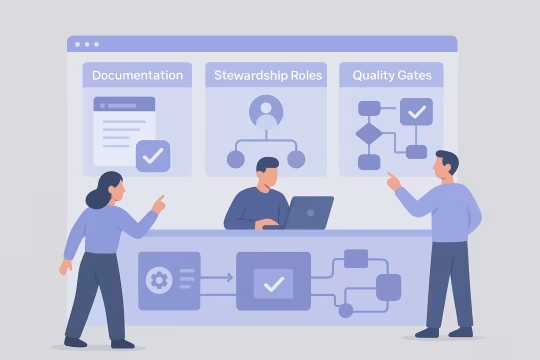
[05]Create stewardship roles, change workflows, and quality gates for taxonomy and schema evolution. Define documentation standards and operational runbooks so the program can scale across teams and regions.
 [06]
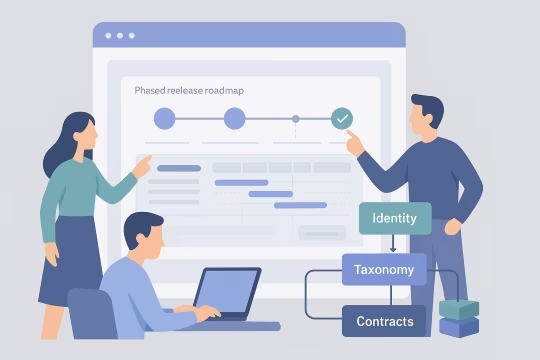
[06]Build a phased delivery plan with milestones, dependencies, and resourcing assumptions. Sequence foundational work (identity, taxonomy, contracts) ahead of activation expansions to reduce rework.
 [07]
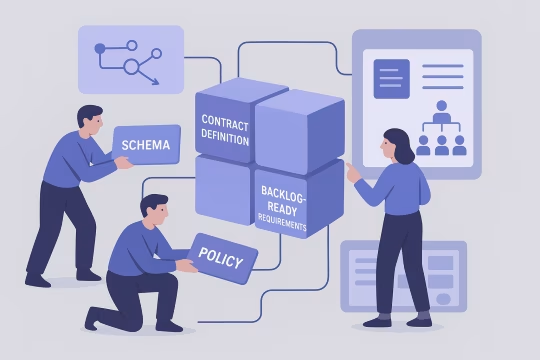
[07]Package decisions into artifacts engineering teams can implement: schemas, contract definitions, policy documents, and backlog-ready requirements. Align on ownership and next-step execution plan across teams.
Customer data strategy reduces ambiguity in CDP programs by turning goals into enforceable technical definitions and operating practices. For enterprise teams, the impact shows up as fewer integration failures, faster onboarding of new use cases, and improved trust in first-party data used for activation and measurement. Clear identity resolution and governance also reduce operational risk and help keep cross-channel execution consistent as the platform scales.
Clear data requirements and sequencing reduce time spent renegotiating definitions for each activation initiative. Teams can onboard new audiences and attributes with fewer integration cycles and less rework across channels.
Stable data contracts and taxonomy rules reduce downstream breakage when sources change. Engineering effort shifts from repeated fixes to planned evolution with predictable release management.
Defined identity policies and attribute ownership improve consistency of customer profiles. Marketing and product teams can rely on shared semantics for segmentation, personalization, and analytics.
Governance workflows and quality gates make changes auditable and controlled. This reduces the likelihood of silent tracking regressions, broken audiences, and inconsistent consent handling across systems.
A shared activation model standardizes audience definitions, refresh cadence, and eligibility rules. This reduces channel-by-channel reimplementation and improves comparability of performance across touchpoints.
Consent, retention, and access constraints are designed into the operating model rather than handled ad hoc. This supports safer activation patterns and clearer accountability for compliance-sensitive decisions.
A roadmap tied to platform foundations enables incremental expansion without architectural drift. The CDP program can add new sources, regions, and destinations while maintaining consistent definitions and controls.
Before you lock the roadmap
Use the CDP health check to identify profile model drift, ownership gaps, and integration constraints before they affect rollout.
These related services extend customer data strategy consulting into adjacent architecture and execution work—implementation planning, integration patterns, and activation architecture—so enterprise CDP programs can move from roadmap to delivery with consistent contracts and governance.
Enterprise CRM data synchronization and identity mapping
Event-driven journeys across channels and products
CDP audience activation with governed delivery to channels
Audience sync activation engineering for CDP activation
CDP real-time decisioning design for real-time experiences
Customer analytics platform implementation for governed metrics and behavioral analytics
Unified customer profile architecture and insight-ready datasets
Scalable enterprise audience segmentation models and cohort definition frameworks
Consistent experiment tracking, metrics, and attribution
Common questions from enterprise teams planning or resetting CDP programs, with a focus on architecture, operations, governance, integration, and delivery mechanics.
Customer data strategy becomes actionable when it is expressed as architectural constraints and contracts. We start by mapping prioritized use cases to required data inputs (events, attributes, identifiers), latency needs (real time vs batch), and activation destinations. From there, we define the target customer profile model, event taxonomy boundaries, and the interfaces between producers, the CDP, and downstream consumers. Architectural decisions typically include: where identity resolution occurs, which identifiers are authoritative, how anonymous-to-known transitions are handled, and how profile updates are merged and audited. We also define non-functional requirements such as retention, data residency, access controls, and operational observability. The output is not a tool-specific diagram; it is a set of implementable rules that guide CDP configuration and surrounding pipelines. This reduces the risk of building a platform that cannot support the intended activation and measurement patterns.
An enterprise customer profile model should define the entities your organization needs to operate on (for example person, account, household, device, subscription) and the relationships between them. It should also specify attribute semantics: source of truth, update frequency, merge precedence, and whether an attribute is derived, observed, or declared. We typically include identifier strategy (primary and secondary IDs), consent and preference signals, and key behavioral summaries that are stable enough to be reused across channels. The model should explicitly separate raw event data from curated profile attributes to avoid uncontrolled growth of the profile. Equally important is operational ownership: who can introduce new attributes, how changes are reviewed, and how versioning is handled so downstream systems are not broken. A good profile model is designed for evolution, not a one-time snapshot.
Preventing drift requires both technical controls and an operating model. On the technical side, we define event naming conventions, required properties, and versioning rules, then recommend validation at collection and ingestion points (schema checks, required fields, allowed values). Where possible, we introduce automated tests in the instrumentation pipeline and monitoring for volume anomalies and property completeness. On the operating side, we establish stewardship roles and a lightweight change workflow: how new events are proposed, reviewed, documented, and released. We also define a cadence for taxonomy review and deprecation, including how long old versions are supported and how migrations are communicated. The goal is to make the “right path” easy for product teams while keeping the dataset consistent enough for identity resolution, segmentation, and analytics. Drift is usually a symptom of unclear ownership and missing validation gates.
Healthy CDP programs track metrics that reflect data reliability, identity quality, and activation effectiveness. Operationally, we look at event pipeline health (ingestion latency, error rates, schema validation failures), data quality (required property completeness, null rates, duplication), and profile stability (merge/split rates, identifier coverage, match confidence distribution). For activation, we track audience freshness (time from event to segment membership), destination delivery success (sync failures, throttling), and consistency across channels (audience size variance explained by eligibility rules rather than data gaps). Governance metrics also matter: change lead time for taxonomy updates, number of undocumented events, and backlog of requested attributes. These metrics should be tied to SLOs that reflect business needs. For example, lifecycle messaging may tolerate hourly updates, while on-site personalization may require near-real-time freshness. The strategy defines which SLOs are required and where to invest in automation and monitoring.
Integration starts with defining contracts: what data is exchanged, at what cadence, with which identifiers, and under what consent constraints. In composable ecosystems, the CDP is rarely the only system holding customer data, so we map sources of truth (CRM, commerce, product telemetry, support) and define how the CDP consumes and publishes curated outputs. We design integration patterns for both streaming and batch, depending on latency and cost constraints. For activation, we specify audience semantics (membership windows, suppression rules, refresh cadence) and destination-specific requirements such as identifier types and field mappings. We also address operational concerns: retries, dead-letter handling, observability, and versioning. The objective is to avoid point-to-point fragility by making integrations predictable and testable, with clear ownership for each interface.
Cross-surface identity resolution requires an explicit identifier strategy and clear rules for when identities can be linked. We typically define a hierarchy of identifiers (for example authenticated user ID, CRM contact ID, email hash, device identifiers, anonymous IDs) and specify which are allowed for matching under privacy and consent constraints. We then define linking events and transitions, such as login, account creation, email capture, or offline-to-online matching. Policies must cover merge precedence, split conditions, and how to handle conflicting attributes. Importantly, identity resolution should be explainable: teams need to understand why two records were linked and how to correct errors. The strategy also defines how identity decisions propagate to activation systems and analytics, and how long anonymous data is retained. This prevents inconsistent matching logic being reimplemented separately in each channel.
Effective governance balances control with delivery speed. We typically recommend a federated model: a central platform owner defines standards (taxonomy rules, profile model, identity policies, access controls), while domain teams own instrumentation and source integrations within those standards. Key elements include decision rights (who approves schema changes), stewardship roles (taxonomy steward, identity steward, data product owners), and a documented change process with versioning and deprecation. Governance should also include data quality ownership and incident response: who investigates tracking regressions, how issues are prioritized, and how fixes are validated. Access governance is part of the model: role-based access, purpose limitation, and auditability for sensitive attributes. The strategy should define what is governed, how it is enforced (process and tooling), and how governance evolves as the CDP expands to new regions and business units.
Schema evolution is managed through contracts, versioning, and communication. We define which fields are stable, which are experimental, and how changes are introduced (additive vs breaking). For events, we recommend versioned schemas and clear deprecation windows so downstream systems can migrate without sudden failures. Operationally, we establish a release process: proposed change, impact assessment, documentation update, and staged rollout. Where possible, we add automated validation and backward-compatibility checks in the pipeline. For activation outputs, we define a stable “activation layer” that changes less frequently than raw events. The strategy also clarifies ownership: who maintains mappings to each destination, and who is responsible for updating audiences when profile semantics change. This reduces the common failure mode where a small tracking change silently alters audience membership and performance reporting.
The most common risks are scope ambiguity, identity inconsistency, and uncontrolled integration complexity. Without a strategy, teams often implement tracking and profile attributes opportunistically, leading to incompatible definitions across products and regions. Identity resolution becomes a set of undocumented rules that are difficult to audit or correct. Another risk is building for activation before foundations are stable. This can produce short-term wins but creates long-term fragility: audiences break when schemas change, consent signals are inconsistently applied, and measurement becomes unreliable. Costs increase because pipelines are rebuilt repeatedly to accommodate new requirements that should have been defined earlier. Finally, governance risk increases. If ownership and decision rights are unclear, changes happen without review, privacy constraints are applied inconsistently, and trust in the platform erodes. Strategy reduces these risks by defining contracts, operating model, and sequencing before heavy implementation investment.
We treat privacy constraints as first-class architecture requirements. The strategy defines what data is collected, for what purposes, and how consent and preferences are represented and propagated through the CDP and activation destinations. We also define retention expectations, data minimization principles, and access controls for sensitive attributes. Practically, this includes specifying which identifiers are permitted for matching, how consent affects identity linking, and how to handle regional differences (for example data residency or different consent regimes). We also define auditability requirements: what needs to be logged to explain why a customer was included in an audience or why data was retained. The output is a set of implementable policies and data contracts that engineering teams can enforce in pipelines and CDP configuration. Legal and compliance stakeholders are engaged to validate assumptions, but the deliverable remains operational: rules that can be tested and monitored.
Deliverables are designed to be directly usable by engineering and platform teams. Typical artifacts include: a prioritized use-case portfolio with measurable success criteria; a target customer profile model and identity policy; an event taxonomy strategy with naming rules and required properties; and data contracts describing interfaces between sources, the CDP, and activation systems. We also deliver a governance and operating model: roles, decision rights, change workflows, documentation standards, and quality gates. Finally, we provide a phased roadmap with dependencies, milestones, and resourcing assumptions, plus a handover package that can be converted into backlog items. Where appropriate, we include a current-state assessment highlighting gaps and risks, and recommendations for instrumentation validation and observability. The emphasis is on clarity and implementability rather than slideware.
We operate as an engineering and architecture partner that complements internal ownership. Early in the engagement, we map stakeholders across product, data, marketing operations, privacy, and engineering, then establish a decision-making structure so recommendations can be adopted without ambiguity. If vendors or agencies are responsible for instrumentation or martech operations, we incorporate them into contract definition and governance workflows. This is important because taxonomy and identity decisions must be implemented consistently across touchpoints, regardless of who ships the code. We aim to produce artifacts that are tool-agnostic but implementation-ready, so internal teams can execute in their chosen CDP and pipeline stack. Collaboration typically includes workshops, working sessions on schemas and policies, and review checkpoints to validate feasibility against platform constraints.
Collaboration usually begins with a short alignment phase to confirm scope, stakeholders, and the decisions the strategy must enable. We start by identifying the highest-priority use cases and the systems involved, then agree on the current-state materials to review (tracking plans, data dictionaries, identity rules, martech architecture, governance documents). Next, we run discovery workshops with product, data, marketing, and platform owners to capture constraints and define a shared vocabulary for events, identities, and profiles. We then perform a focused assessment of existing data flows and integration points to surface gaps that will affect roadmap sequencing. Within the first few weeks, we aim to produce an initial target-state outline (profile model, identity approach, taxonomy boundaries) and validate it with stakeholders. From there, we iterate into detailed contracts, governance, and a phased roadmap that internal teams can implement.
These case studies showcase practical implementations of customer data platform strategies, including identity resolution, data governance, and activation requirements. They highlight how unified customer profiles and analytics tracking were integrated into scalable digital platforms to drive measurable business outcomes. The selected examples demonstrate the alignment of customer data strategy with platform modernization and multi-brand delivery models.
Organogenesis faced operational challenges managing multiple brand websites on outdated platforms, resulting in fragmented workflows, high maintenance costs, and limited scalability across a multi-brand digital presence.
The transformation reduced time-to-deliver marketing updates by 20–25%, improved Lighthouse scores to ~90+, and delivered a scalable multi-brand foundation for long-term growth.
JYSK required a robust retail Digital Experience Platform (DXP) integrated with a Customer Data Platform (CDP) to enable data-driven design decisions, enhance user engagement, and streamline content updates across more than 25 local markets.
The modernized platform empowered JYSK’s marketing and content teams with real-time insights and modern workflows, leading to stronger engagement, higher conversions, and a scalable global platform.
Oleksiy (PathToProject) worked with me on a specific project over a period of three months. He took full ownership of the project and successfully led it to completion with minimal initial information.
His technical skills are unquestionably top-tier, and working with him was a pleasure. I would gladly collaborate with Oleksiy again at any opportunity.

Nikolaj Stockholm Nielsen
Strategic Hands-On CTO | E-Commerce Growth
It was my pleasure working with Oleksiy (PathToProject) on a new Drupal website. He is a true full-stack developer—the ideal mix of DevOps expertise, deep front-end knowledge, and the structured thinking of a senior back-end developer.
He is well-organized and never lets anything slip. Oleksiy understands what needs to be done before being asked and can manage a project independently with minimal involvement from clients, product managers, or business analysts.
One of the best consultants I’ve worked with so far.

Andrei Melis
Technical Lead at Eau de Web
As Dev Team Lead on my project for 10 months, Oleksiy (PathToProject) demonstrated excellent technical skills and the ability to handle complex Drupal projects. His full-stack expertise is highly valuable.

Laurent Poinsignon
Domain Delivery Manager Web at TotalEnergies
These articles expand on the practical decisions behind a customer data strategy: activation ownership, identity confidence, event governance, and recovery patterns for real-world CDP programs. They are useful for readers evaluating how to turn a strategy roadmap into an operating model that can scale without breaking profiles, audiences, or measurement.
Let’s review your current customer data landscape, clarify priority use cases, and produce an implementable strategy for identity, governance, and activation.