



 [01]
[01]Discovery
We assess the current WordPress platform, editorial workflows, content structures, and existing block usage. This establishes the operational constraints, governance gaps, and modernization opportunities that shape the implementation.
WordPress Gutenberg assessment
Identify block architecture gaps, editor governance issues, and content model risks that slow publishing and increase maintenance overhead.
Built for teams managing custom blocks, patterns, theme.json, and structured editorial workflows.
No login required. Takes 2–3 minutes.
Gutenberg block editor development focuses on turning WordPress into a structured publishing platform rather than a collection of loosely managed page templates. It includes custom block engineering, editor experience design, content model alignment, theme.json configuration, and integration with existing platform architecture. The objective is to give editorial teams flexible authoring tools without introducing inconsistency, layout drift, or long-term maintenance overhead.
Organizations typically need this capability when content operations become more complex across brands, teams, regions, or product lines. As publishing requirements expand, default editor behavior and ad hoc block usage often create fragmented page structures, duplicated patterns, and unclear governance. A well-engineered block editor implementation establishes reusable content components, predictable authoring rules, and a clear relationship between design systems, frontend rendering, and editorial workflows.
In enterprise WordPress environments, Gutenberg development supports scalable platform architecture by standardizing how content is created, validated, and rendered. It improves maintainability for engineering teams, reduces manual publishing work for editors, and creates a foundation for future platform evolution such as multisite governance, headless delivery, or design system integration.
Core Focus
Best Fit For
Key Outcomes
Technology Ecosystem
Delivery Scope
As WordPress platforms grow, editorial teams often inherit a mix of legacy templates, unrestricted rich text areas, shortcodes, page builder conventions, and partially customized Gutenberg implementations. What begins as a flexible publishing model gradually becomes difficult to govern. Different teams create similar content in different ways, layout decisions move into day-to-day editing, and reusable patterns are replaced by one-off page compositions that are hard to maintain.
These issues affect both engineering and content operations. Developers spend time supporting edge-case layouts, retrofitting inconsistent content structures, and maintaining blocks that were never designed as part of a coherent system. Editors face unclear authoring rules, inconsistent interfaces, and varying behavior between content types. Over time, the relationship between design standards, frontend rendering, and editorial workflows becomes fragmented, making platform changes slower and riskier.
Operationally, this leads to slower publishing cycles, higher QA effort, and more frequent regressions when themes or plugins evolve. Governance becomes difficult because there is no reliable boundary between controlled components and freeform editing. Without a structured editor architecture, organizations accumulate content debt alongside technical debt, limiting their ability to scale publishing operations or modernize the broader WordPress platform.
Review the current WordPress implementation, editorial workflows, content types, and existing block usage. This stage identifies authoring pain points, governance gaps, and technical constraints that shape the editor architecture.
Define the content structures, field relationships, and reusable composition patterns required across page types and editorial journeys. The goal is to align authoring flexibility with predictable rendering and long-term maintainability.
Design the block library, variation strategy, pattern model, and theme.json configuration. Decisions at this stage establish how design tokens, layout controls, and component boundaries will be enforced in the editor.
Build custom blocks, editor controls, server-side rendering logic, and supporting PHP or React integrations. Implementation focuses on reusable behavior, clean data structures, and compatibility with the wider WordPress platform.
Connect blocks and authoring patterns to content operations, approval processes, and existing platform integrations. This may include ACF fields, taxonomy structures, search behavior, analytics requirements, or localization workflows.
Test editor behavior, rendering consistency, accessibility, responsive output, and content resilience across realistic publishing scenarios. Validation covers both the authoring experience and the frontend output generated from block data.
Deploy the editor capability with documentation, usage rules, and governance controls for future changes. This stage establishes ownership, versioning expectations, and a process for extending the block system safely.
This service establishes Gutenberg as a governed application layer for content creation rather than a generic editing surface. The focus is on reusable block architecture, controlled authoring behavior, and alignment between editorial workflows, design systems, and frontend rendering. The resulting platform is easier to maintain, extend, and operate across multiple teams. It supports structured publishing without forcing engineering teams to manage uncontrolled layout variation or duplicated implementation patterns.

Custom blocks are built to represent real content and interface patterns used across the platform. They encapsulate fields, layout rules, rendering logic, and editor controls in a maintainable way, reducing dependence on ad hoc page composition. This creates a stable foundation for reusable publishing components that can evolve with the platform.

theme.json is used to define design tokens, spacing rules, typography settings, color controls, and editor capabilities at platform level. This centralizes visual governance and reduces the need for scattered theme overrides or inconsistent editor settings. It also improves alignment between design standards and what editors can actually configure.

Block patterns and templates provide structured starting points for common page types, campaign layouts, and reusable content assemblies. They help editorial teams create consistent pages without rebuilding layouts from scratch. For engineering teams, they reduce duplication and create a clearer relationship between content models and rendered output.

Blocks are designed around content semantics rather than purely visual composition. This means fields, relationships, and data structures are organized to support reuse, validation, and future integration needs such as search, personalization, or headless delivery. A structured model also makes content easier to migrate and govern over time.

The editor interface can be tailored to remove unnecessary options, constrain risky formatting choices, and expose only the controls relevant to each role or content type. This reduces editorial friction while improving consistency. It also lowers support overhead by making the authoring environment more predictable and task-oriented.

Block output is engineered to map cleanly to theme architecture, component systems, and responsive frontend behavior. This avoids the common disconnect between editor previews and production rendering. It also allows teams to manage presentation changes centrally without rewriting content or introducing fragile template logic.

Gutenberg implementations can integrate with ACF, custom post types, taxonomies, APIs, analytics requirements, and existing WordPress platform services. The block editor becomes part of a broader architecture rather than an isolated UI layer. This makes it possible to support complex publishing workflows without compromising maintainability.

A maintainable block platform depends on clear code organization, build tooling, version control discipline, and testing support for editor behavior and rendering logic. Establishing these foundations improves change safety and makes future block development more efficient. It also helps teams scale ownership across multiple contributors.
Review how blocks, patterns, templates, and editorial controls are working together across your WordPress platform.
Delivery is structured around platform analysis, editor architecture, controlled implementation, and long-term governance. The model supports both new Gutenberg initiatives and modernization of existing WordPress editorial environments.
[01]We assess the current WordPress platform, editorial workflows, content structures, and existing block usage. This establishes the operational constraints, governance gaps, and modernization opportunities that shape the implementation.
 [02]
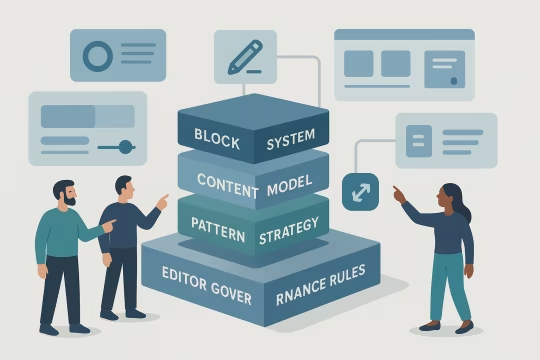
[02]We define the block system, content model, pattern strategy, and editor governance rules. The architecture phase also aligns design tokens, rendering logic, and authoring controls with the wider platform.
 [03]
[03]We build custom blocks, templates, patterns, and supporting integrations using maintainable PHP and React code. Implementation emphasizes reusable structures, predictable data handling, and compatibility with platform standards.
 [04]
[04]We validate editor behavior, block rendering, responsive output, accessibility, and content resilience across realistic scenarios. Testing covers both authoring workflows and the frontend behavior generated from block data.
 [05]
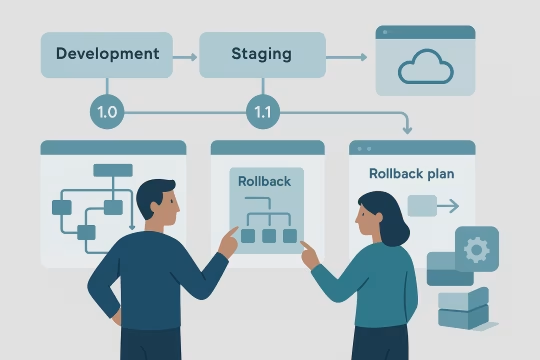
[05]We release the Gutenberg capability through controlled environments and versioned delivery processes. Deployment planning includes migration considerations, rollback paths, and coordination with editorial teams.
 [06]
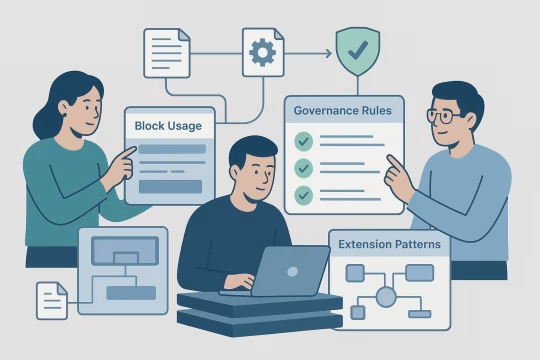
[06]We provide technical and editorial documentation covering block usage, governance rules, and extension patterns. This supports adoption while reducing dependency on informal team knowledge.
 [07]
[07]We define how new blocks, patterns, and editor changes are reviewed and introduced over time. Governance helps maintain consistency as more teams contribute to the publishing platform.
 [08]
[08]We refine the editor platform based on usage patterns, operational feedback, and evolving content requirements. This allows the block system to grow without losing structural integrity or maintainability.
A well-engineered Gutenberg platform improves both publishing operations and technical maintainability. The impact is seen in faster content production, lower support overhead, and a more governable WordPress architecture.
Editors work with reusable blocks, patterns, and clearer authoring rules instead of rebuilding layouts manually. This reduces time spent composing pages and lowers the effort required for routine content production.
Engineering teams manage a governed block system rather than a growing collection of one-off templates and exceptions. This makes changes easier to implement and reduces the cost of supporting editorial edge cases.
Shared components, controlled editor settings, and centralized design rules create more predictable output across teams and content types. Consistency improves both user experience and internal operational reliability.
Structured content models and reusable patterns limit the accumulation of inconsistent page structures over time. This makes future redesigns, migrations, and platform modernization work significantly more manageable.
When rendering logic and authoring structures are clearly defined, teams can update themes, integrations, and frontend behavior with less risk. The platform becomes easier to evolve without destabilizing publishing operations.
Clear block architecture, reusable implementation patterns, and stronger tooling reduce repetitive development work. Teams can focus on extending platform capabilities instead of repeatedly fixing inconsistent content behavior.
The editor can enforce boundaries around layout, styling, and content composition while still supporting flexibility where it is needed. This improves quality control without creating unnecessary friction for authors.
WordPress editorial platform review
Use a focused health check to uncover where your editor experience, frontend rendering, and governance model need tightening.
No login required. Takes 2–3 minutes.
Common questions about Gutenberg engineering, editorial architecture, governance, integration, and delivery for enterprise WordPress platforms.
In an enterprise WordPress architecture, Gutenberg should be treated as a structured authoring layer that sits between content models and frontend rendering, not as an unrestricted page composition tool. That means block design needs to reflect platform architecture decisions around content types, taxonomies, design systems, permissions, and rendering patterns. When Gutenberg is introduced without this architectural framing, teams often end up with blocks that duplicate template logic, inconsistent data structures, and editorial interfaces that are difficult to govern. A stronger model defines clear boundaries. Content entities should represent durable business content, while blocks should represent reusable presentation and composition patterns. theme.json, templates, patterns, and custom block controls should enforce design and authoring rules centrally. Rendering should align with the theme or component architecture so that frontend changes can be managed without rewriting content. In more complex environments, Gutenberg also needs to coexist with search, analytics, localization, workflow tooling, and sometimes headless delivery requirements. The practical goal is to make the editor a reliable part of the platform rather than a customization layer that grows independently. When designed this way, Gutenberg supports scalable publishing while remaining maintainable for engineering teams over time.
Standard core blocks are useful when the publishing requirement is generic and the available controls already align with editorial needs, design rules, and frontend behavior. They are often appropriate for basic text, media, lists, and simple layout patterns. However, custom blocks become the better choice when teams need structured fields, controlled output, reusable business-specific components, or tighter alignment with a design system. For example, if a content pattern includes specific metadata, conditional rendering, integration with taxonomies, or a fixed relationship between content and layout, a custom block usually provides a more maintainable solution than combining several generic blocks. The same applies when editors need a simplified interface that removes unnecessary formatting options or when frontend rendering must follow strict accessibility, performance, or brand requirements. Custom blocks also help reduce long-term operational complexity. Instead of relying on editors to assemble the same pattern repeatedly from low-level building blocks, engineering teams can provide a single governed component with clear behavior. That improves consistency, reduces QA effort, and makes future updates easier because the logic is centralized. The decision should be based on content semantics, governance needs, and platform maintainability rather than customization for its own sake.
Gutenberg development improves editorial operations when the editor is designed around real publishing tasks rather than generic formatting freedom. Custom blocks, patterns, templates, and controlled settings reduce the amount of manual layout work required from editors. Instead of recreating common content structures repeatedly, teams can use predefined components that reflect approved design and content patterns. This has several operational effects. It shortens page creation time, reduces formatting inconsistencies, and lowers the number of content issues that need review before publication. Editors spend less time solving presentation problems and more time working on the content itself. It also becomes easier to onboard new team members because the authoring environment is more predictable and aligned with documented workflows. For content operations teams, a governed Gutenberg setup also improves coordination across multiple contributors or business units. Shared patterns and controlled interfaces create a common publishing model, even when different teams manage different sections of the platform. That consistency reduces support requests and makes quality assurance more efficient. Over time, the editor becomes a stable operational tool rather than a source of variation and rework, which is especially important in enterprise environments with high publishing volume or distributed editorial ownership.
Yes, Gutenberg can support large multi-team publishing environments, but only when it is implemented with governance, role clarity, and reusable architecture. In these settings, the challenge is rarely whether the editor can create content. The challenge is whether many teams can create content consistently without introducing structural drift, duplicated patterns, or support overhead. A scalable setup usually includes a defined block library, controlled pattern usage, content-type-specific templates, and editor restrictions that reflect the needs of different roles. theme.json can centralize visual controls, while custom blocks can encode business-specific structures that should not be assembled manually. Permissions, workflow rules, and documentation also become important because the editor is being used by multiple groups with different responsibilities. From an engineering perspective, support for multi-team publishing also depends on maintainable code organization and change management. New blocks and patterns should be introduced through review processes rather than informal additions. Existing components should be versioned and monitored for adoption. With those controls in place, Gutenberg can scale effectively across brands, departments, or regions. Without them, the editor often becomes fragmented as each team develops its own conventions, which eventually increases maintenance cost and slows platform evolution.
Gutenberg can integrate closely with ACF, custom post types, taxonomies, and broader WordPress data models when the implementation is planned around content architecture rather than isolated UI components. ACF Blocks can be useful for teams that want structured field management within block interfaces, especially when existing ACF-based workflows are already part of the platform. Custom post types and taxonomies can provide the durable content entities that blocks reference, display, or compose within pages. The key is to define which information belongs in reusable content entities and which belongs in page-level composition. For example, product data, team profiles, or resource metadata may be better managed as structured content types, while Gutenberg blocks control how those entities are surfaced in specific contexts. This separation improves reuse, searchability, and maintainability. It also reduces the risk of embedding important business content directly into page layouts where it becomes harder to govern. Technically, integration may involve server-side rendering, REST API usage, editor data stores, field mapping, and validation logic. The implementation should also account for migration from legacy metaboxes or shortcode-based content. When done well, Gutenberg becomes a coherent interface over existing WordPress data structures instead of a parallel system that duplicates them.
When Gutenberg needs to align with a design system or frontend framework, the most important consideration is maintaining a clear mapping between editorial components and frontend components. Blocks should not be designed as isolated editor widgets. They should represent governed interface patterns that correspond to design tokens, spacing rules, content constraints, and rendering behavior already defined elsewhere in the platform. In practical terms, this often means using theme.json for global editor settings, defining a consistent block naming and variation strategy, and ensuring that frontend templates or component layers consume block data predictably. If a React-based design system or component library exists, the Gutenberg implementation should reflect the same structural assumptions rather than recreating similar patterns independently. Otherwise, teams end up maintaining two parallel systems that drift over time. It is also important to decide where flexibility belongs. Some design systems require strict control over layout and styling, while others allow a limited range of editorial variation. Gutenberg should expose only the controls that fit those rules. Accessibility, responsive behavior, and preview fidelity also need attention so that the editor reflects production output closely enough for authors to work confidently. Alignment succeeds when design, frontend, and editorial architecture are treated as one system.
Block sprawl usually happens when every new publishing request results in a new custom block, variation, or exception without a clear review model. Over time, the editor becomes crowded, overlapping components appear, and teams lose confidence in which block should be used for which purpose. Governance starts by defining a block taxonomy and decision framework: what qualifies as a new block, what should be a variation, what belongs in a pattern, and what should remain a content-type or template concern. A maintainable governance model also includes ownership. Someone needs responsibility for reviewing proposed additions, assessing overlap with existing components, and checking alignment with design and content architecture. Documentation should describe intended use cases, constraints, and deprecation paths. Analytics or editorial feedback can also help identify blocks that are underused, misused, or creating support issues. From a technical perspective, code organization and release discipline matter as much as content governance. Blocks should be versioned, tested, and introduced through a controlled delivery process. Deprecated components should not remain indefinitely without a migration plan. The goal is not to prevent change, but to ensure that the block library evolves as a coherent system rather than as a collection of local solutions created under short-term pressure.
Editorial consistency depends on limiting unnecessary freedom while preserving enough flexibility for real publishing needs. Useful governance controls in Gutenberg include restricted formatting options, curated block availability by content type, predefined patterns for common page structures, and theme.json settings that centralize typography, spacing, and color rules. These controls reduce the likelihood that editors will create visually inconsistent or structurally fragile content. Template locking and block locking can also be valuable in contexts where certain layouts must remain stable. For example, campaign pages, landing pages, or regulated content types may require fixed structural sections while still allowing content updates within those sections. Role-based permissions and workflow processes add another layer of control by ensuring that not every user can alter every aspect of the publishing experience. Governance should also include non-technical elements such as documentation, editorial guidance, and a process for requesting new capabilities. If editors do not understand why controls exist, they may work around them in ways that reintroduce inconsistency. The most effective governance model combines platform-level restrictions with clear operational guidance, so that consistency is achieved through both system design and team practice rather than through manual review alone.
Poorly implemented Gutenberg projects often create risk in three areas: content structure, maintainability, and editorial adoption. On the content side, blocks may be designed around visual layout rather than content semantics, which makes reuse, migration, and integration more difficult later. Important information can become trapped inside page compositions instead of being modeled as structured data. That creates long-term constraints for search, personalization, reporting, and platform evolution. Maintainability risks appear when custom blocks are built without clear standards, testing, or alignment with theme architecture. Teams may end up with inconsistent rendering logic, duplicated code, and fragile dependencies on plugins or editor behaviors. As WordPress evolves, these implementations become harder to upgrade safely. What initially looked like flexibility turns into a growing support burden. Editorial adoption is another common failure point. If the editor is too open-ended, authors struggle with inconsistency and uncertainty. If it is too rigid or poorly designed, they bypass intended workflows or revert to legacy practices. In both cases, the platform does not deliver the expected operational improvement. Reducing these risks requires architectural planning, realistic workflow analysis, and a clear governance model before implementation expands across the organization.
Modernizing a legacy page builder or shortcode-based setup requires a staged approach that separates immediate operational continuity from long-term architectural improvement. The first step is usually an audit of existing content patterns, shortcode usage, template dependencies, and editorial workflows. This helps identify which structures can map cleanly to Gutenberg blocks, which need redesign, and which should remain temporarily supported during transition. A common strategy is to introduce Gutenberg for new content first while planning migration paths for high-value legacy templates. In some cases, teams create compatibility layers or transformation scripts to preserve rendering while content is gradually restructured. It is important not to force a full migration before the new block system is stable, documented, and validated with real editorial users. Otherwise, disruption shifts from the old platform to the new one. Operational planning matters as much as technical migration. Editors need training, clear guidance on what changes, and confidence that existing publishing responsibilities will still be supported. Engineering teams need rollback options, content validation processes, and a way to prioritize migration based on business value. A controlled modernization program reduces disruption by treating migration as a platform transition, not just a component replacement exercise.
A typical Gutenberg engagement includes discovery, content and editorial analysis, block architecture design, implementation, testing, and governance planning. The exact scope depends on whether the organization is building a new WordPress platform, modernizing an existing editor experience, or replacing legacy templates and page builder patterns. In most cases, the work begins by understanding how content is currently created, where editorial friction exists, and which publishing patterns need to be standardized. From there, the engagement usually defines a target block library, pattern strategy, theme.json configuration, and the relationship between blocks, content types, and frontend rendering. Implementation may include custom blocks, ACF-based integrations, editor restrictions, templates, and migration support. Testing covers both the authoring experience and the rendered output, with attention to accessibility, responsive behavior, and content resilience. Governance is often a critical final component. Enterprise teams need a way to introduce new blocks, manage changes, document usage, and keep the editor aligned with platform standards over time. Without that layer, even a strong initial implementation can become fragmented. The engagement is most effective when it addresses both the technical system and the operating model required to sustain it.
Collaboration typically begins with a structured assessment of the current WordPress platform, editorial workflows, and publishing constraints. This is usually a short discovery phase focused on understanding how content is created today, where editors encounter friction, what technical patterns already exist, and how Gutenberg needs to fit into the broader architecture. The goal is not to jump directly into block development, but to establish whether the platform needs foundational content modeling, governance work, or modernization planning first. During this early phase, teams often review sample page types, existing templates, legacy page builder usage, design system inputs, and integration requirements such as ACF, taxonomies, analytics, or localization. This helps identify the highest-value opportunities for structured blocks and the main risks that need to be managed. It also clarifies whether the right starting point is a pilot block library, a redesign of editorial workflows, or a phased migration from older authoring models. The output is usually a practical implementation roadmap. That roadmap defines priorities, architectural decisions, delivery stages, and ownership expectations so that the work can proceed in a controlled way. Starting this way reduces ambiguity and gives both engineering and content stakeholders a shared basis for decision-making.
These case studies are relevant because they show how structured content models, component-based authoring, and editorial governance were implemented in real CMS delivery. They reinforce the same service themes behind Gutenberg block editor development: reusable content components, design-system alignment, and scalable publishing operations across teams. Together, they provide concrete proof of how governed authoring experiences can replace inconsistent builder usage and support long-term platform maintainability.
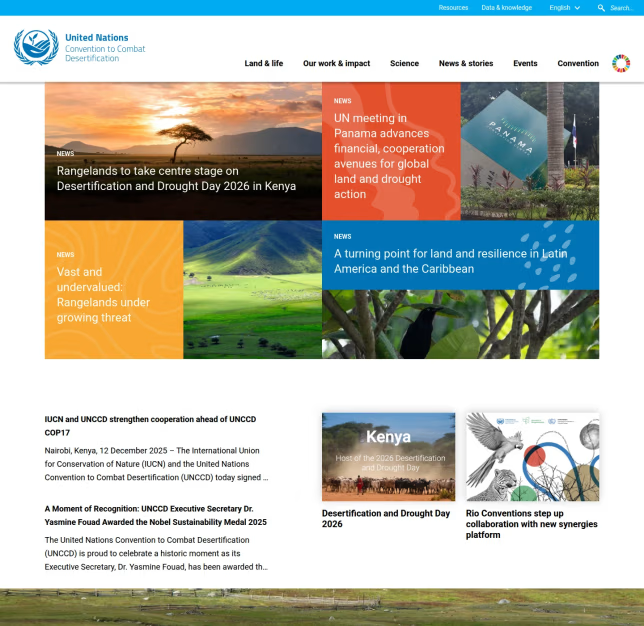
UNCCD operated four separate websites (two WordPress, two Drupal), leading to inconsistencies in design, content management, and user experience. A unified, scalable solution was needed to support a large-scale CMS migration project and improve efficiency and usability.
The modernization effort resulted in a cohesive, user-friendly, and scalable website, improving content management efficiency and long-term digital sustainability.
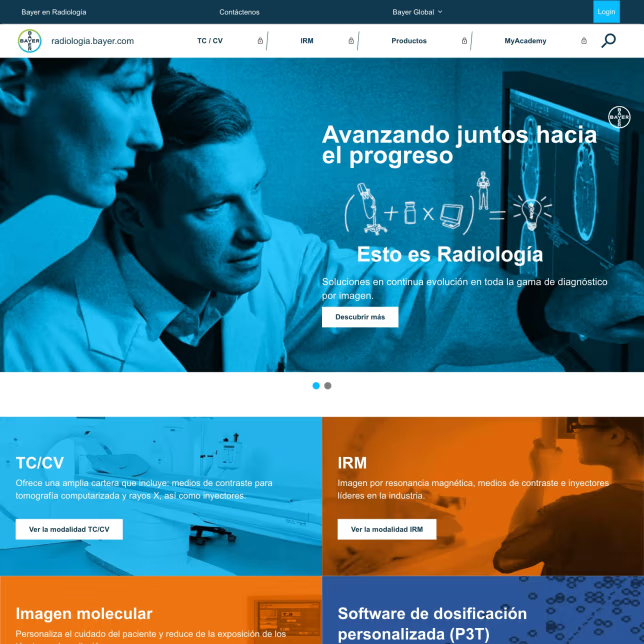
An advanced healthcare digital platform for LATAM was required to facilitate collaboration among radiology HCPs, distribute company knowledge, refine treatment methods, and streamline workflows. The solution needed secure medical website role-based access restrictions based on user role (HCP / non-HCP) and geographic region.
The platform enhanced collaboration, streamlined workflows, and empowered radiology professionals with advanced tools to gain insights and optimize patient care.
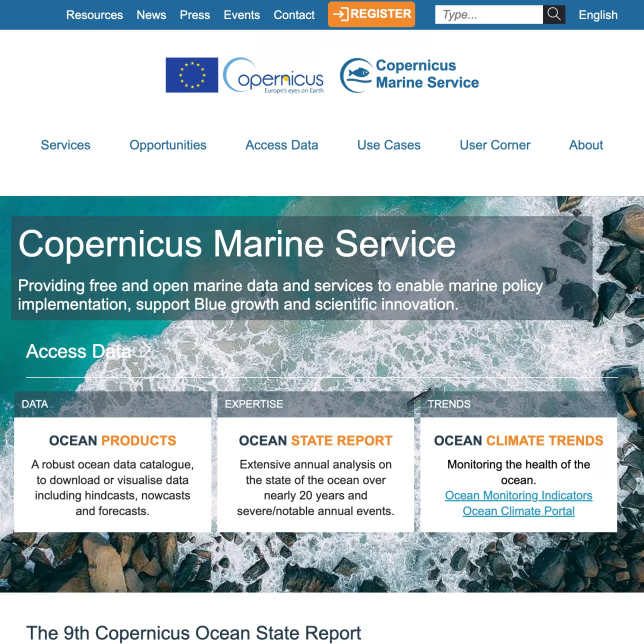
The existing marine data portal relied on three unaligned WordPress installations and embedded PHP code, creating inefficiencies and risks in content management and usability.
The new Drupal DXP streamlined content operations and improved accessibility, offering scientists and businesses a more efficient gateway to marine data services.
These articles expand on the architectural and governance decisions that make Gutenberg implementations scalable in enterprise WordPress environments. They cover block governance, information architecture, reference patterns, and the integration boundaries that shape maintainable editorial platforms.
Let’s review your Gutenberg implementation, content model, and publishing workflows to define a maintainable path for block editor evolution.