In enterprise digital platforms, the problem is rarely that a CMS model is wrong or that a frontend component is poorly built in isolation. The deeper issue is that both sides often change on different timelines, with different owners, and with different assumptions about compatibility.
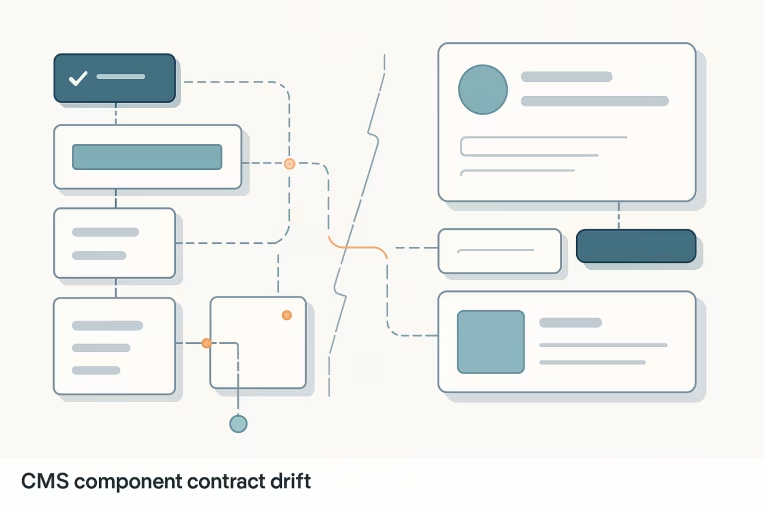
That gap creates component contract drift: the slow misalignment between the structured content a platform can produce and the component APIs the frontend expects to render.
In headless and hybrid delivery models, this contract matters more than many teams initially expect. The CMS is not just storing content. It is defining fields, relationships, allowed values, and editorial intent. The frontend is not just rendering UI. It is interpreting that structure through component props, validation rules, layout expectations, and fallback behavior.
When those two layers drift apart, the symptoms show up everywhere:
- previews that do not match production behavior
- pages that break when optional fields are actually missing
- rushed transformation logic added in delivery teams
- repeated content-entry work because models no longer fit the component
- governance overhead caused by undocumented exceptions
The good news is that contract drift is manageable. It usually does not require a large governance program. It requires a more explicit definition of the boundary between the CMS schema and the frontend component API, plus a few release controls that treat that boundary as a product interface rather than an informal agreement.
Why component drift appears in enterprise platforms
Component drift usually begins for understandable reasons.
A CMS team updates a content model to support new editorial needs. A frontend team refactors a component to simplify implementation, improve accessibility, or match a revised design pattern. A design system team changes naming conventions to improve consistency. None of these decisions are inherently wrong.
The problem is that they often happen independently.
In enterprise environments, that separation is common because teams are organized around capabilities:
- CMS or content platform teams manage schemas and authoring workflows
- design system teams manage reusable UI patterns
- product or channel teams build page experiences
- frontend platform teams manage rendering frameworks and integration layers
Each group sees only part of the contract.
A CMS architect may think in terms of field semantics, editorial safety, and reuse across channels. A frontend lead may think in terms of prop contracts, rendering states, performance, and testability. A design system owner may focus on presentational consistency and tokenized variants. If these viewpoints are not reconciled through a shared contract model, drift becomes almost inevitable.
Enterprise delivery makes the issue worse because scale amplifies small inconsistencies. A field renamed in one model, a newly required prop in one component, or a slightly different relationship structure in one content type can ripple across multiple sites, locales, or teams.
Drift also accumulates quietly. Teams often patch around issues with adapters, defaults, and one-off transforms. That can keep releases moving, but it hides the fact that the contract itself is becoming less stable.
The contract boundary between content schema and UI component API
The most useful governance step is to define what the contract actually includes.
For content-driven components, the contract boundary typically sits between:
- the CMS schema that defines what structured data can be authored and delivered
- the frontend mapping layer that translates structured content into component-ready data
- the UI component API that defines the props and states needed for rendering
Many teams treat only the mapping layer as the contract. That is too narrow. The real contract includes semantics, constraints, and rendering assumptions across all three layers.
A practical component contract often needs to define:
- component identifier or content type name
- required and optional fields
- allowed field value formats
- enum values or variant options
- relationship structures for nested items
- localization expectations
- default behavior when values are absent
- rules for rich text, media, links, and references
- validation rules that apply before rendering
- deprecated fields and supported compatibility windows
For example, a promotional banner component may look simple, but the contract still needs clarity. Is headline required? Can cta be omitted entirely? Is theme a controlled enum or a free-text string? Can media be image or video? Can two CTAs exist, or only one? Is the component responsible for layout alignment, or is that a page-level concern?
If the CMS model answers one set of questions and the frontend component assumes another, teams will compensate with brittle logic.
This is why contract definition should not be reduced to a field list. The contract is the combination of shape, meaning, constraints, and rendering expectations.
Common failure modes: optional fields, naming drift, nested relationships, presentation leakage
Most contract drift shows up in a few recurring patterns.
Optional fields that are not really optional
A field may be marked optional in the CMS because editors do not always need it. But the frontend may still assume it exists because the component design was approved with that field present.
That creates a dangerous mismatch. The schema says absence is valid. The component says absence is an edge case.
Typical symptoms include:
- blank headings creating broken hierarchy
- layout collapse when images are missing
- CTA wrappers rendered without links
- inconsistent preview behavior because mock data always includes the field
A useful rule is simple: if the component cannot render acceptably without a field, that field is not optional for that component state. Either make it required in the schema or define and test a legitimate no-value state.
Naming drift between model and component
Teams often rename fields for good reasons. eyebrow becomes kicker. bodyCopy becomes description. imageAlt becomes altText.
Individually, these changes seem minor. Over time, they create mapping layers full of aliases and exceptions. New team members no longer know which name is canonical. Content and code documentation diverge.
The solution is not to freeze naming forever. It is to establish a canonical contract vocabulary and treat renames as versioned changes, not incidental cleanup.
Nested relationships that outgrow the original component
Drift frequently appears when simple components become compositional. A card list becomes a list of cards with badges, secondary links, and analytics metadata. A hero becomes a container with media, actions, legal text, and nested promotional modules.
If the CMS schema evolves to support richer nesting while the frontend component was built for shallow props, teams start pushing transformation logic into page-specific code. That undermines reuse and makes preview less trustworthy.
When nested relationships are introduced, teams should revisit the contract explicitly:
- Is the component still a single reusable unit?
- Should some nested items become separate component contracts?
- Are relationship depth and allowed child types controlled?
- Is authoring complexity still acceptable?
Presentation leakage into content models
One of the most common governance mistakes is letting frontend implementation or design naming drive unnecessary presentation fields into the CMS.
Examples include:
- raw CSS-oriented variant labels
- breakpoint-specific layout settings exposed to editors
- design-system internal names with little editorial meaning
- duplicate fields created only to satisfy current component prop signatures
Some presentation control is often necessary, especially in modular page builders. But if the content model begins reflecting implementation details rather than editorial intent, the contract becomes fragile. A frontend refactor then forces schema changes that should never have affected content authors.
A better pattern is to store editor-meaningful choices in the CMS and translate them into implementation-specific props in the mapping layer.
Ownership model across CMS, design system, and frontend teams
Contract drift is fundamentally an ownership problem.
If nobody owns the contract end to end, every team will optimize locally and drift will continue. The answer is not to assign one team total control over all layers. It is to define distinct ownership by decision type.
A practical ownership model often looks like this:
CMS team ownership
Owns:
- schema structure and field definitions
- editorial validation rules
- authoring usability and workflow implications
- content lifecycle and governance metadata
Must not change without contract review:
- required versus optional field status
- enum values used by the frontend
- relationship types and nesting depth
- canonical component identifiers
Design system ownership
Owns:
- supported UI patterns and behavioral states
- presentational variants that are truly reusable
- accessibility and interaction expectations
- documentation of component states and constraints
Must coordinate when changing:
- supported variants that map from CMS values
- state requirements that affect field necessity
- deprecated patterns still referenced by content models
Frontend platform or application team ownership
Owns:
- mapping layer and rendering implementation
- runtime validation and safe fallbacks
- preview integration behavior
- compatibility handling across versions
Must not change unilaterally:
- prop expectations that invalidate current schemas
- removal of support for active contract versions
- assumptions about field availability not enforced upstream
Shared contract stewardship
One cross-functional group should steward the contract catalog itself. This does not need to be a heavy committee. In many organizations it can be a lightweight working group that reviews material changes and maintains a single source of truth for:
- active component contracts
- version history
- compatibility notes
- deprecation dates
- examples of valid payloads and rendered states
That shared stewardship is what turns the CMS-to-frontend boundary from tribal knowledge into an operational interface.
Versioning and deprecation patterns for content-driven components
Versioning is where many platforms either become resilient or stay fragile.
Without versioning, every schema or component change is effectively a breaking change hidden inside a routine release. With versioning, teams can evolve content-driven components deliberately.
The right approach depends on platform complexity, but a few patterns are consistently useful.
Version the contract, not just the code
A frontend package version alone is not enough. A schema migration record alone is not enough either. What needs versioning is the content-to-rendering contract.
That version may be represented by:
- a component version field in the CMS
- a schema version associated with the content type
- a resolver in the frontend that maps content structures to renderer versions
- a contract definition stored in a shared registry
The exact mechanism matters less than the principle: teams need to know which payload shapes are supported by which renderer behavior.
Prefer additive change when possible
The safest changes are usually additive:
- introducing a new optional field
- supporting a new enum value with fallback behavior
- adding a new nested child type behind validation
Even additive changes should be documented, but they avoid forced migrations.
Breaking changes need more discipline, such as:
- removing a field the component currently uses
- changing field meaning
- changing relationship cardinality
- renaming values relied on by rendering logic
Those changes should trigger explicit migration and compatibility planning.
Define deprecation windows
Enterprise content rarely updates instantly. Old entries, templates, and page compositions can persist for long periods. If a contract change assumes immediate content cleanup, delivery teams usually absorb the risk.
A better pattern is to publish:
- what is deprecated
- what replaces it
- which versions remain supported
- when support will end
- what migration is required
This gives editorial, platform, and product teams a common timeline instead of scattered assumptions.
Use adapter layers intentionally, not permanently
Adapters can be useful during migration. They can translate old schemas into current component props or normalize inconsistent fields.
But adapter logic should have an expiry plan. Otherwise the platform ends up supporting historical inconsistencies indefinitely. When that happens, every new feature is slowed by compatibility complexity.
Validation, preview, and release controls that catch drift early
The fastest way to reduce contract debt is to catch misalignment before it reaches published pages.
That means validation cannot live in only one place.
Schema-level validation
At the CMS level, validate what authors can reasonably control:
- field presence
- allowed values
- relationship limits
- basic formatting constraints
This prevents many invalid states from ever being authored.
Contract-level validation in the integration layer
Not every rendering rule belongs in the CMS. Some rules depend on component behavior or multiple fields in combination.
Examples include:
- requiring either image or video, but not both
- requiring CTA label only when CTA URL exists
- supporting only certain child component mixes
- rejecting variant values unsupported by the current renderer
These checks are often best handled in the integration or mapping layer, where teams can validate real delivery payloads before render. This is also where stronger React frontend architecture decisions can reduce ambiguity between data shape, mapping logic, and component boundaries.
Preview validation that mirrors production
Preview often gives false confidence because it bypasses production-like validation or uses mocked data. When that happens, editors see a valid-looking page that fails later in the live channel.
A more trustworthy preview flow should:
- use the same mapping and validation logic as production where possible
- surface contract errors clearly, not silently swallow them
- identify whether failure is schema, content, or renderer related
- provide actionable messages for editors and developers
Preview is not only an editorial convenience. It is an early-warning environment for contract drift.
Release controls and test fixtures
Component contracts benefit from the same controls teams already use for APIs.
Useful practices include:
- fixture payloads for each supported component state
- snapshot or visual tests against contract-defined states
- schema change reviews tied to frontend impact checks
- compatibility tests for deprecated and current versions
- release notes that call out contract-affecting changes
These practices are not excessive process. They are lightweight safeguards against shipping mismatched assumptions. In larger programs, they often sit alongside broader Headless DevOps controls for environment parity, release orchestration, and rollback safety.
A recovery plan for platforms already carrying contract debt
Many enterprise teams are not starting fresh. They already have inconsistent schemas, deeply customized mapping code, and components supporting too many undocumented states.
In that situation, the goal should not be a full redesign. It should be controlled recovery.
A practical recovery plan can follow four phases.
1. Inventory current contracts
List the major content-driven components and document:
- current CMS schema shape
- actual frontend prop expectations
- known fallback logic
- active variants and hidden states
- common production or preview failures
This inventory usually reveals that only a subset of components are responsible for most delivery friction.
2. Classify drift severity
Not all drift is equally urgent. Classify issues such as:
- documentation drift: names or rules are unclear, but runtime is stable
- validation drift: invalid content can be authored, but components usually recover
- rendering drift: legitimate payloads fail or degrade visibly
- governance drift: nobody can approve changes confidently
This helps teams prioritize where contract work will deliver the most value.
3. Stabilize high-risk components first
Choose the components that are widely reused, business-critical, or failure-prone. For each one:
- define the canonical contract
- document required states and field semantics
- add validation and fixtures
- create a deprecation path for unsupported variants
- remove accidental presentation leakage where practical
A small number of stabilized contracts can reduce a large amount of operational noise.
4. Introduce change control going forward
Recovery only lasts if new drift is prevented. Put in place a lightweight process so that any material contract change includes:
- owner approval across CMS and frontend stakeholders
- compatibility assessment
- migration requirement review
- preview and test coverage updates
- documented release notes
The objective is not bureaucracy. It is to make contract changes visible before they become production issues.
What good looks like in practice
In a healthy enterprise platform, content models and frontend components do not need to evolve at the same speed. They just need to evolve through a shared, versioned contract.
That usually means:
- editor-facing schemas describe meaningful content, not implementation residue
- mapping layers translate content into stable component inputs
- component APIs are designed with explicit states and fallback behavior
- changes to required fields, enums, and relationships trigger review
- preview and production use aligned validation logic
- deprecated contracts stay supported only for a defined period
This is the balance mature teams aim for. Not rigidity, but controlled evolution.
Component contract drift is rarely caused by careless teams. More often, it appears because the CMS, design system, and frontend are all improving in parallel without a formal shared interface. Once that interface is named, versioned, and validated, delivery gets easier. Preview becomes more trustworthy. Rework drops. And teams can change the platform with less fear of hidden breakage.
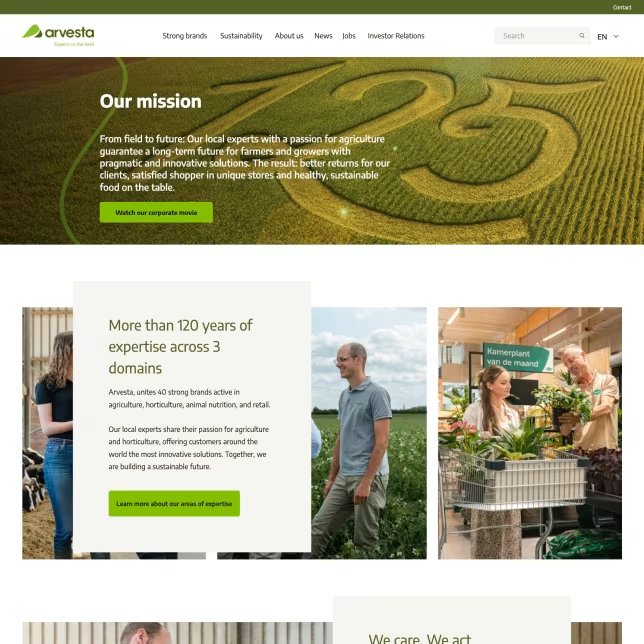
For enterprise digital platforms, that is the real payoff: content structure and UI rendering can both evolve, but not at each other's expense. That kind of alignment is usually strongest when headless content modeling and frontend implementation are treated as parts of the same contract, as seen in projects like Arvesta, where design system governance and structured content models had to stay aligned across teams.
Tags: component contract drift, Content Operations, CMS governance, frontend architecture, design systems, headless CMS, enterprise platforms