Choosing between Drupal vs WordPress for a structured content platform is not a matter of declaring one system universally better. Both can publish content, support modern frontend architectures, and integrate with external services. The more useful question is this: which platform better supports the way your organization needs to model, govern, deliver, and evolve content over time?
That distinction matters in enterprise environments. A structured content platform is not just a website CMS. It often becomes a shared operational layer for multiple channels, teams, workflows, and integrations. Once that happens, decisions about content types, permissions, editorial states, API design, and extensibility become more important than surface-level publishing features.
Assess your Drupal platform fit for structured contentRun a quick Drupal Platform Health CheckFor many teams in 2026, Drupal and WordPress remain viable options, but they tend to reward different operating models. Drupal often aligns well with organizations that need stronger structure, more explicit governance, and deeper customization in the content domain itself. WordPress often aligns well with organizations that prioritize editorial familiarity, speed of adoption, and a broad ecosystem, especially when the content model is relatively straightforward or can be carefully bounded.
Start with the platform question, not the CMS question
Before comparing products, it helps to define what kind of platform you are actually building.
A structured content platform usually includes several characteristics:
- content is modeled intentionally, not just authored as pages and posts
- multiple content types have relationships, validation rules, and lifecycle states
- content may be reused across channels, regions, brands, or experiences
- editorial permissions and workflow states matter operationally
- APIs, integrations, and downstream consumers are part of the design
- the platform is expected to evolve over several years
If those characteristics are central to the program, then the evaluation should focus less on template convenience and more on architectural fit.
That is where the content platform architecture discussion becomes more meaningful.
Governance: where enterprise differences become visible
Governance is often the first area where the practical differences between Drupal and WordPress show up.
In enterprise settings, governance is not only about security or approval chains. It includes how clearly the system enforces content rules, how permissions are segmented, how publishing states are controlled, and how much variation teams can introduce without weakening the platform.
Drupal has historically been strong when governance needs to be explicit and deeply embedded in the content model. Its approach tends to favor structured entities, configurable field-level architecture, and more formalized control over content types, roles, and workflows. That can be valuable when multiple business units share a platform and need guardrails that are visible in the system itself rather than documented outside it.
WordPress can absolutely support governance, but it often requires more deliberate design discipline to prevent the platform from drifting toward looser patterns. Out of the box, WordPress is optimized for approachable publishing. That is one reason it is widely adopted. In enterprise programs, however, that same flexibility can become a challenge if teams begin solving structured content problems with inconsistent custom fields, page-builder conventions, or plugin-specific data models.
This does not mean WordPress lacks governance capability. It means governance in WordPress often depends more heavily on implementation choices:
- how custom post types and taxonomies are designed
- whether field structures are standardized across teams
- how editorial permissions are extended
- how much plugin sprawl is allowed
- whether the organization has a clear platform ownership model
In practice, Drupal often gives architecture teams a stronger native foundation for governance-heavy environments. WordPress can work well when governance is important but the organization is prepared to enforce standards through platform engineering, code review, and operational discipline.

See if your Drupal setup can support governance and reuse
Benchmark your platform against content modeling, workflow, integration, and long-term maintainability needs.
- Check content model readiness
- Review workflow and governance
- Spot integration and scaling risks
Content modeling: the core of the structured content decision
For a true enterprise CMS comparison, content modeling should be near the top of the decision criteria.
Structured content platforms succeed or fail based on how well they represent the business domain. If the model is weak, every downstream concern becomes harder: editorial UX, API consistency, search relevance, personalization, localization, and analytics.
Drupal is typically well suited to content models that are relational, varied, and expected to grow over time. Its architecture has long been comfortable with the idea that content is made of entities, fields, references, and reusable structures. That tends to make Drupal a strong fit when teams need Drupal content architecture:
- many distinct content types
- nested or related content structures
- reusable components with clear data boundaries
- content references across domains or sections
- future expansion without redesigning the entire platform
This matters because enterprise content models rarely stay small. A platform may begin with articles, landing pages, and events, then expand into product content, knowledge content, campaign assets, regional variants, or partner-managed material. Systems that handle structured growth gracefully usually age better.
WordPress can support structured content through custom post types, taxonomies, and custom fields. For many organizations, that is enough. If the model is relatively stable and the team is disciplined, WordPress can provide a clean and effective structure. It can also work well when the primary need is to organize editorial content rather than represent a deeply interconnected content domain.
The tradeoff appears when the model becomes more complex than the implementation conventions around it. In WordPress, teams can end up with structure that is technically possible but operationally uneven. Different plugins may store data differently. Reusable content patterns may be implemented in ways that are convenient for one team but difficult for another to consume consistently. Over time, the platform can become harder to reason about.
A useful framing is this:
- Drupal often starts from the assumption that content architecture is a first-class concern.
- WordPress often starts from the assumption that publishing should be accessible and extensible, then structured upward as needed.
Neither assumption is wrong. The better fit depends on how central structured content is to the platform strategy.
Editorial workflows: usability versus operational rigor
Editorial workflows are another area where teams should avoid simplistic scoring.
The right question is not which platform has workflow features. The right question is which platform supports the editorial operating model your organization actually needs.
WordPress is often attractive because editorial teams already know how to use it, or can learn it quickly. That familiarity reduces adoption friction. For organizations with straightforward publishing flows, this can be a major advantage. If your workflow is mostly draft, review, publish, and update, WordPress can feel efficient and approachable.
That ease of use matters more than technical teams sometimes admit. A structured content platform only succeeds if editors can work effectively inside it.
Drupal, however, often becomes more compelling when editorial workflows are more formal or varied. If different content types require different review paths, if multiple roles need controlled transitions, or if governance needs to be reflected directly in workflow states, Drupal can provide a stronger foundation. It tends to fit scenarios where workflow is not just a convenience layer but part of compliance, quality control, or multi-team coordination.
Examples where this difference matters include:
- regional publishing with central oversight
- legal or policy review before publication
- staged release processes across business units
- content ownership split across multiple specialist teams
- translation or localization steps with explicit handoffs
That said, workflow strength is not only about state machines or approval buttons. It is also about editorial clarity. A technically powerful workflow that confuses editors can create bottlenecks. A simpler workflow that teams actually follow may be more effective.
For that reason, the best evaluation approach is to prototype representative editorial journeys, not just review admin screenshots. Test how each platform handles:
- creating structured content with required fields
- reusing content across pages or channels
- routing content for review
- updating already-published content safely
- managing exceptions without bypassing governance
This usually reveals more than a feature matrix.
Integration flexibility: where platform architecture shows its maturity
Most enterprise platforms do not operate in isolation. They connect to search services, CRMs, DAMs, identity providers, analytics tools, personalization engines, translation services, and internal systems.
That is why integration flexibility should be evaluated as a platform concern, not an afterthought.
Drupal is often a strong fit when the CMS needs to act as a structured system of record for content and expose that content predictably to other services. Its data-oriented architecture can make it easier to think in terms of entities, references, validation, and API-ready structures. For teams building composable or decoupled experiences, that can be a meaningful advantage.
WordPress also supports integrations well, especially when the use case is common and the ecosystem already provides mature patterns. Its broad adoption means many teams can move quickly with familiar tools and implementation approaches. For organizations that need practical integration velocity more than deep content-domain customization, this can be compelling.
The difference is often less about whether integration is possible and more about how cleanly the platform supports long-term integration design.
Questions worth asking include:
- Is the content model stable enough to support multiple consumers?
- Can the platform expose content consistently across channels?
- How easy is it to apply validation and governance before content reaches downstream systems?
- Will integrations depend on a patchwork of plugins, or on a more coherent domain model?
- How difficult will versioning and change management become over time?
In many cases, Drupal is favored when integration architecture is tightly coupled to structured content architecture. WordPress is often favored when integration needs are real but the organization values speed, familiarity, and ecosystem convenience.
Long-term flexibility: extensibility is not the same as durability
Both Drupal and WordPress are extensible. That alone is not enough to guide an enterprise decision.
What matters more is durable flexibility: the ability to evolve the platform without accumulating avoidable complexity.
WordPress is extremely flexible in the sense that many things can be added quickly. This is one of its greatest strengths. It supports rapid delivery, broad plugin availability, and a large implementation talent pool. For the right problem space, that can reduce time to value significantly.
But fast extensibility can become fragile if the platform grows without a strong architecture model. In enterprise settings, durability depends on whether customizations remain understandable, supportable, and aligned with the intended content model. If every new requirement introduces another plugin-specific pattern, long-term flexibility can actually decrease.
Drupal often asks for more architectural intentionality earlier. That can increase upfront design effort, but it may produce a platform that is easier to evolve coherently when the content domain becomes more complex. In other words, Drupal can trade some short-term convenience for stronger long-term structural consistency.
This is especially relevant for organizations that expect:
- multiple site properties on a shared platform
- long platform lifecycles
- changing business models or service lines
- increasing reuse of content across channels
- tighter governance over time rather than looser governance
If the platform is likely to remain focused, editorially driven, and bounded in complexity, WordPress may remain the more efficient choice. If the platform is likely to become a strategic content backbone, Drupal may offer a better long-term fit.
Delivery model matters as much as product choice
One of the most common evaluation mistakes is treating the CMS as the whole answer.
In reality, platform outcomes are heavily shaped by delivery practices:
- content architecture discipline
- frontend implementation standards
- release management
- testing strategy
- platform ownership
- governance over extensions and customizations
A well-run WordPress platform can outperform a poorly governed Drupal implementation. The reverse is also true.
For example, if a WordPress program has:
- a tightly controlled plugin policy
- well-defined custom post type strategy
- consistent field architecture
- clear editorial governance
- strong CI/CD and code review practices
it can support structured content use cases very effectively.
Likewise, if a Drupal implementation is overengineered, difficult for editors, or poorly maintained, its architectural strengths may never translate into business value.
This is why senior teams should evaluate not only product fit, but also organizational fit. Ask whether your delivery model can support the platform well.
A practical decision framework for CTOs and platform owners
If the goal is a balanced decision, it helps to evaluate both platforms against a small set of weighted criteria rather than a long feature checklist.
Consider scoring them against questions like these.
1. How complex is the content domain?
Choose Drupal more confidently when content types, relationships, and reuse patterns are central to the platform.
Choose WordPress more confidently when the content model is important but can remain bounded and well-governed.
2. How formal does governance need to be?
If governance must be deeply encoded in roles, workflows, and content structures, Drupal often has the stronger native posture.
If governance can be achieved through disciplined implementation and platform operations, WordPress may still be a strong option.
3. What editorial experience will drive adoption?
If editorial familiarity and speed of onboarding are critical, WordPress often has an advantage.
If editorial complexity is high and workflows need to reflect nuanced business rules, Drupal may be the better fit.
4. How strategic is content reuse across channels?
If the platform is expected to serve as a structured content source for multiple experiences, headless CMS architecture often becomes part of the decision, and Drupal often aligns well.
If the primary use case remains web publishing with selective reuse, WordPress may be sufficient and more efficient.
5. How much architectural control can the organization sustain?
Drupal tends to reward organizations willing to invest in stronger upfront architecture.
WordPress tends to reward organizations that want faster adoption but are disciplined enough to prevent architectural drift.
6. What does change look like over the next three to five years?
If the platform is likely to expand in scope, governance, and integration depth, Drupal may provide more headroom.
If the platform roadmap is more focused and speed matters most, WordPress may be the more pragmatic choice.
Common patterns where Drupal is often the better fit
A Drupal-first decision is often reasonable when:
- structured content is a strategic asset, not just a publishing concern
- multiple teams or business units share the platform
- content relationships and reuse are central to the experience model
- workflow complexity is significant
- governance needs to be explicit and durable
- the organization expects the platform to evolve into a broader content operating layer
In these cases, Drupal’s strengths are less about isolated features and more about architectural alignment.
Common patterns where WordPress is often the better fit
A WordPress-first decision is often reasonable when:
- editorial usability and adoption speed are top priorities
- the content model can be clearly bounded
- the organization wants broad ecosystem support and implementation familiarity
- delivery speed is a major factor
- governance can be enforced through engineering standards and platform ownership
- the platform is important, but not intended to become a highly complex content backbone
In these cases, WordPress can offer a very effective balance of usability, extensibility, and delivery efficiency.
What not to do in this evaluation
Because this is a comparison with real architectural consequences, there are a few traps worth avoiding.
Do not decide based only on:
- editor preference without considering platform growth
- developer familiarity without considering governance needs
- plugin/module counts
- assumptions that headless or composable architecture removes content modeling concerns
- a generic feature checklist detached from actual operating requirements
Also avoid designing the evaluation around idealized demos. Instead, test both platforms against realistic scenarios from your own environment.
For example:
- model three representative content types with relationships
- define actual editorial roles and approval paths
- simulate one integration with a downstream consumer
- test how reusable content is managed and updated
- review how easily the implementation can be explained to a new team member
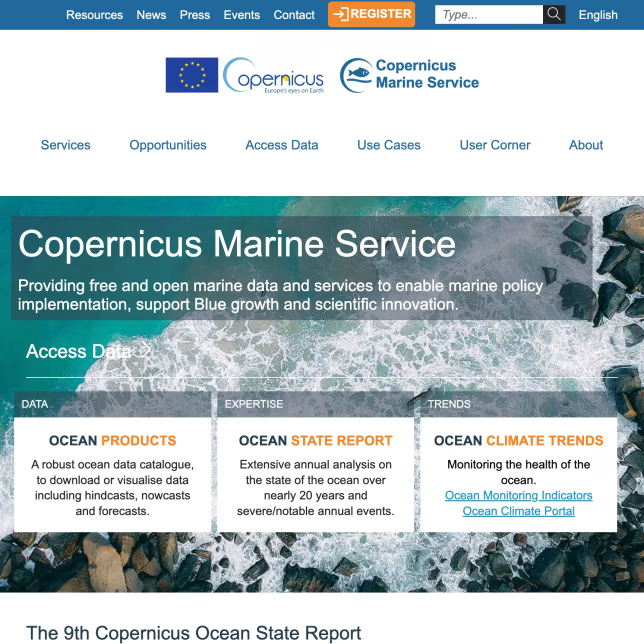
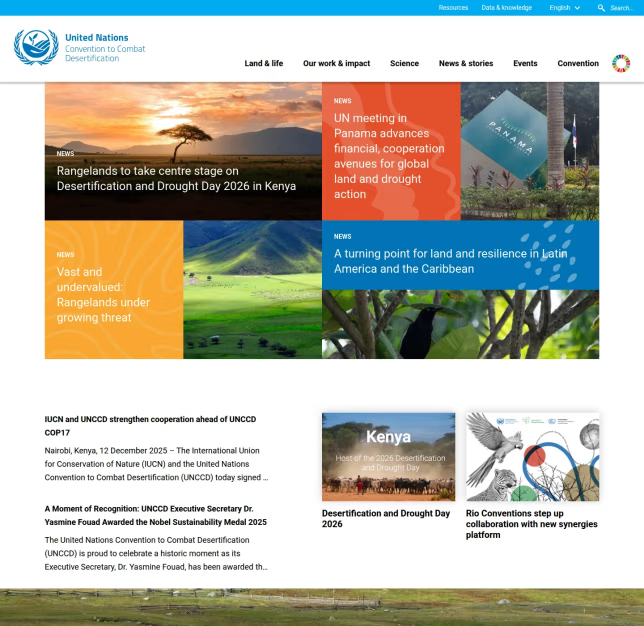
Those exercises usually expose the real tradeoffs quickly, as seen in Drupal consolidation programs like Copernicus Marine Service and UNCCD, where governance, migration complexity, and platform standardization had to be addressed together.
Final perspective: choose the platform that matches your content operating model
The most useful conclusion in the Drupal vs WordPress discussion is not that one platform wins universally. It is that each tends to perform best under different assumptions.
Drupal is often the stronger choice when structured content, governance, and long-term architectural flexibility are central to the platform strategy. It tends to fit organizations that want the CMS to behave like a disciplined content system, not just a publishing tool.
WordPress is often the stronger choice when editorial accessibility, implementation speed, and ecosystem familiarity matter most, and when the organization can keep the content model intentionally bounded and well governed.
For CTOs, digital platform owners, and solution architects, the decision should come down to this: what kind of content operating model are you building, and what kind of platform behavior will you need to sustain over time?
Drupal platform decision support
Validate whether your Drupal platform is ready for enterprise content demands
Use the Health Check to identify gaps in structure, governance, editorial workflows, and platform durability before complexity grows.
If your answer points toward deeper structure, stricter governance, and broader content reuse, Drupal will often feel more natural. If your answer points toward efficient publishing, faster adoption, and controlled extensibility, WordPress may be the better strategic fit.
In 2026, the better platform is still the one that aligns most closely with the complexity you actually have, the governance you truly need, and the delivery discipline your organization can realistically maintain.
Tags: Drupal, WordPress, Enterprise CMS, Structured Content, Content Modeling, Editorial Workflows, Digital Platform Strategy