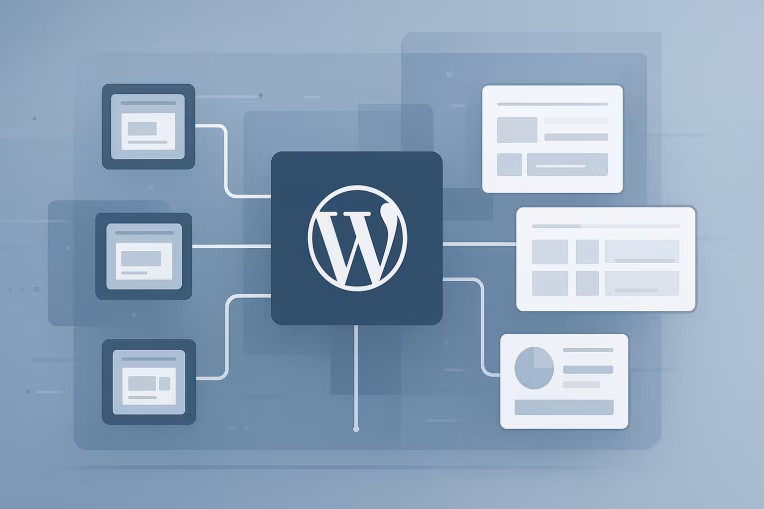
WordPress multisite is attractive for understandable reasons. It promises reuse, consistency, and lower operational overhead. For organisations managing multiple brands, countries, departments, or campaign sites, the idea of one shared platform can look like a disciplined architectural choice.
Sometimes it is.
But multisite is not just a technical configuration. It is an operating model. And that distinction matters.
A multisite estate concentrates power, risk, and dependency into a shared platform. The moment multiple teams rely on that platform for business-critical publishing, the question shifts from can we run many sites from one WordPress installation? to who governs change, accepts risk, and decides what the platform is for?
That is where problems typically begin.
Why teams choose multisite in the first place
Most enterprise teams do not choose multisite because they love complexity. They choose it because it appears to remove it.
Common reasons include:
- centralised hosting and infrastructure
- a shared codebase across multiple sites
- common design patterns or brand components
- easier rollout of platform-wide fixes
- lower duplication across teams
- a simpler path for launching new sites quickly
In the right context, these are legitimate benefits.
If the organisation has a strong central digital team, a well-defined platform roadmap, and a clear distinction between what is shared and what is site-specific, multisite can work well. It can reduce fragmentation and improve consistency.
The problem is that many estates adopt multisite before they have settled the governance questions that come with it. The technical decision is made first. The operating model is assumed to work itself out later.
It usually does not.
The shift from technical convenience to governance burden
A small multisite network can feel efficient. A large one can feel politically and operationally heavy.
That change often happens gradually. At first, sites share a common base and a small set of needs. Over time, more teams join, new requirements appear, and exceptions accumulate. The platform becomes responsible for more use cases than it was designed to support.
At that point, the challenge is no longer WordPress itself. The challenge is governance across shared ownership.
Typical symptoms include:
- no clear platform owner with decision authority
- central teams carrying operational responsibility without full control of demand
- business units expecting autonomy while relying on a shared release model
- increasing disagreement over plugin adoption, theme changes, and roadmap priority
- urgent site-level needs colliding with platform-level stability requirements
This is why multisite can become a governance problem rather than a pure engineering problem. The architecture creates interdependence. If that interdependence is not matched by explicit rules and responsibilities, delivery slows down and risk increases.
A useful early step is to baseline the current estate before debating bigger structural changes.
See where your WordPress content platform is creating governance dragRun a quick WordPress Health CheckThat kind of review helps teams separate symptoms caused by governance gaps from symptoms caused by code quality, dependency sprawl, or operational drift.
Shared platform means shared policy, whether teams admit it or not
A multisite network is not just shared infrastructure. It is shared policy.
Every decision about code, configuration, security posture, update cadence, and editorial capability has consequences across multiple sites. Even when individual site teams believe they operate independently, they are still affected by central decisions.
That means enterprise multisite needs answers to questions such as:
- Who approves new plugins or integrations?
- Who owns the base theme or component library?
- Who can introduce custom code for a single site?
- What service levels apply to urgent fixes?
- How are breaking changes communicated and scheduled?
- What happens when one site's requirement conflicts with the network standard?
If those questions are unresolved, teams tend to create informal workarounds. Informal workarounds are often where governance debt starts to accumulate.
Where governance issues usually appear
Governance problems in multisite are rarely abstract. They show up in routine delivery work.
1. Platform ownership is unclear
A multisite estate needs a clear owner, or at least a clearly defined platform function. Without one, decisions get made by whichever team is loudest, closest to the risk, or currently funding a change.
That creates a distorted roadmap.
The shared platform starts responding to local needs rather than managing network-wide outcomes. Over time, the estate becomes harder to reason about because the platform evolves through exceptions instead of policy.
A healthy model usually defines:
- product ownership for the platform itself
- technical ownership for core architecture and code quality
- service ownership for availability, support, and operational readiness
- decision rights for site teams versus platform teams
Without that separation, accountability becomes blurred very quickly.
2. Autonomy is promised but not really available
One of the most common enterprise tensions is this: site teams are told they are empowered, but the platform structure gives them limited control.
They may own content and local priorities, but not:
- plugin installation
- deployment timing
- theme architecture
- infrastructure configuration
- security settings
- release dependency management
This mismatch creates frustration on both sides. Site teams feel blocked. Central teams feel overloaded. Neither problem is solved by adding more process unless the underlying rights and responsibilities are redesigned.
3. Governance becomes approval-heavy instead of rules-based
Poorly governed multisite estates often drift into manual gatekeeping. Every change becomes a request. Every exception becomes a meeting. Every delivery team has to negotiate with the same small group of maintainers.
That is not real governance. It is congestion.
Good platform governance should make many decisions predictable in advance. Teams should know what patterns are approved, what extension model is allowed, and what level of deviation is acceptable. If everything depends on case-by-case approval, the operating model is already under strain.
Plugin and theme ownership risks
Plugin sprawl is often discussed in WordPress conversations, but in enterprise multisite the deeper issue is ownership.
The important questions are not only how many plugins are installed? but also:
- who selected them
- who maintains them
- who accepts upgrade risk
- who tests compatibility across sites
- who deprecates them when they no longer fit the platform
A shared plugin in multisite is effectively a shared dependency contract. Once several sites rely on it, removing or changing it becomes a governance issue, not a local technical choice.
The same is true for themes.
A base theme or shared design system can be a strong asset when it is intentionally managed. But when many site-level customisations are layered onto a shared theme without a clear extension strategy, the platform becomes fragile. Minor changes carry uncertain blast radius. Teams stop trusting upgrades. Release cycles slow down.
A few patterns often signal governance trouble:
- shared themes that contain large amounts of site-specific logic
- plugins activated network-wide without lifecycle ownership
- custom functionality introduced for one site and silently reused by others
- no formal review for dependency additions
- no retirement plan for outdated components
These are not just technical smells. They indicate that the platform is evolving without a durable stewardship model.
Release coordination is where multisite governance becomes operationally visible
Many governance weaknesses remain hidden until release coordination exposes them.
In a multisite environment, even small changes can involve multiple constituencies. A security update may require testing across different site configurations. A theme change may affect one team's roadmap but disrupt another team's campaign schedule. A plugin update may be low-risk for most sites but business-critical for one.
This creates a coordination burden that separate estates do not always share in the same way.
Release planning for multisite typically has to account for:
- cross-site regression testing
- shared deployment windows
- freeze periods for major campaigns or publishing events
- communication across multiple stakeholder groups
- rollback strategy when one release affects many sites differently
The operational question becomes: is the organisation mature enough to manage release dependency at platform scale?
If not, multisite can turn what should be routine maintenance into a recurring negotiation exercise.
This is often the point where teams realise they did not just centralise technology. They centralised operational risk.
The hidden cost of exceptions
Enterprise multisite rarely fails because everything is standardised. It struggles because standardisation is partial.
A network may start with a shared baseline, then accumulate exceptions for regional needs, legacy integrations, brand differences, accessibility variations, workflow demands, or campaign delivery pressures. Each exception may be individually reasonable. Collectively, they can undermine the platform model.
Exceptions increase cost in several ways:
- they make testing less predictable
- they weaken the value of shared releases n- they complicate support and incident response
- they blur what the platform officially supports
- they make onboarding new teams harder
More importantly, they change the political character of the platform. Once enough exceptions exist, every team starts arguing that its needs are unique. Governance becomes harder because the shared standard no longer feels credible.
That is usually a sign that the organisation is trying to force multiple operating models into one technical estate.
Multisite is strongest when the operating model is genuinely shared
The most successful multisite estates tend to have a few things in common.
They are not merely collections of websites. They are managed platforms with clear boundaries.
Typically, that means:
- a central platform team with explicit mandate
- agreed standards for design, security, content model, and extension
- a limited and well-governed dependency set
- a clear process for introducing and retiring shared capabilities
- transparent release governance
- site teams who understand the tradeoff between speed and standardisation
In other words, multisite works best when participating sites agree that they are part of a shared platform, not just consumers of a convenient hosting arrangement.
That cultural point matters as much as the technical one.
When separate estates may be the better choice
There is no virtue in using multisite if the organisation does not actually behave like a shared platform organisation.
Separate WordPress estates may be more appropriate when:
- business units have genuinely different governance needs
- release calendars cannot be coordinated sensibly
- security and compliance requirements vary significantly
- teams need independent vendor or delivery control
- brand systems are materially different
- one site's complexity would impose disproportionate risk on others
Separate estates can increase infrastructure duplication, but they may reduce governance friction. They can also create cleaner accountability. A team that owns its own stack, roadmap, and release cycle can often move more clearly, even if some shared efficiencies are lost.
The question is not whether separate estates are architecturally purer. The question is whether they better match the organisation's decision-making reality.
Practical decision criteria: multisite or separate estates?
For enterprise teams making or revisiting this decision, it helps to assess the operating model before the technology pattern.
Ask the following:
Do we have a real platform owner?
If no team can define the roadmap, standards, and service model for the shared estate, multisite is likely to drift.
Are participating sites willing to accept shared constraints?
If teams want local freedom on code, releases, integrations, or vendor choice, separate estates may be more honest and sustainable.
Is there a clear extension model?
If every site expects bespoke functionality, the value of multisite will erode quickly unless those variations can be contained in a structured way.
Can we coordinate releases across the network?
If shared changes regularly collide with local business priorities, the central platform may become a bottleneck.
Do we understand the blast radius of change?
A multisite architecture should come with disciplined dependency management, testing, and rollback planning. If those capabilities are weak, operational risk rises sharply.
Are we standardising for a reason, or just consolidating by habit?
Multisite is useful when there is a meaningful shared product model. It is less useful when it is primarily a reaction to budget pressure or an assumption that one installation is always simpler.
How to reduce governance risk if you already run multisite
Many organisations are not deciding from scratch. They already have a multisite estate and need to make it more governable.
In that case, the goal is not necessarily to unwind the network immediately. It is to make the operating model explicit.
A practical starting point includes:
- Define platform ownership clearly. Name the function responsible for roadmap, standards, and platform health.
- Document decision rights. Be precise about what site teams can control and what remains central.
- Rationalise shared dependencies. Review plugins, themes, and custom modules against ownership, usage, and upgrade risk.
- Create an extension policy. Decide how site-specific needs are introduced without destabilising the core platform.
- Formalise release governance. Establish testing expectations, change windows, communication patterns, and rollback responsibilities.
- Measure exceptions. Track where the network diverges from the standard and whether those deviations still justify being in the same estate.
- Be willing to split the estate when needed. Sometimes the right governance decision is architectural separation.
This last point is important. Enterprises often continue defending multisite long after the original rationale has weakened. But a platform should be evaluated by how well it supports delivery, control, and risk management now, not by how sensible it looked when it was first adopted.
The core question is organisational, not just technical
WordPress multisite can be effective. It can support scalable publishing, consistent experience patterns, and efficient operations.
But only when the organisation has the governance maturity to run it as a platform.
Without that, multisite often becomes an uncomfortable middle ground: too centralised for local autonomy, too fragmented for genuine standardisation, and too interdependent for low-risk operations.
That is the point where it stops being a simplification.
For CTOs, platform owners, and WordPress delivery leads, the real decision is not whether multisite is possible. It is whether the organisation can sustain the shared ownership model that multisite requires. A clearer WordPress platform strategy can make that decision more explicit before more governance debt accumulates.
If the answer is yes, multisite can be a useful platform pattern.
If the answer is no, separate estates may not be a failure of standardisation. They may be the more honest and governable architecture.
That kind of proof matters because governance problems in WordPress are rarely solved by infrastructure consolidation alone.
It shows that platform outcomes improve when dependency ownership, release discipline, and architectural boundaries are treated as one operating model.
For multisite teams, the lesson is not that every network should be split. It is that shared estates need explicit rules for what is standard, what is extensible, and who carries the risk of change.
It also suggests that modernization work should start with the areas of highest coupling. In multisite, that usually means shared plugins, shared themes, deployment coordination, and exception-heavy site requirements.
Those are the places where technical debt and governance debt reinforce each other.
A useful roadmap therefore does more than list upgrades. It identifies which dependencies should be rationalised, which decision rights need to be formalised, and which sites still belong in the same platform boundary.
That helps leadership move from abstract debate to sequenced action.
In some estates, the right next step is tighter standards and a cleaner extension model.
In others, it is selective separation to reduce blast radius and restore accountability.
Either way, the practical goal is the same: make the platform easier to govern before the next release cycle, security event, or business-critical exception exposes the same structural weakness again.
WordPress modernization roadmap
Map a clearer content operating model for multisite
Assess governance gaps, shared dependency risk, and platform boundaries to define a practical modernization roadmap for your content estate.
Paid assessment. No implementation commitment required.
- Data-informed recommendationsBased on your stack and traffic patterns.
- Prioritize with confidenceFocus on the changes that reduce risk fast.
- Plan around releases and spikesRight-sizing cache, origin, and invalidation.
- Built for engineering teamsPractical, actionable, and implementation-aware.
Tags: WordPress, wordpress multisite governance, WordPress platform governance, multisite operations, enterprise WordPress architecture