Core Focus

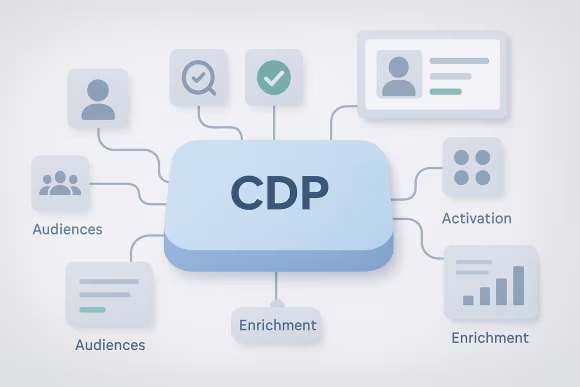
CDP-centered ecosystem architecture
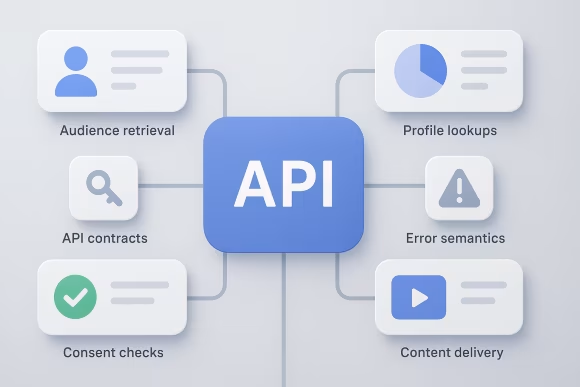
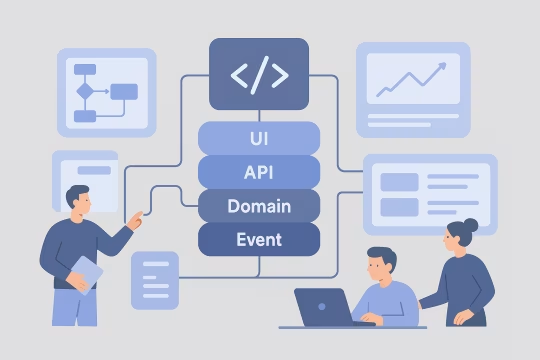
API and event contracts
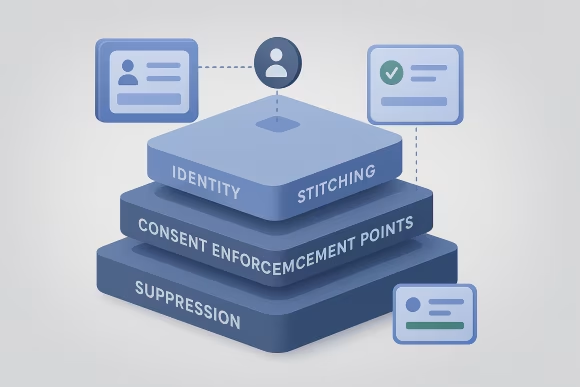
Identity and consent patterns
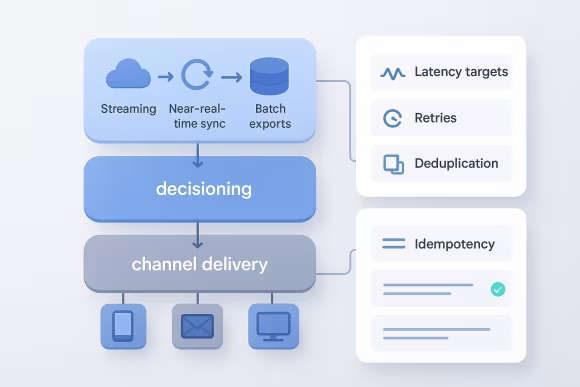
Activation flow design

Best Fit For

  • Multi-vendor martech stacks
  • Global multi-brand organizations
  • High-volume personalization programs
  • Regulated data environments

Key Outcomes

  • Reduced integration rework
  • Clear platform ownership boundaries
  • Faster tool onboarding
  • Lower activation latency

Technology Ecosystem

  • CDP and audience services
  • Headless CMS platforms
  • API gateways and iPaaS
  • Analytics and experimentation tools

Delivery Scope

  • Reference architecture and standards
  • Integration and data flow mapping
  • Governance and operating model
  • Roadmap and migration plan

Tool Sprawl Creates Fragile Activation Pipelines

As marketing ecosystems grow, teams add tools to solve immediate needs: a new personalization engine, an additional analytics tag, a separate consent layer, or another messaging platform. Over time, the stack becomes a mesh of point-to-point integrations with inconsistent identifiers, duplicated tracking, and unclear ownership of data contracts. The CDP may exist, but it is not consistently treated as a platform capability with defined boundaries and interfaces.

Engineering teams then spend disproportionate effort maintaining integrations rather than improving customer experiences. Changes to one vendor’s API or schema ripple across multiple systems. Audience definitions drift between tools, event taxonomies diverge, and content and offer models are duplicated. Without explicit integration patterns, some flows become batch-based while others are near-real-time, creating unpredictable activation behavior and difficult-to-debug incidents.

Operationally, this increases release coordination overhead, slows experimentation, and elevates compliance risk. Consent and purpose limitations are enforced inconsistently, data retention policies vary by system, and auditability becomes manual. The platform becomes harder to evolve because every new capability requires bespoke integration work and cross-team negotiation without shared architectural standards.

Composable Martech Architecture Methodology

Ecosystem Discovery

Inventory the current martech landscape, data sources, activation destinations, and ownership. Capture critical journeys, latency expectations, compliance constraints, and vendor contract boundaries to establish the real operating context for the architecture.

Domain Decomposition

Define platform domains such as identity, profile, audiences, consent, content, offers, measurement, and orchestration. Establish bounded contexts and responsibilities to reduce overlap between tools and to clarify what belongs in the CDP versus adjacent systems.

Reference Architecture

Design a target composable architecture centered on the CDP, including integration topology, trust boundaries, and runtime environments. Specify how systems communicate (APIs, events, file exchange) and where canonical models and contracts are enforced.

Data and Event Contracts

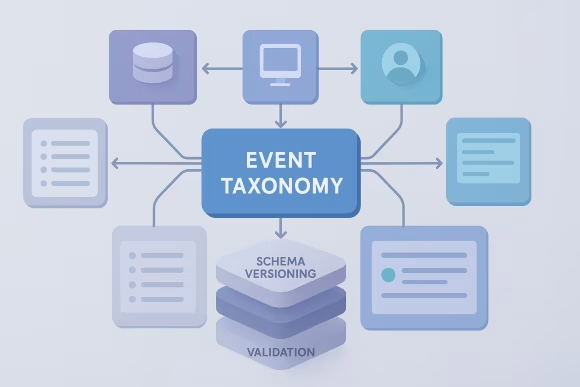
Define event taxonomy, naming conventions, schema evolution rules, and versioning strategy. Establish audience and profile contracts, identity resolution inputs/outputs, and consent signals so downstream systems can integrate predictably and safely.

Integration Patterns

Select patterns for key flows: ingestion, enrichment, audience sync, decisioning, and activation. Document when to use synchronous APIs versus asynchronous events, how to handle retries and idempotency, and how to manage vendor-specific adapters.

Governance Model

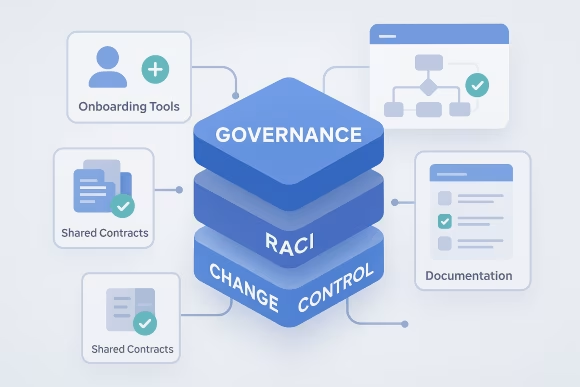
Create standards and decision processes for onboarding tools, approving schema changes, and managing shared libraries and connectors. Define RACI across marketing, data, security, and engineering, including ownership of contracts and runbooks.

Roadmap and Migration

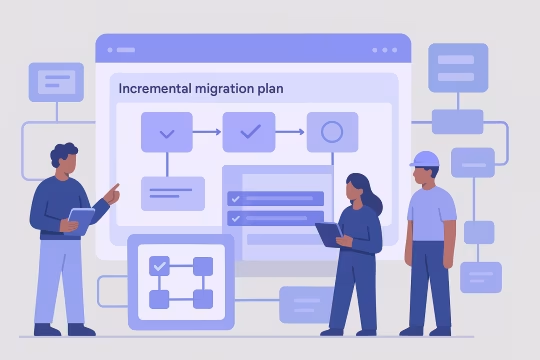
Plan incremental migration from point-to-point integrations to the target architecture. Prioritize high-risk and high-change areas, define transitional states, and align delivery sequencing with product roadmaps and vendor renewal timelines.

Operational Enablement

Define observability requirements, SLIs/SLOs for activation flows, and incident response procedures. Establish environments, release coordination practices, and documentation so teams can operate and evolve the ecosystem with predictable change control.

Core Composable Martech Capabilities

This service establishes the technical foundations required to run a multi-vendor marketing ecosystem as a coherent platform. It focuses on domain boundaries, integration contracts, and operational controls that make CDP-centered activation reliable at scale. The emphasis is on interoperability, schema and identity consistency, and governance mechanisms that allow teams to evolve tools and channels without repeatedly rebuilding core data and integration layers.

Capabilities
  • Composable martech reference architecture
  • CDP domain and responsibility mapping
  • Event taxonomy and schema governance
  • Identity and consent architecture patterns
  • Integration pattern selection and standards
  • Activation pipeline design and SLAs
  • Tool onboarding and governance framework
  • Migration roadmap and transition states
Target Audience
  • Marketing Architects
  • Enterprise Architects
  • Digital Transformation Teams
  • CDP and Data Platform Owners
  • Marketing Operations Leadership
  • Security and Privacy Stakeholders
  • Product and Platform Engineering Leads
Technology Stack
  • Composable Martech
  • Customer Data Platforms (CDP)
  • API Platforms and gateways
  • Headless CMS
  • Event streaming and messaging
  • iPaaS and integration tooling
  • Identity and consent management
  • Analytics and experimentation platforms
  • Data warehouses and lakehouses

Delivery Model

Engagements are structured to produce an implementable architecture, not a theoretical diagram set. We work from current-state constraints, define target patterns and contracts, and provide a roadmap that teams can execute incrementally while maintaining platform stability and compliance.

Delivery card for Discovery and Inventory[01]

Discovery and Inventory

Run stakeholder and system workshops to map tools, data sources, activation endpoints, and current integrations. Capture pain points, latency requirements, compliance constraints, and ownership boundaries to ground the architecture in operational reality.

Delivery card for Current-State Assessment[02]

Current-State Assessment

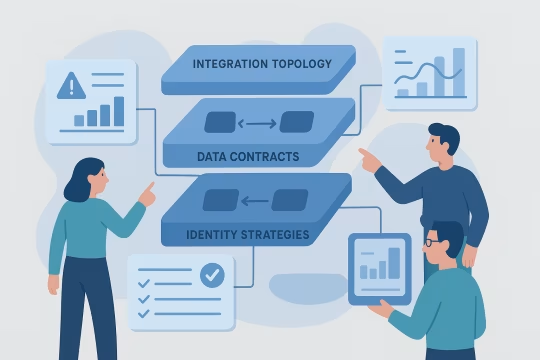
Assess integration topology, data contracts, identity strategy, and consent enforcement across systems. Identify coupling, duplication, and failure hotspots, and document architectural risks that affect scalability, maintainability, and auditability.

Delivery card for Target Architecture Design[03]

Target Architecture Design

Define the target composable architecture, including domains, interfaces, and integration patterns. Produce reference diagrams and decision records that clarify where canonical models live and how systems interact through APIs and events.

Delivery card for Contract and Standards Definition[04]

Contract and Standards Definition

Create event taxonomy, schema evolution rules, and API standards for key capabilities. Define ownership, versioning, and validation expectations so teams can integrate consistently and reduce breaking changes across vendors and internal services.

Delivery card for Governance and Operating Model[05]

Governance and Operating Model

Define RACI, change control, onboarding criteria for new tools, and documentation standards. Establish how architectural decisions are made and maintained, including review cadences and escalation paths for cross-team dependencies.

Delivery card for Roadmap and Migration Plan[06]

Roadmap and Migration Plan

Build an incremental roadmap with transition states, sequencing, and dependencies. Prioritize high-impact flows such as identity, consent, and audience activation, and align milestones with product delivery and vendor renewal timelines.

Delivery card for Implementation Support[07]

Implementation Support

Support teams during initial execution with architecture reviews, integration design validation, and contract testing guidance. Provide patterns for adapters, observability, and runbooks to reduce operational risk during rollout.

Delivery card for Continuous Architecture Review[08]

Continuous Architecture Review

Set up periodic reviews to evaluate drift, new tool requests, and evolving channel requirements. Update standards and reference architecture as the ecosystem changes, keeping interoperability and compliance controls intact.

Business Impact

Composable martech architecture improves delivery predictability by reducing integration ambiguity and clarifying platform responsibilities. It lowers operational risk through standardized contracts, observable activation flows, and consistent identity and consent enforcement. The impact is realized through fewer integration regressions, faster onboarding of capabilities, and a platform that can evolve without repeated rework of core data pathways.

Faster Tool Onboarding

Standardized integration patterns and contracts reduce the time required to connect new vendors and channels. Teams can reuse adapters, schemas, and governance processes rather than negotiating bespoke implementations for each addition.

Lower Integration Risk

Clear API and event contracts reduce breaking changes and unexpected downstream impacts. Versioning and validation rules make changes explicit, improving release coordination across marketing, data, and engineering teams.

Improved Activation Reliability

Defined activation flows with retries, idempotency, and observability reduce delivery failures and silent data loss. SLIs/SLOs provide a shared operational view of freshness and completeness across critical pipelines.

Reduced Architectural Coupling

Domain boundaries and adapter strategies limit point-to-point dependencies between tools. This makes vendor changes and parallel migrations feasible without cascading rewrites across the ecosystem.

Consistent Identity and Consent

Shared patterns for identifiers, stitching inputs, and consent propagation reduce discrepancies between systems. This improves compliance posture and reduces manual audit effort by making enforcement points and data lineage explicit.

Better Cross-Team Alignment

A documented operating model clarifies ownership of contracts, schemas, and runbooks. Decision records and governance cadences reduce ambiguity and improve coordination across marketing operations, platform teams, and security stakeholders.

Lower Long-Term Maintenance Cost

Reusable standards and shared libraries reduce repeated integration work and duplicated models. Over time, teams spend less effort on integration firefighting and more on improving customer experiences and measurement quality.

Scalable Platform Evolution

A roadmap with transition states enables incremental modernization without destabilizing production activation. The ecosystem can expand to new channels and capabilities while keeping core data pathways and controls consistent.

FAQ

Common questions from enterprise teams designing and operating composable martech ecosystems around CDP capabilities, governed integrations, and scalable activation.

How do you define boundaries between the CDP and other martech tools?

We start by decomposing the ecosystem into domains (identity, profile, audiences, consent, content, offers, measurement, orchestration) and then map each domain to a system-of-record and systems-of-use. The CDP typically owns profile unification, audience computation, and activation interfaces, while adjacent tools may own channel execution, content authoring, or decisioning in specific contexts. The key is to avoid overlapping responsibilities that create duplicated models and inconsistent outcomes. For example, if multiple tools compute audiences independently, you will see drift in membership and reporting. We define explicit contracts: what the CDP publishes (audience membership, profile attributes, consent state), what it consumes (events, identifiers, consent signals), and what is delegated (channel-specific rendering, campaign execution). We document these decisions as a reference architecture and decision records, including “anti-patterns” to avoid (point-to-point audience exports without versioning, identity stitching in multiple places, consent checks only at the edge). This makes boundaries enforceable during tool onboarding and change reviews.

What integration patterns work best for composable martech: APIs, events, or batch exports?

Most enterprise ecosystems require a mix, chosen per flow based on latency, volume, and failure tolerance. APIs are appropriate for synchronous lookups (e.g., consent checks, profile enrichment at request time) where you need immediate responses and can manage rate limits and timeouts. Events are appropriate for behavioral tracking, near-real-time segmentation inputs, and downstream activation triggers where decoupling and replayability matter. Batch exports remain valid for high-volume destinations, cost-sensitive processing, or vendors that only support file-based ingestion. The risk is that batch introduces freshness gaps and makes debugging harder unless you add lineage, reconciliation, and monitoring. We define patterns with explicit rules: idempotency and retry behavior for APIs; schema versioning, ordering expectations, and dead-letter handling for events; and completeness checks, watermarking, and reconciliation for batch. The architecture should also define where transformations occur (source, CDP, or integration layer) and how you prevent vendor-specific schemas from leaking into upstream producers.

How do you operationalize reliability for audience sync and activation pipelines?

We treat activation as an operational product with measurable service levels. First, we identify critical flows (event ingestion, identity updates, audience computation, audience delivery to channels, suppression/consent updates) and define SLIs such as freshness (time since last successful sync), completeness (percentage of expected records delivered), error rate, and latency distribution. Next, we design observability to support those SLIs: structured logs with correlation identifiers, metrics for throughput and failures, and tracing where synchronous calls exist. For asynchronous flows, we add queue depth monitoring, dead-letter queues, replay procedures, and reconciliation jobs that compare expected versus delivered audience counts. Finally, we define operational ownership and runbooks. This includes escalation paths between marketing ops, data platform teams, and vendors; release coordination for schema changes; and incident response procedures that prioritize customer-impacting channels. The goal is to move from “it seems delayed” to actionable signals and repeatable recovery steps.

What does a sustainable operating model look like for a multi-vendor martech ecosystem?

A sustainable model separates platform stewardship from campaign execution while keeping shared contracts governed. Typically, a platform or digital engineering team owns integration standards, shared connectors, identity and consent patterns, and the observability baseline. Marketing operations owns configuration, campaign setup, and channel execution within those guardrails. We define RACI for key artifacts: event taxonomy ownership, schema change approval, connector lifecycle management, and vendor onboarding. We also define cadences: architecture review for new tools, contract review for schema changes, and operational review for SLO performance and incident trends. Documentation and automation are part of the operating model. For example, schema registries or contract repositories, automated validation in pipelines, and standardized runbooks reduce reliance on tribal knowledge. The model should also include a deprecation process so old events, attributes, and integrations can be retired without breaking downstream consumers.

How do you integrate a headless CMS into a CDP-centered composable architecture?

We integrate a headless CMS by defining clear contracts between content, offers, and audience context. The CMS typically remains the system-of-record for content structures, localization, and publishing workflows, while the CDP provides audience membership, profile attributes, and sometimes decision inputs (e.g., propensity or lifecycle stage). Integration patterns depend on runtime needs. For server-rendered or edge experiences, the application may call the CDP (or a decisioning layer) at request time to obtain audience context, then query the CMS for the appropriate content variants. For precomputed personalization, the CDP may export segments to a delivery layer that selects content without synchronous CDP calls. We also define identifiers and metadata: how content is tagged for eligibility, how experiments are represented, and how exposure events are tracked back into analytics/CDP. The architecture should avoid embedding vendor-specific personalization logic directly into CMS content models; instead, keep decision rules and eligibility criteria in a dedicated layer with versioned contracts.

How do you handle identity resolution across channels and vendors?

We start with an identifier strategy: which identifiers are authoritative (customer ID, account ID), which are transient (cookies, device IDs), and how they are linked. We define where stitching occurs (often in the CDP or a dedicated identity service) and what evidence is required for merges. We also define how identity changes propagate to downstream systems to prevent stale mappings. For integrations, we specify how identifiers are carried in events and API payloads, including hashing/encryption requirements and consent constraints. We define join keys for audience exports and channel imports, and we document fallbacks when an identifier is missing. Operationally, we add monitoring for identity health: match rates, merge/split volumes, and anomalies that indicate tracking regressions. We also define governance for identity rules because changes can materially affect measurement and activation. The goal is consistent identity semantics across tools, not just “getting data in.”

How do you govern event taxonomies and schema evolution without slowing teams down?

We implement lightweight governance with clear ownership and automation. First, we define an event taxonomy with naming conventions, required fields, and semantic definitions (what an event means, when it is emitted). Then we define schema evolution rules: backward-compatible changes, deprecation windows, and versioning expectations. To avoid bottlenecks, we separate “standards” from “approvals.” Standards are documented and reusable; approvals are reserved for changes that affect shared consumers or compliance. We recommend a contract repository (or schema registry) where producers submit changes via pull requests, with automated checks for naming, required fields, and compatibility. We also define a consumer impact process: identify downstream systems, provide migration guidance, and schedule deprecations. This approach keeps teams moving while preventing uncontrolled drift that later requires expensive remediation across analytics, CDP ingestion, and activation pipelines.

What governance is needed for vendor onboarding and connector lifecycle management?

Vendor onboarding should be treated as an architectural change, not just procurement. We define criteria for onboarding: supported integration patterns (API/event/batch), security requirements, data residency, consent handling, observability hooks, and exit strategy. We also define who owns the connector and what “done” means (runbooks, monitoring, contract tests, and documentation). For connector lifecycle, we recommend versioned adapters with configuration management and clear environments (dev/test/prod). Changes should follow change control: release notes, rollback plans, and compatibility checks against contracts. If an iPaaS is used, the same principles apply: treat flows as code where possible, with peer review and promotion pipelines. Finally, we define decommissioning processes. Tools and connectors accumulate; without a retirement path, you keep paying operational cost and compliance risk. Governance should include periodic reviews to remove unused integrations, retire deprecated events, and consolidate overlapping capabilities.

What are the biggest risks when moving from a suite-based stack to composable martech?

The most common risk is replacing suite coupling with integration sprawl. Without explicit domain boundaries and contracts, teams create point-to-point integrations that are harder to operate than the original suite. Another risk is inconsistent identity and consent enforcement, especially when multiple tools store profile-like data and apply different suppression rules. There is also a delivery risk: attempting a “big bang” migration. Composable ecosystems work best with incremental transition states where you can run parallel flows, validate counts and freshness, and cut over per channel or journey. We mitigate these risks by defining a reference architecture early, prioritizing foundational capabilities (identity, consent, event taxonomy, observability), and creating a roadmap that sequences changes to minimize customer impact. We also define an exit strategy for each vendor integration so the ecosystem remains adaptable rather than locked into a new set of dependencies.

How do you reduce compliance and privacy risk in a composable ecosystem?

We design privacy controls as part of the architecture, not as an afterthought. That starts with data classification and purpose limitation: which attributes and events are allowed for which use cases, and how those constraints are represented in contracts. We define where consent is captured, how it is stored, and how consent state propagates to the CDP and activation tools. We also define enforcement points: where suppression is applied (before activation exports, at channel execution, or both), how deletions and retention policies are executed across vendors, and how auditability is maintained. Data lineage and reconciliation are important because multi-vendor flows can obscure where data went and when. Operationally, we recommend monitoring for policy violations (unexpected destinations, missing consent flags, unusually large exports) and establishing a change review process for any integration that introduces new data categories or destinations. The goal is consistent, provable controls across the ecosystem, even as tools change.

What are the typical deliverables from a composable martech architecture engagement?

Deliverables are designed to be implementable by platform and delivery teams. Typically this includes a current-state map (systems, integrations, ownership), a target reference architecture (domains, interfaces, integration patterns), and a set of standards (event taxonomy, schema evolution rules, API guidelines, identity and consent patterns). We also provide governance artifacts: RACI, onboarding criteria for new tools, change control processes for contracts, and an operating model for observability and incident response. Where needed, we include example contracts and templates (event definitions, API specs, adapter boundaries) to accelerate adoption. Finally, we produce a roadmap with transition states. This is critical: it defines sequencing, dependencies, and validation steps so teams can migrate incrementally without destabilizing activation. If implementation support is included, we add architecture reviews and guidance during early execution to ensure the standards are applied consistently.

How do you work with internal teams and vendors during the engagement?

We run joint working sessions with marketing architecture, data/platform engineering, security/privacy, and marketing operations to establish shared definitions and constraints. Vendor participation is used selectively: to validate integration capabilities, confirm API/event semantics, and align on operational responsibilities and support boundaries. We keep decisions explicit through architecture decision records and contract documentation. This reduces ambiguity and prevents re-litigation of the same topics across teams. We also align with delivery teams by translating architecture into actionable standards and backlog-ready work items. Where organizations have multiple business units, we focus on reusable patterns and a federated governance model: central standards with local execution. The engagement is structured to leave teams with artifacts they can maintain, not a one-time report that becomes outdated after the next tool change.

How do you decide where decisioning and personalization logic should live?

We decide based on latency, channel requirements, and governance. Some decisioning belongs close to the experience runtime (e.g., edge or application layer) when you need low-latency responses and tight control over rendering. Other decisioning can be precomputed (e.g., audience membership, eligibility) and distributed to channels when near-real-time is sufficient. We also consider ownership and auditability. If marketing teams need to manage rules, the architecture should provide a governed rule/offer model with versioning and approvals. If engineering teams own logic, it should be implemented as services with tests, observability, and deployment controls. A common pattern is to separate concerns: the CDP computes audiences and provides profile context; a decisioning layer selects offers based on rules and constraints; the CMS provides content; and the channel executes delivery. This avoids embedding complex logic in vendor UIs where it becomes hard to test, version, and migrate.

How do you connect analytics and measurement to a composable martech architecture?

We align measurement by standardizing events, identifiers, and exposure tracking across channels. The foundation is an event taxonomy that supports both product analytics and marketing attribution needs, with clear definitions for key events and required context fields. We define how events flow to analytics platforms and to the CDP, including deduplication and late-arriving data handling. For experimentation and personalization, we define exposure and decision events so you can measure what was shown, to whom, and under what rule/version. This is essential for trustworthy uplift analysis and for debugging. We also define governance for tracking changes: versioned event schemas, validation in pipelines, and monitoring for drops in volume or shifts in key dimensions. The goal is to prevent “measurement drift” where each tool reports different numbers because they interpret events and identities differently.

How does collaboration typically begin for this service?

Collaboration typically begins with a short scoping phase to confirm goals, constraints, and stakeholders. We identify the primary outcomes (e.g., reduce integration fragility, enable new channels, standardize identity/consent, improve activation reliability) and agree on the systems in scope: CDP, analytics, CMS, messaging platforms, integration layer, and key data sources. Next, we run discovery workshops and collect existing artifacts (integration diagrams, vendor lists, event specs, data models, incident history, privacy requirements). We establish a shared glossary and map current-state flows end to end, including ownership and operational pain points. From there, we propose an engagement plan with milestones: current-state assessment, target reference architecture, contract/standards definition, governance model, and roadmap with transition states. We align on working cadence, decision-making process, and required vendor participation. This ensures the architecture work is grounded in delivery reality and can be executed by internal teams immediately after the engagement.

Align your martech ecosystem around clear contracts

Let’s assess your current martech topology, define CDP-centered domain boundaries, and establish the integration and governance standards needed for reliable activation at scale.

Oleksiy (Oly) Kalinichenko

Oleksiy (Oly) Kalinichenko

CTO at PathToProject

Do you want to start a project?