[01]
[01]Discovery and Audit
Assess current tracking, destinations, and reporting dependencies. Identify gaps, duplication, and high-risk areas such as SPA routing, cross-domain flows, and consent behavior, then prioritize a phased implementation plan.
CDP tracking readiness
Review event taxonomy, consent handling, routing logic, and implementation gaps before they disrupt CDP data quality and activation.
Built to surface governance drift, integration issues, and upgrade readiness across web tracking.
No login required. Takes 2–3 minutes.
Web tracking implementation services cover the engineering work required to instrument a website or web application so user interactions are captured as reliable, well-defined events and delivered to analytics and CDP destinations. This includes creating an event tracking plan, selecting the right collection approach, implementing tags or trackers, mapping events to a schema, and validating that data is complete, consistent, and privacy-compliant.
Organizations need this capability when reporting becomes inconsistent across properties, when product changes break measurement, or when CDP activation depends on trustworthy behavioral signals. Without disciplined implementation, teams accumulate ad hoc tags, ambiguous event names, and gaps caused by SPA navigation, cross-domain flows, and consent constraints.
A robust implementation treats tracking as part of platform architecture: events are modeled as a contract, instrumentation is versioned and testable, and data quality is monitored. This enables scalable measurement across multiple teams and release cycles while keeping analytics and CDP pipelines stable as the platform evolves.
Core Focus
Best Fit For
Key Outcomes
Technology Ecosystem
Delivery Scope
As digital platforms grow, tracking often evolves through incremental tag additions, campaign requests, and product experiments. Over time, event names drift, parameters change without coordination, and different teams implement similar interactions in incompatible ways. Single-page applications, cross-domain checkouts, and embedded experiences further complicate measurement because navigation and state changes are not captured by default page-based analytics models.
These inconsistencies create architectural friction. Analytics engineers spend time reverse-engineering event meaning, building brittle transformations, and explaining discrepancies between tools. Product teams lose confidence in funnels and experimentation results when key events are missing or duplicated. Marketing operations struggles to maintain stable audiences and conversion signals when consent, ad blockers, and tag sequencing cause unpredictable delivery to CDP and advertising destinations.
Operationally, tracking becomes a high-risk dependency. Releases can silently break instrumentation, leading to delayed detection and backfilled reporting. Without governance and validation, the platform accumulates technical debt in the form of unmanaged tags, undocumented schemas, and fragile integrations that are difficult to test, audit, or evolve.
Review business objectives, reporting needs, and activation use cases. Inventory existing tags, trackers, and destinations, and identify gaps caused by SPA routing, cross-domain flows, consent behavior, and inconsistent event definitions.
Define an event taxonomy and parameter schema with clear naming, required fields, and versioning rules. Align events to product domains and analytics/CDP requirements so downstream transformations and audiences can rely on stable contracts.
Select the collection approach (tag manager, SDK, or tracker) and define how events are triggered, enriched, and routed. Specify identity strategy, cross-domain linking, consent gating, and destination-specific mappings.
Implement events in the application and configure the tracking layer in the chosen tooling. Add enrichment for context such as page metadata, product identifiers, and experiment variants while keeping payload size and performance constraints in view.
Configure routing to analytics and CDP destinations, including filtering, transformations, and environment separation. Ensure consistent handling of user identifiers, consent states, and data residency requirements where applicable.
Validate event firing, payload structure, and delivery using debugging tools and automated checks. Test edge cases such as SPA navigation, cross-domain sessions, consent changes, and duplicate suppression to reduce regressions.
Deploy with controlled rollout and establish monitoring for volume anomalies, schema violations, and delivery failures. Set up alerting and dashboards so issues are detected quickly after releases or configuration changes.
Deliver documentation, tracking plan, and operational runbooks. Define ownership, change control, and review workflows so future instrumentation changes remain consistent and auditable across teams.
This service provides the technical foundations needed for CDP event tracking engineering and enterprise analytics instrumentation across web platforms. The focus is on explicit event contracts, consent-aware analytics tagging, and implementation patterns that work across modern frontends and complex user journeys. Capabilities include reliable identity handling, destination routing, and validation mechanisms that reduce regressions. The result is an instrumentation layer that can evolve with the platform without breaking downstream reporting and activation.

Define a structured event taxonomy with required parameters, naming conventions, and versioning rules. Events are treated as an interface between product surfaces and downstream analytics/CDP pipelines, enabling consistent transformations, stable dashboards, and predictable audience logic as the platform evolves.

Implement tracking behavior that respects consent states and regional policies by gating collection, enrichment, and destination delivery. Integrate with consent management signals and ensure events are handled consistently when consent is granted, denied, or changed mid-session.

Instrument modern web applications where navigation is client-side and page context must be derived from route state. Ensure page views, virtual page changes, and interaction events include consistent context so funnels and attribution remain accurate across SPA transitions.

Design and implement cross-domain linking and session continuity for journeys spanning multiple domains or subdomains. Handle identifier propagation, referrer behavior, and destination-specific constraints so conversions and user paths are not fragmented.

Configure how events are forwarded to analytics and CDP destinations, including filtering, mapping, and environment separation. Support multiple consumers with different requirements while keeping a single source of truth for event definitions and payload structure.

Validate event payloads against the schema and verify delivery end-to-end. Establish checks for missing required fields, unexpected parameter types, duplicate events, and volume anomalies to detect regressions quickly and reduce downstream remediation work.

Implement consistent user and session identification patterns, including anonymous and authenticated states. Enrich events with page metadata, product context, and experiment variants in a controlled way so downstream segmentation and analysis can rely on stable dimensions.
Identify where instrumentation drift, consent gaps, and routing issues are weakening CDP collection, audience reliability, and downstream reporting.
Delivery follows an engineering sequence from discovery and audit through implementation, QA, and operational handover. Work starts with an event tracking plan and event contracts, then moves into consent-aware analytics tagging, destination configuration, and end-to-end validation before rollout. Governance and monitoring are established so measurement remains stable as releases, GTM/tag changes, and platform architecture evolve.
[01]Assess current tracking, destinations, and reporting dependencies. Identify gaps, duplication, and high-risk areas such as SPA routing, cross-domain flows, and consent behavior, then prioritize a phased implementation plan.
 [02]
[02]Work with stakeholders to define events, parameters, and definitions that map to product and marketing use cases. Establish naming conventions, required fields, and versioning so the plan can be maintained as a living specification.
 [03]
[03]Design the collection approach, identity strategy, and destination routing. Define how consent signals are applied and how environments (dev/stage/prod) are separated to support safe testing and release management.
 [04]
[04]Implement instrumentation in the web application and configure Segment, Snowplow, or GA4 as required. Add controlled enrichment for context and ensure performance considerations are addressed for high-traffic pages.
 [05]
[05]Validate event firing, payload structure, and delivery to each destination. Test edge cases including consent changes, ad blockers, duplicate suppression, and cross-domain continuity, and document expected behaviors.
 [06]
[06]Deploy with a controlled rollout plan and verification steps. Coordinate with release management to reduce regressions and ensure measurement continuity during migrations or parallel tracking periods.
 [07]
[07]Set up dashboards and alerts for schema violations, delivery failures, and volume anomalies. Define incident response steps and ownership so issues are detected and resolved quickly after releases.
 [08]
[08]Deliver documentation, runbooks, and change workflows for ongoing maintenance. Establish review gates for new events and updates so tracking remains consistent across teams and product iterations.
Reliable tracking reduces decision risk by making analytics and CDP signals consistent across teams, properties, and releases. It also lowers operational overhead by shifting work from reactive debugging to governed change management and validation. The impact is improved measurement continuity, faster iteration, and more dependable activation pipelines.
Consistent event definitions and validated payloads reduce discrepancies between tools and dashboards. Teams spend less time reconciling numbers and more time using data for decisions.
Stable instrumentation improves the quality of funnel and experiment metrics. Product teams can iterate without repeatedly re-implementing tracking for each release or feature variant.
Monitoring and QA reduce the chance that releases silently break measurement. When issues occur, clear contracts and runbooks shorten diagnosis and recovery time.
Cleaner, consent-aware behavioral signals produce more stable audiences and downstream activation. This reduces churn in segments caused by missing events, duplicates, or inconsistent identifiers.
A governed event model decreases the need for brittle transformations and manual fixes in downstream pipelines. Analytics engineers can focus on modeling and insights rather than constant remediation.
Standardized tracking patterns make multi-site and multi-domain measurement comparable. This supports consolidated reporting and shared KPIs across business units and regions.
Defined change workflows and documentation make tracking maintainable across teams. New events and updates can be reviewed, tested, and deployed with less coordination overhead.
Before you commit roadmap time
Use the health check to pinpoint schema drift, fragile integrations, and release risks so your next tracking changes improve CDP reliability.
Adjacent capabilities that extend web tracking implementation into governed event architecture, a durable data layer, and downstream activation and analytics pipelines.
Enterprise CRM data synchronization and identity mapping
Event-driven journeys across channels and products
CDP audience activation with governed delivery to channels
Audience sync activation engineering for CDP activation
CDP real-time decisioning design for real-time experiences
Customer analytics platform implementation for governed metrics and behavioral analytics
Unified customer profile architecture and insight-ready datasets
Scalable enterprise audience segmentation models and cohort definition frameworks
Consistent experiment tracking, metrics, and attribution
Common questions about implementing web tracking for analytics and CDP ecosystems, including architecture, operations, integration, governance, and engagement.
We treat the event schema as a contract that must support multiple consumers without becoming ambiguous. Practically, that means defining a small set of event types with consistent naming, a clear definition for each event, and a parameter model that separates required fields from optional context. We map events to product domains (for example, account, checkout, content) and define shared primitives such as user identifiers, page context, and timestamps. To keep the schema usable across teams, we document: event purpose, trigger conditions, required parameters, allowed values, and examples. We also define versioning rules so changes are explicit and backward compatibility is considered. Where tools impose constraints (for example, GA4 parameter limits or destination-specific naming), we design a canonical schema and then apply deterministic mappings per destination. The goal is to make downstream modeling predictable: analytics engineers can build transformations once, marketing operations can build audiences with confidence, and product teams can add features without inventing new tracking patterns each time.
Single-page applications require explicit instrumentation for route changes and state transitions because traditional page-load signals are incomplete. We implement a consistent approach for virtual page views, route metadata capture, and interaction events so each event includes stable context (route, page type, content identifiers, and relevant state). We also ensure that events are not duplicated due to re-renders or client-side retries. For cross-domain journeys, we design session continuity and identifier propagation based on the chosen stack. That can include linker parameters, first-party cookies, or explicit identity handoff patterns. We test critical flows such as authentication, checkout, and embedded experiences to confirm that attribution and funnels are not fragmented. We also account for consent and browser constraints that affect cookies and referrers. The outcome is a measurement model that reflects user journeys as they actually occur across modern web architectures, rather than relying on assumptions from page-based analytics.
We implement monitoring at three levels: collection health, schema quality, and destination delivery. Collection health focuses on whether events are being emitted at expected volumes and whether key flows (for example, sign-up, add-to-cart, purchase) continue to produce events. Schema quality checks validate required fields, parameter types, and allowed values, and flag unexpected changes that typically indicate a regression or an unreviewed implementation. Destination delivery monitoring verifies that events arrive in analytics and CDP endpoints and that routing rules are behaving as intended. Where possible, we separate environments and include release markers so changes can be correlated with deployments. Operationally, we define alert thresholds, ownership, and response steps. The intent is to detect issues within hours, not weeks, and to provide enough context to pinpoint whether the failure is in the application instrumentation, the tracking configuration, or a downstream destination integration.
We start by selecting an implementation pattern that fits the platform: lightweight client instrumentation, tag manager configuration, or tracker SDK usage. We minimize synchronous work on critical rendering paths and avoid blocking network calls. Where enrichment is needed, we prefer deterministic client-side context that is already available rather than expensive DOM queries or repeated computations. We also manage payload size and event frequency. High-volume interactions (scroll, hover, keypress) are either sampled, aggregated, or excluded unless there is a clear analytical requirement. For single-page applications, we ensure that route-change tracking is debounced and that event listeners are not duplicated across re-renders. Finally, we test in realistic conditions and validate that tracking failures degrade gracefully. Instrumentation should never break core user flows; it should fail silently and be observable through monitoring so issues can be corrected without impacting the customer experience.
A typical Segment web implementation includes a defined tracking plan, a consistent event schema, and a configured source that routes events to the required destinations. On the client side, we implement identify, track, and page calls (or their equivalents) with standardized context fields. We also define how anonymous and authenticated identities are handled, including when to call identify and how to manage userId versus anonymousId. On the configuration side, we set up destinations, filtering, and transformations where needed to keep the canonical schema consistent while meeting destination constraints. We also separate environments so development and staging data does not pollute production reporting. Quality assurance includes validating event payloads, confirming delivery to each destination, and testing edge cases such as consent changes, ad blockers, and cross-domain flows. The deliverable is a maintainable setup where new events can be added through a governed change process rather than ad hoc tag additions.
Snowplow implementations are typically more schema-driven and pipeline-oriented. Instead of relying primarily on destination-specific event models, we define events and entities with explicit schemas and validate them as they move through the collection and enrichment pipeline. This supports stronger data quality guarantees and makes downstream warehouse modeling more predictable. Implementation includes selecting the tracker approach, defining event and entity schemas, configuring collectors and enrichments, and ensuring identity and consent behaviors are correctly applied. We also design how events are routed into storage and how they are exposed to analytics tools and CDP activation workflows. Compared to tag-based approaches, Snowplow often requires more upfront architecture but provides clearer governance and extensibility. The key is aligning the schema and pipeline design to the organization’s operating model so teams can evolve tracking without breaking downstream consumers.
We establish governance as a lightweight engineering workflow rather than a documentation exercise. That includes a single source of truth for the tracking plan, clear ownership for approving changes, and a review process that checks naming, definitions, required parameters, and destination mappings. Changes are versioned so downstream consumers can understand when and why an event changed. We also define implementation standards: where tracking code lives, how events are triggered, and how context is populated. For organizations with multiple teams, we recommend a small set of reusable utilities or wrappers so instrumentation is consistent across codebases. Finally, we connect governance to operations by adding validation and monitoring. If a team introduces an unapproved event or breaks a required field, it should be detected quickly. This combination of review gates and automated checks is what prevents schema drift in practice.
We deliver documentation that supports implementation, operations, and decision-making. At minimum, that includes a tracking plan with event definitions, trigger conditions, required and optional parameters, allowed values, and examples. We also document destination mappings, identity rules, consent behavior, and environment separation so teams understand how data flows end-to-end. For operations, we provide runbooks covering validation steps, debugging methods, and monitoring dashboards and alerts. This includes common failure modes such as duplicate events, missing identifiers, consent gating issues, and SPA route-change problems. Where multiple teams contribute, we document the change workflow: how new events are proposed, reviewed, implemented, tested, and released. The objective is to make tracking changes routine and auditable, reducing reliance on tribal knowledge and minimizing regressions during future platform evolution.
We design tracking to be consent-aware and purpose-driven. First, we classify events and parameters to identify what is necessary for measurement and activation versus what should be excluded or minimized. We avoid collecting sensitive data in event payloads and implement safeguards to prevent accidental capture (for example, form field values or free-text inputs). Consent is applied consistently across collection and delivery. Depending on the stack, that can mean gating event emission, suppressing enrichment, or blocking routing to specific destinations until consent is granted. We also define how consent changes mid-session are handled so behavior is predictable and auditable. We align the implementation with the organization’s policies and regional requirements, and we document the data flow so privacy and governance stakeholders can review it. The result is a tracking layer that supports analytics and CDP needs without creating uncontrolled data collection risk.
Common risks include inconsistent event naming, missing required parameters, duplicate firing, and broken identity linkage. These often arise from decentralized implementation, SPA re-render behavior, tag manager changes without code review, and destination-specific constraints that force ad hoc mappings. We mitigate these risks by defining an explicit schema contract and implementing validation. Validation can be manual during initial rollout, but we also recommend automated checks that flag schema violations and unexpected volume changes. For duplicates, we implement deterministic trigger conditions and guardrails in the code to prevent multiple listeners or repeated calls. Identity risks are addressed by clearly defining when users are anonymous versus authenticated, how identifiers are stored, and how cross-domain continuity is handled. Finally, we reduce destination-induced drift by maintaining a canonical schema and applying consistent mappings per destination, rather than letting each tool define its own event model independently.
Timelines depend on platform complexity, number of properties, and how mature the existing tracking is. A focused implementation for a single web application with a clear tracking plan can often be delivered in a few weeks, while multi-site or cross-domain ecosystems with multiple destinations and consent requirements typically take longer and benefit from phased rollout. We usually structure work into: discovery and audit, event model definition, implementation design, instrumentation and configuration, QA and validation, and rollout with monitoring. Phasing is common: we start with critical conversion and identity events, then expand to secondary interactions and content engagement. We align the implementation to release cycles and ensure stakeholders have time to review definitions and validate reporting. The goal is to deliver measurable improvements early while building a foundation that supports ongoing evolution without repeated rework.
We define clear interfaces between teams: the tracking plan is the contract, and implementation standards define how events are added. Product teams contribute requirements and implement instrumentation in their codebases, while analytics engineers validate schema suitability and downstream usability. Marketing operations provides destination and activation requirements. To avoid slowing delivery, we use a review workflow that is proportional to risk. High-impact events and schema changes get explicit review; low-risk additions follow established patterns and can be approved quickly. We also provide reusable utilities and examples so teams don’t reinvent instrumentation patterns. Validation is integrated into the delivery process through checklists, debugging steps, and monitoring. This reduces back-and-forth after release and prevents late discovery of broken tracking. The result is a collaborative model that supports fast iteration while maintaining data integrity.
Collaboration typically begins with a short discovery phase to establish the current state and define the scope. We start by reviewing existing tracking implementations, destinations (analytics and CDP), consent behavior, and the reporting or activation use cases that matter most. We also identify the critical user journeys and the platform constraints, such as SPA routing, cross-domain flows, and release cadence. From there, we align on a tracking plan: the event taxonomy, parameter definitions, and ownership model. If a tracking plan already exists, we assess it for ambiguity, destination compatibility, and maintainability, then propose targeted refinements rather than rewriting everything. Once scope and contracts are agreed, we plan implementation in phases and set up a shared validation process. This usually includes access to staging environments, destination configuration permissions, and a clear path for code review and deployment so instrumentation changes can be delivered safely and verified end-to-end.
These case studies showcase real-world applications of consent-aware web tracking, event schema design, and analytics instrumentation aligned with CDP activation strategies. They highlight implementations involving GA4, GTM, and advanced tracking governance that ensure data quality, privacy compliance, and scalable measurement across platforms. Reviewing these examples provides insight into practical delivery models and technology integrations relevant to web tracking implementation services.
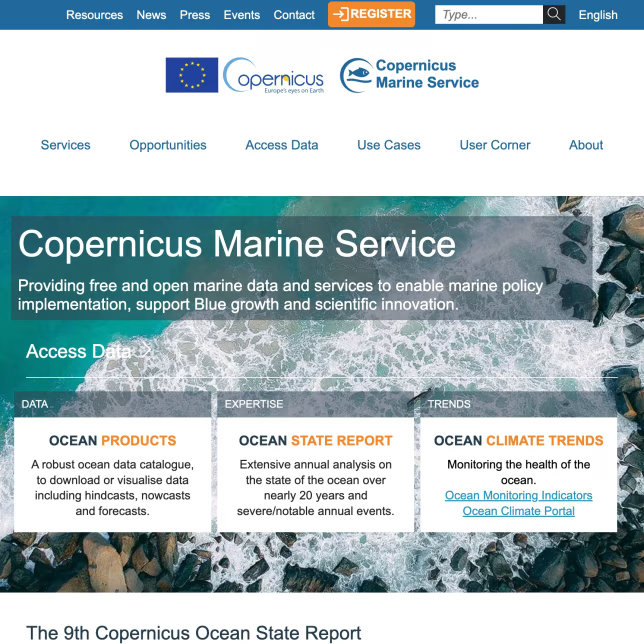
The existing marine data portal relied on three unaligned WordPress installations and embedded PHP code, creating inefficiencies and risks in content management and usability.
The new Drupal DXP streamlined content operations and improved accessibility, offering scientists and businesses a more efficient gateway to marine data services.
JYSK required a robust retail Digital Experience Platform (DXP) integrated with a Customer Data Platform (CDP) to enable data-driven design decisions, enhance user engagement, and streamline content updates across more than 25 local markets.
The modernized platform empowered JYSK’s marketing and content teams with real-time insights and modern workflows, leading to stronger engagement, higher conversions, and a scalable global platform.
Organogenesis faced operational challenges managing multiple brand websites on outdated platforms, resulting in fragmented workflows, high maintenance costs, and limited scalability across a multi-brand digital presence.
The transformation reduced time-to-deliver marketing updates by 20–25%, improved Lighthouse scores to ~90+, and delivered a scalable multi-brand foundation for long-term growth.
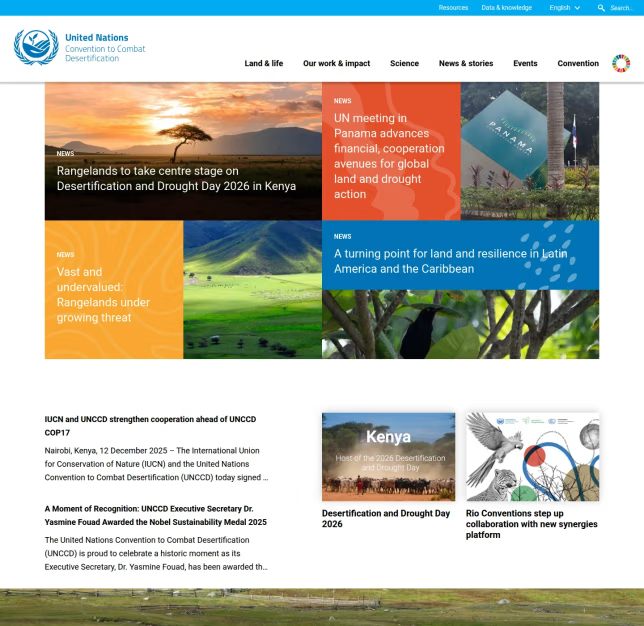
UNCCD operated four separate websites (two WordPress, two Drupal), leading to inconsistencies in design, content management, and user experience. A unified, scalable solution was needed to support a large-scale CMS migration project and improve efficiency and usability.
The modernization effort resulted in a cohesive, user-friendly, and scalable website, improving content management efficiency and long-term digital sustainability.
Oleksiy (PathToProject) worked with me on a specific project over a period of three months. He took full ownership of the project and successfully led it to completion with minimal initial information.
His technical skills are unquestionably top-tier, and working with him was a pleasure. I would gladly collaborate with Oleksiy again at any opportunity.

Nikolaj Stockholm Nielsen
Strategic Hands-On CTO | E-Commerce Growth
It was my pleasure working with Oleksiy (PathToProject) on a new Drupal website. He is a true full-stack developer—the ideal mix of DevOps expertise, deep front-end knowledge, and the structured thinking of a senior back-end developer.
He is well-organized and never lets anything slip. Oleksiy understands what needs to be done before being asked and can manage a project independently with minimal involvement from clients, product managers, or business analysts.
One of the best consultants I’ve worked with so far.

Andrei Melis
Technical Lead at Eau de Web
Oleksiy (PathToProject) is demanding and responsive. Comfortable with an Agile approach and strong technical skills, I appreciate the way he challenges stories and features to clarify specifications before and during sprints.

Olivier Ritlewski
Ingénieur Logiciel chez EPAM Systems
These articles expand on the contract, consent, and operational controls that make web tracking reliable in practice. They are useful if you want to understand how event schemas, data layers, and privacy rules stay consistent as implementations evolve across teams and channels.
Let’s review your current instrumentation, consent constraints, and destination requirements, then implement a governed tracking layer that stays reliable through platform change.