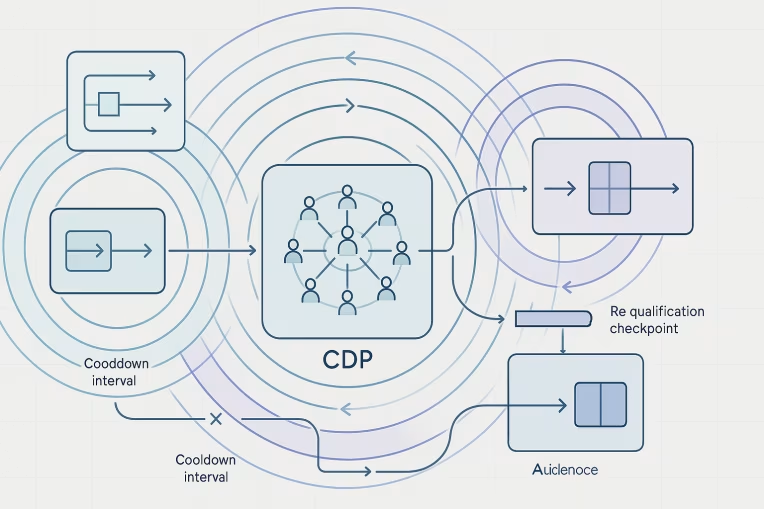
Time-based audience logic is one of the most underestimated failure points in CDP programs.
Most teams put significant effort into identity resolution, event modeling, segmentation, and consent handling. But audience behavior in production often depends just as much on when a profile qualifies, how long it stays eligible, when it is suppressed, and *what has to happen before it can qualify again.
That timing logic is rarely owned in one place. A CDP might define the segment. A CRM might store lifecycle state. A marketing automation platform might apply journey wait steps, message caps, or exclusion periods. Paid media and downstream channels may introduce their own refresh schedules and retention rules. The result is not simply operational complexity. It is activation drift.
Activation drift happens when multiple systems are enforcing different interpretations of the same audience over time. The audience may look correct in a dashboard or segment builder, but behave differently in execution. Customers can receive messages too early, too late, too often, or after they should have been excluded. Reporting becomes difficult to trust because the enrolled population no longer maps cleanly to the intended business rule.
The fix is not to push every rule into the CDP, nor to let every downstream tool manage its own timing independently. The more durable approach is to distinguish segmentation logic from activation timing, then define a shared contract for how entry, exit, cooldown, expiration, and re-qualification work across systems.
The hidden complexity of time-based audience logic
Many audience definitions sound simple when written in business language:
- customers who abandoned a journey in the last 24 hours
- leads eligible for nurture after a 7-day cooling-off period
- users excluded from a promotion for 30 days after redemption
- subscribers who should be removed from activation when consent changes
In practice, each of those statements contains several hidden decisions.
For example, does "in the last 24 hours" mean based on event time or processing time? Is the clock measured from the original activity, the profile update, or the moment the audience sync runs? If a profile qualifies, leaves, and re-qualifies within the same day, is that a new entry? If consent is revoked after export but before send, which system is responsible for suppression?
These questions matter because time-based rules are not just segmentation filters. They are operating rules. They govern the lifecycle of an audience member as data moves through refresh schedules, orchestration steps, and channel-specific constraints.
A useful distinction is this:
- Segmentation logic determines whether a profile meets the business definition of an audience.
- Activation timing logic determines when that eligible profile can enter, remain in, exit, or re-enter downstream execution.
Teams often combine both in one place without realizing it. That is where drift begins.
Where eligibility windows usually get fragmented
Eligibility windows usually fragment for understandable reasons. Different teams own different systems, and each system solves a real local problem.
Common fragmentation points include:
- CDP segment definitions that compute who currently qualifies based on profile attributes and recent behavior
- CRM fields or statuses that capture milestones like contacted, converted, disqualified, or active in journey
- Marketing automation journeys that impose waits, enrollment rules, exit conditions, or frequency controls
- Destination sync behavior that updates audiences on a schedule rather than in real time
- Channel execution logic that holds records, retries deliveries, or caches exported audience members
- Suppression lists maintained outside the CDP for operational or channel-specific reasons
A familiar example is abandoned journey activation. The CDP may define the audience as profiles with a qualifying abandonment event and no completion event within one hour. The automation platform may only sync every four hours. The email journey may allow entry only once every seven days. The CRM may mark a customer as "in outreach" for 14 days after first contact. None of those rules is wrong on its own, but without a shared design, they produce a combined behavior no one explicitly intended.
The same issue appears in nurture programs. A lead may become eligible in the CDP after a profile score crosses a threshold, but a downstream nurture tool may also enforce its own re-entry rules and quiet periods. If those are not aligned, a lead can remain segment-eligible while being operationally blocked, or be allowed back into a journey before the intended cooldown has expired.
Entry, exit, cooldown, and expiration rule patterns
The most practical way to reduce drift is to treat audience timing as a set of explicit patterns. Four rule types appear in most programs.
1. Entry rules
Entry rules define the event or state transition that allows a profile to begin activation.
Examples include:
- first abandonment event after a session ends
- profile becomes eligible once a consented channel is available
- account enters a lifecycle stage and remains there at the next evaluation cycle
The design question is not only who qualifies, but what constitutes an entry moment. If a segment is evaluated continuously, a profile may appear eligible for a long period. If you need a one-time trigger, you need a clear entry event or entry state change, not just a static audience definition.
2. Exit rules
Exit rules define when a profile should no longer be considered active for the use case.
Examples include:
- conversion or completion event occurs
- consent is withdrawn for the activated channel
- exclusion condition becomes true, such as active service case or recent purchase
- expiration date passes for the offer or communication window
Exit rules should be designed for both business meaning and operational timing. A profile can become logically ineligible before that ineligibility is reflected in downstream tools. That lag needs to be understood and controlled.
3. Cooldown or suppression rules
Cooldown rules prevent repeated activation too soon after prior treatment. These are often implemented as suppression durations.
Examples include:
- do not re-enter nurture for 14 days after exit
- exclude promotion recipients for 30 days after send
- suppress profiles after a failed contact attempt until data quality is refreshed
Cooldown logic is especially vulnerable to drift because it is often implemented separately from eligibility. A profile may still satisfy the audience definition, but be temporarily blocked from activation. If the suppression lives only in the automation tool, the CDP may keep exporting a "valid" audience that cannot actually be used.
4. Re-qualification rules
Re-qualification rules determine the conditions under which a previously activated profile can become newly eligible again.
This usually requires more than waiting out a timer. Good re-qualification logic often combines:
- a prior exit or completion marker
- elapsed suppression duration
- a new qualifying event or meaningful state change
Without this structure, teams can accidentally allow stale eligibility to trigger repeated outreach. A customer who remained in a broad segment for weeks may be treated as newly eligible again simply because a downstream tool dropped and re-synced the record.
Failure modes in reporting, customer experience, and compliance
When time-based rules drift, the symptoms show up across three areas: reporting, customer experience, and governance risk.
Reporting failure modes
The first issue is metric ambiguity. One team reports segment population from the CDP. Another reports journey enrollment from the automation tool. A third reports sends after downstream suppression. All three numbers may be accurate within their own systems, yet none of them represents the actual business audience in a stable way.
This makes it hard to answer basic questions:
- How many profiles were truly eligible?
- How many were suppressed due to cooldown, consent, or channel readiness?
- How many entered late because of sync delays?
- How many re-qualified versus remained continuously eligible?
If the underlying timing model is unclear, performance analysis becomes noisy. Teams can misdiagnose a drop in volume as a segmentation issue when it is really an export lag, a hidden exclusion, or an expired window.
Customer experience failure modes
From the customer perspective, drift often feels like inconsistency.
Examples include:
- receiving an abandoned journey email after already completing the journey
- entering the same nurture path repeatedly because re-entry rules are not aligned
- being excluded from one channel but not another during a cooling-off period
- receiving activation after a profile refresh corrected the data too late
These are not always dramatic failures. More often, they appear as subtle friction: redundant outreach, stale messages, or untimely contact that weakens trust.
Governance and compliance-related failure modes
Time-based drift can also affect governance outcomes, especially where consent, suppression, or policy-based exclusions must be enforced consistently. It is important to stay precise here: not every mismatch becomes a regulatory issue, and requirements vary by context. Still, fragmented timing increases the chance that a profile is activated based on outdated state.
Typical concerns include:
- consent changes not propagating at the same speed as audience exports
- channel suppression windows applied inconsistently across tools
- expiration rules for offers or campaigns being interpreted differently
- unclear auditability about which system determined eligibility at the time of activation
The right response is not broad compliance claims. It is stronger traceability and clearer ownership of timing decisions.
Contract design across CDP, CRM, and activation tools
A reliable operating model starts with a simple principle: every time-based audience should have an explicit cross-system contract.
That contract does not need to be heavyweight. But it should make the business rule executable in a repeatable way across the CDP, CRM, and downstream activation tools.
A practical contract usually answers the following questions.
What defines business eligibility?
State the core segmentation logic separately from orchestration controls.
For example:
- qualifying event or profile condition
- required identity resolution state, if relevant to activation
- channel readiness prerequisites
- exclusion conditions tied to consent, suppression, or lifecycle state
This is the "who should qualify" layer.
What defines the activation window?
Specify the valid time range during which activation is intended.
Examples:
- within 24 hours of abandonment event
- no earlier than 7 days after prior outreach
- until conversion, consent withdrawal, or 30-day expiry
This is the "when activation is still meaningful" layer.
What is the system of record for each timing field?
Time-based governance fails when multiple tools derive the same date independently. Choose where each critical field is authored and which systems consume it.
Typical fields might include:
eligible_ateligible_untilsuppressed_untillast_activated_atlast_exit_reasonrequalify_after
Not every use case needs all of them. But defining a small canonical set can dramatically reduce ambiguity.
Which system executes which rule?
A shared contract should identify where each rule is evaluated and where each rule is enforced.
For example:
- CDP evaluates segment eligibility and computes
eligible_until - CRM holds lifecycle status used as an exclusion input
- automation tool enforces one active journey instance per profile
- destination connector refreshes every two hours and must drop expired records on next sync
This creates a realistic model instead of an idealized one. In practice, this is where data activation architecture and CRM data integration decisions have to line up with the operating model.
What is the allowed latency?
Timing rules are meaningless without latency expectations. If a profile should exit within minutes after a conversion or consent change, a daily sync is not operationally equivalent.
Define acceptable delay for:
- profile updates
- segment recomputation n- audience export
- downstream suppression refresh
- journey enrollment or removal
This does not require real-time architecture for every use case. It requires agreement about where delay is acceptable and where it is not.
How is re-entry controlled?
Re-entry should be based on explicit state, not accidental resynchronization.
A good pattern is to require:
- a completed or exited prior activation state,
- a cooldown or suppression period to expire, and
- a new qualifying trigger or updated eligibility timestamp.
That combination helps distinguish a fresh opportunity from a profile that simply remained in the same audience.
Monitoring, exception handling, and governance rituals
Even a strong contract will drift without operating discipline. Time-based audience governance needs monitoring and review, not just initial design.
Monitor the gaps between stages
Track the movement from:
- segment eligible
- operationally activatable
- exported
- enrolled or delivered
- exited or suppressed
If large unexplained gaps appear between those stages, there is usually a timing rule or data dependency causing divergence.
Useful operational questions include:
- How many profiles are segment-eligible but blocked by suppression?
- How many exports contain already-expired records?
- How many downstream enrollments occur after the intended activation window?
- How often do profiles re-enter within suspiciously short intervals?
Instrument reason codes
Counts alone are not enough. Reason codes make audience behavior explainable.
Examples:
- exited_due_to_conversion
- suppressed_due_to_cooldown
- excluded_due_to_consent_state
- expired_before_export
- rejected_due_to_active_journey_instance
These can be lightweight but are valuable for analytics, operations, and stakeholder trust.
Plan for exceptions
Profiles do not move cleanly through systems. Data arrives late. Identity links change. Consent updates race with exports. CRM state may be corrected after activation has already started.
Instead of pretending these cases are rare, define how they should be handled.
Examples:
- if a conversion arrives after export but before send, suppress at send time if possible
- if identity stitching changes audience membership, treat it as a governed state transition rather than a silent overwrite
- if profile refresh timing delays an exclusion, log the exception and measure recurrence
Exception handling is where governance becomes operational rather than theoretical.
Establish recurring governance reviews
Time-based rules often drift slowly as teams add new channels, new campaigns, or new data sources. A quarterly or release-based review can help keep the audience contract current.
Those reviews should check:
- whether business definitions still match system behavior
- whether latency assumptions are still realistic
- whether suppression and re-entry rules remain aligned across tools
- whether reporting still maps to the intended lifecycle states
This is especially important in enterprise environments where ownership is distributed across CDP, CRM, data engineering, and marketing operations teams.
A practical design approach for enterprise teams
For teams trying to mature CDP activation governance, a phased approach is usually more realistic than a full redesign.
Start with high-impact journeys where timing matters most, such as abandonment, nurture re-entry, promotional exclusion periods, and consent-sensitive communications.
Then:
- document the intended audience lifecycle in plain language,
- separate eligibility from activation timing,
- identify which system currently owns each rule,
- define canonical timing fields and reason codes,
- map latency expectations and downstream enforcement points, and
- add monitoring for drift between intended and actual behavior.
This creates a foundation that can be reused across use cases.
The key mindset shift is simple: an audience is not just a list of qualifying profiles. In enterprise CDP programs, it is a governed lifecycle that spans systems, refresh cycles, and operational controls.
When entry windows, exit criteria, suppression durations, and re-qualification rules are treated as shared contract elements rather than hidden tool settings, teams can reduce activation drift significantly. They also gain clearer reporting, more predictable customer experiences, and a stronger basis for governance. That kind of cross-tool control is closely related to marketing automation integration, privacy and consent architecture, and customer journey orchestration.
That is the real value of CDP audience window governance. It turns time-based activation from an accumulation of local rules into a managed cross-system design.
Tags: CDP, CDP audience window governance, Audience governance, Marketing operations, CRM integration, Activation architecture