[01]
[01]Discovery and Mapping
Inventory sources, destinations, and critical datasets, and map end-to-end data paths. Identify ownership, SLAs, and current operational pain points such as schema drift, latency, and connector instability.
CDP integration readiness
Use the CDP health check to surface ingestion, warehouse, identity, and activation issues before they slow releases or break downstream use cases.
Built to inform architecture, governance, upgrade, and integration decisions before roadmap commitments.
No login required. Takes 2–3 minutes.
Customer data infrastructure engineering is the operational foundation that moves customer events and attributes from collection points into a governed warehouse and onward to activation systems. It includes event collection architecture, ingestion patterns, identity and profile stitching dependencies, storage and compute configuration, orchestration, and the monitoring required to keep data products stable as schemas and sources evolve.
Organizations need this capability when CDP usage expands beyond a single team and becomes a shared platform dependency for marketing, product, analytics, and customer support. Without an engineered infrastructure layer, changes to tracking plans, warehouse models, or vendor connectors can silently break downstream audiences, personalization, and reporting.
A well-run infrastructure approach supports scalable platform architecture by standardizing interfaces between sources, the warehouse, and activation endpoints, and by introducing operational controls such as lineage, quality checks, and release processes. This reduces fragility, improves incident response, and enables teams to evolve customer data models without destabilizing the broader ecosystem.
Core Focus
Best Fit For
Key Outcomes
Technology Ecosystem
Delivery Scope
As customer data platforms grow, the number of sources, schemas, and downstream consumers increases quickly. Event collection changes, new products are instrumented, and multiple teams introduce their own transformations. Without a stable infrastructure layer, ingestion patterns diverge, identity inputs become inconsistent, and warehouse models drift from what activation tools expect.
Engineering teams then spend disproportionate time diagnosing data issues that are hard to reproduce: late-arriving events, duplicated identities, broken joins, connector failures, and silent schema changes. The architecture becomes tightly coupled to vendor-specific behavior, while operational visibility remains limited. When incidents occur, root-cause analysis is slowed by missing lineage, unclear ownership, and a lack of runbooks.
Operationally, these weaknesses create delivery bottlenecks and risk. Releases to tracking plans or warehouse models require manual coordination, and teams avoid necessary changes because they fear breaking audiences, personalization, or reporting. Costs can also rise due to inefficient compute patterns, repeated backfills, and uncontrolled retry behavior across pipelines and connectors.
Review current CDP architecture, warehouse topology, ingestion sources, and activation endpoints. Map data movement paths, ownership boundaries, and operational constraints such as SLAs, privacy requirements, and change frequency.
Establish current reliability and performance baselines using incident history, pipeline runtimes, freshness, and data quality signals. Identify critical datasets and define service objectives for ingestion, identity inputs, and activation feeds.
Define reference patterns for ingestion (streaming and batch), warehouse staging, transformation boundaries, and activation interfaces. Specify data contracts, schema evolution rules, and dependency management to reduce coupling between teams.
Implement or harden connectors, orchestration, and compute configuration across cloud platforms and warehouses. Standardize environments, secrets management, and deployment workflows for data infrastructure components.
Introduce monitoring for freshness, volume, schema drift, and quality checks at key handoffs. Add lineage and logging to support traceability from source events through warehouse models to activation outputs.
Validate failure modes such as partial loads, late events, connector outages, and schema changes. Add automated checks and controlled backfill procedures to ensure predictable recovery and minimal downstream impact.
Define change control for tracking plans, schemas, and transformations, including review gates and rollback strategies. Establish ownership, runbooks, and escalation paths aligned to platform operating models.
Operate the platform with regular health reviews, cost and performance tuning, and incident retrospectives. Evolve patterns as new sources and destinations are added while keeping contracts and monitoring consistent.
This service provides customer data infrastructure engineering capabilities required to run CDP operations as a dependable platform dependency. The focus is on stable interfaces between sources, the cloud data platform for CDP (including the warehouse), and activation systems, with operational controls that make change predictable. Capabilities include standardized ingestion patterns, identity-related dependencies, data reliability monitoring, and data lineage and observability for freshness and quality. The result is an infrastructure layer that supports scale without increasing fragility or operational load.

Design ingestion patterns for event streams and batch sources with clear staging and retry behavior. Implement idempotency, deduplication strategies, and late-arrival handling so downstream models remain stable under real-world delivery conditions.

Engineer reliable connectivity between CDP tooling and cloud data warehouses, including secure access patterns and performance-aware extraction. Define dataset boundaries and materialization strategies that balance freshness, cost, and downstream query behavior.

Stabilize the inputs that drive identity resolution and profile stitching by enforcing consistent keys, normalization rules, and validation checks. Introduce monitoring for identity cardinality shifts and join breakage to prevent silent audience degradation.

Define and enforce data contracts for critical event schemas and customer attributes, including versioning and compatibility rules. Implement schema drift detection and controlled evolution workflows so producers can change safely without breaking consumers.

Implement orchestration patterns that make dependencies explicit across ingestion, transformations, and activation datasets. Use scheduling, backfill controls, and concurrency limits to keep runtimes predictable and reduce cascading failures.

Add automated checks for completeness, freshness, volume anomalies, and key integrity at platform handoffs. Route failures into actionable alerts with context, enabling faster triage and reducing time-to-detection for data incidents.

Instrument pipelines and connectors with logs, metrics, and lineage so teams can trace issues from activation outputs back to source events. Establish dashboards aligned to SLAs and operational ownership for ongoing platform health.

Implement least-privilege access, secrets management, and environment separation for data infrastructure components. Align operational controls with privacy and compliance requirements while keeping deployment and troubleshooting workflows efficient.
Identify where integration patterns, ownership, and controls are creating avoidable risk across customer data flows.
Engagements are structured to establish operational control first, then harden infrastructure and interfaces, and finally introduce governance and continuous improvement. The delivery model supports incremental adoption so critical datasets and activation paths become reliable without requiring a full platform rebuild.
[01]Inventory sources, destinations, and critical datasets, and map end-to-end data paths. Identify ownership, SLAs, and current operational pain points such as schema drift, latency, and connector instability.
 [02]
[02]Define responsibilities, escalation paths, and service objectives for customer data flows. Establish how changes are proposed, reviewed, released, and communicated across producer and consumer teams.
 [03]
[03]Stabilize connectors, compute configuration, and orchestration to reduce failure rates and improve predictability. Implement environment separation, secrets management, and repeatable deployment workflows.
 [04]
[04]Add monitoring for freshness, volume, schema changes, and quality checks at key handoffs. Build dashboards and alert routing aligned to operational ownership and incident response practices.
 [05]
[05]Introduce controlled backfills, replay strategies, and failure-mode testing for common incident scenarios. Document runbooks and validate recovery procedures to reduce time-to-restore during outages.
 [06]
[06]Implement data contracts, schema versioning, and review gates for tracking plan and model changes. Add release notes and rollback strategies to make evolution safe and auditable.
 [07]
[07]Optimize warehouse workloads, materializations, and connector extraction patterns. Reduce unnecessary recomputation and backfill cost while maintaining required freshness for activation use cases.
 [08]
[08]Run regular platform health reviews, incident retrospectives, and roadmap updates. Evolve patterns as new sources and destinations are added, keeping interfaces and monitoring consistent over time.
Customer data infrastructure improvements translate into measurable operational stability for teams that depend on CDP-driven activation and analytics. By reducing fragility and improving visibility, organizations can change tracking and models more frequently without increasing incident rates or delivery overhead.
Reduced connector and pipeline failures through hardened ingestion patterns and explicit dependencies. Fewer silent data issues due to freshness and quality checks at critical handoffs.
Improved traceability with lineage, logging, and operational dashboards. Shorter time-to-detect and time-to-restore because alerts include actionable context and runbooks are validated.
Schema evolution becomes predictable through data contracts, versioning, and release controls. Teams can update tracking plans and warehouse models with lower risk to audiences and downstream reporting.
More stable datasets for segmentation and personalization by standardizing warehouse-to-activation interfaces. Reduced audience volatility caused by identity input drift and join breakage.
Less manual coordination for releases and backfills due to standardized procedures and orchestration. Engineering time shifts from firefighting to planned platform evolution.
Warehouse and pipeline costs become more predictable through performance tuning and reduced recomputation. Backfills and retries are controlled to avoid runaway compute usage.
Defined operating model clarifies who owns datasets, connectors, and incident response. Governance reduces cross-team friction and improves auditability for regulated environments.
Before you commit to changes
Get a focused view of architecture, governance, upgrade, and integration signals so teams can reduce operational risk and sequence CDP improvements with confidence.
Adjacent services that extend enterprise customer data platform ops into data engineering, governance, and data activation infrastructure—useful when you need to evolve the same customer data foundation across orchestration, activation, and platform architecture.
Enterprise CRM data synchronization and identity mapping
Event-driven journeys across channels and products
CDP audience activation with governed delivery to channels
Audience sync activation engineering for CDP activation
CDP real-time decisioning design for real-time experiences
Customer analytics platform implementation for governed metrics and behavioral analytics
Unified customer profile architecture and insight-ready datasets
Scalable enterprise audience segmentation models and cohort definition frameworks
Consistent experiment tracking, metrics, and attribution
Common questions about operating customer data infrastructure for CDP ecosystems, including architecture, integrations, governance, risk, and engagement models.
The boundary should be defined by ownership, latency requirements, and how many downstream consumers depend on the dataset. A common enterprise pattern is to treat the warehouse as the system of record for customer attributes and event history, while the CDP focuses on identity stitching, audience computation, and activation connectors. In this model, the warehouse owns canonical tables and transformations that must be reusable across teams. Practically, we define which datasets are authoritative (for example, customer, account, consent, and key behavioral events), how they are versioned, and how the CDP reads them (direct query, extracts, or materialized views). We also define what the CDP is allowed to write back, if anything, and how those outputs are validated. The goal is to avoid circular dependencies and vendor lock-in. If identity or segmentation logic must be portable, we keep the inputs and derived datasets in the warehouse with explicit contracts, and treat CDP-specific outputs as products with clear SLAs and monitoring.
Identity resolution becomes fragile when key inputs are inconsistent, when join logic is implicit, or when upstream changes are not detected early. We start by defining the identity graph inputs: identifiers, their source systems, normalization rules, and precedence. Then we implement validation checks that detect shifts in identifier cardinality, null rates, and unexpected new values. From an infrastructure perspective, we separate raw ingestion from standardized identity inputs. Raw events land in a staging layer with immutable storage and replay capability. Standardized identity tables are produced through controlled transformations with explicit dependencies and versioning. This makes it possible to backfill or replay identity inputs without rewriting the entire pipeline. We also introduce observability specifically for identity: monitoring match rates, merge/split behavior, and downstream audience volatility. When identity behavior changes, alerts should point to the upstream dataset and schema change that caused it, not just the activation symptom.
The most useful metrics are those that reflect whether downstream teams can trust and use the data on time. We typically define service objectives around freshness (how late is the latest partition), completeness (expected volume ranges), and quality (key integrity checks such as non-null identifiers and referential consistency). For activation use cases, we also track delivery success to destinations and the time from event occurrence to activation availability. At the pipeline level, we monitor runtimes, failure rates, retry behavior, and backfill frequency. For connectors, we track API error rates, throttling, extraction lag, and schema drift. For warehouse workloads, we track query cost, concurrency, and the performance of materializations that feed the CDP. The key is to connect metrics to ownership and action. Alerts should be routed to the team that can fix the issue, include the impacted datasets and consumers, and support fast triage through lineage and logs. Otherwise, monitoring becomes noise.
We set up on-call by first defining what constitutes an incident from the perspective of consumers: missed freshness targets for critical datasets, failed activation deliveries, or quality checks that invalidate key attributes. Then we map those incidents to the components that can fail: ingestion, orchestration, transformations, warehouse resources, and destination connectors. Runbooks are written around failure modes, not tools. Each runbook includes: how to confirm impact, how to identify the failing step, where to find logs and lineage, safe remediation steps (rerun, replay, backfill), and rollback or containment actions. We also include decision points for when to pause downstream activation to avoid propagating bad data. Finally, we validate runbooks through drills or by applying them during real incidents, and we feed learnings into post-incident improvements such as better checks, clearer ownership, or changes to retry and backfill procedures.
We integrate new sources by treating events and attributes as contract-driven interfaces. Before implementation, we define the tracking plan or source schema, required identifiers, expected volumes, and how the data maps into canonical warehouse models. We also define compatibility rules: what changes are additive, what changes require versioning, and what changes are breaking. Implementation typically follows a staged approach: land raw data in an immutable staging layer, validate schema and volumes, then promote into standardized tables used by identity and activation. During promotion, we run parallel checks against existing datasets to detect unexpected shifts in key metrics such as event counts, identifier coverage, and join success rates. This approach reduces risk because new sources do not immediately affect downstream consumers. Only after validation and sign-off do we update the canonical models and activation datasets, with release notes and monitoring to catch issues early.
Activation consistency depends on stable dataset definitions, predictable refresh schedules, and clear handling of identity and consent. We define activation datasets as products with explicit schemas, refresh cadence, and acceptance checks. These datasets are typically materialized in the warehouse or exported in controlled jobs so that destinations receive consistent shapes and semantics. We also implement validation at the activation boundary: record counts, key coverage, and schema checks before delivery. For destinations with API limits or asynchronous processing, we track delivery success, retries, and lag, and we design idempotent delivery where possible to avoid duplicates. When destinations change requirements, we version the activation dataset or delivery contract rather than modifying it in place. This allows downstream teams to coordinate changes, reduces surprise breakage, and supports rollback if a destination integration introduces errors or unexpected behavior.
Governance is primarily about making change safe and auditable without slowing teams down unnecessarily. We implement data contracts for critical datasets (events, customer attributes, consent) that define schema, semantics, owners, and compatibility rules. Contracts are enforced through automated checks for schema drift, required fields, and key integrity. For changes, we establish a lightweight review process: proposed change, impact analysis using lineage, validation plan, and release communication. Breaking changes require versioning, with a defined deprecation window and a migration path for consumers. Additive changes can often be promoted faster but still require monitoring for unexpected volume or null-rate shifts. Governance also includes documentation and ownership. Each dataset has an accountable owner, and operational responsibilities are clear: who responds to incidents, who approves changes, and who maintains runbooks. This reduces cross-team ambiguity and improves long-term maintainability.
Access control starts with classifying datasets by sensitivity and defining least-privilege roles for producers, platform operators, and consumers. We typically separate environments (development, staging, production) and use managed identity and secrets management for connectors and orchestration. Warehouse permissions are structured around schemas or domains so teams can access what they need without broad read access. For privacy requirements, we implement controls at multiple layers: consent and suppression logic in canonical models, restricted access to raw event data when necessary, and audit logging for access and changes. Where applicable, we design deletion and subject request workflows that can propagate through derived datasets and activation outputs. Operationally, privacy controls must be observable. We add checks that confirm consent filters are applied, that restricted datasets are not exported to unauthorized destinations, and that changes to access policies are reviewed and tracked. This keeps compliance aligned with day-to-day operations rather than being a one-time exercise.
Reducing lock-in is mainly about keeping canonical data and transformations portable, and treating vendor-specific features as optional layers. We typically anchor the system of record in the warehouse with well-defined models for events, customer attributes, identity inputs, and consent. Transformations that define business meaning live in warehouse-managed code and are versioned and tested like software. For CDP-specific capabilities, we define clear interfaces: what datasets the CDP reads, what outputs it produces, and how those outputs are validated. If the CDP provides identity or audience computation, we still monitor and document the inputs and outputs so they can be replicated or migrated if needed. We also avoid coupling operational processes to a single vendor UI. Monitoring, lineage, and incident response should rely on platform-level observability and logs. This makes it easier to swap connectors or tools while keeping the operational model and data contracts intact.
Prevention requires controls at the boundaries where data changes meaning or becomes actionable. We implement quality gates at ingestion (schema and volume checks), at canonical modeling (key integrity, referential checks, and anomaly detection), and at activation (acceptance checks before export or sync). The checks are tied to actions: block delivery, quarantine a dataset, or route to manual review depending on severity. We also design for safe failure. For example, if a critical identifier field drops below a threshold, the system should stop producing the activation dataset rather than delivering incomplete audiences. This reduces the risk of incorrect targeting or broken personalization. Finally, we use lineage to understand blast radius. When a check fails, teams should immediately see which downstream audiences, destinations, and reports are affected. This supports fast containment, clear communication to stakeholders, and targeted remediation such as replaying a specific partition or rolling back a schema change.
A typical engagement starts with a short discovery phase to map data flows, identify critical datasets, and establish an operational baseline. From there, we prioritize the highest-impact paths: usually ingestion reliability for key event streams, warehouse connectivity for canonical models, and activation datasets that drive business-critical workflows. In many environments, meaningful improvements can be delivered incrementally within weeks by adding monitoring, stabilizing connectors, and introducing controlled backfill and replay procedures. Larger efforts, such as reworking identity inputs or standardizing data contracts across many producers, are usually planned as phased workstreams with clear milestones and deprecation windows. We align the timeline to operational constraints: release calendars, peak business periods, and existing on-call capacity. The goal is to improve reliability without forcing a platform freeze, and to leave behind an operating model, documentation, and automation that internal teams can sustain.
We work as an extension of your teams, with clear ownership boundaries and shared operational practices. Early on, we agree on who owns which components (connectors, orchestration, warehouse models, activation jobs) and how changes are reviewed and released. We also align on incident processes: alert routing, severity definitions, and how post-incident actions are tracked. Day-to-day collaboration typically includes joint architecture sessions, paired implementation on critical pipelines, and regular operational reviews focused on reliability metrics and upcoming changes. We prefer to implement improvements in your repositories and tooling where possible, so the work is maintainable and consistent with your standards. Where multiple teams produce data, we help establish cross-team interfaces through data contracts and documentation, and we facilitate impact analysis using lineage. This reduces coordination overhead and makes platform evolution safer as new sources and destinations are added.
Collaboration typically begins with a focused technical assessment to understand your current customer data landscape and operational risks. We start by identifying the critical paths: which sources feed the warehouse and CDP, which datasets drive activation, and which destinations are most sensitive to freshness and schema changes. We also review recent incidents, current monitoring, and how backfills and releases are handled. From that assessment, we produce a short, prioritized plan that includes: immediate reliability fixes (for example, connector hardening or freshness alerts), medium-term architecture work (such as standardizing ingestion patterns or defining data contracts), and governance steps (ownership, runbooks, and change control). We align this plan to your delivery calendar and confirm success metrics. The first implementation sprint usually targets one or two high-value datasets end-to-end, so teams can validate the operating model, monitoring, and release workflow before scaling the approach across the broader CDP ecosystem.
These case studies showcase real-world implementations of customer data infrastructure engineering, focusing on scalable data ingestion, identity resolution, data observability, and operational governance. They highlight how enterprise platforms were modernized and stabilized to support reliable CDP operations, data contracts, orchestration, and analytics integration. The selected work demonstrates measurable improvements in platform stability, data quality, and cross-team collaboration essential for evolving customer data ecosystems.
Organogenesis faced operational challenges managing multiple brand websites on outdated platforms, resulting in fragmented workflows, high maintenance costs, and limited scalability across a multi-brand digital presence.
The transformation reduced time-to-deliver marketing updates by 20–25%, improved Lighthouse scores to ~90+, and delivered a scalable multi-brand foundation for long-term growth.
JYSK required a robust retail Digital Experience Platform (DXP) integrated with a Customer Data Platform (CDP) to enable data-driven design decisions, enhance user engagement, and streamline content updates across more than 25 local markets.
The modernized platform empowered JYSK’s marketing and content teams with real-time insights and modern workflows, leading to stronger engagement, higher conversions, and a scalable global platform.
LSHTM required improvements to its existing higher education Drupal platform to better manage and distribute complex research data, including support for third-party integrations, Drupal performance optimization, and more reliable synchronization.
The solution improved data accessibility, streamlined research workflows, and enhanced system performance, enabling LSHTM to manage complex datasets more efficiently.
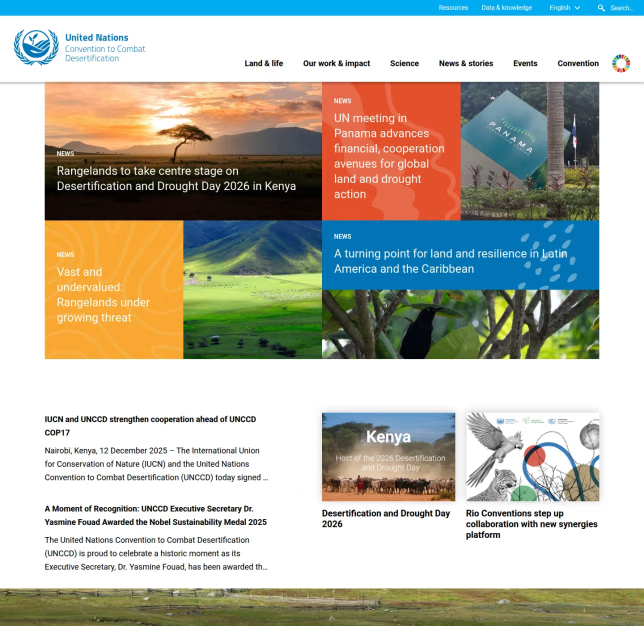
UNCCD operated four separate websites (two WordPress, two Drupal), leading to inconsistencies in design, content management, and user experience. A unified, scalable solution was needed to support a large-scale CMS migration project and improve efficiency and usability.
The modernization effort resulted in a cohesive, user-friendly, and scalable website, improving content management efficiency and long-term digital sustainability.
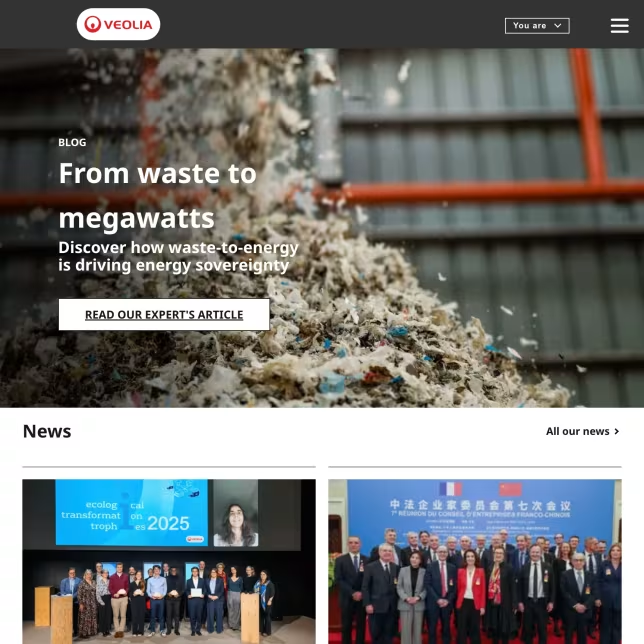
With Drupal 7 reaching end-of-life, Veolia needed a Drupal 7 to Drupal 10 enterprise migration for its Acquia Site Factory multisite platform—preserving region-specific content and multilingual capabilities across more than 200 sites.
The platform was modernized into a stable, scalable multisite foundation with improved performance, maintainability, and long-term upgrade readiness.
Oleksiy (PathToProject) worked with me on a specific project over a period of three months. He took full ownership of the project and successfully led it to completion with minimal initial information.
His technical skills are unquestionably top-tier, and working with him was a pleasure. I would gladly collaborate with Oleksiy again at any opportunity.

Nikolaj Stockholm Nielsen
Strategic Hands-On CTO | E-Commerce Growth
Oleksiy (PathToProject) has been a valuable developer resource over the past six months for us at LSHTM. This included coming on board to revive and complete a stalled Drupal upgrade project, as well as carrying out work to improve our site accessibility and functionality.
I have found Oleksiy to be very knowledgeable and skilful and would happily work with him again in the future.

Ali Kazemi
Web & Digital Manager at London School of Hygiene & Tropical Medicine
As Dev Team Lead on my project for 10 months, Oleksiy (PathToProject) demonstrated excellent technical skills and the ability to handle complex Drupal projects. His full-stack expertise is highly valuable.

Laurent Poinsignon
Domain Delivery Manager Web at TotalEnergies
These articles expand on the operational and governance concerns that shape reliable customer data infrastructure. They cover identity confidence, schema and event contract control, deletion propagation, and the delivery pitfalls that often appear when CDP programs move from pilot to enterprise scale.
Let’s review your CDP data flows, warehouse interfaces, and operational controls, then define a prioritized plan to improve reliability, observability, and safe change management.