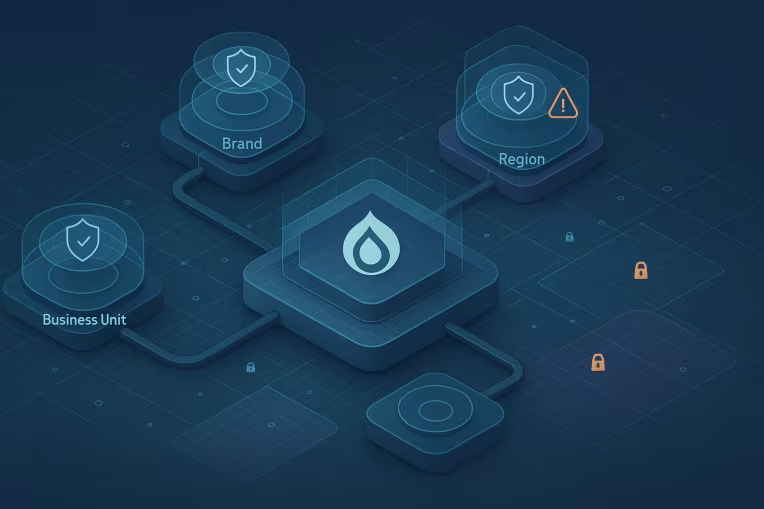
Enterprise multisite programs are often created for the right reasons. Shared codebases reduce duplication. Centralized platform teams improve standards. Reusable patterns make it easier to launch additional brands, regions, or business units without rebuilding the entire stack each time.
But standardization is not the same thing as isolation.
A Drupal estate can look well-governed from a delivery perspective while still carrying cross-tenant risk in day-to-day operations. The problem is usually not a single dramatic platform flaw. It is the accumulation of small assumptions: a role granted too broadly, a search index scoped too widely, a cache context missed in a custom component, or an integration credential reused across sites because it was expedient at the time.
That is why Drupal multisite tenant isolation should be treated as an architectural and governance concern, not just a hosting decision. In large enterprise platforms, the real question is not whether multiple sites share infrastructure. The question is whether the boundaries between tenants are explicit, testable, monitored, and recoverable.
Why multisite standardization does not guarantee isolation
Enterprise teams often describe multisite as "shared where possible, separated where necessary." That is a sensible principle, but it only works when the platform has a clear definition of what must be separated.
In practice, shared Drupal platforms usually centralize several things at once:
- code and deployment pipelines
- design systems and frontend components
- module sets and configuration patterns
- user management approaches
- search, analytics, and other shared services
- operational support and release governance
None of those choices are automatically wrong. In fact, they are often what makes enterprise Drupal viable at scale.
The risk appears when the platform assumes that shared delivery mechanics also guarantee tenant boundaries. They do not. A single codebase can support strong separation, weak separation, or inconsistent separation depending on how the estate handles configuration ownership, access control, content modeling, files, caching, and integrations.
A useful audit mindset is this: multisite is a delivery model, while tenant isolation is a control model. The first helps teams move faster. The second determines whether a mistake in one site can affect another.
The main isolation surfaces: content, config, files, search, cache, identities, integrations
A good Drupal multisite audit does not stop at infrastructure diagrams. It reviews the full set of surfaces where tenants can influence one another, intentionally or accidentally.
Content boundaries
Content isolation is the most visible surface and often the first one business stakeholders think about.
Questions to examine include:
- Can editors from one brand or region view, edit, publish, or unpublish content for another?
- Are entity reference patterns capable of pulling content from the wrong site or group boundary?
- Do shared content types introduce ambiguity around ownership, workflow, or moderation?
- Are scheduled publishing, translation, and media workflows scoped correctly per tenant?
The audit should account for both intended sharing and unintended exposure. Some enterprises do want carefully controlled content syndication across sites. That is different from accidental cross-site visibility caused by weak permissions or loose content queries.
Configuration boundaries
Configuration is where many hidden risks live because the platform may appear stable until a deployment or admin change creates cross-tenant side effects.
Review whether:
- site-specific configuration is clearly separated from globally shared configuration
- administrators understand which changes are safe to make locally and which belong in the platform baseline
- feature toggles, content model variations, or view settings can change behavior outside the intended tenant
- deployment processes validate tenant-specific overrides before release
In large estates, configuration drift is not just a maintenance problem. It can become an isolation problem when one site's exception alters shared assumptions for others.
File and media boundaries
Shared file systems, media libraries, or asset delivery patterns deserve specific attention.
Audit teams should look at:
- whether uploads are logically and operationally separated by tenant
- whether media references can expose assets across sites unintentionally
- whether file access policies match content access policies
- whether CDN or storage rules allow predictable segregation and cleanup
Even when direct file access is restricted, metadata leakage or mistaken reuse of media assets can still create governance and brand risks.
Search boundaries
Search mistakes are common in enterprise multisite estates because search services are often centralized for efficiency.
The key issue is scope. Can the search index, crawler, or API distinguish clearly between tenants? Are filters applied consistently in ingestion and in query execution? Can a site search experience surface content from another site because the index design assumes a broader corpus than the business expects?
This is especially important in multi-brand and multi-region estates where content may be similar enough that errors are not immediately obvious.
Cache boundaries
Drupal cache isolation is one of the most technically subtle areas because problems can be intermittent and hard to reproduce.
Audit questions include:
- Are cache contexts and tags complete for user state, geography, language, site, and brand variations?
- Do reverse proxy or CDN rules separate tenants appropriately?
- Can personalized or access-dependent fragments be cached too broadly?
- Do shared domains, preview environments, or edge rules introduce contamination paths?
A cache issue does not have to be catastrophic to matter. Even occasional cross-tenant rendering can create brand, legal, or trust problems.
Identity and access boundaries
Multisite access control is usually where governance drift becomes most visible over time.
Review:
- role definitions and whether they mean the same thing across all tenants
- administrative scopes for platform, site, and content operations
- SSO group mappings and automated provisioning rules
- emergency or temporary access patterns that were never revoked
- non-human accounts, service users, and API credentials
One of the most common enterprise failure modes is role expansion through convenience. A permission granted to speed up one workflow later becomes normalized across the estate, even though it crosses boundaries the original governance model intended to preserve.
Integration boundaries
Integrations often receive less attention than editorial permissions, but they can create some of the most damaging cross-tenant issues.
Check whether tenants have distinct:
- API credentials
- webhook routing rules
- CRM or marketing automation mappings
- analytics and consent configurations
- feed imports and export jobs
- queue workers and retry handling
Shared integrations are not inherently bad. The risk appears when tenant identity is not explicit in message flow, error handling, logging, or downstream processing.
Common failure modes in large Drupal multisite estates
Most platform issues are not caused by a single bad decision. They emerge from layered operational shortcuts that made sense locally.
Common patterns include:
- Role leakage: a role designed for one site is copied widely, but its permissions exceed what other tenants should have.
- Shared service assumptions: a platform team assumes a search, analytics, or media service is safely segmented, but the segmentation rules are incomplete or inconsistently applied.
- Cache bleed: a custom component omits required cache contexts, causing output variation by brand, locale, or user segment to be cached too broadly.
- Search scope mistakes: content from multiple sites enters a common index, but tenant filters are weak or bypassed in some experiences.
- Configuration side effects: a change made for one tenant is implemented in shared configuration and changes behavior elsewhere.
- Integration cross-talk: inbound or outbound payloads are routed by convention instead of strict tenant identifiers, so updates can land in the wrong downstream process.
- Exception sprawl: one-off tenant customizations accumulate until the estate no longer has a clear baseline for what is shared versus isolated.
These are the issues a mature enterprise Drupal multisite architecture review should expect to find. They are not proof that multisite is failing. They are signs that the platform has grown faster than its boundary controls.
What a tenant isolation audit should inventory
A practical tenant isolation audit should produce more than a list of technical observations. It should create a usable map of shared and separated responsibilities across the platform.
At minimum, the audit should inventory the following categories.
1. Tenant model and boundary intent
Start by documenting what a tenant actually means in the estate.
For example:
- Is a tenant a brand, country, region, business unit, program, or legal entity?
- Which resources are supposed to be shared across all tenants?
- Which resources are shared only within a subgroup?
- Which resources must never cross boundaries?
Without this definition, teams often evaluate the platform against inconsistent assumptions.
2. Site topology and ownership
Document all sites, domains, environments, and operational owners.
This helps reveal where governance is centralized, where it is delegated, and where ownership is ambiguous. Ambiguous ownership is often where exceptions persist longest.
3. Access model
Inventory:
- human roles
- platform admin scopes
- editorial roles
- SSO mappings
- service accounts
- temporary access patterns
- approval workflows for privilege changes
Then compare the real model to the intended model. In many estates, the documentation says one thing while the actual group mappings or inherited permissions say another.
4. Shared versus tenant-specific configuration
Create a configuration inventory that distinguishes:
- global platform baseline
- tenant override layers
- environment-specific settings
- custom modules or theme logic with tenant branching
The goal is to identify where tenant-specific behavior is controlled and whether that control is auditable.
5. Data flow and integration map
Trace how each tenant exchanges data with external systems.
Include:
- source systems
- destination systems
- credentials
- routing identifiers
- batch jobs and queues
- failure and retry behavior
- logging and alerting ownership
This is where many hidden cross-tenant risks emerge, especially when integrations were onboarded incrementally.
6. Cache and delivery path review
Map the full delivery chain:
- Drupal render caching
- reverse proxies
- CDN behavior
- edge logic
- personalization layers
- preview and authoring paths
A tenant isolation audit should test whether cache keys and contexts reflect the dimensions that matter in the estate.
7. Search and discovery scope
Review how content enters search indexes and how it is filtered at retrieval time.
Do not assume that search boundaries are safe just because content is modeled correctly in Drupal. Search often introduces a separate layer of scope logic.
8. Exception register and compensating controls
Every mature multisite estate has exceptions. The important question is whether they are visible and governed.
Inventory:
- known deviations from the platform standard
- business justification
- owner
- expiry or review date
- compensating controls
- rollback or remediation plan
That turns informal exceptions into manageable risk instead of hidden platform debt.
Designing safer boundaries without abandoning shared delivery
A strong audit does not automatically lead to a recommendation to split the platform apart. Often the better answer is to redesign boundaries so the estate keeps the benefits of shared delivery while reducing cross-tenant exposure.
Practical design approaches include:
Make tenant identity explicit everywhere
Tenant identity should not depend on convention, naming habits, or team memory.
It should be explicit in:
- content ownership rules
- access scopes
- search filters
- cache variation logic
- integration payloads
- monitoring and logs
The more a platform relies on implied tenant context, the harder it becomes to prove isolation.
Reduce the number of broadly shared administrative capabilities
Not every admin function needs to be available to every operator. Separate platform administration from site administration and site administration from editorial administration where possible.
This is not just a security principle. It reduces the blast radius of routine mistakes.
Standardize boundary patterns, not only components
Many enterprise teams are good at standardizing UI components and release tooling. Fewer standardize the isolation patterns behind them.
Useful standards may include:
- approved permission models
- cache variation requirements for custom components
- search indexing conventions
- integration onboarding checklists
- rules for tenant-specific configuration
This is where Acquia Site Factory governance or similar platform governance models matter most: not as vendor mechanics, but as operating discipline around shared platform boundaries. Large estates such as Veolia show how configuration governance, rollout control, and caching strategy become inseparable from multisite risk management at scale.
Design for controlled sharing instead of accidental sharing
Some content, assets, or services may need to be shared across tenants. That is fine when sharing is deliberate, visible, and revocable.
Prefer mechanisms that:
- define what is shareable
- define who approves sharing
- preserve source ownership
- log usage across tenants
- allow rollback without broad platform change
Controlled sharing is very different from weak isolation.
Operational controls, monitoring, and exception handling
Architecture alone does not preserve tenant boundaries. Operations do.
Enterprise platform teams should treat isolation as something they continuously validate, not something they assume after initial launch.
Key operational controls include:
Change review with boundary impact in scope
Release reviews should ask more than "Does this feature work?" They should also ask:
- Could this alter tenant scope?
- Does it change access behavior?
- Does it introduce new caching or search rules?
- Does it create a new integration path?
This is especially important for custom code, shared modules, and platform-wide configuration changes.
Automated tests for boundary-sensitive behavior
Where possible, include tests that validate:
- access restrictions between representative tenant roles
- search filtering by tenant
- cache behavior under varying tenant contexts
- integration routing with explicit tenant identifiers
Not every risk can be fully automated, but even a targeted suite helps prevent regressions.
Logging and alerting that preserve tenant context
If incidents occur, teams need to know which tenant was affected and whether any spillover occurred.
Logs and alerts should make tenant context visible in a way that supports investigation without requiring guesswork.
Periodic access recertification
Access drift is predictable in large enterprises. Recertifying roles, SSO mappings, and service accounts is one of the simplest ways to reduce cross-tenant risk.
Exception review cadence
Exceptions should be time-bound where possible. A quarterly or release-based review cycle helps prevent temporary accommodations from becoming permanent, undocumented architecture.
Recovery playbooks
A mature platform should know how to respond if a boundary fails.
That can include:
- content takedown procedures
- cache purge strategies
- credential rotation steps
- index rebuild plans
- access rollback procedures
- communication paths to affected site owners
Recovery planning matters because some tenant isolation incidents are operationally small but reputationally sensitive.
When a shared multisite model is no longer the right fit
A balanced view matters here. Multisite is not inherently unsafe, and single-site separation is not inherently better. The right model depends on how much shared behavior the organization can govern with confidence.
A shared model may no longer be the right fit when:
- tenant-specific requirements dominate more than shared standards
- regulatory or contractual boundaries require stronger separation than the platform can practically enforce
- exception volume keeps rising and the baseline is no longer clear
- shared releases create unacceptable coordination overhead across business units
- integration or identity models are too divergent to manage safely in one operating pattern
At that point, the decision is not ideological. It is architectural. The question becomes whether the governance cost of preserving a shared model exceeds the delivery value it provides.
For many enterprises, the answer will still be to keep multisite and improve controls. For others, the better answer may be a more segmented platform strategy. A good audit should help leadership make that decision with evidence rather than instinct.
Conclusion
The most useful way to evaluate Drupal multisite tenant isolation is to stop treating it as a narrow hosting concern and start treating it as a platform control problem.
Shared Drupal estates can be highly effective for multi-brand, multi-region, and multi-business-unit delivery. But they stay effective only when the boundaries between tenants are explicit across content, configuration, files, search, cache, identities, and integrations.
That is what a strong tenant isolation audit provides: a clear inventory of where boundaries exist, where they are assumed, where they have drifted, and what operational controls are needed to keep shared delivery safe.
For enterprise teams, that clarity is often more valuable than any specific technical fix. It turns multisite from a convenient implementation pattern into a governable platform model.
Tags: Drupal, Drupal multisite tenant isolation, Enterprise architecture, Platform governance, Security, Acquia Site Factory governance