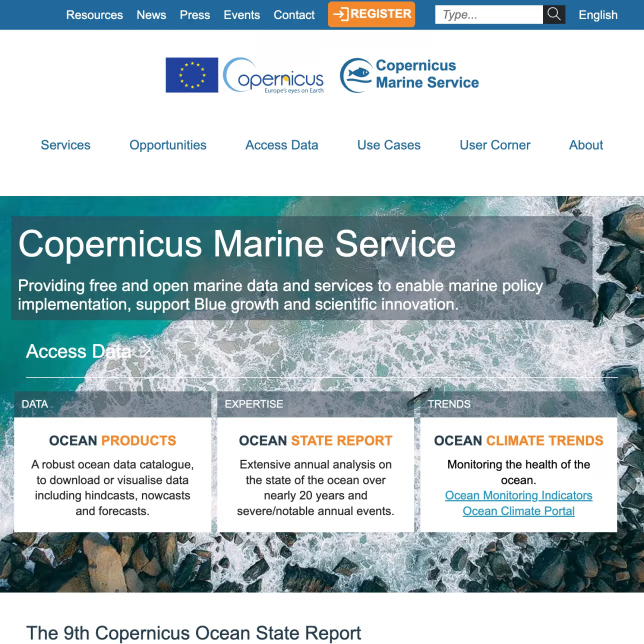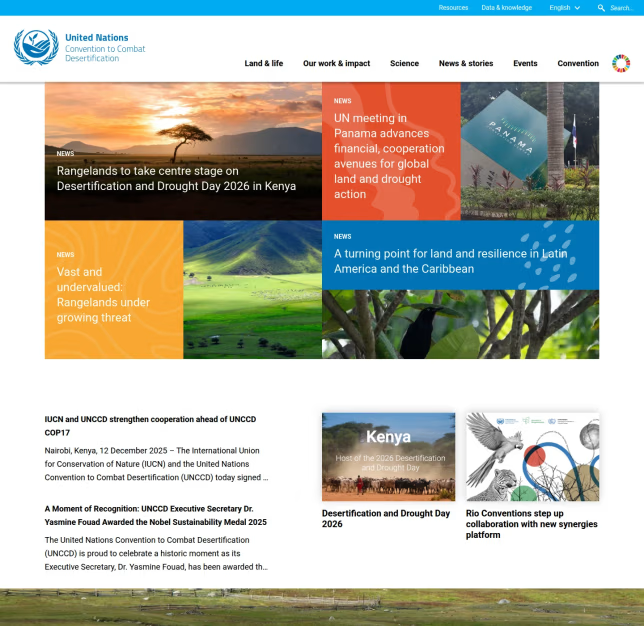
In many enterprise Drupal programs, navigation looks deceptively simple at the start. A global header is designed, a footer is agreed, and a few menu patterns are rolled out across sites. From a delivery perspective, the platform may appear standardized.
But over time, navigation often becomes one of the clearest signs that the platform is not actually operating as a shared system.
One business unit adds direct links to campaign landing pages. A region renames core sections to match local terminology. Another team duplicates links because the original destination is hard to find. Local administrators create emergency workarounds for missing content, while central platform teams assume navigation is being managed consistently. The code may still be shared, but the user journey is no longer coherent.
That is why Drupal navigation governance should be treated as a structural and operational concern. Menus are not just presentation elements. They express content priorities, reflect ownership decisions, shape findability, and influence how well a multi-site platform can support reuse and localization.
Why navigation becomes platform debt in Drupal multisite estates
Navigation debt tends to accumulate because it sits between several disciplines without being fully owned by any of them.
Frontend teams may implement the components, but they are rarely responsible for long-term menu quality. Editors may have permission to manage links, but not the authority to define cross-site structure. Information architects may design the initial model, but not govern ongoing exceptions. Platform leaders may assume shared menus will remain shared simply because the code is shared.
In a Drupal multisite estate, this ambiguity matters. Navigation is one of the few elements that users encounter on nearly every page, across every region and business unit. When it drifts, the effects are broad:
- shared templates stop producing shared experiences
- content reuse becomes harder because destinations are labeled differently across sites
- local teams create workarounds instead of using the intended structure
- global reporting becomes less meaningful because navigation patterns are inconsistent
- users have to relearn the platform from one site or market to another
This is why navigation debt is so persistent. It rarely fails in a dramatic way. Instead, it degrades gradually through small local decisions that seem reasonable in isolation.
Common sources of menu drift across regions and business units
Menu drift usually does not start with negligence. It starts with unresolved questions.
Who decides whether a global item can be renamed locally? When should a region be allowed to hide a section that is irrelevant in that market? What happens when a business unit wants a shortcut to a high-priority page that does not fit the shared hierarchy? If those decisions are not governed, teams answer them ad hoc.
Common sources of drift include:
- Duplicated links: the same destination appears in multiple menus because teams are trying to compensate for weak findability
- Inconsistent labels: one site uses "Solutions," another uses "Capabilities," and a third uses "Services" for overlapping content
- Orphaned pages: content is published but not meaningfully connected to navigational paths, so users can only reach it through search or direct links
- Regional overrides: local teams replace or suppress shared items without a defined exception model
- Campaign contamination: temporary promotional links become permanent parts of core navigation
- Unclear destination strategy: menu items point to landing pages in some markets, listing pages in others, and detail pages elsewhere
In Drupal, these issues can appear even when content types and templates are well controlled. Standardized content modeling does not automatically produce standardized navigation behavior.
Navigation as a structured content and governance problem
A useful way to improve Drupal menu governance is to stop thinking of menus as loose collections of links.
In enterprise environments, navigation should be treated as a structured content system with explicit rules. That does not mean overengineering every menu item. It means acknowledging that navigation has:
- purpose
- hierarchy
- ownership
- lifecycle
- dependencies on content and localization
A menu item is not only a label and URL. It also represents decisions such as:
- whether the item is global, regional, or site-specific
- what kind of destination it is allowed to link to
- whether the label is fixed, translatable, or locally adaptable
- which team owns the destination page and resulting user journey
- how exceptions are proposed, reviewed, approved, and retired
This is where Drupal content architecture and navigation governance intersect. Navigation should reflect the platform's information architecture, not substitute for missing architecture.
If teams are constantly adding direct links because users cannot find content, the real issue may be weak landing pages, poor section design, or unclear content relationships. Menus should help users orient themselves. They should not become a catch-all solution for every discoverability problem.
Local variation vs shared global navigation rules
A mature menu ownership model does not force every site into identical menus. It distinguishes between what must be shared and what may vary.
This distinction is critical in Drupal multisite navigation because enterprises usually need both:
- a recognizable cross-site structure for brand consistency and user familiarity
- local flexibility for market realities, legal constraints, service availability, or organizational differences
The governance challenge is not whether variation is allowed. The challenge is defining the categories of variation.
A practical model often starts with a few rule layers:
-
Global mandatory navigation
Items that appear across all sites because they represent universal corporate priorities or platform-wide orientation. -
Global recommended navigation
Items that should generally appear, but may be adapted or omitted under approved conditions. -
Local extension zones
Clearly defined areas where regional or business-unit teams can add relevant links without changing the global structure. -
Temporary or contextual navigation
Campaign or program links with expiration rules and review dates. -
Restricted exception paths
Changes that require governance review because they affect core findability or cross-site consistency.
This approach helps teams avoid a false choice between central control and total local freedom. The goal is controlled flexibility.
Without these layers, local teams often make structural changes to solve short-term needs. Over time, those changes accumulate into platform inconsistency.
Localization, fallback, and market-specific exceptions
Localization makes navigation governance harder because it introduces legitimate reasons for variation.
A direct translation of a menu label is not always the right answer. In some markets, product categories, public sector terms, or regulatory concepts may need different wording. In others, certain content areas may not exist at all. Some regions may need extra access points for legal disclosures, support structures, or country-specific offerings.
This is why a strong localized navigation strategy needs more than translation workflows. It needs policy.
Useful policy questions include:
- Which labels are translatable but conceptually fixed?
- Which labels can be adapted for local comprehension?
- Which destinations require market-specific replacements rather than direct translation?
- What is the fallback behavior when localized destination content does not exist?
- Who approves suppression of a shared global item in a given market?
Fallback is particularly important. If a translated label points to a destination that does not exist locally, teams often improvise. They may link to a different page, point to global content in another language, or remove the item altogether. Each option may be valid in some cases, but not without a rule set.
A better governance approach defines fallback patterns up front, such as:
- show approved global content when local content is unavailable
- redirect to a localized section overview rather than a missing detail page
- hide the item only when an approved exception exists
- flag the missing destination for content ownership review
These are operating decisions, not design details. They prevent navigation from becoming a patchwork of market-by-market improvisation.
Search, analytics, and UX consequences of poor navigation governance
Poor navigation governance does not only affect menus. It can also weaken findability across the broader platform.
When labels differ significantly from site to site, users may struggle to predict where information lives. A section called "Insights" in one region and "Resources" in another may technically contain similar content, but users do not experience that as consistency.
Search can also become less effective indirectly. If navigation sends users through inconsistent paths, content may be organized unevenly, landing pages may be bypassed, and user expectations about terminology may diverge from page structure. This does not justify exaggerated SEO claims, but it does reflect a real architectural problem: weak navigation often correlates with weaker information scent.
Analytics become harder to interpret as well. If one market routes users through top-level product pages, another through campaign pages, and another through manually curated shortcuts, cross-site comparisons become noisy. Teams may think they are measuring content performance when they are actually measuring differences in menu design and local governance choices.
From a UX perspective, the consequences are usually visible in familiar patterns:
- users rely on search because they do not trust navigation
- important pages receive traffic from direct links but remain hard to discover through browsing
- support or contact pages accumulate as "safe destinations" because upstream pathways are unclear
- sections grow bloated because teams fear removing links that compensate for structural weaknesses
In other words, navigation drift can become a symptom and a cause of findability problems.
Recovery patterns: ownership, review workflow, and model redesign
Recovering from navigation drift usually requires more than a cleanup project. If the operating model stays vague, the menus will drift again.
A practical recovery effort often has three parallel tracks.
1. Clarify ownership
Start by identifying who owns which decisions.
That typically includes:
- platform ownership for shared navigation principles and cross-site consistency
- information architecture ownership for hierarchy, labeling standards, and structural logic
- editorial or content ownership for destination quality and lifecycle management
- regional or business-unit ownership for approved local variation
Ownership should be explicit enough that teams know who can approve a new top-level item, who can request a local exception, and who is accountable when a navigational path stops making sense.
2. Introduce a review workflow
Navigation changes with broad user impact should not be handled as informal content edits.
A lightweight review workflow can help evaluate requests against criteria such as:
- Does the proposed link solve a structural problem or just mask one?
- Is the destination stable enough to belong in persistent navigation?
- Does the label match established naming conventions?
- Should the need be addressed through page design, taxonomy, search tuning, or cross-linking instead?
- Is this request global, regional, or site-specific?
- When should this item be reviewed again?
The workflow does not need to be bureaucratic. It needs to make structural decisions visible.
3. Redesign the navigation model where necessary
Sometimes governance alone is not enough because the menu model itself is flawed.
Warning signs include:
- too many top-level items competing for attention
- mixed destination types within the same level of hierarchy
- labels based on internal organization rather than user tasks
- persistent dependence on manual shortcuts
- core journeys that require users to understand local exceptions
In those cases, the right response may be model redesign rather than stricter enforcement. A revised model might define clearer section purposes, separate corporate and market-level concerns, or create standardized local extension patterns.
This is also where enterprise information architecture matters. Good governance cannot rescue a structure that was never coherent. But it can preserve a coherent structure once one exists.
A practical governance checklist for Drupal multisite teams
For teams trying to make progress without turning navigation into a large transformation program, a focused checklist can help.
Review your current state against questions like these:
- Are global, local, and temporary navigation items clearly distinguished?
- Are destination types defined for each menu level?
- Do labels follow shared naming conventions across sites and regions?
- Is there a documented process for regional exceptions?
- Are fallback rules defined for missing localized destinations?
- Can teams explain why duplicate links exist?
- Are orphaned pages a content problem, a navigation problem, or both?
- Is menu performance being interpreted alongside structure and content context?
- Do governance decisions live in documentation that editors and platform teams actually use?
Even answering these questions often reveals that the platform's biggest menu issues are not technical limitations. They are unresolved governance decisions.
Conclusion
In enterprise Drupal programs, navigation is often assumed to be a solved layer once the header and menus are implemented. In practice, it is one of the most fragile shared systems in a multisite estate.
That fragility comes from weak ownership, unclear exception handling, and the tendency to treat menus as simple UI elements rather than expressions of content architecture. When that happens, menu drift undermines reuse, complicates localization, and makes findability less predictable from one site or market to another.
A stronger Drupal navigation governance approach does not require eliminating local variation. It requires defining where variation belongs, how it is reviewed, and how navigation connects to broader information architecture and editorial operating models.
Teams that do this well usually end up with more than cleaner menus. They gain a platform that is easier to scale, easier to localize, and easier for users to trust.
Tags: Drupal, Drupal navigation governance, Drupal multisite navigation, Enterprise CMS, Information architecture, Editorial governance