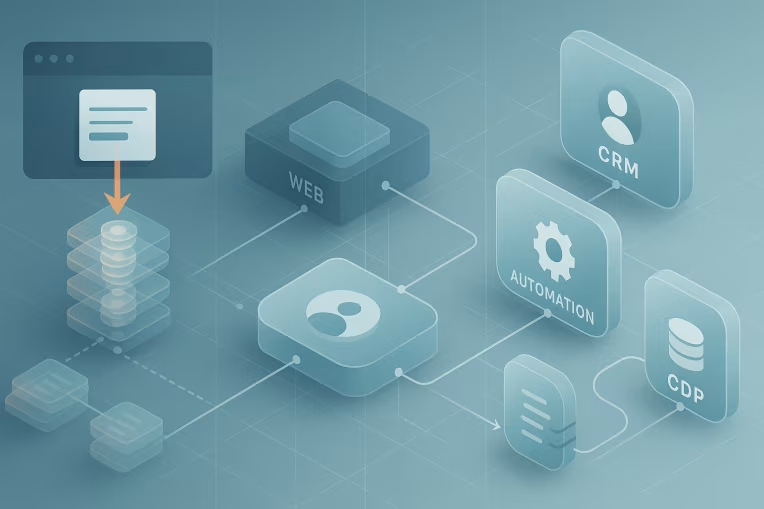
A duplicate lead record rarely starts as a dramatic systems failure. More often, it starts with a perfectly ordinary form submission that gets processed more than once as it moves through the browser, web application, integration layer, CRM, marketing automation platform, and CDP.
The result is familiar to many enterprise teams: one person fills out one form, but three records appear somewhere in the stack. Sales sees repeated leads. Marketing sees inflated conversions. Data teams see conflicting timelines. Nobody is fully confident in attribution, funnel reporting, or downstream activation.
In most cases, this is not just a bad API mapping or a careless implementation detail. It is a contract problem across systems that were never fully aligned on what counts as the same submission, which system is allowed to retry it, and how duplicates should be treated for reporting versus profile unification.
For organizations running lead capture across Drupal, WordPress, or other enterprise web platforms, the lesson is not to blame the CMS. The same duplication patterns can appear in any stack when identifiers, acknowledgement behavior, and downstream rules are loosely defined.
Why duplicate lead records are usually architectural, not accidental
Teams often investigate duplicate submissions by looking for a single bug: a plugin firing twice, a webhook replay, a CRM sync issue, or a thank-you page event that triggered again. Those things do happen. But duplicate records persist because the architecture often allows them to happen without a shared rule for prevention.
A form submission can be represented in multiple ways at once:
- a browser-side analytics event
- a server-side form handler transaction
- a CRM lead or contact create request
- a marketing automation event
- a CDP track or identify call
- a conversion event on the thank-you page
If each of those actions uses a different identifier, a different clock, and a different retry policy, then the stack has no reliable way to prove that all of them refer to one original submission.
That is why form submission deduplication should be treated as a systems design issue. The core question is not only "where did the duplicate come from?" It is also:
- What is the canonical submission unit?
- Which ID represents it across systems?
- Which state changes indicate success, retry, or failure?
- Which systems are allowed to create new records?
- How should downstream tools deduplicate events versus people?
Without those answers, teams are left cleaning duplicates after the fact instead of preventing them upstream.
Where duplication enters: browser, form handler, CRM, CDP, and automation tools
Duplicate records can enter the pipeline at several points, and more than one source may be active at the same time.
In the browser, a user can double-click a submit button, reload after a slow response, or resubmit after a timeout message even though the first request succeeded. Frontend code can also fire multiple analytics events if validation, submit handling, and thank-you page logic are not coordinated.
In the form handler, server-side processing may create duplicate records when the same request is received twice and the backend has no idempotency check. This can happen when infrastructure retries a request, when reverse proxies reissue traffic, or when custom submission handlers process the same payload more than once.
At the CRM boundary, duplicate lead creation is common when integrations do not distinguish between create and upsert behavior. A timeout can be especially misleading: the CRM may have created the record, but the website never receives a clean confirmation, so the integration retries and creates another one. This is exactly the kind of boundary that benefits from stronger CRM data integration patterns.
In the CDP, the same submission may arrive as both a browser event and a server event with different event IDs. If identity stitching is incomplete or delayed, the platform may temporarily treat them as distinct events or even attach them to different profiles.
In marketing automation tools, webhook replays, import jobs, or workflow triggers can amplify duplication. A single lead create action may cause downstream campaign enrollment, email events, or custom object creation more than once if the automation layer lacks idempotent safeguards.
On thank-you pages, conversion events often get overcounted because page loads are easy to repeat. A bookmarked thank-you URL, browser refresh, or cross-domain redirect issue can make one form submission look like multiple conversions.
These are not edge cases. They are typical failure modes in distributed lead capture systems.
Event IDs, submission IDs, and idempotency keys
The cleanest way to reduce duplicate processing is to distinguish clearly between three concepts that teams often blur together.
Submission ID: the canonical identifier for the business action of submitting the form. This should be created once per successful submission attempt and persist across all downstream systems that need to refer back to that specific conversion.
Event ID: the identifier for a specific emitted event message. A single submission may generate several event messages, but each should still carry the canonical submission ID as a shared reference.
Idempotency key: the value used by a receiving system to determine whether it has already processed an equivalent request. In some architectures, the submission ID can also serve as the idempotency key. In others, a separate key is better because request semantics differ by endpoint.
A practical pattern looks like this:
- Generate a canonical submission ID at the point where the form is accepted by the server.
- Persist it in the web platform alongside the raw submission record and processing status.
- Include that submission ID in every downstream API call, event payload, and log entry related to that form submission.
- Use it as the idempotency reference when sending create or upsert requests to downstream platforms where possible.
- Preserve it in analytics and CDP events so reporting teams can reconcile submissions across systems.
This approach matters because email address alone is not enough. A user may legitimately submit multiple forms. A contact ID may not exist yet. A browser session ID can change. A CRM lead ID is usually generated too late to serve as the universal anchor.
If every system invents its own identifier, reconciliation becomes probabilistic. If systems share a canonical submission ID, reconciliation becomes operational.
Retry behavior, timeouts, and asynchronous acknowledgements
Many duplicate records are created by well-intentioned reliability patterns.
Retries are necessary in distributed systems. APIs time out, networks fail, queues back up, and third-party services return transient errors. But retry logic without idempotency is one of the fastest ways to create duplicate leads.
A common sequence looks like this:
- The website submits a lead to the CRM.
- The CRM processes it slowly but successfully.
- The website or middleware times out before receiving confirmation.
- The integration retries the request.
- The CRM creates a second record because it has no way to recognize the request as the same submission.
This can also happen in reverse with webhook consumers. A platform sends a webhook, the receiver processes it successfully, but the acknowledgement is delayed or lost. The sender replays the webhook, and the receiver processes it again.
To reduce this class of issue, teams should define explicit delivery semantics:
- Which operations are safe to retry?
- What status codes or acknowledgements count as success?
- How long should clients wait before retrying?
- How many retries are allowed?
- What key proves a retry is the same business event?
- Where is retry state stored and observable?
Asynchronous architectures also need clear state models. For example, a submission can move through states such as:
acceptedqueuedsent_to_crmcrm_confirmedsent_to_cdpcdp_confirmedfailed_retryablefailed_terminal
When these states are explicit, teams are less likely to re-run processing blindly. When state is implicit or scattered across logs, manual replays often create the next wave of duplicates.
A useful principle is simple: retry delivery, not business creation. Systems should be allowed to try again to deliver the same submission, but they should not interpret every retry as permission to create a new lead or conversion record.
Deduplication rules for reporting versus profile unification
One reason duplication is hard to fix is that not all forms of deduplication mean the same thing.
For reporting, the question is often: How many distinct form submissions occurred?
For identity resolution or profile management, the question is different: Which records belong to the same person or account?
Those are related but separate problems.
A single person can submit multiple legitimate forms. Those should usually unify to one profile but remain separate submission events.
Conversely, one submission can appear as multiple events due to retries or parallel tracking. Those may need to collapse to one conversion in reporting even if profile stitching is imperfect.
That is why downstream rules should distinguish between:
- event deduplication: removing repeated representations of the same submission
- record unification: associating multiple identifiers to one person or account
- reporting aggregation: deciding what counts as one conversion in dashboards and attribution models
Problems occur when teams assume one layer will solve all three.
A CDP may help unify profiles but still preserve duplicate events if event IDs differ. A CRM may merge contacts but keep separate lead or activity records. A BI team may deduplicate in a dashboard query, while automation workflows continue to trigger on raw duplicate events.
The better pattern is to define rules at each layer:
- In the web and integration layer, prevent duplicate submission creation where possible.
- In the event pipeline, preserve canonical submission IDs and event timestamps.
- In the CRM, prefer create-or-update patterns that respect idempotency and business keys.
- In reporting, define what counts as a unique conversion and document the logic.
- In activation systems, ensure repeated events do not trigger enrollment or notification more than intended.
This does not promise perfect identity resolution or perfect attribution. It does create a more trustworthy operating model.
Operational ownership across web, CRM, and data teams
Duplicate lead records often persist because ownership is fragmented.
The web team may own the form UX. The CRM team may own object models and lifecycle workflows. The marketing operations team may own automation triggers. The data team may own event ingestion and reporting logic.
Each team sees only part of the problem.
A browser engineer may confirm the submit button only fires once. The CRM architect may confirm duplicate rules exist on lead email. The CDP engineer may confirm both browser and server events are arriving as designed. Marketing operations may confirm workflows are functioning according to trigger rules. Yet the business still sees duplicate conversions.
This is why governance matters as much as implementation.
A workable ownership model usually includes:
- a named owner for the canonical lead capture contract
- documented payload specifications for form submissions and conversion events
- agreed definitions for submission ID, event ID, contact ID, and business keys
- retry and replay policies for each integration boundary
- a runbook for investigating suspected duplicates
- observability that spans web logs, middleware, CRM responses, and CDP events
For enterprise organizations, this often sits at the intersection of customer data infrastructure, CRM data integration, customer data infrastructure, event pipeline architecture, and web tracking implementation. No single team can fully solve it alone.
A practical audit checklist for lead capture pipelines
If duplicate records are appearing across your stack, an audit should start with the submission journey from the first accepted request to the last downstream activation.
Use this checklist to structure that review.
1. Define the canonical submission moment
- At what exact point is a form considered successfully submitted?
- Is that moment determined in the browser, on the server, or after a downstream acknowledgement?
- Can multiple code paths declare success?
2. Identify all systems that receive the submission
- Web platform n- CRM
- CDP
- marketing automation platform
- analytics tools
- middleware, queues, or iPaaS layers
- data warehouse or reporting exports
Map whether each system receives the payload directly, through a queue, via webhook, or from a downstream replication.
3. Trace the identifiers
- Is there a canonical submission ID?
- Is it generated once and reused everywhere?
- Do browser and server events share that same reference?
- Are CRM and automation records storing it in a queryable field?
4. Review duplicate entry points
- Double-click submissions
- browser refreshes
- thank-you page reloads
- webhook replays
- API retries after timeout
- parallel browser and server event sending
- manual resubmission by operations teams
- batch reprocessing after failure recovery
5. Inspect idempotency controls
- Which endpoints accept idempotency keys?
- Which systems perform upserts versus unconditional creates?
- Where are duplicate checks based on weak fields like email only?
- Are idempotency windows long enough for realistic retry delays?
6. Examine state and acknowledgement behavior
- What response counts as success?
- Are asynchronous writes acknowledged before completion?
- Is retry state recorded centrally?
- Can operators tell whether a request failed, is still pending, or already succeeded?
7. Separate reporting logic from profile logic
- What defines one unique conversion?
- What defines one person?
- Are dashboard counts based on raw events, filtered events, or deduplicated submissions?
- Are activation workflows triggered by raw or deduplicated events?
8. Confirm governance and escalation paths
- Who owns the lead capture contract?
- Who approves schema changes?
- Who investigates when duplicates exceed a threshold?
- Who signs off on replay jobs or backfills?
This audit usually reveals that duplication is not coming from one dramatic flaw. It is emerging from multiple reasonable decisions that were never stitched together into a single operating model.
Practical controls that help reduce duplicates
Teams do not need a perfect architecture to make meaningful improvements. A few controls often reduce duplicate creation substantially.
Technical controls
- Generate a server-side canonical submission ID for every accepted form.
- Store processing state durably before calling downstream systems.
- Use idempotency keys for create operations wherever supported.
- Prefer upsert or create-with-external-key patterns over unconditional creates when they fit the business model.
- Send browser and server events with shared submission references.
- Avoid counting thank-you page views as the sole source of conversion truth.
- Add replay protection for webhook consumers.
- Log request IDs, submission IDs, and downstream response codes in a correlated way.
Governance controls
- Document which system is the source of truth for submission creation.
- Define a standard for unique conversion counting across analytics and BI.
- Review automation workflows for repeated triggers on duplicate events.
- Establish approval for schema changes that affect identifiers or event emission.
- Create an operational runbook for retries, replays, and manual recovery.
The goal is not to eliminate every duplicate possibility. It is to make duplicate creation uncommon, visible, and governable.
Conclusion
When one form submission turns into three records, the issue is usually bigger than a single connector or plugin. It reflects a gap in how the organization defines, transmits, retries, and interprets the submission across systems.
That is why form submission deduplication should be approached as a cross-system contract. The web platform needs a canonical submission record. The integration layer needs idempotent delivery. CRM and CDP pipelines need shared identifiers. Reporting and activation layers need clear rules for what gets collapsed and what remains distinct.
Enterprise teams that do this well do not rely on luck or downstream cleanup alone. They define submission identity explicitly, make retries safe, separate event deduplication from profile unification, and assign operational ownership across web, CRM, and data functions.
The payoff is not just cleaner records. It is more trustworthy conversion reporting, less friction for sales and marketing teams, and a lead capture pipeline that behaves more like an engineered system than a collection of loosely connected tools.
Tags: CDP, form submission deduplication, CRM CDP integration, lead capture data quality, conversion deduplication, event idempotency, web to CRM data contracts