


 [01]
[01]Discovery and Audit
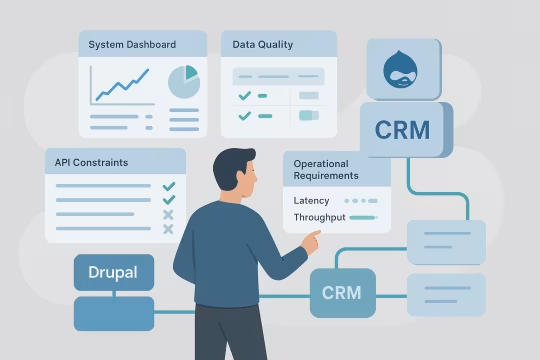
Assess current Drupal touchpoints, CRM configuration, and existing integrations. Capture data quality issues, API constraints, and operational requirements such as latency, throughput, and support responsibilities.
Drupal CRM integration readiness
Use a Drupal health check to surface mapping gaps, brittle API flows, governance issues, and upgrade risks before you commit to integration changes.
Built for Drupal teams managing Salesforce, HubSpot, webforms, queues, and consent-sensitive data flows.
No login required. Takes 2–3 minutes.
Drupal often becomes the primary entry point for customer interactions: lead capture, event registrations, gated content, and authenticated experiences. When CRM connectivity is incomplete or inconsistent, customer records fragment across systems and teams compensate with manual exports, ad-hoc scripts, and duplicated logic in multiple applications. This is where Drupal CRM integration services become critical for enterprise teams that need dependable customer data movement across platforms.
Drupal CRM integration aligns Drupal’s content and interaction layer with CRM systems such as Salesforce and HubSpot through explicit data contracts, mapped entities, and controlled synchronization workflows. The work typically includes OAuth-secured API authentication, field-level mapping, validation rules, error handling, and observability so integrations remain stable as both Drupal and the CRM evolve.
For enterprise platforms, the goal is not only “sending leads” but establishing a maintainable integration architecture: clear ownership of data, predictable sync behavior, and platform integration governance that supports multi-site, multiple forms, and changing campaign requirements without repeatedly re-implementing the same connectivity patterns.
Core Focus
Best Fit For
Key Outcomes
Technology Ecosystem
Platform Integrations
As Drupal platforms grow, customer interactions expand across multiple sites, forms, and authenticated journeys. Without a consistent integration layer, teams implement one-off connectors per campaign or per site, each with different mapping rules, validation behavior, and error handling. Over time, the CRM becomes populated with inconsistent fields, duplicated contacts, and partial attribution data that is difficult to reconcile.
Engineering teams then inherit operational complexity: integrations fail silently, API limits are exceeded, and changes in CRM schemas or authentication policies break production workflows. When data contracts are not explicit, upstream changes in Drupal content models or form structures propagate unpredictable downstream effects. The result is brittle coupling between the web platform and CRM, with limited observability into what was sent, what was rejected, and why.
Operationally, this creates delivery bottlenecks and risk. Marketing teams wait for fixes, reporting becomes unreliable, and compliance requirements (consent, retention, auditability) are handled inconsistently across touchpoints. The platform spends increasing effort on maintenance rather than evolving customer experiences and data capabilities.
Review Drupal touchpoints (forms, accounts, events), CRM objects, and current data flows. Identify authoritative sources, required fields, consent constraints, and operational expectations such as latency, volume, and failure handling.
Define canonical payloads, field mappings, validation rules, and identifiers for contacts, leads, and related objects. Document ownership boundaries and establish versioning expectations to reduce breaking changes across teams.
Select integration patterns (server-side calls, queues, webhooks) and design authentication using OAuth/token rotation. Define secrets management, least-privilege scopes, and network controls appropriate for enterprise environments.
Implement Drupal-side integration modules, event subscribers, and webform handlers. Normalize data, enforce validation, and create reusable services so new forms and sites can adopt the same integration patterns consistently.
Coordinate CRM-side objects, custom fields, and validation rules to match the data contract. Establish error semantics and ensure that required fields, deduplication rules, and lifecycle stages behave predictably.
Add retry strategies, dead-letter handling, and idempotency controls to prevent duplicates. Implement structured logging, correlation IDs, and dashboards/alerts so failures are visible and diagnosable.
Create automated tests for mapping logic and API interactions, including contract tests against mocked endpoints. Validate edge cases such as partial submissions, consent changes, and CRM-side validation failures.
Deploy with controlled rollout, feature flags where appropriate, and runbooks for operations. Establish change management for schema updates, credential rotation, and ongoing monitoring responsibilities.
This capability focuses on building durable Drupal CRM integration services for Salesforce and HubSpot through explicit data contracts, secure OAuth API access, and resilient synchronization workflows. The emphasis is on predictable behavior under change: schema evolution, new campaigns, additional sites, and increasing traffic. Implementations prioritize observability, idempotency, and platform integration governance so integrations remain maintainable across teams and release cycles.
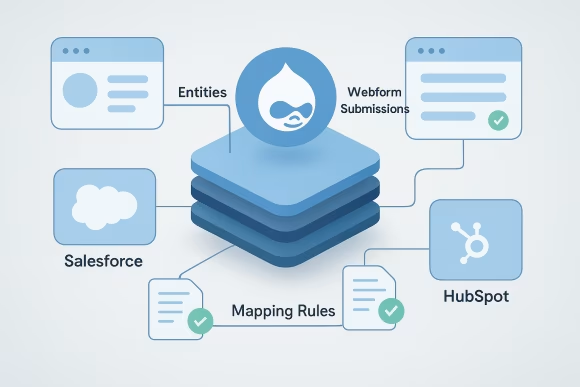
Translate Drupal entities and webform submissions into CRM objects using explicit mapping rules, normalization, and validation. Mapping is implemented as versionable configuration or code, enabling controlled evolution when fields change. This reduces drift between marketing requirements and CRM schemas while keeping the integration logic auditable.
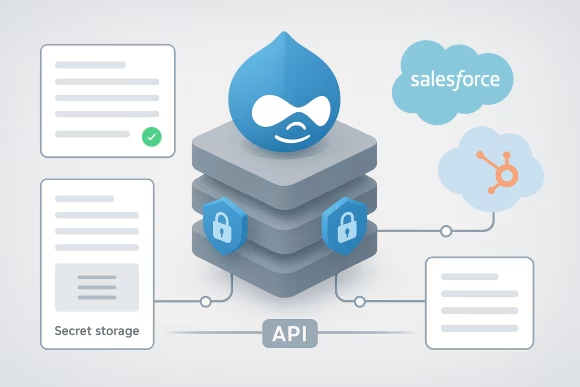
Implement authenticated connectivity to Salesforce and HubSpot using OAuth flows, scoped permissions, and secure secret storage. Requests are structured to respect API limits and error semantics. Security controls include token rotation strategies, environment separation, and least-privilege access aligned with enterprise policies.

Design synchronization workflows for create/update operations, including bidirectional patterns when required. Use queues and background processing to decouple user-facing requests from CRM latency. Workflows include idempotency keys and deduplication strategies to prevent duplicate contacts and inconsistent lifecycle states.
Support inbound CRM events via webhooks or polling patterns where appropriate, validating signatures and enforcing rate controls. Events are mapped into Drupal-side updates or downstream notifications. This enables near-real-time alignment for status changes, campaign membership, or consent updates.

Implement structured failure handling with retry policies, backoff, and dead-letter queues for non-recoverable errors. Capture CRM validation failures with actionable diagnostics and correlation IDs. This reduces silent data loss and makes operational support measurable and repeatable.
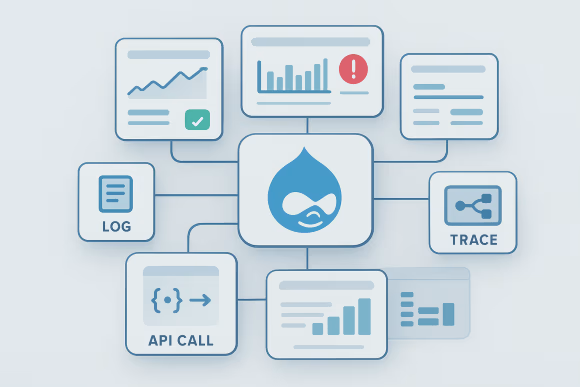
Provide logs, metrics, and traces for integration calls, queue depth, and error rates, with dashboards and alert thresholds. Monitoring distinguishes transient API issues from mapping defects and credential problems. This supports incident response and capacity planning as traffic and campaign volume increase.
Integrate consent capture and identity resolution into the data contract, ensuring that opt-in status and lawful basis are propagated correctly. Implement rules for updates, retention, and suppression lists where required. This supports consistent compliance behavior across multiple Drupal touchpoints.
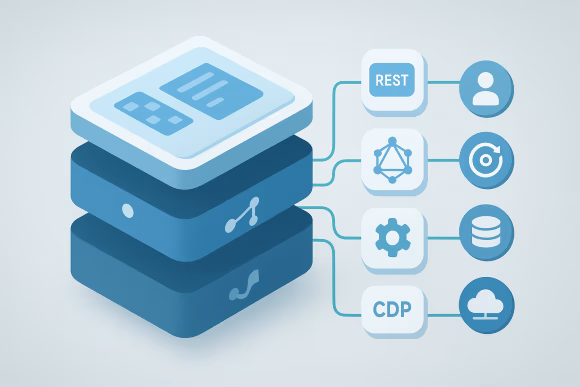
Build reusable Drupal services and adapters so additional CRMs, CDPs, or downstream systems can be added without rewriting core logic. The integration layer separates transport concerns (REST/GraphQL) from mapping and business rules. This improves maintainability and reduces coupling to any single vendor API.
Review the Drupal integration layer to identify failure points, weak observability, schema drift, and governance gaps that affect CRM data quality and release confidence.
Engagements follow a clear engineering sequence—from discovery and data-contract definition through implementation, testing, and operational enablement—for Drupal CRM integration services. Delivery reduces risk early by clarifying data ownership, CRM data model mapping, and OAuth security expectations before building sync workflows. The approach emphasizes testable mappings, resilient enterprise CRM data synchronization for Drupal, and observability so the integration can be operated reliably and extended over time.
[01]Assess current Drupal touchpoints, CRM configuration, and existing integrations. Capture data quality issues, API constraints, and operational requirements such as latency, throughput, and support responsibilities.
 [02]
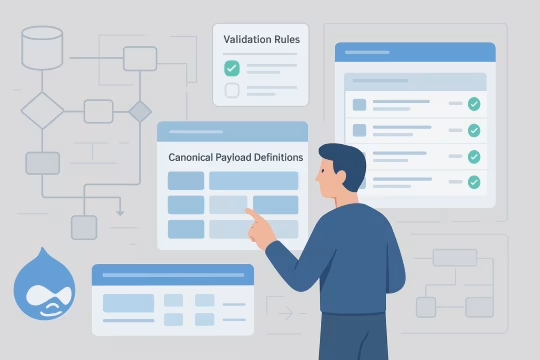
[02]Define the canonical payloads, identifiers, and field mappings for each CRM object. Agree validation rules, error semantics, and how changes will be introduced without breaking existing campaigns.
 [03]
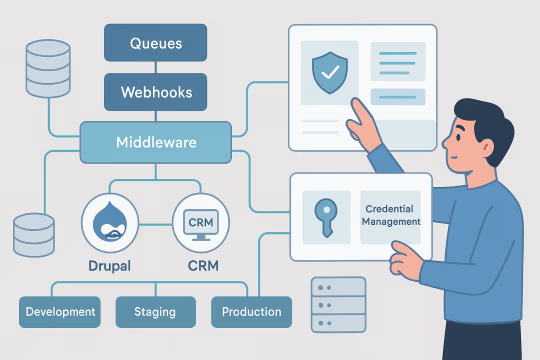
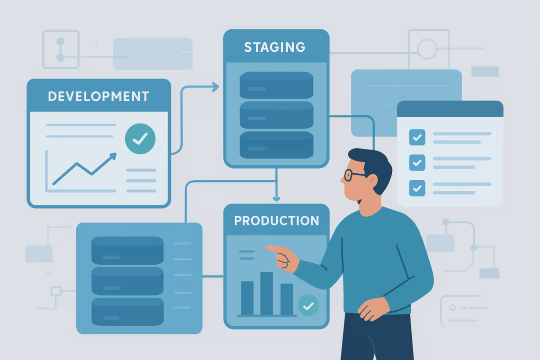
[03]Design the integration topology, including queues, webhooks, and any middleware. Establish security controls, credential management, and environment separation for development, staging, and production.
 [04]
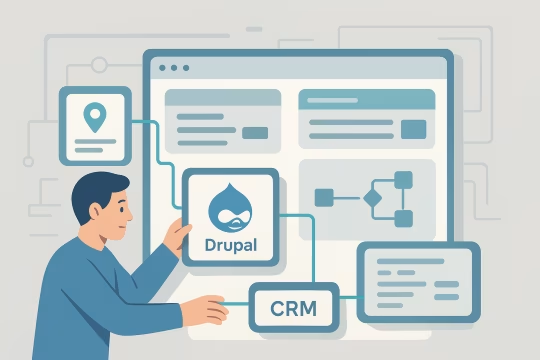
[04]Build Drupal modules/services for mapping, transport, and workflow orchestration. Configure CRM-side objects and validation alignment, and implement reusable patterns for new forms and sites.
 [05]
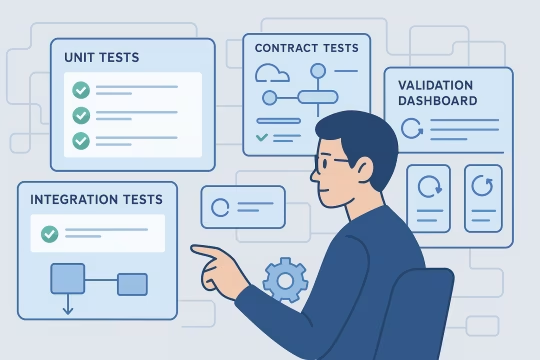
[05]Add unit and integration tests for mapping logic and API interactions, including contract tests against mocked endpoints. Validate idempotency, retries, and edge cases such as partial submissions and consent changes.
 [06]
[06]Release using controlled rollout and monitoring, with backout plans for critical workflows. Validate production behavior with real CRM responses and confirm reporting consistency.
 [07]
[07]Deliver dashboards, alerts, and runbooks for incident response and routine maintenance. Define ownership for credential rotation, schema changes, and ongoing monitoring.
 [08]
[08]Iterate on mappings, performance, and observability as campaigns and schemas evolve. Add new objects, sites, or downstream integrations using the established integration layer and governance process.
A governed Drupal CRM integration reduces operational friction and improves the reliability of customer data used for marketing, sales, and reporting. For enterprise teams, the impact comes from enterprise customer data sync between Drupal and systems like Salesforce and HubSpot, implemented with consistent data contracts, resilient synchronization, and improved observability across platform boundaries.
Consistent mapping and validation reduce incomplete or malformed CRM records. Deduplication and idempotency controls lower the volume of duplicate contacts and conflicting lifecycle states.
Reusable integration patterns allow new forms, sites, and journeys to connect to the CRM with less custom engineering. Changes are implemented through controlled mapping updates rather than one-off scripts.
Retries, dead-letter handling, and monitoring reduce the likelihood of silent failures. Clear runbooks and alerting shorten incident resolution time when CRM APIs or credentials change.
Separation of mapping, transport, and workflow logic reduces coupling between Drupal releases and CRM changes. Versioned contracts make schema evolution predictable across teams.
More reliable identifiers and consistent event capture improve downstream reporting and segmentation. Teams spend less time reconciling exports and more time using trusted datasets.
Queue-based processing and rate-limit-aware clients support higher submission volumes without degrading user experience. The platform can absorb traffic spikes while maintaining sync reliability.
Consent propagation and auditable data flows support regulated marketing operations. Centralized rules reduce inconsistent handling of opt-in status across multiple Drupal touchpoints.
Standardized adapters and shared services reduce duplicated integration code across products. Engineering effort shifts from reactive fixes to planned improvements and platform evolution.
Before changing connectors or workflows
A Drupal health check helps you validate integration architecture, upgrade exposure, operational controls, and change governance before expanding sync logic or rebuilding connectors.
Adjacent capabilities that extend Drupal integration architecture, API design, and operational reliability for enterprise platforms.
Connect Drupal with Your Enterprise Ecosystem
Drupal API development services for secure integration layers
Drupal GraphQL schema design and schema-first integration
Drupal event tracking architecture, identity, and audience sync engineering
Drupal ecommerce API integration and data synchronization
Drupal GA4 event tracking and enterprise instrumentation
Secure endpoints and consistent resource modeling
Roadmaps, governance model design, and platform decision frameworks
Common questions about integrating Drupal with CRM platforms, including architecture, operations, governance, risk management, and engagement structure.
The right pattern depends on latency requirements, data volume, and how much coupling you can tolerate between the web request and the CRM API. For most enterprise Drupal platforms, an asynchronous pattern is preferred: Drupal captures the interaction (for example a webform submission), writes a normalized record, and enqueues a job for CRM synchronization. This avoids blocking the user experience on CRM latency and provides a controlled retry mechanism. For near-real-time updates, webhooks can be used for inbound CRM events, but they should still be processed through a queue to handle bursts and to isolate Drupal from transient CRM outages. Direct synchronous calls are typically reserved for low-volume, high-importance actions where immediate confirmation is required. Across all patterns, the key architectural elements are explicit data contracts, idempotency to prevent duplicates, rate-limit-aware clients, and observability (correlation IDs, structured logs, and metrics). These elements make the integration resilient to schema changes and operational incidents.
We start by defining which system is authoritative for each attribute (for example, email and consent may be authoritative in the CRM, while campaign source metadata may be authoritative in Drupal). Then we define a canonical payload that represents the integration contract, including required fields, optional fields, and validation rules. Mapping is implemented as a dedicated layer (configuration or code) rather than being embedded across multiple forms or controllers. This layer handles normalization (date formats, enums, country codes), identifier strategy (external IDs, CRM IDs), and lifecycle semantics (lead vs contact, stage transitions). We also define how updates behave: overwrite, merge, or ignore based on timestamps or ownership rules. Finally, we plan for evolution by versioning mappings and documenting change procedures. This prevents “silent drift” when Drupal content models or CRM schemas change, and it keeps downstream reporting stable.
Operational support starts with making integration behavior observable. We implement structured logging for each sync attempt, including correlation IDs that link a Drupal submission to the CRM request/response. Metrics typically include queue depth, success/failure rates, retry counts, API latency, and CRM error categories (validation vs authentication vs rate limiting). Dashboards and alerts are configured so teams can detect issues before they impact campaign operations. Alerts should be actionable: for example, “OAuth token refresh failing” or “validation failures increased after mapping change,” rather than generic error counts. We also provide runbooks that describe common failure modes and response steps: credential rotation, replaying dead-letter messages, handling CRM schema changes, and safely reprocessing jobs without creating duplicates. This operational layer is what keeps the integration maintainable when teams, campaigns, and platform versions change.
CRM APIs impose rate limits, concurrency constraints, and sometimes strict validation behavior. We design the integration client to be rate-limit-aware by using queues, controlled worker concurrency, and backoff strategies when limits are approached. Where supported, we use bulk APIs or batching to reduce request volume and improve throughput. We also minimize payload size and avoid unnecessary calls by caching reference data and using idempotent upsert operations (for example, upserting by an external ID). For high-traffic Drupal platforms, we separate user-facing capture from background synchronization so traffic spikes do not translate into immediate API pressure. Performance work includes measuring end-to-end latency (submission to CRM availability), identifying bottlenecks, and tuning worker counts and batch sizes. The goal is predictable sync behavior that remains stable under peak campaign load.
Yes, but reliability depends on treating the integration as a system with contracts and operational controls, not as a single HTTP request. For Drupal Webform, we typically implement a handler that captures the submission, normalizes values, and writes an integration event that is processed asynchronously. This allows retries, dead-letter handling, and replay without requiring users to resubmit forms. On the CRM side, we align required fields, validation rules, and deduplication behavior so that submissions do not fail unexpectedly. We also define how to handle partial submissions, multi-step forms, and updates to existing contacts. Reliability features include idempotency keys to prevent duplicates, explicit error categorization (validation vs transient), and monitoring so teams can see what was accepted, rejected, or delayed. This approach scales across multiple forms and sites while keeping behavior consistent.
Yes. Most CRM systems expose REST APIs as the primary integration surface, and we commonly use REST for create/update operations, lookups, and authentication flows. GraphQL can be relevant in two scenarios: when Drupal is part of a broader headless architecture with a GraphQL gateway, or when an internal integration layer exposes GraphQL to standardize access across multiple downstream systems. The choice is less about preference and more about governance and consistency. If GraphQL is used, we still define strict schemas and validation rules, and we ensure that mutations are idempotent and observable. For REST, we focus on stable endpoint usage, versioning awareness, and clear error handling. In both cases, the integration should be designed so that transport concerns (REST/GraphQL) are separated from mapping and workflow logic, keeping the system maintainable as APIs evolve.
We treat mappings and payloads as versioned contracts. Changes start with impact analysis: which forms, sites, and downstream reports depend on a field, and whether the change is additive, breaking, or behavioral (for example, validation rules changing). We then implement changes behind controlled releases, ideally with feature flags or staged rollout when multiple sites are involved. Documentation is part of governance: field definitions, ownership, required/optional status, and transformation rules should be recorded in a shared artifact. We also define who approves changes (CRM architect, platform team, marketing ops) and how changes are tested. Operationally, we use monitoring to detect mapping drift after release, and we keep replay mechanisms safe through idempotency. This governance model reduces emergency fixes and keeps integration behavior predictable across campaign cycles.
We implement least-privilege access by scoping CRM integration users to only the objects and operations required. Authentication is typically OAuth-based, with token refresh handled server-side and secrets stored in a dedicated secrets manager or encrypted environment configuration, depending on the hosting model. Credential rotation is planned as an operational routine, not an emergency event. We document rotation procedures, validate them in non-production environments, and ensure monitoring detects authentication failures quickly. Access is separated by environment (development, staging, production) to prevent cross-environment data leakage. We also consider auditability: who changed credentials, when tokens were refreshed, and what requests were made. These controls are important for enterprise security reviews and for maintaining stable operations as teams and vendors change policies.
Common risks include unclear data ownership, unstable schemas, insufficient error handling, and lack of observability. If teams do not agree on which system is authoritative for specific fields, integrations can create data “ping-pong,” overwriting values and degrading trust in the CRM. We mitigate this by defining ownership rules and update semantics early. Schema instability is another risk: CRM admins may add required fields or change validation rules, and Drupal teams may change forms without considering downstream impact. Versioned contracts, change governance, and automated tests reduce the chance of breaking production. Operational risks include API limits, credential changes, and transient outages. Queue-based processing, backoff/retry strategies, idempotency, and monitoring reduce the impact of these incidents. Finally, compliance risk is addressed by explicitly modeling consent and retention behavior in the integration contract rather than relying on ad-hoc handling per form.
Duplicate prevention starts with identifier strategy. We typically use a stable external ID derived from a trusted key (for example, CRM contact ID when known, or a hashed email plus tenant/site context when appropriate). Sync operations should use upsert semantics where supported, rather than “create then search then update” patterns that are prone to race conditions. We also implement idempotency at the workflow level: each submission or event has a unique idempotency key so retries do not create new records. Deduplication rules in the CRM (matching rules, duplicate rules) should be aligned with the integration’s behavior, and we ensure that validation failures are captured and surfaced rather than retried indefinitely. Lifecycle consistency requires explicit rules for stage transitions and updates. For example, a webform submission may create a lead, but subsequent authenticated actions may update a contact; the integration must define when and how those transitions occur to avoid conflicting states across campaigns and teams.
We typically need a clear view of Drupal touchpoints and CRM requirements. On the Drupal side: the list of forms and entities involved, current field definitions, any existing integration code, and expected traffic/volume patterns. On the CRM side: object model details, required fields, validation rules, deduplication configuration, and API access constraints. We also need operational context: who owns the integration in production, what the acceptable sync latency is, and what monitoring/alerting tools are available. Security requirements matter early as well, including how secrets are managed, network restrictions, and whether data residency or compliance constraints apply. Finally, we align on reporting and downstream usage: which fields drive segmentation, attribution, or sales workflows. This helps prioritize correctness and stability for the data that actually affects business processes, and it prevents building mappings that look complete but do not support real operational needs.
We estimate based on the number of touchpoints (forms/sites), the complexity of the CRM object model, and the required operational characteristics. A single lead-capture flow with straightforward mapping is very different from a multi-site platform with bidirectional sync, consent propagation, and multiple CRM objects (contacts, accounts, campaigns, custom objects). We typically break scope into measurable components: discovery and contract definition, Drupal implementation, CRM configuration alignment, testing, deployment, and operations enablement. Risks and unknowns are made explicit, such as unclear ownership rules, pending CRM schema changes, or missing non-production environments. Where possible, we propose an incremental delivery plan: start with one or two high-value touchpoints, establish the integration framework (queues, logging, mapping layer), and then onboard additional forms/sites using the same patterns. This approach reduces time-to-value while keeping architecture consistent.
Collaboration usually begins with a short discovery phase to align on objectives and constraints. We run working sessions with marketing technology stakeholders, CRM architects, and the Drupal/platform team to inventory touchpoints, confirm the CRM objects involved, and identify the data that must be reliable for operations and reporting. From there, we produce an integration brief: proposed architecture pattern (synchronous vs queued), data contract and mapping outline, security approach (OAuth scopes, secrets management), and an operational plan (monitoring, alerts, runbooks, ownership). We also identify quick wins and high-risk areas that should be validated early, such as deduplication rules or required-field constraints. Once the brief is agreed, implementation starts with establishing the integration framework (logging, queues, adapters) and delivering one end-to-end flow into a non-production CRM environment. This creates a reference implementation that can be extended to additional forms, sites, and objects with predictable effort.
These case studies showcase advanced Drupal platform integrations, focusing on secure data synchronization, API orchestration, and governance. They highlight real-world implementations of complex content and data workflows, OAuth-secured connectivity, and scalable multi-site architectures that align closely with Drupal CRM integration requirements.
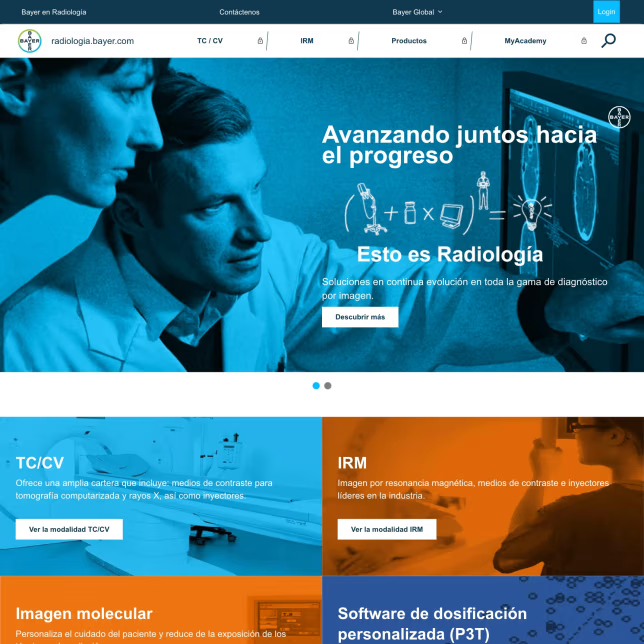
An advanced healthcare digital platform for LATAM was required to facilitate collaboration among radiology HCPs, distribute company knowledge, refine treatment methods, and streamline workflows. The solution needed secure medical website role-based access restrictions based on user role (HCP / non-HCP) and geographic region.
The platform enhanced collaboration, streamlined workflows, and empowered radiology professionals with advanced tools to gain insights and optimize patient care.
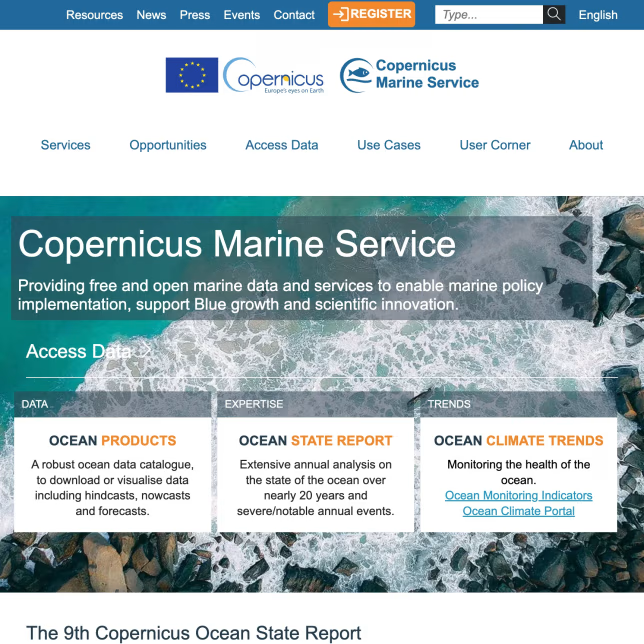
The existing marine data portal relied on three unaligned WordPress installations and embedded PHP code, creating inefficiencies and risks in content management and usability.
The new Drupal DXP streamlined content operations and improved accessibility, offering scientists and businesses a more efficient gateway to marine data services.
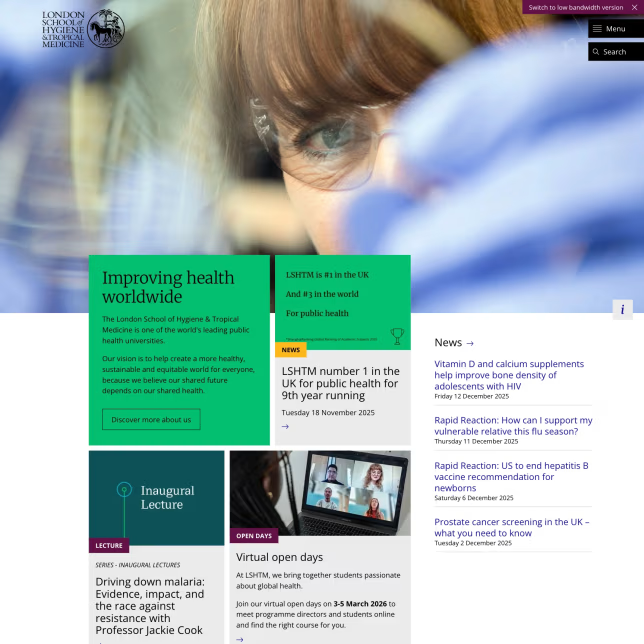
LSHTM required improvements to its existing higher education Drupal platform to better manage and distribute complex research data, including support for third-party integrations, Drupal performance optimization, and more reliable synchronization.
The solution improved data accessibility, streamlined research workflows, and enhanced system performance, enabling LSHTM to manage complex datasets more efficiently.
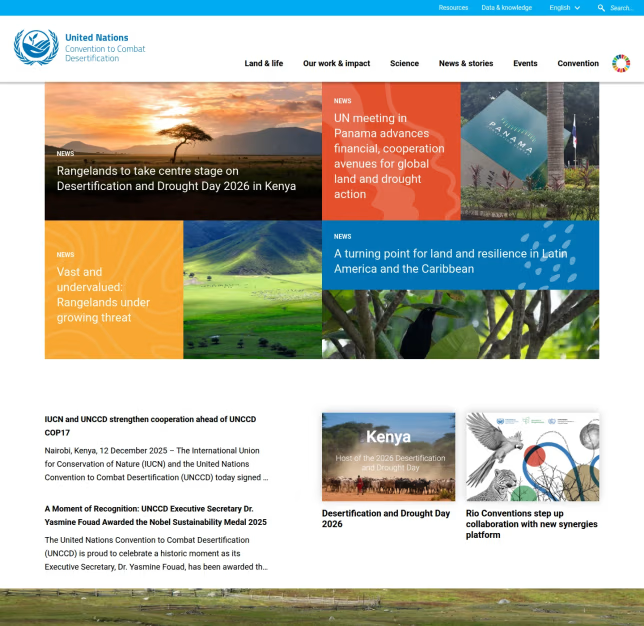
UNCCD operated four separate websites (two WordPress, two Drupal), leading to inconsistencies in design, content management, and user experience. A unified, scalable solution was needed to support a large-scale CMS migration project and improve efficiency and usability.
The modernization effort resulted in a cohesive, user-friendly, and scalable website, improving content management efficiency and long-term digital sustainability.
With Drupal 7 reaching end-of-life, Veolia needed a Drupal 7 to Drupal 10 enterprise migration for its Acquia Site Factory multisite platform—preserving region-specific content and multilingual capabilities across more than 200 sites.
The platform was modernized into a stable, scalable multisite foundation with improved performance, maintainability, and long-term upgrade readiness.
It was my pleasure working with Oleksiy (PathToProject) on a new Drupal website. He is a true full-stack developer—the ideal mix of DevOps expertise, deep front-end knowledge, and the structured thinking of a senior back-end developer.
He is well-organized and never lets anything slip. Oleksiy understands what needs to be done before being asked and can manage a project independently with minimal involvement from clients, product managers, or business analysts.
One of the best consultants I’ve worked with so far.

Andrei Melis
Technical Lead at Eau de Web
Oleksiy (PathToProject) and I worked together on a Digital Transformation project for Bayer LATAM Radiología. Oly was the Drupal developer, and I was the business lead. His professionalism, technical expertise, and ability to deliver functional improvements were some of the key attributes he brought to the project.
I also want to highlight his collaboration and flexibility—throughout the entire journey, Oleksiy exceeded my expectations.
It’s great when you can partner with vendors you trust, and who go the extra mile.

Axel Gleizerman Copello
Building in the MedTech Space | Antler
Oleksiy (PathToProject) is demanding and responsive. Comfortable with an Agile approach and strong technical skills, I appreciate the way he challenges stories and features to clarify specifications before and during sprints.

Olivier Ritlewski
Ingénieur Logiciel chez EPAM Systems
These articles expand on the architecture and governance decisions that shape reliable Drupal CRM integrations. They cover field ownership, canonical entity mapping, workflow contracts, and the operational risks that appear when data moves across systems. Together they provide useful context for designing secure, maintainable sync workflows between Drupal and CRM platforms.
Let’s review your current data flows, define a stable integration contract, and design a synchronization approach that your teams can operate and extend safely.