Enterprise lead capture looks deceptively simple from the outside. A visitor completes a form, the website sends data to a CRM, and internal teams use that record for routing, nurture, reporting, and sales follow-up.
In practice, the weakest point is often not the API connection. It is the lack of a durable agreement about who owns each field, what values are allowed, when changes are permitted, and how those changes are tested across systems.
That problem becomes especially visible in enterprise Drupal and WordPress environments, where forms may be distributed across business units, regions, campaign templates, and third-party plugins. A CRM can stay online, an integration can still authenticate successfully, and submissions can continue flowing, while the underlying data contract has already drifted out of alignment.
Field mappings drifting across your CRM stack?Run Health CheckWhen that happens, teams usually notice the symptoms first:
- leads stop reaching the right queue
- campaign attribution becomes unreliable
- required fields fail silently or unpredictably
- duplicate fields emerge for the same business concept
- compliance-sensitive consent data becomes inconsistent
These are ownership problems disguised as technical issues.
The hidden fragility of enterprise lead capture
Most organizations do not operate a single form connected to a single destination. They operate a network of lead capture points across landing pages, gated content, webinar registrations, contact forms, event pages, and regional sites. Those forms often sit on platforms managed by web teams, while the receiving schema is controlled by CRM administrators or marketing operations.
That division of responsibility is normal. The risk appears when responsibilities are split but the contract is not.
A field like country, product interest, business unit, or consent status may look stable. But each of those fields carries assumptions:
- whether the field is required
- what data type it expects
- what labels or enumerated values are valid
- whether the value is user-entered or system-derived
- how it maps to routing rules or automation
- whether it has reporting or compliance implications
If one team changes any of those assumptions without coordination, the integration can degrade long before it fully fails.
This is why enterprise lead capture is fragile even in technically mature environments. The API is only the transport layer. The real dependency is shared meaning.
How field ownership drift appears across forms, APIs, and CRM configuration
Field ownership drift usually happens gradually.
A marketing operations team updates a CRM picklist to support a new region. A CRM admin deprecates an old field and creates a replacement with a cleaner name. A web team changes a Drupal form component to improve conversion. A WordPress site owner swaps one plugin for another and loses a normalization step. None of these changes seem dramatic on their own.
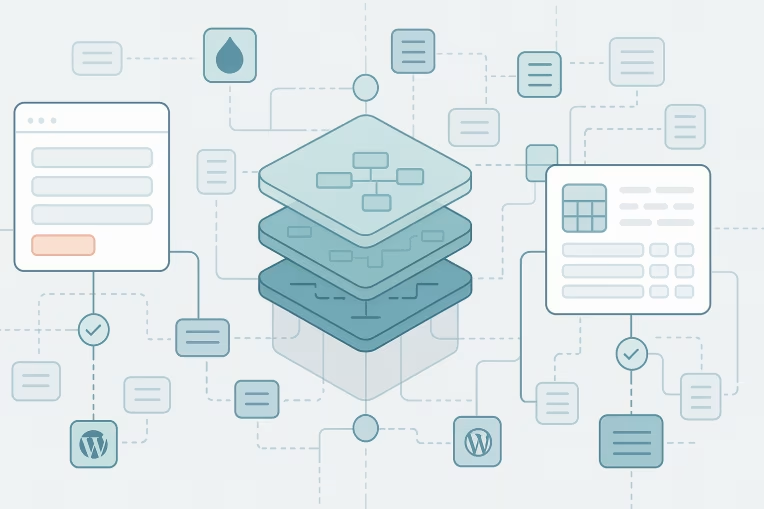
The problem is that lead capture integrations connect multiple layers at once:
- the public form UI
- client-side validation
- server-side processing in Drupal or WordPress
- middleware or direct API mapping logic
- CRM field definitions
- downstream routing, scoring, segmentation, and reporting rules
If ownership is unclear, each layer can evolve independently.
For example, the website may still display "United States" while the CRM now expects US. The web form may send a free-text value for state while the CRM has moved to a constrained list. A field that was once optional may now be required for lead assignment, but that requirement may not be reflected in the front-end experience. The API call may return a partial success or a generic acceptance response, while the data is later rejected, defaulted, or quarantined deeper in the process.
This is why integration teams often say, "the API works," while business users still experience broken lead capture.

Find integration gaps before lead data breaks
Assess form mappings, validation rules, and CRM handoffs across Drupal and WordPress.
- Audit field ownership
- Check mapping integrity
- Catch routing risks
Common failure modes: validation mismatch, duplicate fields, broken routing, reporting inconsistency
The most common failures are not always dramatic outages. Many are low-visibility data quality defects that accumulate over time.
Validation mismatch
Validation rules often diverge between the web layer and the CRM layer. A form may allow an entry that the CRM no longer accepts, or the CRM may start enforcing a new required attribute that the form does not collect. In some implementations, this causes visible submission errors. In others, records are created with empty defaults, fallback values, or exception handling that hides the problem until later.
Duplicate fields for the same concept
A common enterprise pattern is the creation of a new field because changing the old one feels risky. Over time, teams end up with variants such as industry, industry_new, industry_v2, or separate fields per business unit. The website may continue writing to an older field while dashboards and automation shift to the newer one. Nothing appears broken technically, but operationally the organization now has split truth.
Broken routing
Lead routing rules often depend on exact values. If a form sends an outdated product code, an obsolete region value, or an unrecognized source identifier, the lead may route to a default queue, the wrong sales team, or no one at all. These failures are expensive because they affect response time and pipeline quality before anyone notices a schema issue.
Reporting inconsistency
When field definitions drift, reporting logic drifts with them. Different forms may populate the same concept differently. Historical trend lines become hard to compare. Marketing operations teams then spend time normalizing exports, rebuilding attribution logic, or explaining why campaign data no longer aligns across dashboards.
Consent and compliance ambiguity
Consent fields deserve special attention. Even without getting into jurisdiction-specific legal advice, enterprise teams should recognize that consent capture relies on precise semantics: what the user agreed to, when they agreed, how the consent text was presented, and how the value is stored. If the website, integration layer, and CRM do not agree on those fields, the organization can create avoidable governance risk.
Defining a field contract between web, CRM, and marketing ops
The most effective way to reduce these failures is to define a field contract for every form-to-CRM integration.
A field contract is not just a technical mapping spreadsheet. It is a shared operational agreement that describes how a field behaves across systems and who is accountable for it.
A practical field contract typically includes:
- Business name and purpose: what the field represents and why it exists
- System identifiers: CMS field key, middleware key if applicable, and CRM API name
- Data type: string, boolean, date, enum, multi-select, numeric value, and so on
- Allowed values: especially for picklists, taxonomies, and controlled vocabularies
- Required status: whether the field is required on the form, required in the CRM, or conditionally required
- Defaulting logic: what happens if the user does not provide a value
- Validation rules: front-end, server-side, and CRM-side checks
- Transformation rules: normalization, trimming, value conversion, concatenation, lookup rules
- Ownership: who approves changes to the field definition and who implements them
- Downstream dependencies: routing, scoring, segmentation, reporting, consent handling, integrations to other systems
The key is to make ownership explicit.
Not every field needs the same owner. In many organizations:
- web teams own presentation and form implementation
- CRM administrators own the receiving schema and platform constraints
- marketing operations owns lifecycle use, campaign attribution, and reporting logic
- solution architects or platform managers own the integration pattern and governance process
What matters is that a field has a clear decision path. If no one owns the definition end to end, everyone assumes someone else does.
Change management for mappings, enums, consent fields, and required attributes
Once a field contract exists, change management becomes much easier because teams can evaluate changes by impact rather than by intuition.
In enterprise environments, the highest-risk changes usually fall into a few categories.
Mapping changes
A field being repointed from one CRM property to another can affect historical reporting, automation triggers, and downstream consumers. Even when the web UI stays the same, the semantic destination may have changed. These changes should be versioned and reviewed.
Enum or picklist changes
Controlled values are a frequent source of breakage. Adding a new value may be safe in the CRM but not in the website if the form cannot present it. Renaming a value may break routing rules that depend on exact matches. Retiring a value may strand older forms or templates.
A useful rule is to treat enum changes as integration changes, not just admin changes.
Consent field changes
Changes to consent labels, storage format, or field structure should receive elevated review because they can affect auditability and downstream communication logic. Even a shift from one checkbox model to another can alter the meaning of the captured value.
Required attribute changes
Making a field required in the CRM often sounds harmless because it improves data completeness. In reality, it can break submissions from legacy forms, embedded widgets, or regional sites that were never updated. Requiredness should be synchronized across all collection points, with a transition period where possible.
A lightweight release process for these changes should include:
- documenting the change in the field contract
- identifying affected forms, templates, and sites
- reviewing downstream dependencies such as routing and reporting
- updating validation and transformation logic
- testing with representative payloads
- scheduling deployment with rollback or fallback plans
This does not need to be bureaucratic. It needs to be repeatable.
Monitoring and QA patterns that catch problems before launch
Even with strong governance, integrations need monitoring because not every defect is obvious during development.
Enterprise teams often benefit from QA patterns that test both data transport and business meaning.
Payload-level validation
Before launch, test realistic submission payloads against the full integration path. Do not only verify that a request returns success. Confirm that each field arrives in the correct CRM destination with the expected transformed value.
Negative testing
Include invalid and edge-case inputs. Test missing required values, unexpected enum values, special characters, long strings, and conditional fields. These cases often reveal where website validation and CRM validation are out of sync.
Reference environment checks
Where possible, maintain a non-production path that mirrors the production mapping structure closely enough to detect schema changes early. If sandbox environments drift too far from production, they stop being useful for validation.
Submission observability
Teams should be able to answer basic operational questions quickly:
- How many submissions were received?
- How many were successfully accepted by the CRM?
- How many were partially rejected or defaulted?
- Which fields generated warnings or transformation errors?
- Did routing outcomes change after a release?
This may involve logs, middleware dashboards, integration alerts, or scheduled reconciliation reports. The specific tooling matters less than the ability to detect anomalies before sales or campaign teams do. In enterprise Drupal CRM integration work and WordPress CRM integration programs, this kind of observability is often what separates a stable lead pipeline from one that only appears healthy.
Post-release reconciliation
After a launch, compare expected submission volumes and field distributions with actual outcomes. If a value that used to appear regularly suddenly drops to zero, or a default queue spikes unexpectedly, the issue may be a field contract change rather than a traffic change.
A lightweight governance model for ongoing platform operations
Governance often fails when organizations assume it requires a large committee or heavy process. For most enterprise web platforms, a lightweight operating model is enough if it is clearly defined.
A workable model often includes the following practices.
1. Define system-of-record ownership
For each field, identify which platform is authoritative for the definition. The CRM may be the system of record for lifecycle attributes and routing fields, while the web platform may own presentational labels and user experience behavior. Authority should not be ambiguous.
2. Maintain a shared field registry
This can be a structured document, spreadsheet, repository artifact, or internal catalog. What matters is that it is current, searchable, and used during delivery. If teams are relying on tribal knowledge, drift is already underway.
3. Require review for schema-affecting changes
Not every CMS edit needs cross-functional approval. But changes to mappings, requiredness, enums, consent semantics, or routing dependencies should trigger review from the relevant owners.
4. Version changes alongside releases
Field definition changes should be tied to release notes or deployment records, especially when multiple Drupal or WordPress properties share common integration patterns. This makes incident investigation much faster. Large multi-site estates such as Veolia show why release governance and integration stability have to be treated as platform concerns, not just form-level concerns.
5. Assign operational metrics
Ownership is stronger when it is measurable. Teams can track submission error rates, unmapped value frequency, routing exceptions, duplicate field creation, and time to resolution for integration issues.
6. Establish deprecation rules
When fields need to be replaced, define how long the old field will remain supported, which forms still rely on it, and what conditions must be met before retirement. Without deprecation discipline, duplicate schema becomes permanent.
This kind of governance does not slow delivery when implemented well. It usually speeds delivery by reducing rework, incident response, and reporting confusion.
Enterprise lead capture does not break only when a connector goes down. It breaks when the organization stops managing form fields as shared operational assets.
That is why CRM field ownership matters. It creates the accountability needed to keep Drupal and WordPress forms aligned with CRM definitions, routing logic, reporting models, and consent handling. It turns mappings from fragile implementation details into governed contracts.
CDP and integration review
Pressure-test your lead capture integrations
Identify field contract drift, validation mismatches, and routing issues that weaken CRM data quality and reporting.
For organizations managing multiple sites, teams, and campaigns, that shift is often the difference between an integration that appears functional and one that remains trustworthy over time. The API may still be healthy either way. The real question is whether the meaning of the data is still intact.
Tags: CRM field ownership, Content Operations, Lead Capture, Drupal, WordPress, Marketing Operations, Data Governance