


 [01]
[01]Discovery and Audit
Assess current Drupal Commerce setup, integration endpoints, and operational pain points. We review data ownership, SLAs, and incident history to identify the highest-risk boundaries and define measurable success criteria.
Drupal Commerce integrations
Use a Drupal health check to uncover sync gaps, brittle API dependencies, webhook risks, and upgrade blockers across commerce integrations.
Built for teams managing orders, inventory, pricing, payments, and external system dependencies in Drupal Commerce.
No login required. Takes 2–3 minutes.
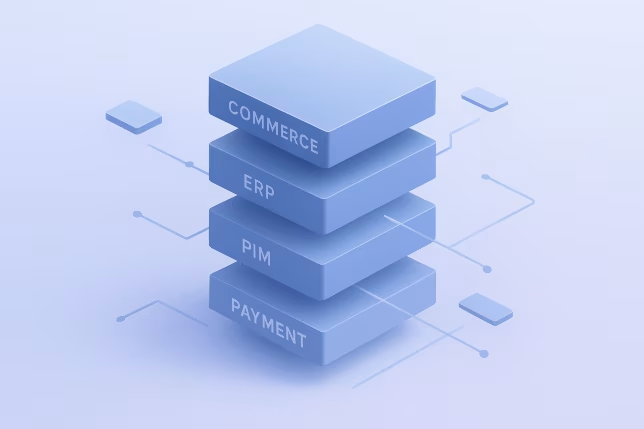
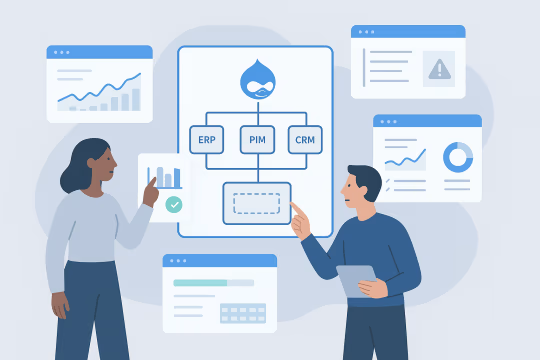
Drupal Commerce integration services connect the storefront and checkout experience to the systems that run pricing, inventory, fulfillment, customer data, and payments. In enterprise environments, these dependencies typically span ERP, PIM, CRM, tax, shipping, and multiple payment providers, each with different data models, SLAs, and failure modes.
This capability focuses on Drupal ecommerce API integration: designing stable REST/GraphQL contracts, mapping and transforming commerce domain data (products, carts, orders, customers), and implementing synchronization patterns that remain reliable under load and partial outages. It includes secure handling of payment flows, idempotent order processing, and event- or job-based integration where real-time coupling would increase risk.
A well-implemented integration layer improves platform maintainability by isolating external system complexity from Drupal, enabling predictable release cycles, clearer observability, and controlled change management as upstream systems evolve. The result is an ecommerce platform that can scale operationally without turning every upstream change into a storefront incident.
Core Focus
Best Fit For
Key Outcomes
Technology Ecosystem
Operational Benefits
As ecommerce platforms mature, the storefront becomes dependent on a growing set of external systems: ERP for pricing and inventory, PIM for product enrichment, payment providers, tax engines, shipping services, and customer systems. Without a clear integration architecture, teams often accumulate point-to-point connections, inconsistent data mappings, and ad-hoc retry logic that behaves differently across features.
These issues surface at the boundaries: orders are created twice after timeouts, inventory becomes stale, promotions differ between systems, and payment states drift from order states. Engineering teams spend time diagnosing integration failures rather than improving the customer journey, because failures are hard to reproduce and observability is limited to scattered logs. Tight coupling to upstream APIs also forces storefront releases whenever an external contract changes, increasing delivery friction and risk.
Operationally, the platform becomes fragile during peak traffic and during upstream incidents. Manual reconciliation grows, customer support load increases, and the business loses confidence in reporting because “source of truth” varies by system and by timing. The underlying problem is not a single broken integration, but an integration layer that lacks consistent contracts, resilience patterns, and governance.
Review the commerce domain model, current integrations, and operational constraints. We identify system owners, data sources of truth, latency requirements, and failure scenarios across product, pricing, inventory, customer, and order lifecycles.
Define API contracts, payload schemas, and versioning strategy for each integration. We document required fields, validation rules, idempotency keys, and error semantics so upstream and downstream teams can change safely.
Design the integration topology: synchronous APIs vs asynchronous events/jobs, data mapping boundaries, and where transformations should live. We select patterns for retries, dead-letter handling, and reconciliation to reduce coupling.
Implement canonical mappings for products, variants, prices, promotions, customers, carts, and orders. We handle normalization, localization, and multi-currency considerations while keeping Drupal’s commerce entities consistent and auditable.
Integrate payment providers using secure redirect or tokenized flows, aligning payment states with order states. We implement webhook handling, signature verification, and idempotent processing to avoid duplicate captures and inconsistent order status.
Add automated tests for critical integration paths, including contract tests and failure-mode scenarios. We validate retry behavior, timeouts, and data consistency rules to reduce regressions during upstream changes.
Deploy with environment-specific configuration, secrets management, and safe rollout strategies. We implement structured logging, correlation IDs, metrics, and alerting around order processing, sync jobs, and webhook throughput.
Establish ownership, runbooks, and change management for integration contracts. We plan version upgrades, deprecations, and backlog-driven improvements based on incident data and platform roadmap changes.
This service provides the technical foundations required for Drupal Commerce integration services in enterprise environments. The focus is on Drupal ecommerce API integration with stable REST/GraphQL contracts, resilient processing, and consistent domain mapping across product, customer, order, and payment lifecycles. Implementations emphasize idempotency, observability, and controlled change management so integrations can evolve independently of storefront releases.
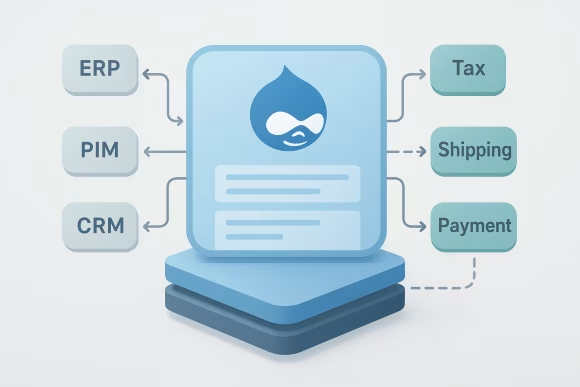
Designs a clear boundary between Drupal Commerce and external systems using well-defined integration patterns. This includes deciding where synchronous calls are acceptable, where asynchronous processing is safer, and how to isolate upstream failures from checkout and order placement. The architecture supports multi-system dependencies while keeping the storefront’s runtime behavior predictable.
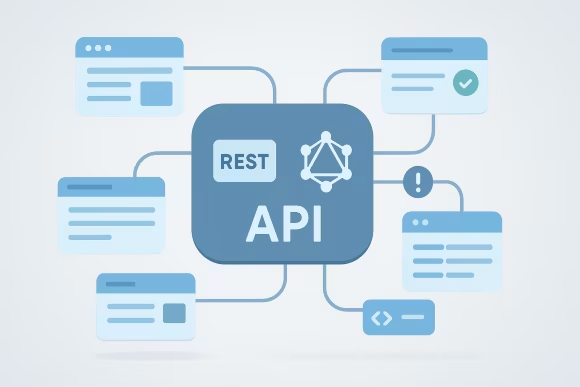
Defines request/response schemas, validation rules, and versioning approaches for REST and GraphQL integrations. Contracts include explicit error semantics, pagination and filtering conventions, and compatibility rules to reduce breaking changes. This enables parallel development across teams and safer upgrades of upstream services.

Implements reliable order creation, status updates, refunds, and fulfillment state propagation across systems. Processing is built around idempotency keys, deduplication, and reconciliation to handle retries and partial failures. The goal is consistent order state across Drupal, payment providers, and back-office systems.
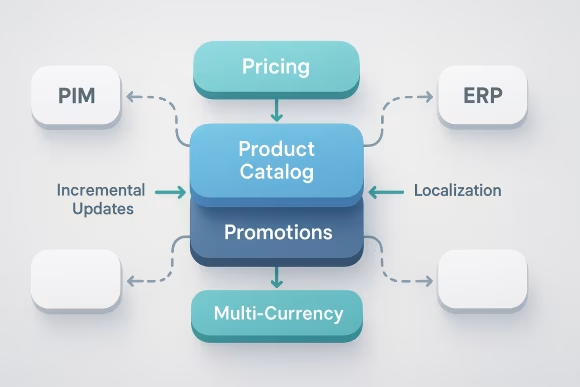
Builds ingestion and synchronization pipelines for product catalogs, variants, attributes, pricing, and promotions from PIM/ERP sources. Supports incremental updates, localization, and multi-currency rules while maintaining traceability of changes. Data validation and fallback behavior reduce storefront breakage from upstream data quality issues.
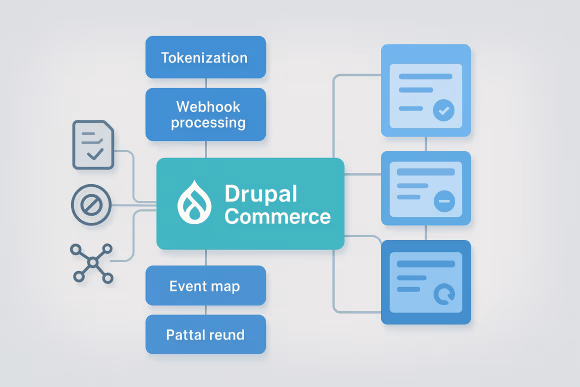
Integrates payment APIs with secure tokenization and webhook-driven state updates. Includes signature verification, replay protection, and careful mapping between payment events and Drupal Commerce payment/order states. Handles edge cases such as delayed captures, partial refunds, and asynchronous authorization outcomes.
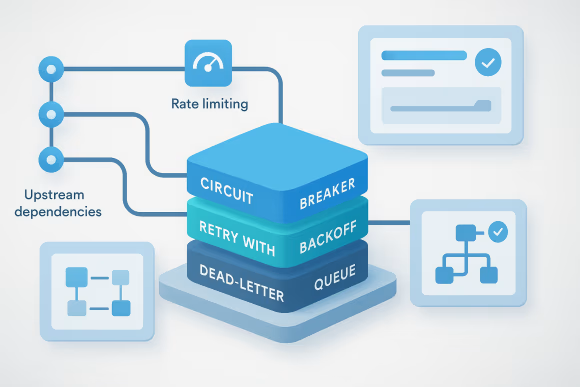
Applies retries with backoff, circuit-breaking where appropriate, and dead-letter handling for failed events or jobs. Implements timeouts, rate limiting, and bulkhead separation so one failing upstream dependency does not cascade into platform-wide degradation. Supports operational reconciliation workflows for exceptional cases.
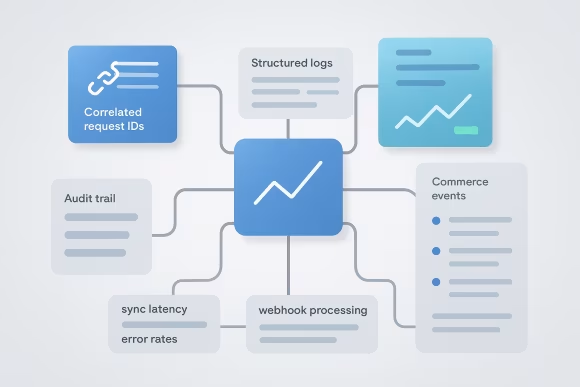
Adds correlation IDs across requests, structured logs, and metrics for sync latency, error rates, and webhook processing. Provides audit trails for key commerce events and data changes to support incident response and compliance needs. Enables targeted alerting for order-impacting failures rather than generic noise.
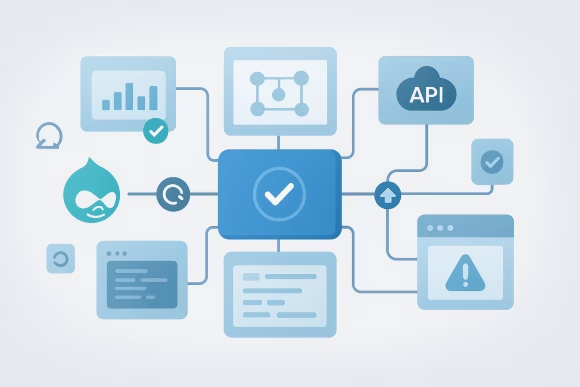
Implements automated tests for critical integration paths, including contract tests, mocked upstream behavior, and failure-mode scenarios. Validates idempotency, state transitions, and data mapping rules across releases. This reduces regressions when upstream APIs change or when Drupal Commerce is upgraded.
Review how Drupal Commerce handles contracts, retries, state changes, and observability so teams can prioritize fixes before incidents and roadmap commitments.
Engagements are structured to reduce integration risk early, then incrementally deliver working connectivity with measurable operational signals. We prioritize critical commerce flows (checkout, payment, order creation) and build outward to catalog, pricing, and fulfillment, with testing and observability treated as first-class engineering work.
[01]Assess current Drupal Commerce setup, integration endpoints, and operational pain points. We review data ownership, SLAs, and incident history to identify the highest-risk boundaries and define measurable success criteria.
 [02]
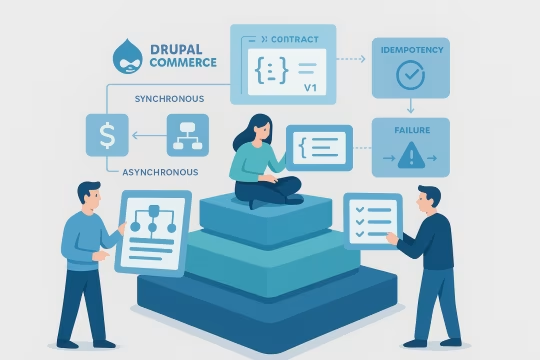
[02]Design the integration topology and define API contracts, schemas, and versioning rules. We align on synchronous vs asynchronous behavior, idempotency strategy, and how failures are surfaced to users and operators.
 [03]
[03]Build integrations in vertical slices that include mapping, processing logic, and operational hooks. Each slice targets a specific domain flow such as product sync, checkout payment, or order export to ERP.
 [04]
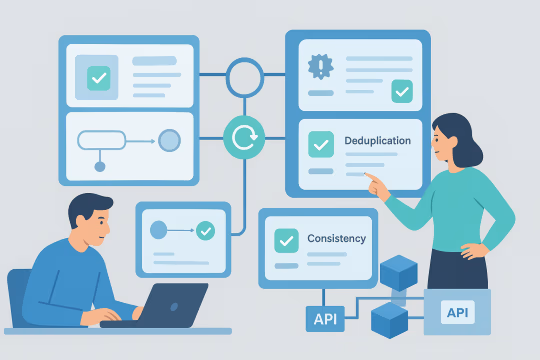
[04]Add automated tests for contract compatibility, state transitions, and failure modes. We validate retry behavior, deduplication, and data consistency to reduce regressions during upstream changes.
 [05]
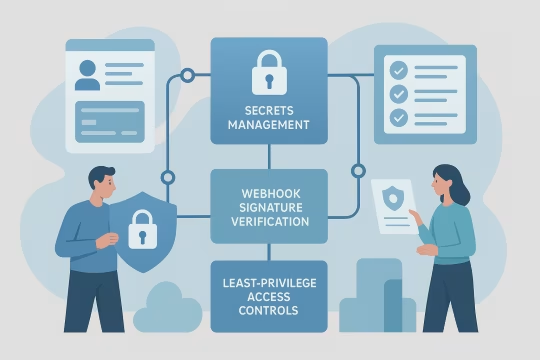
[05]Implement secrets management, webhook signature verification, and least-privilege access for external systems. We review data handling for PII and payment-related constraints and document operational controls.
 [06]
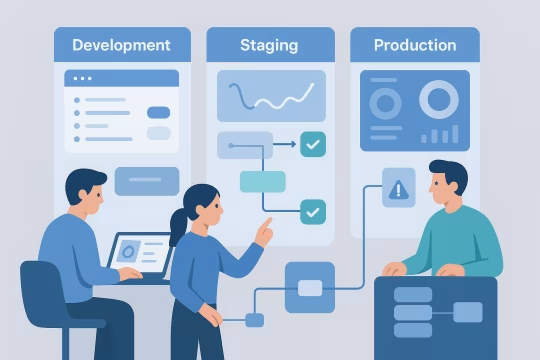
[06]Deploy with environment-specific configuration and safe rollout strategies such as feature flags or staged enablement. We verify monitoring, alerting, and runbooks before enabling critical order flows in production.
 [07]
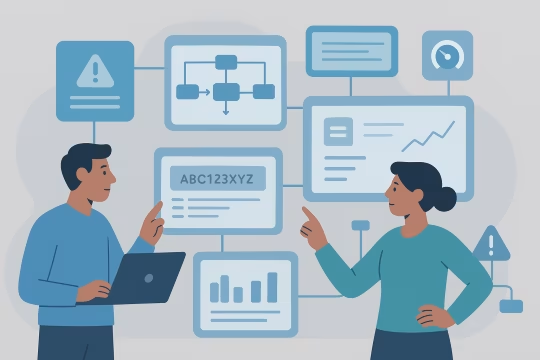
[07]Provide dashboards, alerts, and support procedures for common failure scenarios. We train teams on reconciliation workflows and how to diagnose issues using correlation IDs and integration metrics.
 [08]
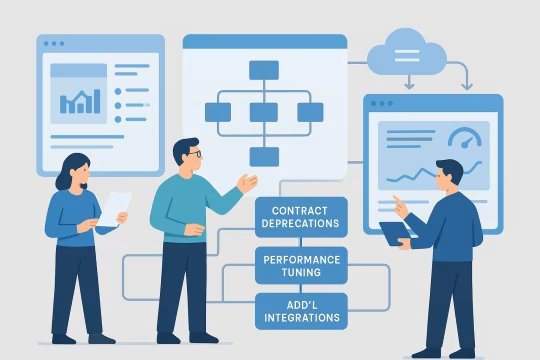
[08]Iterate based on production telemetry, upstream roadmap changes, and platform evolution. We plan contract deprecations, performance tuning, and additional integrations without destabilizing checkout and order processing.
Commerce integrations affect revenue-critical workflows and operational cost. With Enterprise ecommerce Drupal architecture that treats integration contracts, resilience, and observability as core platform concerns, organizations reduce order failures, improve product and order data consistency across ERP/PIM, and decouple storefront delivery from upstream system change cycles.
Idempotent processing and consistent state transitions reduce duplicate orders and stuck payments. Operational teams spend less time on manual fixes and customer support escalations tied to integration errors.
Stable API contracts and versioning reduce emergency storefront changes when upstream systems evolve. Teams can plan releases around product priorities rather than reacting to integration breakage.
Clear reconciliation paths, structured logs, and targeted alerts shorten incident triage. Support and engineering teams can identify root causes faster and avoid repeated manual data corrections.
Canonical mappings and validation reduce drift between catalog, pricing, inventory, and order systems. Reporting becomes more reliable because system-of-record decisions are explicit and enforced.
Timeouts, retries, and bulkhead separation reduce cascading failures during traffic spikes or upstream incidents. Checkout remains more stable even when non-critical dependencies degrade.
Reusable patterns for contracts, mapping, and job processing reduce the time to add new providers or regions. New integrations can be delivered with less bespoke engineering and fewer regressions.
Webhook verification, secrets management, and least-privilege access reduce exposure at integration boundaries. Sensitive flows such as payments and customer data exchange are handled with explicit controls and auditability.
Replacing ad-hoc point integrations with governed patterns reduces long-term maintenance cost. The platform becomes easier to upgrade because integration logic is isolated, tested, and observable.
Drupal decision support
A Drupal health check highlights architecture, governance, and integration readiness issues affecting reliability, change velocity, and operational support.
Adjacent Drupal capabilities that extend integration architecture, API design, and platform operations for commerce ecosystems.
Drupal API development services for secure integration layers
Secure Drupal Salesforce and HubSpot connectivity with enterprise data sync
Drupal event tracking architecture, identity, and audience sync engineering
Drupal GraphQL schema design and schema-first integration
Connect Drupal with Your Enterprise Ecosystem
Secure endpoints and consistent resource modeling
Drupal GA4 event tracking and enterprise instrumentation
Kubernetes Drupal infrastructure design for Drupal workloads
Common architecture, operations, integration, governance, risk, and engagement questions for Drupal Commerce integration work.
We start by mapping the commerce domain and identifying systems of record for each concept: product master data (often PIM), price and availability (often ERP), customer identity (IdP/CRM), and payment state (payment provider). Drupal Commerce typically owns the storefront experience, cart state, and the orchestration of checkout, while referencing authoritative data from upstream systems through contracts. From there, we define boundaries based on latency tolerance and failure impact. For example, checkout should not depend on multiple real-time calls that can fail independently; we may cache or pre-sync catalog and pricing, and use asynchronous order export with clear customer messaging when back-office confirmation is delayed. We also consider change frequency and ownership. If another team controls an upstream API and changes it often, we isolate that dependency behind a stable adapter layer and versioned contracts. The goal is to keep Drupal’s runtime behavior predictable while still integrating with enterprise systems in a controlled, observable way.
Synchronous integrations are appropriate when the user experience requires immediate confirmation and the upstream dependency is reliable, fast, and well-governed. Typical examples include payment authorization flows (within the payment provider’s supported patterns) or address validation when it is optional and has safe fallbacks. Asynchronous integrations are preferred for workflows that can tolerate eventual consistency or where upstream systems have variable latency and availability. Order export to ERP, fulfillment updates, and large catalog synchronization are common candidates. Asynchronous processing allows retries, dead-letter handling, and reconciliation without blocking checkout. We design these choices explicitly per domain flow, documenting acceptable staleness, retry windows, and customer-visible behavior. We also implement idempotency and correlation IDs in both modes so that retries and partial failures do not create duplicate orders or inconsistent states. The result is an integration model that matches business criticality and operational reality.
We instrument integrations around business-critical signals rather than generic infrastructure noise. For Drupal Commerce, that typically includes metrics for checkout attempts, payment authorization outcomes, order creation success, webhook processing throughput, sync job latency, and error rates by integration endpoint. We implement structured logging with correlation IDs that propagate across inbound requests, outbound API calls, and asynchronous jobs. This enables tracing a single order from checkout through payment events and downstream exports. Where possible, we add dashboards that separate transient upstream failures from systemic issues such as schema mismatches or authentication errors. Alerting is tuned to operational impact: for example, sustained increases in payment failures, growing dead-letter queues, or order export backlogs beyond an agreed threshold. We also document runbooks for common failure modes (timeouts, signature verification failures, rate limiting) so on-call teams can respond consistently and safely.
Retries are implemented with clear rules: bounded attempts, exponential backoff, and idempotency keys so repeated processing does not create duplicates. For asynchronous flows, we use dead-letter handling for messages or jobs that exceed retry limits, preserving payloads and context for investigation. Reconciliation is treated as a designed workflow, not an afterthought. We define what “correct” state means across systems (for example, payment captured implies order paid, but fulfillment may be pending). We then implement tools or scripts to reprocess specific orders, replay webhooks safely, or resync data ranges without impacting unrelated traffic. For “stuck” orders, we focus on observability and deterministic transitions. Orders should not silently fail; they should move into explicit states that operations teams can act on. This reduces manual database edits and makes incident response safer and auditable.
We begin by identifying which system is authoritative for each attribute: product identifiers, variant structure, pricing, inventory, tax classes, and localized content. We then define a canonical mapping into Drupal Commerce entities, including validation rules and how to handle missing or inconsistent upstream data. For PIM-driven catalogs, we typically implement incremental sync based on timestamps or change feeds, with full rebuild capabilities for recovery. For ERP-driven pricing and inventory, we choose between near-real-time updates (webhooks/events) and scheduled sync depending on volatility and acceptable staleness. We also consider caching and precomputation to avoid runtime dependency on ERP during checkout. Finally, we design operational controls: monitoring for sync lag, error queues for invalid records, and audit trails linking Drupal entities back to upstream identifiers. This makes ongoing catalog operations predictable and reduces the risk of storefront breakage due to upstream data quality issues.
We implement payment integrations using the provider’s recommended flow (redirect, hosted fields, or tokenization) to avoid handling sensitive card data directly. Payment state is modeled explicitly: authorization, capture, refund, and chargeback events are mapped to Drupal Commerce payment and order states with clear transition rules. Webhook handling is treated as a critical integration surface. We verify signatures, validate timestamps where supported, and ensure idempotent processing so repeated webhook deliveries do not duplicate captures or refunds. We also store enough event context to support auditability and troubleshooting. Operationally, we design for partial failure: a payment may succeed while the order export fails, or vice versa. We implement reconciliation paths and customer-safe messaging so the platform remains consistent and support teams can resolve exceptions without risky manual intervention.
We treat contracts as versioned artifacts with explicit ownership. For each integration, we document schemas, required fields, error semantics, and compatibility rules. Where possible, we use contract tests to validate that upstream and downstream changes remain compatible before deployment. Versioning strategy depends on the integration surface. For REST APIs, we may use explicit versioned endpoints or backward-compatible additive changes with deprecation windows. For GraphQL, we rely on schema evolution rules and deprecation directives, combined with monitoring of field usage. Governance also includes change management: release notes, migration plans, and a process for emergency fixes. The objective is to decouple teams so that upstream changes do not force immediate storefront releases, while still allowing the integration layer to evolve in a controlled, observable manner.
Ownership is defined per integration and per operational responsibility: code ownership, credential management, monitoring/alerting ownership, and incident response. In many organizations, platform teams own the Drupal codebase while integration or middleware teams own upstream services; we align responsibilities to match that structure. We provide documentation that supports day-2 operations: architecture diagrams, contract specifications, configuration and secrets requirements, runbooks for common failures, and reconciliation procedures. We also document data lineage and system-of-record decisions so future changes do not accidentally shift authoritative sources. If the client team will operate the integrations, we include knowledge transfer sessions focused on real scenarios: replaying a failed job, diagnosing webhook signature failures, and validating upstream schema changes. The goal is operational independence with clear escalation paths when upstream systems are involved.
We design payment flows to minimize exposure to cardholder data by using tokenization and provider-hosted components where possible. Drupal should not store sensitive card data; instead, it stores tokens, references, and non-sensitive metadata required for reconciliation and customer service. For integration security, we implement least-privilege credentials, rotate secrets, and separate environments with distinct keys. Webhooks are verified using signatures and replay protection mechanisms supported by the provider. We also validate inbound payloads strictly to prevent injection or state manipulation. Beyond payments, we address PII handling across customer and order integrations: encryption in transit, careful logging (no sensitive payloads in logs), and access controls for operational tooling. Security requirements are captured early as non-functional requirements and validated during testing and pre-production readiness reviews.
We classify dependencies by criticality and design fallbacks accordingly. For example, catalog browsing can often tolerate cached product data, while payment authorization must follow the provider’s flow but can be isolated from non-critical calls such as loyalty lookups or optional recommendations. We implement timeouts and circuit-breaking behavior so slow upstream services do not tie up Drupal resources. For non-critical dependencies, we degrade gracefully: skip optional calls, queue work for later, or present clear messaging when a feature is temporarily unavailable. For critical flows, we ensure failures are explicit and recoverable, with idempotent retries and reconciliation. We also use observability to detect upstream degradation early and operational controls to reduce impact, such as temporarily disabling a failing integration path via configuration. The aim is to prevent cascading failures and keep revenue-critical paths stable during partial outages.
A typical scope starts with a short discovery to map systems, data ownership, and critical commerce flows. From there, we define a prioritized integration backlog, usually starting with checkout/payment and order export, then expanding to catalog, pricing, inventory, tax, shipping, and customer data depending on the platform’s maturity. Delivery is usually organized into vertical slices that include mapping, processing logic, tests, and operational instrumentation. Each slice results in a working integration path that can be validated in lower environments and rolled out safely. We also include governance artifacts such as contract documentation, versioning rules, and runbooks. The exact scope depends on whether integrations already exist and need stabilization, or whether the platform is being built new. In both cases, we focus on measurable operational outcomes: reduced failures, clear observability, and controlled change management across systems.
We work with platform teams, integration teams, and vendor contacts through a shared contract-first process. Early on, we establish communication paths and define who can change what: API schemas, credentials, deployment windows, and incident escalation. This reduces delays caused by unclear ownership. During implementation, we use integration environments and test doubles where vendor sandboxes are limited. We also align on acceptance criteria that reflect real operational behavior: idempotency, retry semantics, and how errors are surfaced. For vendors, we document required webhook behavior, rate limits, and authentication expectations. We aim to make collaboration efficient by producing artifacts that multiple teams can use: contract specs, mapping tables, and runbooks. This helps internal teams maintain the integrations after delivery and reduces dependency on individual contributors for institutional knowledge.
Collaboration typically begins with a focused technical discovery workshop and access setup. We request current architecture diagrams (if available), a list of systems to integrate (ERP, PIM, payment, tax, shipping), and any existing API documentation or contracts. We also review the Drupal Commerce configuration, key modules, and the current order/payment lifecycle implementation. Next, we align on operational requirements: peak traffic expectations, acceptable latency and staleness for catalog and inventory, incident response expectations, and compliance constraints (PII, payment handling). We identify system owners and define environments, credentials, and sandbox availability so integration work can proceed without blocking. The output of this initial phase is a prioritized integration plan with clear contracts, a delivery sequence for the highest-risk flows (usually checkout/payment and order export), and a definition of done that includes testing and observability. From there, implementation proceeds in incremental slices with regular technical checkpoints.
These case studies highlight real-world implementations of Drupal ecommerce integrations, focusing on payment gateway connectivity, order synchronization, and platform stability. They showcase secure payment workflows, reliable order processing, and integration patterns that align closely with Drupal Commerce API and enterprise ecommerce operations. The selected work demonstrates measurable improvements in performance, security, and operational scalability relevant to Drupal Commerce integration services.
The Deprexis mental health digital platform on Drupal required stabilization, faster performance, and a secure ecommerce payment workflow to support online services. The solution needed to meet strict reliability and security expectations common for digital healthcare products.
The platform was stabilized, performance was improved, and secure checkout workflows were delivered with strong automated coverage to reduce operational and compliance risks.
Oleksiy (PathToProject) and I worked together on a Digital Transformation project for Bayer LATAM Radiología. Oly was the Drupal developer, and I was the business lead. His professionalism, technical expertise, and ability to deliver functional improvements were some of the key attributes he brought to the project.
I also want to highlight his collaboration and flexibility—throughout the entire journey, Oleksiy exceeded my expectations.
It’s great when you can partner with vendors you trust, and who go the extra mile.

Axel Gleizerman Copello
Building in the MedTech Space | Antler
Oleksiy (PathToProject) worked with me on a specific project over a period of three months. He took full ownership of the project and successfully led it to completion with minimal initial information.
His technical skills are unquestionably top-tier, and working with him was a pleasure. I would gladly collaborate with Oleksiy again at any opportunity.

Nikolaj Stockholm Nielsen
Strategic Hands-On CTO | E-Commerce Growth
As Dev Team Lead on my project for 10 months, Oleksiy (PathToProject) demonstrated excellent technical skills and the ability to handle complex Drupal projects. His full-stack expertise is highly valuable.

Laurent Poinsignon
Domain Delivery Manager Web at TotalEnergies
These articles expand on the integration patterns, data contracts, and operational risks that shape reliable Drupal Commerce work. They are useful if you want to understand how synchronization, mapping, validation, and delivery governance affect ecommerce integrations in practice.
Let’s review your Drupal Commerce flows, external system dependencies, and failure modes, then define an integration plan with clear contracts, resilience patterns, and operational visibility.