




 [01]
[01]Discovery and Audit
Assess current Drupal configuration, custom modules, and existing integrations. Map consumers, data domains, and non-functional requirements, then identify contract gaps, security risks, and performance bottlenecks.
Drupal integration readiness
Run a Drupal health check to uncover contract drift, upgrade blockers, governance gaps, and integration weaknesses before you commit to API changes.
Useful when endpoints, consumers, and release cycles are getting harder to manage.
No login required. Takes 2–3 minutes.
Drupal API development services focus on designing, implementing, and operating stable API surfaces that expose content, workflows, and platform capabilities to other systems. This includes Drupal REST API engineering, Drupal JSON:API architecture, and Drupal GraphQL endpoints, as well as integration patterns for identity, caching, rate limiting, and event-driven workflows.
Organizations need this capability when Drupal becomes part of a broader enterprise landscape: multiple frontends, mobile apps, partner portals, data platforms, and line-of-business systems. Without a deliberate API strategy, teams often ship ad-hoc endpoints that are hard to secure, difficult to evolve, and expensive to support.
An API-first approach treats Drupal as a governed platform component. Clear contracts, consistent resource modeling, and versioning enable parallel product development. Operational controls such as authentication, observability, and performance tuning ensure APIs remain reliable under load and across release cycles, supporting headless Drupal backend API development and long-term maintainability.
Core Focus
Best Fit For
Key Outcomes
Technology Ecosystem
Platform Integrations
As Drupal platforms grow beyond a single website, integration demands increase quickly: multiple consumers, different release cadences, and higher expectations for reliability. Without a consistent API model, teams often expose data through a mix of custom endpoints, partially configured JSON:API resources, and one-off integrations that reflect immediate needs rather than a coherent contract.
This fragmentation creates architectural drift. Resource representations vary across endpoints, authorization rules are inconsistently applied, and performance characteristics are unpredictable. Engineering teams spend time reverse-engineering payloads, handling edge cases in consumers, and coordinating releases to avoid breaking changes. Over time, the API layer becomes tightly coupled to internal Drupal implementation details, making upgrades and refactoring risky.
Operationally, weak API governance increases incident frequency and slows delivery. Missing observability makes it hard to diagnose latency or error spikes. Lack of caching and rate limiting can amplify load on Drupal and downstream systems. Security gaps emerge when authentication and token handling are implemented differently across integrations, increasing compliance and audit effort.
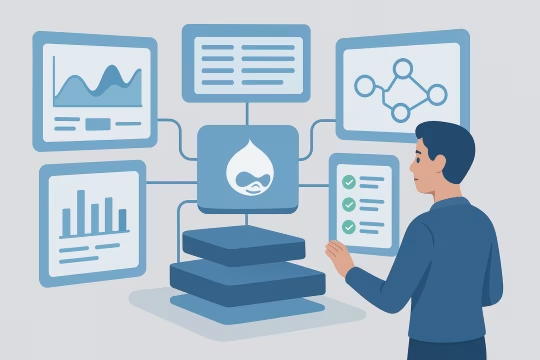
Review current Drupal architecture, consumers, and integration touchpoints. Identify API use cases, data domains, security requirements, and non-functional constraints such as latency, throughput, and availability targets.
Define resource models, representations, and relationships aligned to content and business domains. Establish naming conventions, filtering/sorting rules, pagination, and error semantics to create consistent contracts across endpoints.
Design authentication and authorization patterns for APIs, including OAuth2 flows, token lifetimes, scopes/permissions, and service-to-service access. Validate requirements for auditability, PII handling, and threat mitigation.
Implement APIs using Drupal core capabilities and custom modules where needed. Configure JSON:API resources, build REST endpoints, or implement GraphQL schemas and resolvers, keeping Drupal internals decoupled from external contracts.
Add caching, rate limiting patterns, and resilience strategies for downstream dependencies. Introduce idempotency where appropriate and ensure consistent handling of retries, timeouts, and partial failures.
Create automated tests for contracts, authorization rules, and critical workflows. Validate backward compatibility, schema changes, and performance characteristics using repeatable test environments and realistic datasets.
Package changes for containerized deployment and align configuration management across environments. Establish rollout and rollback procedures, and ensure secrets management and environment-specific settings are controlled.
Define versioning strategy, deprecation policy, and change control for API contracts. Implement monitoring dashboards and operational runbooks, and plan iterative improvements based on consumer feedback and platform metrics.
This service builds Drupal API layers that behave like a governed platform interface rather than a collection of endpoints. We apply Drupal JSON:API architecture, Drupal REST API engineering, and Drupal GraphQL API engineering and architecture to keep contracts consistent, secure, and evolvable through versioning and deprecation. Performance and reliability are treated as first-class concerns through caching strategy, operational observability, and integration resilience. The result is an API surface that supports multiple consumers and release cycles without coupling them tightly to Drupal internals.
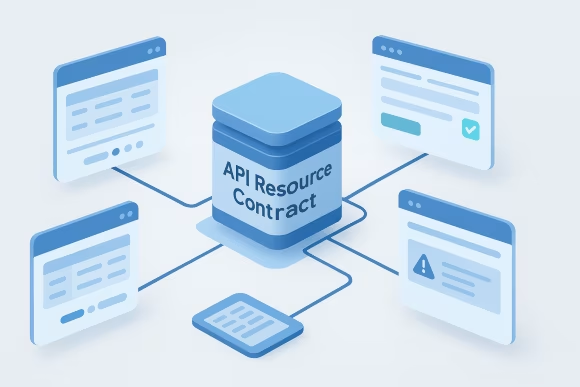
Define stable, consumer-oriented representations for content and domain entities, independent of internal Drupal storage details. Establish consistent conventions for fields, relationships, pagination, filtering, and error responses so multiple consumers can integrate without bespoke handling.
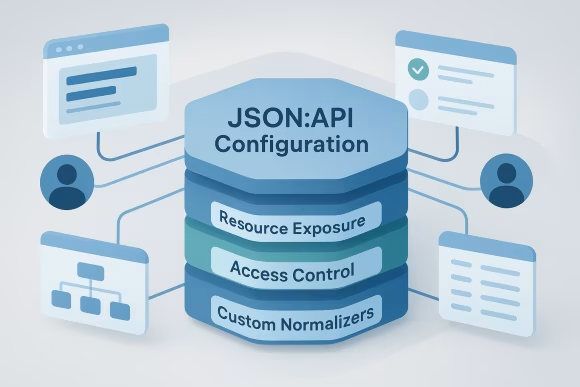
Configure and extend Drupal JSON:API to expose the right resources with controlled fields and relationships. Implement access control, include strategies, and custom normalizers where needed to keep payloads consistent and efficient for enterprise consumers.

Build REST endpoints for workflows that do not map cleanly to standard resource operations, such as composite reads, commands, or integration-specific actions. Implement consistent request validation, error semantics, and response shaping to maintain contract quality.
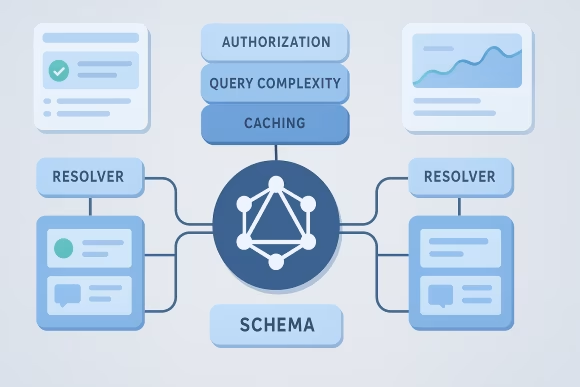
Design GraphQL schemas and resolvers that provide flexible querying while enforcing authorization and performance constraints. Apply query complexity controls, caching strategies, and schema governance to prevent consumer-driven load amplification.
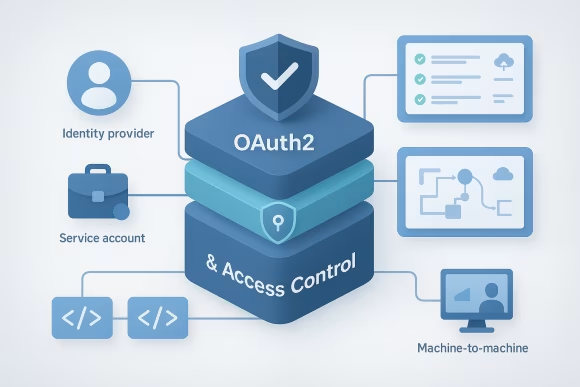
Implement token-based authentication and authorization patterns aligned with enterprise identity providers. Define scopes, roles, and permission mapping, and ensure consistent enforcement across endpoints, including service accounts and machine-to-machine integrations.
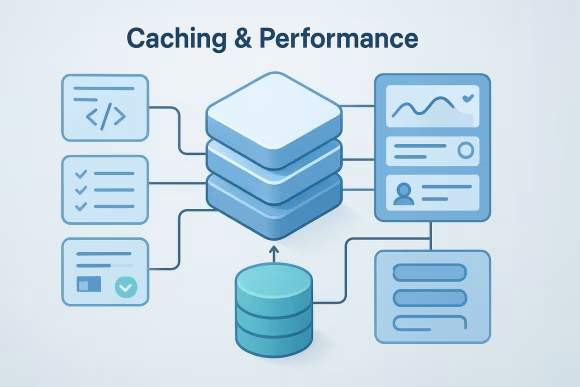
Design caching layers using Drupal cache metadata, HTTP caching patterns, and Redis-backed strategies. Reduce database pressure and improve latency through cacheability analysis, invalidation rules, and careful handling of personalized or permissioned responses.
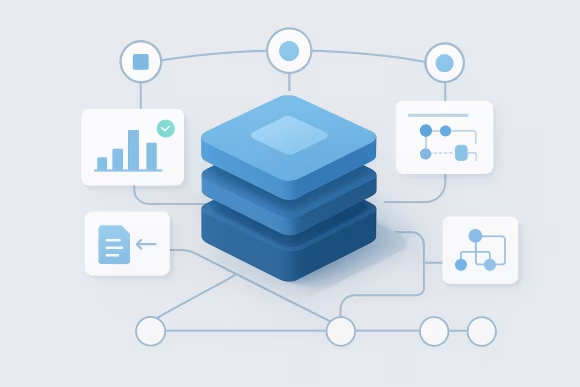
Introduce explicit versioning strategies for endpoints and schemas, with backward compatibility rules and deprecation timelines. Provide migration guidance and contract tests to reduce breaking changes across parallel product and platform release cycles.
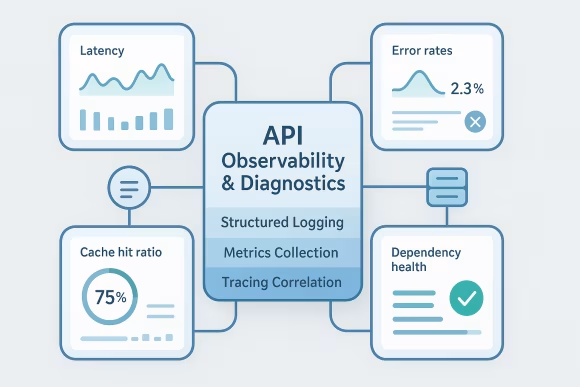
Instrument APIs with structured logging, metrics, and tracing-friendly correlation identifiers. Establish dashboards and alerting for latency, error rates, cache hit ratios, and dependency health to support reliable operations and faster incident resolution.
Review how your Drupal APIs handle versioning, access control, performance, and operational visibility so teams can prioritize the issues most likely to slow delivery or break consumers.
Engagements follow a clear engineering sequence from discovery through implementation and long-term evolution. We reduce enterprise Drupal API integration risk early by establishing API contracts, then deliver Drupal JSON:API and REST API development services (and GraphQL where appropriate) in incremental, testable releases. Implementation is aligned with your release processes, security requirements, and platform governance so the API layer can evolve safely across Drupal upgrades and consumer changes.
[01]Assess current Drupal configuration, custom modules, and existing integrations. Map consumers, data domains, and non-functional requirements, then identify contract gaps, security risks, and performance bottlenecks.
 [02]
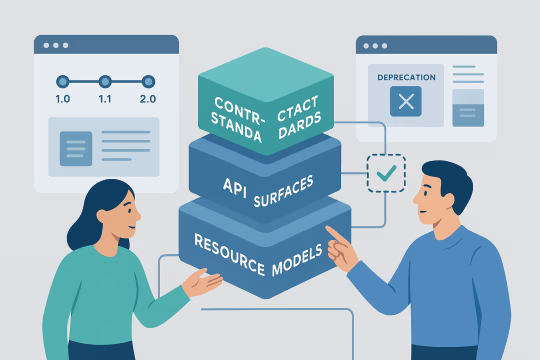
[02]Define API surface area, resource models, and contract standards. Establish versioning, deprecation policy, and documentation approach, aligned with platform governance and consumer release cadences.
 [03]
[03]Deliver endpoints and integration components in small, testable increments. Prioritize high-value consumers first, while keeping internal Drupal changes isolated from external contracts.
 [04]
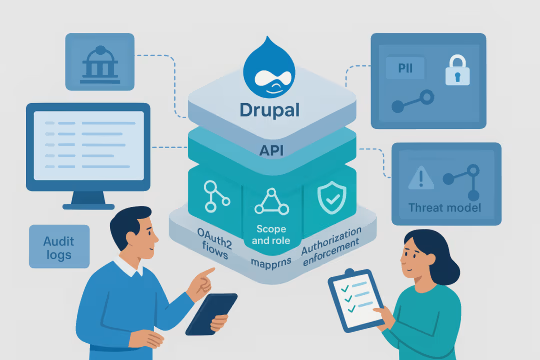
[04]Implement OAuth2 flows, scope/role mapping, and consistent authorization enforcement. Validate PII handling, audit requirements, and threat models, and align with enterprise IAM and security review processes.
 [05]
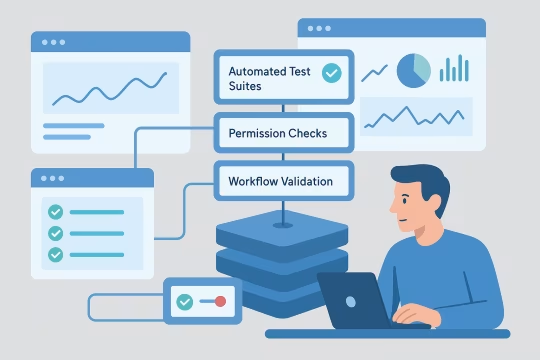
[05]Add automated tests for contracts, permissions, and critical workflows. Run performance checks and regression suites in CI to detect breaking changes before they reach consumers.
 [06]
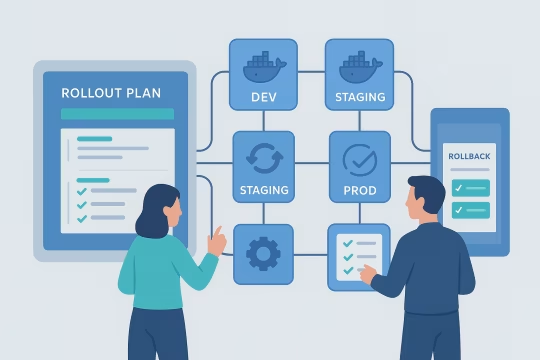
[06]Package changes for Docker-based environments and align configuration management across dev/test/prod. Provide rollout plans, rollback procedures, and environment readiness checks for safe releases.
 [07]
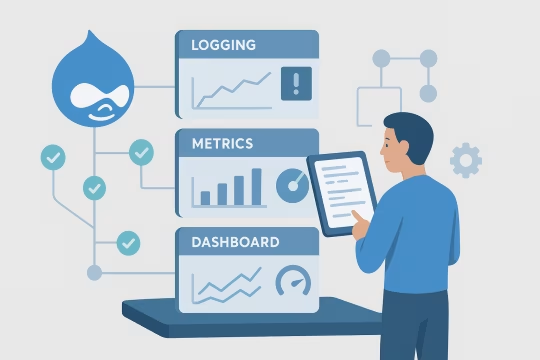
[07]Implement logging, metrics, and dashboards for API health and dependency behavior. Provide runbooks and incident response guidance focused on integration failure modes and performance degradation.
 [08]
[08]Support iterative improvements, new consumers, and contract extensions. Manage deprecations, upgrade readiness for Drupal core changes, and continuous performance tuning based on real usage patterns.
A governed Drupal API layer reduces integration friction and makes platform change safer. Clear contracts, Drupal REST/JSON:API/GraphQL governance, and operational controls help teams deliver new channels and integrations without creating hidden coupling, while OAuth2 security and observability reduce risk and support predictable operations.
Standardized resource models and reusable patterns reduce time spent designing each new integration. Teams can onboard new consumers with fewer bespoke decisions and less rework across releases.
Consistent authentication, authorization, and rate-control patterns reduce security and stability incidents. Improved diagnostics shortens time-to-resolution when failures occur in Drupal or downstream systems.
Versioning and deprecation policies make contract evolution predictable. Consumer teams can plan upgrades and migrations without emergency coordination or unplanned release freezes.
Caching strategy and performance tuning reduce load on Drupal and databases under high traffic or multi-consumer usage. This supports growth in channels, content volume, and integration throughput.
Defined API standards and change control reduce ambiguity across teams. Platform owners can enforce consistency while enabling product teams to deliver independently within agreed contracts.
Decoupling external contracts from internal Drupal implementation reduces the cost of refactoring and Drupal upgrades. Common integration patterns reduce duplicated code and inconsistent fixes.
OAuth2 scope design, permission mapping, and audit-friendly logging improve control over data access. Security reviews become repeatable because patterns are consistent across endpoints.
Contract tests, documentation conventions, and predictable error semantics reduce integration debugging time. Engineers spend less effort interpreting payload differences and more time delivering product features.
Before major API changes
Use a Drupal health check to identify weak contracts, inconsistent authorization, observability gaps, and scaling risks before roadmap commitments lock in technical debt.
These related services extend Drupal API development services into adjacent areas such as REST/GraphQL specialization, broader enterprise Drupal API integration work, and the platform architecture and infrastructure needed to operate a headless or hybrid Drupal backend reliably.
Secure endpoints and consistent resource modeling
Drupal GraphQL schema design and schema-first integration
Drupal event tracking architecture, identity, and audience sync engineering
Drupal GA4 event tracking and enterprise instrumentation
Secure Drupal Salesforce and HubSpot connectivity with enterprise data sync
Connect Drupal with Your Enterprise Ecosystem
Drupal ecommerce API integration and data synchronization
Custom modules, extensions, and feature engineering
Kubernetes Drupal infrastructure design for Drupal workloads
Common questions about engineering, operating, and evolving Drupal API layers in enterprise environments.
We start from consumer needs and operational constraints rather than preference. JSON:API is a strong default for resource-oriented content delivery because it is standardized, supports relationships, and aligns well with Drupal’s entity model. REST is appropriate for workflow-oriented endpoints (commands, composite operations, integration-specific actions) where a pure resource model becomes awkward or inefficient. GraphQL is useful when consumers need flexible query shapes, but it requires stronger governance to avoid performance issues and uncontrolled query complexity. In practice, many enterprise Drupal platforms use a hybrid approach: JSON:API for core content resources, REST for specialized workflows, and GraphQL for selected use cases where query flexibility materially reduces round-trips. We also consider caching strategy, authorization complexity, and how contracts will be versioned and tested over time. The goal is a small number of well-governed patterns that teams can apply consistently.
We treat the API contract as an external interface that should not leak internal Drupal implementation details. That means defining resource representations and field naming conventions that are consumer-oriented, limiting exposure of internal IDs or storage-specific structures, and using explicit mapping layers when necessary. We also introduce contract tests that validate response shape, required fields, error semantics, and authorization behavior. These tests run in CI and become a guardrail during Drupal core upgrades, module updates, and refactoring. For changes that must be introduced, we apply versioning and deprecation rules so consumers can migrate on a planned timeline. Finally, we align configuration management and environment parity so that upgrades are tested in realistic conditions. This reduces the risk that an upgrade changes serialization behavior, access checks, or performance characteristics in ways that break consumers unexpectedly.
We focus on metrics that indicate consumer experience and platform stress. At minimum, that includes request rate, latency percentiles (p50/p95/p99), error rates by endpoint and status code, and cache hit ratios. For authenticated APIs, we also track authorization failures and token-related errors to detect IAM issues early. On the platform side, we correlate API behavior with Drupal and infrastructure signals: PHP-FPM saturation, database query time, Redis performance, and upstream dependency health. Where possible, we add correlation IDs and structured logs so a single request can be traced across layers. The exact dashboards depend on your architecture, but the principle is consistent: measure what consumers feel, measure what Drupal is doing, and connect the two so incidents can be diagnosed quickly and performance work can be prioritized based on real usage.
Authenticated APIs often reduce caching opportunities because responses can vary by user, role, or scope. We start by analyzing cacheability at the resource and field level, then apply strategies such as separating public and private data, minimizing personalization in core resources, and using cache contexts/tags correctly so invalidation is precise. For HTTP caching, we use Drupal’s cache metadata to control variation and invalidation, and we avoid accidental cache fragmentation. For application-level caching, Redis can be used to reduce repeated computation and database load, but it must be designed with clear invalidation rules. We also address performance at the source: query optimization, limiting includes, controlling GraphQL query complexity, and shaping payloads to reduce over-fetching. The goal is predictable latency under load without compromising access control guarantees.
We design OAuth2 flows based on the consumer type: authorization code with PKCE for browser-based apps, client credentials for service-to-service integrations, and carefully controlled refresh token policies where needed. We then map identity claims and scopes to Drupal roles/permissions in a consistent way so authorization decisions are explainable and auditable. Integration typically involves aligning token validation, key rotation, and session lifetimes with enterprise IAM policies. We also define how user provisioning works (just-in-time, sync, or hybrid) and how deprovisioning is enforced. Operationally, we add monitoring for token validation failures, scope mismatches, and unusual access patterns. This helps distinguish IAM outages from application defects and supports security review requirements without introducing brittle, consumer-specific logic in Drupal.
Yes, but it requires explicit design. Drupal is commonly used for request/response APIs, while event-driven patterns are introduced for content lifecycle events, integration triggers, and downstream synchronization. We identify which events matter (publish/unpublish, taxonomy changes, media updates, workflow transitions) and define event payload contracts that are stable and versioned. Implementation options include emitting events from Drupal via custom modules, using queues for reliability, and integrating with messaging infrastructure in your environment. We also design idempotency and retry behavior so downstream systems can process events safely. The key is governance: event schemas, delivery guarantees, and operational monitoring must be defined so event-driven integrations remain reliable as the platform evolves.
We establish a versioning strategy that matches how consumers deploy. For REST/JSON:API, that may mean URI versioning, header-based versioning, or a controlled set of additive changes with explicit deprecation windows. For GraphQL, we typically use schema evolution patterns with deprecation directives and documented removal timelines. Governance includes a change review process for contract-affecting updates, a definition of what constitutes a breaking change, and a communication mechanism for consumer teams. Contract tests and schema snapshots help detect accidental breaks early. We also recommend maintaining a small set of canonical examples and reference clients to validate behavior. The goal is to allow independent delivery while keeping the API surface predictable and reducing cross-team coordination overhead during releases.
Documentation is treated as part of the contract. For REST endpoints, we typically provide an OpenAPI description where feasible, plus examples that reflect real authorization contexts and error cases. For JSON:API, we document resource types, relationships, filtering/sorting conventions, and any extensions or constraints beyond the base specification. For GraphQL, we rely on schema introspection plus curated guides for common queries and performance considerations. We also document operational expectations: rate limits (if applicable), caching behavior, versioning and deprecation policy, and how to request changes. Where consumers are internal teams, we align documentation with your developer portal or internal knowledge base. The objective is to reduce integration ambiguity and make onboarding repeatable, so consumer teams spend less time interpreting behavior and more time building features.
The most common risks are inconsistent authorization checks, over-exposure of fields, and assumptions that authenticated equals authorized. JSON:API and GraphQL can expose more than intended if resource access and field-level permissions are not designed carefully. Another frequent issue is token handling: incorrect validation, overly broad scopes, or weak rotation and expiry policies. We mitigate these risks by defining explicit access rules, validating them with automated tests, and reviewing endpoints for data leakage under different roles/scopes. We also ensure error responses do not reveal sensitive internal details. Beyond application logic, we consider operational security: secrets management, TLS configuration, dependency patching, and logging hygiene (avoiding PII in logs). Security is implemented as a consistent pattern across the API surface, not as endpoint-by-endpoint exceptions.
We combine contract governance with performance guardrails. First, we define performance budgets for critical endpoints (latency and throughput targets) and identify the main cost drivers: database queries, serialization, authorization checks, and downstream calls. Then we add automated checks where practical, such as regression tests for query counts or load tests for high-traffic endpoints. We also design APIs to be cache-friendly and to avoid unbounded expansions (for example, controlling JSON:API includes and GraphQL query complexity). Observability is essential: if you can’t see latency by endpoint and consumer, regressions will be discovered late. Finally, we align release practices with safe rollout: feature flags where appropriate, staged deployments, and clear rollback procedures. This reduces the blast radius when a change behaves differently under production load.
Engagements usually start with a short discovery phase to map consumers, integration requirements, and the current Drupal implementation. We then define the target API surface and contract standards, including security model, versioning approach, and operational requirements. Delivery proceeds in iterative increments, prioritizing the highest-value consumers and establishing reusable patterns early. We work alongside your teams: platform engineers, integration teams, and product teams. Responsibilities are made explicit—who owns contract decisions, who approves security changes, and who operates the API in production. We also align with your CI/CD and environment management so changes are testable and deployable in your existing workflow. The engagement typically includes implementation, automated testing, documentation, and operational enablement (dashboards/runbooks). Ongoing support can cover evolution, new consumers, and Drupal upgrade readiness.
Collaboration usually begins with a focused technical intake to establish context and constraints. We ask for an overview of your Drupal platform (version, hosting model, key modules), current consumers (frontends, apps, partner systems), and the integrations that are most critical or most painful today. We also review security requirements, identity provider setup, and any existing API documentation or contracts. From there, we run a short discovery workshop with platform and integration stakeholders to define the initial API scope, success criteria, and operational expectations (latency targets, availability, support model). We identify quick wins and high-risk areas, then propose an implementation plan with milestones, testing strategy, and governance approach. The first delivery increment is typically a thin vertical slice: one or two representative resources/endpoints, end-to-end authentication, automated tests, and baseline observability. This establishes patterns the rest of the API surface can follow.
These case studies showcase advanced Drupal API development, integration strategies, and platform modernization efforts that align closely with Drupal JSON:API, REST, and GraphQL endpoint engineering. They highlight real-world implementations of secure, scalable, and maintainable Drupal API layers, including OAuth2 security, caching, versioning, and operational controls essential for enterprise-grade Drupal integrations.
An advanced healthcare digital platform for LATAM was required to facilitate collaboration among radiology HCPs, distribute company knowledge, refine treatment methods, and streamline workflows. The solution needed secure medical website role-based access restrictions based on user role (HCP / non-HCP) and geographic region.
The platform enhanced collaboration, streamlined workflows, and empowered radiology professionals with advanced tools to gain insights and optimize patient care.
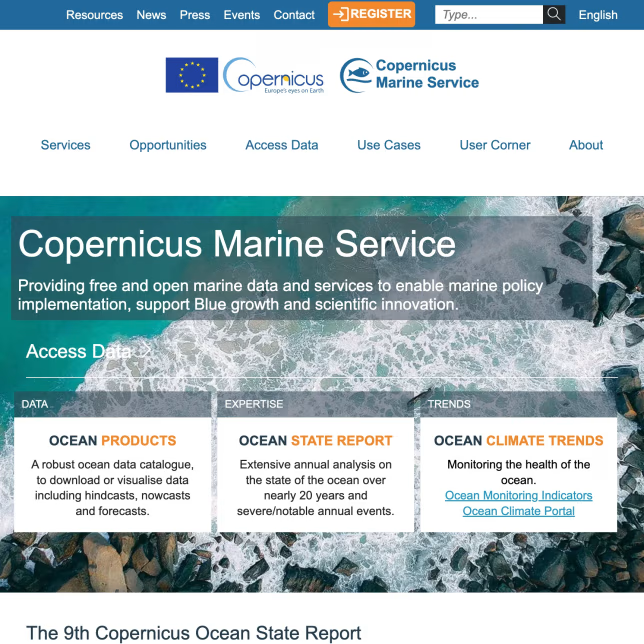
The existing marine data portal relied on three unaligned WordPress installations and embedded PHP code, creating inefficiencies and risks in content management and usability.
The new Drupal DXP streamlined content operations and improved accessibility, offering scientists and businesses a more efficient gateway to marine data services.
UNCCD operated four separate websites (two WordPress, two Drupal), leading to inconsistencies in design, content management, and user experience. A unified, scalable solution was needed to support a large-scale CMS migration project and improve efficiency and usability.
The modernization effort resulted in a cohesive, user-friendly, and scalable website, improving content management efficiency and long-term digital sustainability.
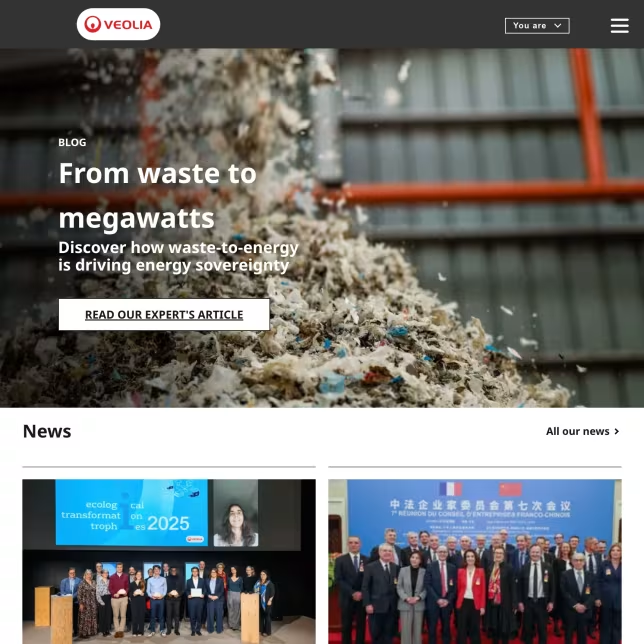
With Drupal 7 reaching end-of-life, Veolia needed a Drupal 7 to Drupal 10 enterprise migration for its Acquia Site Factory multisite platform—preserving region-specific content and multilingual capabilities across more than 200 sites.
The platform was modernized into a stable, scalable multisite foundation with improved performance, maintainability, and long-term upgrade readiness.
It was my pleasure working with Oleksiy (PathToProject) on a new Drupal website. He is a true full-stack developer—the ideal mix of DevOps expertise, deep front-end knowledge, and the structured thinking of a senior back-end developer.
He is well-organized and never lets anything slip. Oleksiy understands what needs to be done before being asked and can manage a project independently with minimal involvement from clients, product managers, or business analysts.
One of the best consultants I’ve worked with so far.

Andrei Melis
Technical Lead at Eau de Web
Oleksiy (PathToProject) and I worked together on a Digital Transformation project for Bayer LATAM Radiología. Oly was the Drupal developer, and I was the business lead. His professionalism, technical expertise, and ability to deliver functional improvements were some of the key attributes he brought to the project.
I also want to highlight his collaboration and flexibility—throughout the entire journey, Oleksiy exceeded my expectations.
It’s great when you can partner with vendors you trust, and who go the extra mile.

Axel Gleizerman Copello
Building in the MedTech Space | Antler
Oleksiy (PathToProject) is demanding and responsive. Comfortable with an Agile approach and strong technical skills, I appreciate the way he challenges stories and features to clarify specifications before and during sprints.

Olivier Ritlewski
Ingénieur Logiciel chez EPAM Systems
These articles expand on the governance and implementation choices that shape reliable Drupal API layers. They cover how to manage identity, source-of-truth modeling, schema change control, and API lifecycle decisions so integrations stay secure and maintainable over time.
Let’s review your current integrations, identify contract and security gaps, and design an API layer that can evolve safely across consumers and Drupal upgrades.