Core Focus

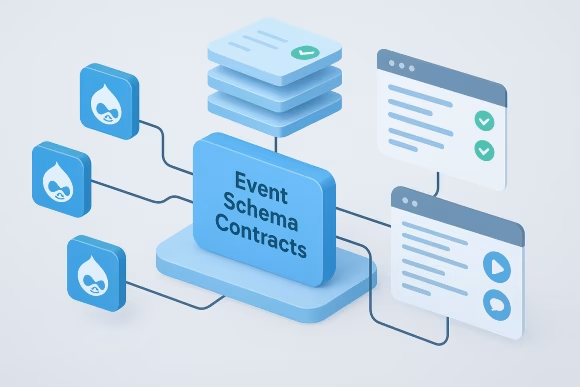
Event schema and tracking
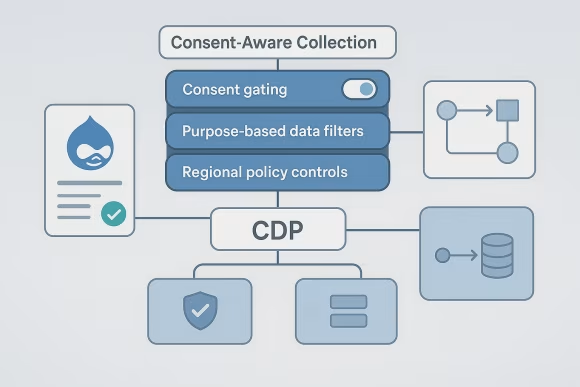
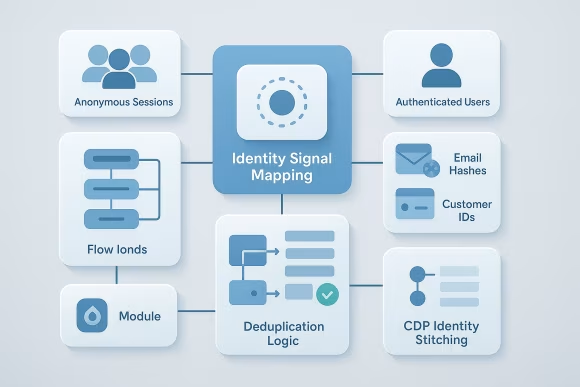
Identity and consent mapping
CDP ingestion pipelines
Audience sync validation

Best Fit For

  • Multi-site Drupal estates
  • Personalization and experimentation programs
  • Centralized analytics governance
  • Complex MarTech ecosystems

Key Outcomes

  • Consistent event semantics
  • Lower tracking regression risk
  • Faster audience activation
  • Improved data observability

Technology Ecosystem

  • Drupal modules and hooks
  • REST APIs and webhooks
  • Kafka event streaming
  • Segment sources and destinations

Delivery Scope

  • Tracking plan implementation
  • Connector and pipeline build
  • Data quality checks
  • Runbooks and ownership model

Inconsistent Data Signals Block Audience Activation

As Drupal platforms expand across brands, regions, and product lines, data collection often grows through incremental tagging and one-off integrations. Events are named differently across sites, payloads drift over time, and identity signals are captured inconsistently between anonymous browsing, authenticated sessions, and downstream systems. CDP teams then spend significant effort normalizing inputs rather than enabling activation.

These inconsistencies create architectural friction. Engineering teams struggle to change templates or upgrade modules without breaking tracking. Marketing technology teams cannot trust audience definitions when key attributes are missing, delayed, or duplicated. When multiple ingestion paths exist (client-side tags, server-side calls, batch exports), it becomes difficult to reason about source-of-truth, consent enforcement, and data lineage.

Operationally, the platform becomes harder to evolve. Releases require manual validation of tracking, incident response is reactive because pipelines lack observability, and compliance requirements (consent, retention, subject access) are implemented unevenly. The result is slower delivery, higher integration risk, and reduced confidence in analytics and activation workflows.


Drupal CDP Integration Workflow

Platform Discovery

Review Drupal architecture, traffic patterns, authentication flows, and existing tracking/tagging. Identify current CDP ingestion methods, downstream destinations, and constraints such as caching, CDN behavior, and privacy requirements.

Data Contract Design

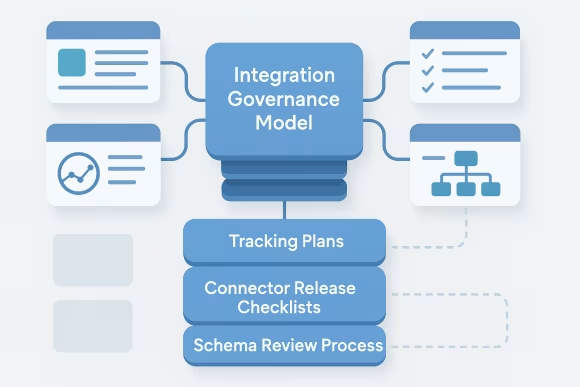
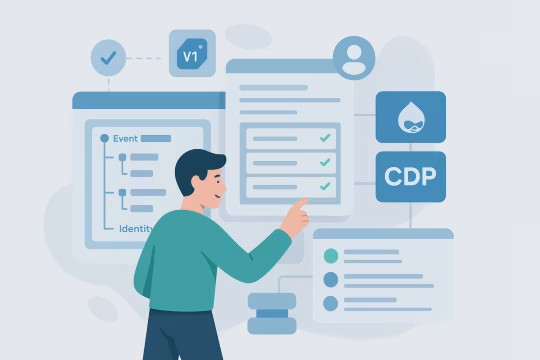
Define a tracking plan with event names, required properties, identity fields, and consent states. Establish versioning rules and ownership so Drupal and data teams can evolve schemas without breaking activation logic.

Integration Architecture

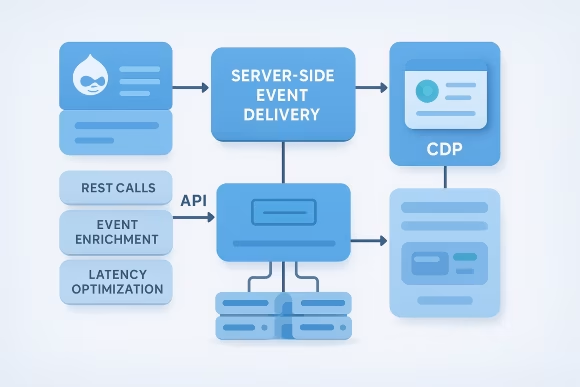
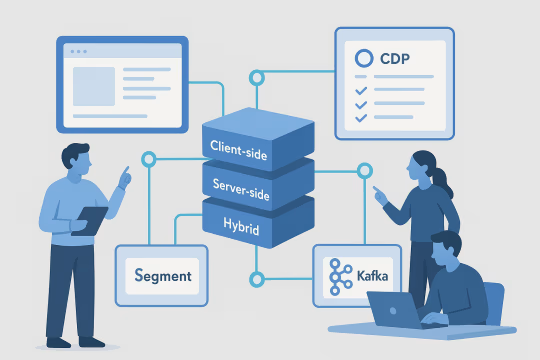
Select delivery patterns (client-side, server-side, or hybrid) and define interfaces to the CDP via REST APIs, Segment, or streaming. Design for reliability, idempotency, retries, and separation between content rendering and data emission.

Drupal Implementation

Implement event emission using Drupal modules, hooks, and middleware where appropriate. Ensure events are generated consistently across routes, components, and personalization variants, with clear mapping from business actions to technical triggers.

Pipeline and Streaming Setup

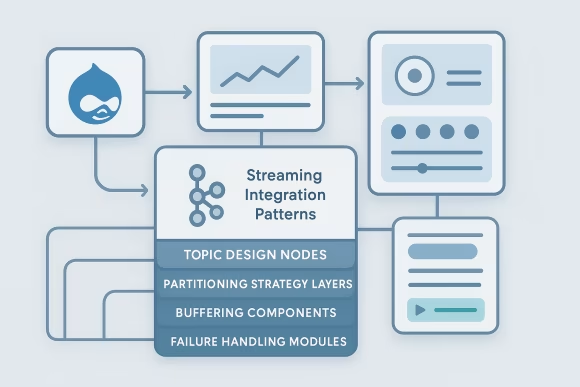
Configure connectors and routing to the CDP, including Kafka topics or Segment sources/destinations when used. Implement buffering, backpressure handling, and dead-letter paths so data issues do not impact the Drupal runtime.

Quality and Validation

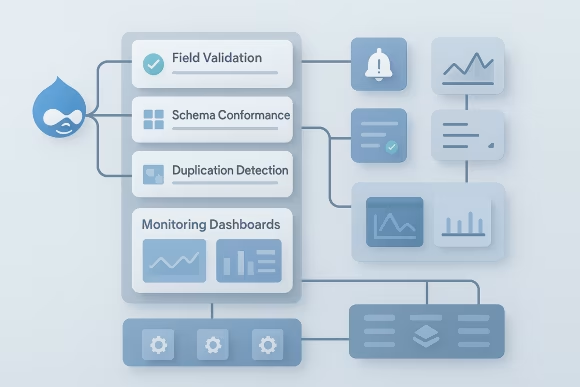
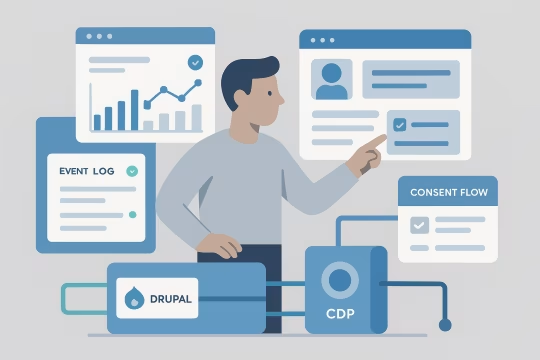
Add automated checks for schema compliance, required fields, and consent behavior across key journeys. Validate identity stitching behavior, deduplication rules, and latency expectations using representative traffic and test accounts.

Observability and Runbooks

Instrument dashboards and alerts for event volume, error rates, and delivery latency. Provide runbooks for incident response, schema changes, and release validation so operational ownership is clear across teams.

Governance and Evolution

Establish change control for tracking plan updates, including review gates and backward compatibility rules. Plan iterative improvements such as server-side enrichment, new destinations, and expanded identity signals as the platform evolves.

Core Integration Engineering Capabilities

This service focuses on building durable data interfaces between Drupal and customer data platforms. The emphasis is on explicit data contracts, consent-aware identity flows, and integration patterns that remain stable through Drupal releases and MarTech changes. Capabilities include event schema design, connector implementation, streaming or API-based delivery, and operational controls for observability and governance. The goal is to make data activation dependable without coupling it tightly to page templates or one-off tags.

Capabilities
  • Tracking plan and event taxonomy
  • Drupal event instrumentation
  • CDP connector implementation
  • Kafka or API delivery pipelines
  • Identity and consent flow design
  • Data quality validation suites
  • Observability dashboards and alerts
  • Integration runbooks and governance
Who This Is For
  • Data platform teams
  • Marketing technology leaders
  • Platform and integration engineers
  • Drupal engineering teams
  • Product owners for digital platforms
  • Analytics engineering teams
  • Security and privacy stakeholders
Technology Stack
  • Drupal
  • CDP platforms
  • REST API
  • Kafka
  • Segment
  • Webhooks
  • OAuth2 and API keys
  • Docker
  • CI/CD pipelines
  • Observability tooling

Delivery Model

Engagements are structured to align Drupal delivery with data platform governance. We start by defining data contracts and integration architecture, then implement instrumentation and pipelines with automated validation and operational controls. The delivery model supports incremental rollout across sites and channels while maintaining schema stability and compliance requirements.

Delivery card for Discovery and Audit[01]

Discovery and Audit

Assess current Drupal tracking, CDP ingestion, identity flows, and consent implementation. Produce a gap analysis covering schema inconsistencies, operational risks, and integration constraints such as caching, authentication, and multi-site variations.

Delivery card for Tracking Plan Definition[02]

Tracking Plan Definition

Create or refine the event taxonomy, required properties, and identity fields. Define versioning, ownership, and acceptance criteria so changes can be reviewed and validated across Drupal and data stakeholders.

Delivery card for Architecture and Interfaces[03]

Architecture and Interfaces

Design the integration approach (client-side, server-side, hybrid) and define interfaces to the CDP, Segment, or Kafka. Document reliability patterns including retries, idempotency, and failure isolation from the Drupal runtime.

Delivery card for Implementation and Instrumentation[04]

Implementation and Instrumentation

Implement event emission and identity mapping within Drupal using maintainable extension points. Ensure consistent behavior across key journeys, content types, and personalization variants, with configuration managed per environment.

Delivery card for Pipeline Build and Routing[05]

Pipeline Build and Routing

Configure connectors, streaming topics, or API routes to deliver events to the CDP and downstream destinations. Implement buffering and dead-letter handling so data issues are observable and recoverable without impacting user experience.

Delivery card for Validation and Testing[06]

Validation and Testing

Add automated checks for schema compliance, consent gating, and identity behavior. Validate end-to-end delivery, latency, and deduplication using controlled test scenarios and representative traffic patterns.

Delivery card for Release Enablement[07]

Release Enablement

Integrate validation into CI/CD and define release checklists for tracking changes. Provide documentation and runbooks so teams can deploy safely and troubleshoot issues with clear escalation paths.

Delivery card for Operate and Evolve[08]

Operate and Evolve

Monitor data quality and pipeline health, and iterate on schemas and destinations using governed change control. Support ongoing enhancements such as enrichment, new activation use cases, and expansion across additional Drupal properties.

Business Impact

A governed Drupal-to-CDP integration improves the reliability of audience activation and measurement while reducing operational overhead for engineering and data teams. By standardizing events and identity signals, organizations can scale multi-site platforms without repeatedly reworking tracking implementations. Operational controls and validation reduce release risk and improve confidence in downstream analytics and personalization workflows.

Faster Audience Activation

Standardized events and identity signals reduce the time required to build and validate audiences. Teams can activate new segments with fewer data exceptions and less manual normalization across Drupal properties.

Lower Release Risk

Schema validation and consent checks reduce tracking regressions during Drupal releases. Clear interfaces and runbooks make changes predictable and easier to review across engineering and data stakeholders.

Improved Data Consistency

A shared event taxonomy and property requirements reduce drift across sites and teams. Analytics and CDP profiles become comparable across brands, regions, and products, supporting enterprise reporting and activation.

Better Operational Observability

Dashboards and alerts provide visibility into event volume, delivery latency, and error rates. Incidents can be triaged using known failure modes rather than ad-hoc debugging across tags and connectors.

Reduced Integration Maintenance

Moving from one-off tagging to explicit contracts and reusable integration patterns lowers ongoing maintenance. Platform upgrades and template changes are less likely to require extensive tracking rework.

Scalable Multi-Site Governance

Versioned schemas and change control support multiple Drupal teams contributing safely. Governance reduces duplication and ensures new sites align to enterprise data standards from the start.

Compliance-Ready Data Flows

Consent-aware collection and documented data lineage support privacy and security requirements. Teams can demonstrate how identifiers and events are captured, routed, and controlled across environments.

Improved Developer Productivity

Clear instrumentation patterns and automated validation reduce time spent debugging tracking issues. Engineers can implement new journeys with predictable data outputs and fewer downstream surprises.

FAQ

Common questions about integrating Drupal with customer data platforms, including architecture, operations, governance, risk management, and typical engagement structure.

What architecture patterns work best for Drupal-to-CDP event collection?

The right pattern depends on latency requirements, data quality expectations, and how much control you need over identity and consent. For many enterprises, a hybrid approach works well: client-side events for UX-only signals (e.g., scroll depth) and server-side events for critical business actions (e.g., form submissions, authenticated actions) where Drupal can enforce contracts and enrich payloads. Key architectural considerations include: (1) explicit event schemas with versioning, (2) idempotency and deduplication rules so retries do not inflate metrics, (3) isolation so CDP outages do not impact Drupal request handling, and (4) consistent identity capture across anonymous and authenticated journeys. If you operate multiple Drupal sites, treat the schema as a shared contract and implement site-specific configuration rather than site-specific event names. We typically recommend designing a stable “event emission layer” in Drupal (module/services) that is independent from templates, and a delivery layer (API calls, Segment, or streaming) that can change without rewriting business logic. This separation reduces regression risk during Drupal upgrades and makes governance practical across teams.

How do you handle identity resolution between anonymous Drupal sessions and known users?

Identity resolution starts with defining which identifiers are authoritative and when they can be collected. In Drupal, anonymous traffic often has only device/session identifiers, while authenticated traffic introduces stable identifiers such as user ID, email (typically hashed), or customer IDs from upstream systems. The integration needs clear rules for when an anonymous profile should be linked to a known profile and how that link is represented in the CDP. From an implementation perspective, we map identity capture points to specific Drupal events (login, registration, account linking, checkout, form submission) and ensure the payload includes both the current anonymous identifier and the newly known identifier when consent allows. We also design for edge cases: users switching accounts, shared devices, consent changes mid-session, and SSO flows where identity is established outside Drupal. Operationally, we document identity semantics so analytics and activation teams understand what “known” means, how quickly stitching occurs, and what downstream systems should treat as the source of truth. This reduces audience definition errors and prevents accidental duplication of profiles across sites.

How do you monitor and troubleshoot CDP delivery issues from Drupal?

We treat data delivery as an operational system with measurable health signals. Monitoring typically includes event throughput (per event type), delivery latency, error rates by connector, and schema validation failures. For streaming pipelines, we also track consumer lag, dead-letter volumes, and replay activity. For API-based delivery, we track response codes, retry counts, and queue depth if buffering is used. Troubleshooting starts with correlation. We include traceable identifiers in events (request IDs, session IDs, or message IDs) so teams can follow a signal from Drupal emission through the delivery pipeline into the CDP. We also separate failures into categories: emission failures (Drupal didn’t create the event), transport failures (connector couldn’t deliver), and ingestion failures (CDP rejected or transformed the payload). Runbooks define what to check first, how to validate whether the issue is isolated to a single site or journey, and how to safely replay or backfill data when appropriate. The goal is to reduce time-to-diagnosis and avoid “silent failures” where activation breaks without clear indicators.

Will CDP integration impact Drupal performance or caching behavior?

It can, unless the integration is designed to avoid coupling data delivery to page rendering. For Drupal platforms using aggressive caching (Drupal cache, reverse proxies, CDNs), client-side tracking is often unaffected by caching but can become inconsistent if it relies on template-level variables that differ across cached variants. Server-side tracking can be more consistent, but it must be implemented asynchronously to avoid adding latency to user requests. We typically design event delivery so that Drupal emits events to a queue or non-blocking transport, with retries and backpressure handled outside the request lifecycle. For authenticated journeys, we pay close attention to how session state and personalization interact with caching layers. During implementation, we validate performance by measuring request timing, queue behavior, and connector overhead under load. We also document which events are safe to emit on cached pages and which require server-side confirmation. The result is predictable performance characteristics and fewer surprises during traffic peaks.

Can you integrate Drupal with Segment as the CDP ingestion layer?

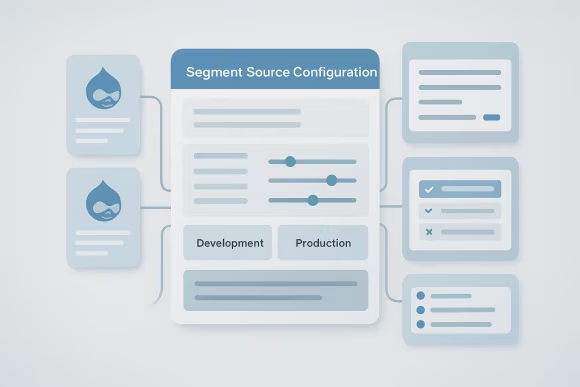
Yes. Segment is commonly used as an ingestion and routing layer, especially when multiple destinations (analytics, experimentation, ad platforms, data warehouses) need consistent event delivery. In this model, Drupal becomes a governed source that emits a defined event schema, and Segment routes those events to the CDP and other destinations. Key engineering tasks include: mapping the tracking plan to Segment event names and properties, configuring environments (dev/stage/prod) to prevent data contamination, and implementing identity calls in a way that matches your identity strategy (anonymous IDs, user IDs, and trait updates). We also define filtering rules so only approved events reach sensitive destinations. Operationally, we align Segment configuration with Drupal release processes: schema changes should be reviewed, validated, and rolled out with clear ownership. We also implement monitoring for delivery failures and unexpected volume changes. This approach reduces one-off integrations and makes it easier to add or change destinations without reworking Drupal instrumentation.

How do Kafka-based pipelines fit into Drupal CDP integration?

Kafka is useful when you need high-throughput, near-real-time delivery, replayability, or decoupling between Drupal and multiple downstream consumers. Drupal typically should not be a direct Kafka producer in the request path unless the runtime and networking model supports it safely; more commonly, Drupal emits events to an internal queue or service that publishes to Kafka. We design Kafka topic structures around event domains and versioning, define partition keys that support ordering where needed (often by user or session), and implement dead-letter topics for invalid messages. Replay strategy is defined up front: which events can be replayed, how deduplication is handled, and how reprocessing affects analytics. Kafka also enables parallel consumers: one consumer can feed the CDP, another can feed a warehouse, and another can support real-time personalization services. The integration remains governed through schema validation and observability so that adding consumers does not degrade data quality or operational stability.

How do you govern event schemas and tracking plan changes over time?

Governance starts with treating the tracking plan as a versioned contract rather than a set of informal conventions. We define naming rules, required properties, and backward compatibility expectations. Changes are categorized (additive, breaking, deprecations) and routed through a lightweight review process involving Drupal engineering, data platform, and MarTech stakeholders. Practically, governance is enforced through tooling: schema validation in CI/CD, automated checks in staging environments, and dashboards that highlight unknown or deprecated events. Documentation includes event definitions, ownership, and examples so new teams can implement consistently. For multi-site Drupal estates, we recommend a shared core schema with site-specific extensions that are explicitly namespaced. This prevents drift while allowing local needs. We also define a deprecation policy so downstream consumers have time to adapt, and we align schema releases with Drupal release cycles to reduce coordination overhead.

Who should own Drupal-to-CDP integration: engineering, data, or MarTech?

Ownership works best as a shared model with clear boundaries. Drupal engineering typically owns the emission layer in Drupal (where events are triggered, what context is available, how consent is enforced in the runtime). Data platform teams often own schema governance, validation rules, and pipeline operations (streaming, transformations, delivery SLAs). MarTech teams usually own activation use cases, destination configuration, and audience definitions. We formalize this by defining RACI-style responsibilities: who proposes schema changes, who approves breaking changes, who operates alerts, and who is responsible for incident response. We also define what “done” means for new tracking: implemented in Drupal, validated end-to-end, documented, and observable. This model reduces gaps where issues fall between teams. It also prevents over-coupling: MarTech teams should not need to modify Drupal templates for routine activation changes, and engineering teams should not be responsible for destination-specific configuration unless it affects data contracts or compliance.

What are the biggest risks in Drupal CDP integration projects?

The most common risks are contract ambiguity, identity inconsistencies, and operational blind spots. If event definitions are not explicit, teams implement similar events differently across sites and releases, which breaks audience logic and reporting. Identity risk appears when anonymous and known identifiers are mixed without clear rules, leading to duplicated profiles or incorrect stitching. Another major risk is coupling data delivery to the Drupal request lifecycle. If CDP calls are synchronous or insufficiently buffered, downstream outages can affect user experience. Conversely, if delivery is fully asynchronous without observability, failures can go unnoticed and activation quietly degrades. We mitigate these risks by establishing a tracking plan and schema validation early, implementing idempotency and deduplication rules, and designing failure isolation (queues, retries, dead-letter handling). We also prioritize monitoring and runbooks so teams can detect and resolve issues quickly, and we align rollout plans to reduce the blast radius when introducing new events or identity changes.

How do you address privacy, consent, and compliance requirements in the integration?

We start by mapping data elements to purposes and consent states: which events and identifiers are allowed under which consent categories, and what must be suppressed or anonymized when consent is not present. In Drupal, this usually means implementing consent-aware gating at the point of event emission, not only in downstream systems. We also define how consent changes are represented and propagated. For example, if a user revokes consent, the integration should stop emitting restricted identifiers and may need to send an update event depending on your CDP and policy. Data retention and subject access requirements influence what identifiers are stored in logs, queues, and dead-letter systems. Operational controls include environment separation, access controls for pipeline tooling, and documentation of data lineage. We work with security and privacy stakeholders to ensure the integration design aligns with organizational policy and that enforcement is testable. The goal is predictable compliance behavior rather than ad-hoc exceptions per site or campaign.

What does a typical engagement deliver for an enterprise Drupal estate?

A typical engagement delivers a governed integration foundation that can be rolled out across multiple Drupal properties. Core outputs usually include: a tracking plan (event taxonomy, properties, identity fields), an implementation pattern in Drupal (modules/services and configuration), and a delivery architecture to the CDP (Segment, REST APIs, and/or Kafka pipelines). We also deliver operational components: schema validation checks, dashboards and alerts for delivery health, and runbooks for incident response and release validation. For multi-site estates, we define how shared schemas and site-specific extensions work, and we provide a rollout plan that prioritizes high-value journeys first. The scope can be adapted. Some organizations need a full rebuild of tracking and identity flows; others need to stabilize existing instrumentation, introduce governance, and reduce regressions during Drupal upgrades. In both cases, the engagement is structured to leave behind maintainable interfaces and clear ownership so the integration remains reliable as teams and platforms evolve.

How long does Drupal-to-CDP integration usually take, and what inputs do you need?

Timelines depend on the number of Drupal sites, the maturity of existing tracking, and whether identity and consent flows are already defined. A focused integration for one site with a clear tracking plan can take a few weeks. Multi-site rollouts or streaming-based architectures typically take longer because schema governance, operational tooling, and rollout coordination add real work that should not be skipped. Inputs we usually need include: access to the Drupal codebase and environments, existing analytics/tagging documentation, CDP/Segment workspace access (or a partner who can configure it), identity requirements (SSO, customer IDs, hashing rules), and privacy/consent policies. We also need clarity on downstream destinations and activation use cases so the schema supports real needs. We recommend identifying a small set of critical journeys to implement first (e.g., registration, lead capture, authenticated content) and using them to validate end-to-end delivery, monitoring, and governance before scaling across the estate.

Should event enrichment happen in Drupal, in the pipeline, or in the CDP?

Enrichment placement should be decided based on data ownership, latency, and change frequency. Drupal is a good place to enrich with request-time context it uniquely knows (route, content type, authenticated roles, feature flags) and to enforce consent and identity rules. However, Drupal is not ideal for enrichment that requires external lookups or heavy transformations, because that can impact performance and increase coupling. Pipelines (API middleware, streaming consumers) are often the best place for enrichment that depends on shared reference data (product catalogs, account hierarchies) or that should be consistent across multiple sources beyond Drupal. This approach also supports replay and backfills. CDPs can enrich data through built-in transformations, but relying exclusively on CDP-side enrichment can make behavior harder to test and version, especially when multiple teams manage CDP configuration. We typically define a minimal, stable payload from Drupal, then apply controlled enrichment in the pipeline where it can be versioned, tested, and observed, while keeping CDP transformations limited and well-governed.

How do you prevent duplicate events and inflated metrics across retries and multiple collectors?

Duplicate prevention starts with architecture: avoid having the same business action emitted by multiple collectors (for example, both a tag manager rule and a Drupal server-side hook) unless there is a deliberate deduplication strategy. We prefer a single authoritative emission path for critical events and clearly document which events are client-only versus server-confirmed. At the event level, we implement idempotency keys or stable message identifiers so downstream systems can detect duplicates. For API delivery, retries should be safe and bounded; for streaming, consumers should be designed to handle at-least-once delivery semantics. We also define deduplication windows and rules that match your reporting needs. Operationally, we monitor for unusual spikes, repeated message IDs, and divergence between expected and observed event counts. During rollout, we run parallel validation to compare old and new collectors and then decommission legacy paths to reduce long-term complexity. This approach keeps metrics trustworthy and reduces downstream cleanup work.

How do you integrate Drupal CDP signals with personalization or experimentation tools?

Personalization and experimentation tools typically need timely, consistent signals: page context, user attributes, and key actions. We design the Drupal-to-CDP integration so that events and identity updates can be consumed by downstream tools either directly (via Segment destinations or CDP connectors) or indirectly through a shared streaming or API layer. The key is to define which signals are required in real time versus which can be batch or delayed. For real-time use cases, we focus on low-latency delivery paths and avoid heavy transformations in the request path. We also ensure that consent gating is applied consistently so personalization does not inadvertently use restricted identifiers. We document how experiments and personalization variants affect event semantics. For example, an A/B test should not change the meaning of a “conversion” event; instead, variant identifiers should be added as properties. This keeps analytics coherent and allows activation logic to remain stable while product teams iterate on experiences.

How does collaboration typically begin for Drupal CDP integration work?

Collaboration typically begins with a short technical discovery focused on data contracts and current-state integration. We start by aligning stakeholders from Drupal engineering, data platform, and MarTech on the primary activation and measurement goals, then review existing tracking implementations, CDP ingestion paths, and identity/consent requirements. From that discovery, we produce a concise integration plan: recommended architecture pattern (client/server/hybrid), a draft tracking plan with a small set of priority journeys, and an implementation roadmap that includes validation and observability. We also clarify ownership and change control so the work can proceed without ambiguity. Once the plan is agreed, we move into an initial implementation increment (often one or two critical journeys) to validate end-to-end delivery in a non-production environment. That first increment establishes the patterns, tooling, and governance used for the broader rollout across the Drupal estate.

Define a reliable Drupal-to-CDP data contract

Let’s review your current Drupal tracking and CDP ingestion, then define an integration architecture with clear schemas, consent controls, and operational monitoring.

Oleksiy (Oly) Kalinichenko

Oleksiy (Oly) Kalinichenko

CTO at PathToProject

Do you want to start a project?