



 [01]
[01]Discovery & Assessment
We review current environments, deployment paths, traffic characteristics, and operational pain points. The output is a dependency map and a prioritized list of architectural risks and constraints to carry into design.
Drupal infrastructure architecture
Use a Drupal health check to surface topology, governance, upgrade, and integration readiness risks across Kubernetes, caching, storage, networking, and delivery.
Built for teams aligning Drupal architecture decisions before roadmap commitments.
No login required. Takes 2–3 minutes.
Drupal platforms often fail operationally for reasons unrelated to application code: inconsistent environments, fragile deployment paths, unclear scaling limits, and infrastructure that cannot be evolved safely. Drupal infrastructure architecture services define the cloud runtime, network boundaries, caching strategy, storage, and delivery topology required to run Drupal predictably across development, staging, and production.
This capability focuses on designing infrastructure that aligns with Drupal’s runtime characteristics (PHP-FPM, database and cache dependencies, file/media handling, cron/queues) while meeting enterprise requirements for security, availability, and change control. It commonly includes Kubernetes platform design for Drupal operations and Drupal AWS network architecture so teams can reason about trust boundaries, traffic flow, and operational responsibilities. The output is an architecture that is explicit about failure modes, scaling triggers, and ownership.
A well-defined infrastructure architecture enables repeatable provisioning, controlled rollouts, and measurable performance. It also reduces platform risk by making dependencies visible, standardizing environment parity, and establishing observability and runbooks that support long-term platform evolution without accumulating hidden operational debt.
Core Focus
Best Fit For
Key Outcomes
Technology Ecosystem
Platform Integrations
As Drupal platforms grow, infrastructure decisions are often made incrementally: a load balancer added for traffic spikes, a cache introduced to address latency, or a container platform adopted without a clear operating model. Over time, the runtime becomes a collection of coupled components with undocumented assumptions about state, persistence, and scaling. Environment parity erodes, and teams lose confidence that changes in one layer will not break another.
These issues surface as architectural friction for engineering and operations teams. Drupal’s dependency graph (database, cache, file storage, cron/queues, search, CDN behavior) requires explicit boundaries and failure handling. Without a defined topology, teams struggle to reason about cache invalidation, session handling, media delivery, and background processing. Security controls also become inconsistent when network segmentation, IAM, and secrets management are not designed as first-class concerns.
Operationally, the result is slower delivery and higher risk: deployments require manual steps, rollbacks are uncertain, incident response depends on tribal knowledge, and performance tuning becomes reactive. Costs can rise due to over-provisioning, while reliability remains fragile because scaling triggers and bottlenecks are not measured or governed.
Review current Drupal runtime, traffic patterns, environments, and operational constraints. We map dependencies such as database, Redis, file/media storage, cron/queues, and CDN behavior, and identify existing failure modes and bottlenecks.
Define the reference architecture across compute, networking, storage, caching, and edge delivery. We document trust boundaries, availability zones, scaling assumptions, and the responsibilities of each component in the Drupal runtime.
Design IAM, network segmentation, secrets management, and encryption requirements aligned to enterprise controls. We define least-privilege access patterns for workloads, administrators, and automation, including audit and key rotation considerations.
Specify container and Kubernetes patterns for Drupal (stateless web tier, persistent services, autoscaling triggers). We define session strategy, cache tiers, background processing, and safe handling of shared state such as files and media.
Establish logging, metrics, tracing, and alerting requirements tied to Drupal and infrastructure signals. We define SLO-relevant indicators, dashboards for operations, and incident triage paths that reduce mean time to recovery.
Design high availability and disaster recovery patterns including backup/restore, multi-AZ behavior, and recovery objectives. We document dependency ordering, data consistency expectations, and validation steps for recovery exercises.
Produce infrastructure-as-code patterns, environment templates, and runbooks that teams can implement consistently. The blueprint includes configuration standards, naming conventions, and integration points for CI/CD and change management.
Define how the architecture is maintained over time through reviews, versioned documentation, and operational standards. We establish decision records, capacity planning routines, and a backlog for incremental improvements.
This service establishes the technical foundations required to run Drupal reliably in cloud environments. It focuses on explicit runtime boundaries, repeatable environment design, and operational controls that support safe change. The capability set spans container and Kubernetes patterns, caching and edge delivery, network and identity architecture, and observability. The goal is an infrastructure model that can be implemented consistently and evolved without destabilizing the platform.
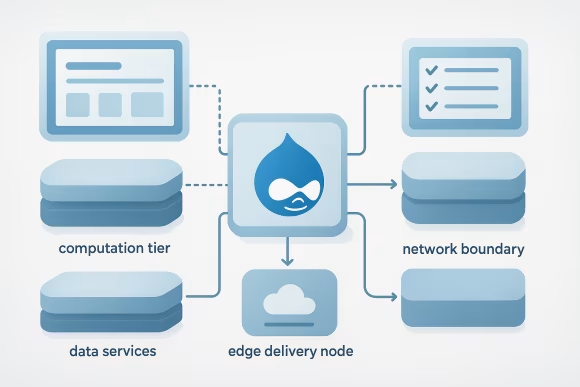
A documented infrastructure reference model for Drupal that defines compute tiers, network boundaries, data services, and edge delivery. It clarifies which components are stateful versus stateless, how traffic flows through the system, and how environments remain consistent across dev, staging, and production.
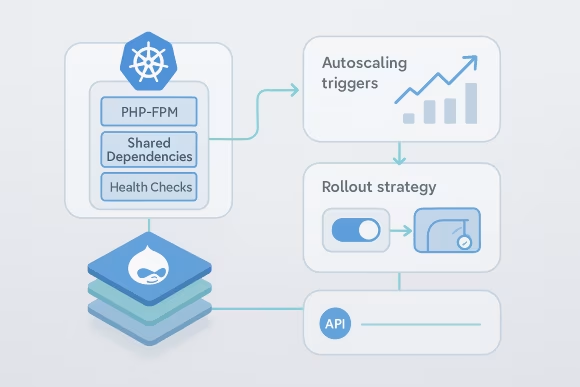
Workload patterns for running Drupal on Kubernetes, including pod design, health checks, autoscaling triggers, and rollout strategies. The architecture addresses PHP-FPM behavior, shared dependencies, and safe deployment practices such as blue/green or canary where appropriate.
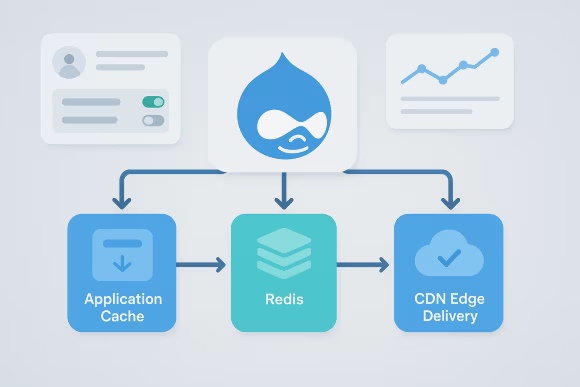
A multi-layer caching strategy covering application cache, Redis usage, and CDN behavior. The design specifies cache keys, invalidation paths, session handling implications, and how caching integrates with Drupal render caching and edge delivery to reduce origin load.
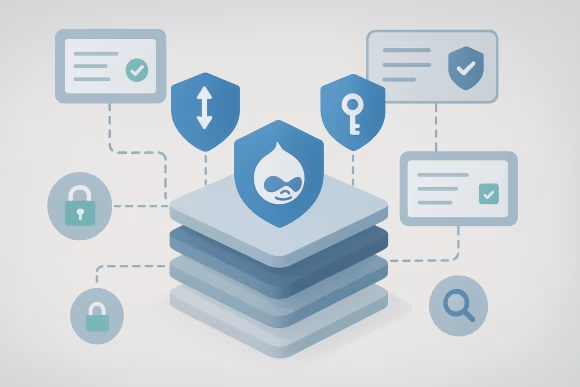
Network segmentation, ingress/egress controls, and identity access patterns aligned to enterprise security requirements. This includes IAM role design, secrets management approach, encryption expectations, and auditability considerations for both human and automated access.
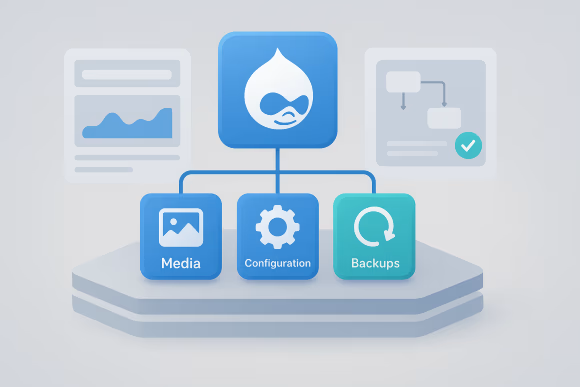
Clear handling of persistent state such as media/files, configuration, and backups. The architecture defines storage options, consistency expectations, and operational workflows for media delivery, backup/restore, and lifecycle management across environments.
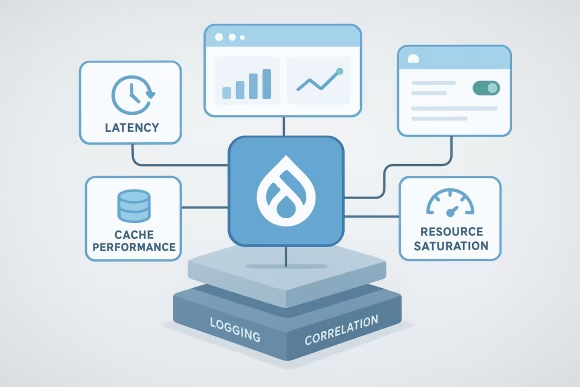
A monitoring and logging model that connects infrastructure signals to Drupal behavior. It defines what to measure, how to alert, and how to correlate incidents across layers, including dashboards for latency, error rates, cache performance, and resource saturation.
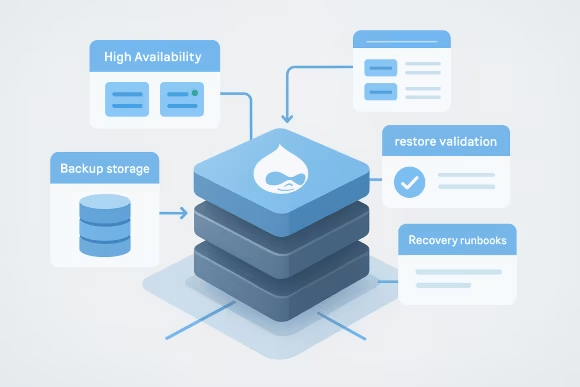
High availability and disaster recovery patterns with explicit recovery objectives and dependency ordering. The capability includes backup design, restore validation, multi-AZ behavior, and documented recovery runbooks that can be exercised and improved over time.
Identify the runtime boundaries, operating gaps, and dependency issues most likely to affect resilience, deployments, and future Drupal changes.
Engagements follow a clear engineering sequence from discovery through implementation planning and long-term evolution. We work from current-state constraints, define a target topology (including Kubernetes and Drupal AWS network architecture where relevant), and produce blueprints, runbooks, and validation criteria that teams can adopt incrementally.
[01]We review current environments, deployment paths, traffic characteristics, and operational pain points. The output is a dependency map and a prioritized list of architectural risks and constraints to carry into design.
 [02]
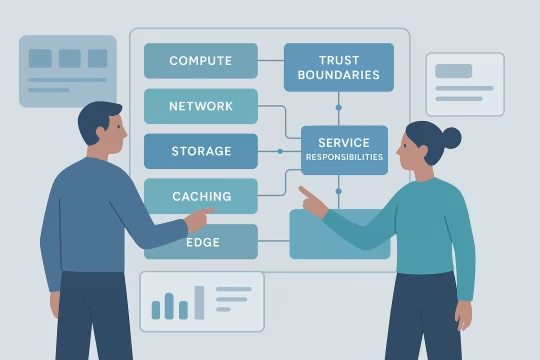
[02]We define target-state topology, trust boundaries, and service responsibilities across compute, network, storage, caching, and edge. Decisions are captured as architecture records with clear trade-offs and assumptions.
 [03]
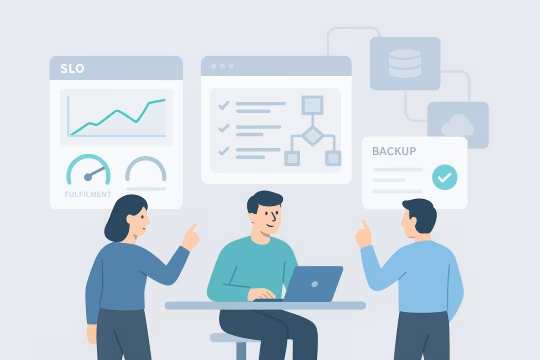
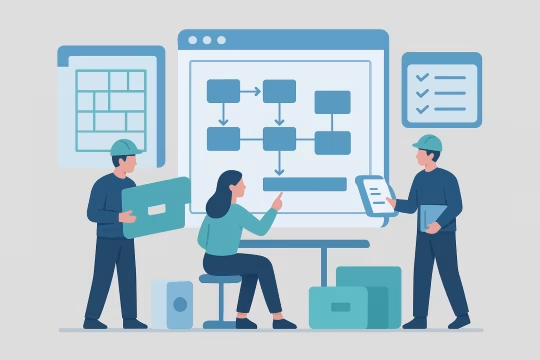
[03]We specify SLO-aligned observability, incident response expectations, backup/restore needs, and change management requirements. This stage ensures the architecture is operable by the teams who will run it.
 [04]
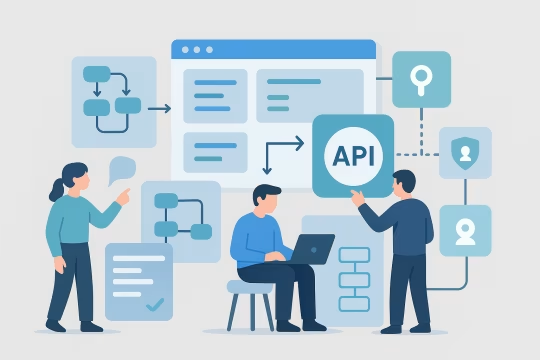
[04]We translate architecture into implementable patterns: environment templates, IaC structure, configuration standards, and runbooks. The blueprint is designed for repeatability across multiple Drupal sites or environments.
 [05]
[05]We define integration points with CI/CD, secrets management, identity providers, and enterprise networking. The output includes rollout sequencing and dependency ordering to reduce risk during adoption.
 [06]
[06]We define validation criteria and test plans for scaling, failover behavior, caching correctness, and recovery procedures. Where possible, we run tabletop exercises or non-production drills to confirm assumptions.
 [07]
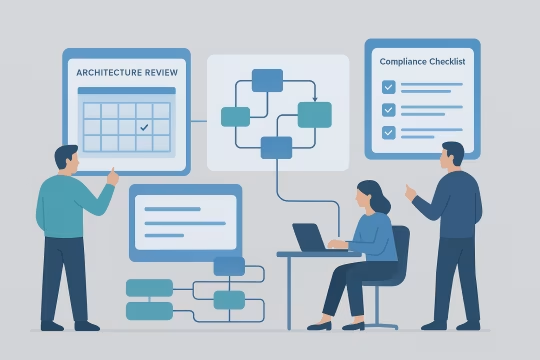
[07]We deliver documentation, runbooks, and operational checklists, and align on ownership boundaries. Enablement sessions focus on day-2 operations: deployments, incident triage, and routine maintenance.
 [08]
[08]We establish an evolution backlog and governance cadence for architecture reviews. This supports incremental improvements as traffic, features, and compliance requirements change over time.
Infrastructure architecture affects delivery speed and platform risk because it defines how safely teams can change and operate the system. A clear, repeatable runtime reduces operational surprises, improves recovery outcomes, and supports predictable scaling as Drupal estates grow.
Standardized environments and explicit rollout patterns reduce the chance of production-only failures. Teams can deploy more frequently with clearer rollback paths and fewer manual steps.
High availability design and well-defined failure modes reduce platform instability under load. Operational teams gain clearer signals and response paths during incidents.
Caching and edge delivery strategies reduce origin load and stabilize response times. Performance work becomes measurable and repeatable rather than reactive tuning.
Runbooks, observability, and consistent infrastructure patterns reduce reliance on tribal knowledge. Routine maintenance and incident triage require less ad hoc investigation.
A defined scaling model supports growth across traffic, content volume, and multi-site estates. Capacity planning becomes a structured activity tied to measurable constraints.
Clear trust boundaries, least-privilege access, and consistent secrets handling reduce security drift. Auditability improves because access and changes are easier to trace.
Measured scaling triggers and caching efficiency reduce over-provisioning. Teams can align spend with actual workload characteristics and performance targets.
Drupal architecture decisions
Before committing to topology changes, confirm how your Drupal stack handles state, cache behavior, security boundaries, observability, and operational ownership.
These related services extend Drupal infrastructure architecture into adjacent concerns—application and content architecture, multisite and search patterns, delivery automation, and governance—so the platform design, operations, and standards evolve together.
Designing Scalable Digital Foundations
Drupal content architecture design and editorial operating design
Entity modeling and durable data structures
Drupal editorial workflow engineering and permissions model design
Headless Drupal Development Services for API-First Front-Ends
One Platform. Multiple Brands. Infinite Scalability.
Scalable indexing and relevance design
Automated CI/CD Pipelines. Reliable Infrastructure.
Enterprise Drupal uptime engineering through resilient infrastructure design
Common questions from platform and infrastructure teams evaluating Drupal infrastructure architecture for cloud operations and long-term maintainability.
A Drupal infrastructure architecture defines the runtime topology and the operational rules that make the platform predictable. It typically covers compute (VMs or containers), network boundaries (VPC/VNet, subnets, ingress/egress), identity and access (IAM roles, service accounts), and the data services Drupal depends on (database, Redis, file/media storage). It also includes delivery and edge concerns such as CDN behavior, TLS termination, cache invalidation paths, and how requests flow from edge to origin. For container platforms, it specifies Kubernetes patterns: health checks, autoscaling triggers, rollout strategies, and how to handle stateful dependencies. Finally, it defines day-2 operations: observability (logs/metrics/traces), alerting and SLO signals, backup/restore and disaster recovery objectives, and runbooks. The goal is to make assumptions explicit so teams can implement and evolve the platform without relying on undocumented tribal knowledge.
Multi-site estates usually introduce shared dependencies (CDN, WAF, identity, logging, CI/CD) and a mix of site-specific requirements (traffic profiles, content models, release cadence). Architecture work starts by defining what is shared versus isolated: network segmentation, namespaces or clusters, database isolation, and how caching is partitioned to avoid cross-site impact. We typically define a reference environment template that can be instantiated per site or per group of sites, with consistent observability and security controls. Shared services are treated as platform products with clear SLAs and change control, rather than “global” resources that drift over time. We also address operational blast radius: how a single site’s deployment, cache purge, or traffic spike can affect others. This includes rate limits, autoscaling boundaries, and resource quotas, plus governance for onboarding new sites and evolving shared components safely.
Reliable cloud operations for Drupal depend on repeatability and visibility. Repeatability comes from consistent environment templates (ideally infrastructure as code), standardized configuration management, and a deployment process that does not require manual production steps. Visibility comes from logging, metrics, and alerting that reflect both infrastructure health and Drupal-specific behavior. Operational practices typically include defined on-call ownership, incident response runbooks, and routine maintenance workflows (patching, certificate rotation, key rotation, dependency upgrades). Capacity planning should be tied to measurable signals such as request latency, cache hit rates, database saturation, and queue backlog. We also recommend periodic resilience exercises: backup/restore validation, failover drills where applicable, and post-incident reviews that feed an improvement backlog. The architecture should support these practices by making dependencies and failure modes explicit rather than implicit.
Environment parity is achieved by standardizing the topology and operational controls, not by making every environment identical in size. We define a reference architecture that is consistent in structure (same components, same traffic flow, same security boundaries) while allowing right-sized capacity for non-production. In practice this means using the same container images, configuration conventions, and deployment mechanisms across environments, with differences limited to parameterized values (instance sizes, replica counts, feature flags, and external integrations). Secrets and credentials are managed per environment with clear access controls. We also define how data moves between environments, including sanitization requirements, and how to validate changes before production. The goal is to reduce “works in staging” gaps by ensuring that the same failure modes and operational behaviors can be observed earlier in the lifecycle.
CI/CD integration starts with defining what the pipeline is responsible for versus what the runtime platform enforces. The architecture typically specifies immutable build artifacts (container images), environment promotion rules, and how configuration and database changes are applied safely. For Drupal, this includes handling config imports, database updates, and cache rebuilds in a controlled sequence. We define integration points for secrets injection, image scanning, policy checks, and deployment strategies (rolling, blue/green, or canary). The pipeline should be able to deploy consistently across environments using the same mechanisms, with approvals and change control aligned to enterprise governance. We also define observability hooks: deployment markers, health checks, and automated rollback criteria where appropriate. The result is a delivery flow that is compatible with operational requirements rather than fighting them.
Correctness depends on understanding what is cached, where it is cached, and how it is invalidated. For Redis, we define its role (cache backend, lock backend, session storage where appropriate) and ensure configuration aligns with Drupal’s cache bins and concurrency behavior. We also design for resilience: what happens when Redis is unavailable, and how to avoid cascading failures. For CDN integration, we define cacheability rules, TTL strategy, purge/invalidation mechanisms, and how authenticated versus anonymous traffic is handled. We pay particular attention to cookies, vary headers, and edge behaviors that can accidentally cache personalized content. The architecture includes a clear cache hierarchy (browser, CDN, reverse proxy if used, Drupal render cache, Redis) and a test plan to validate cache hit rates and content correctness under real traffic patterns.
Architecture drift usually happens when changes are made under time pressure without updating standards, documentation, or templates. Governance should be lightweight but explicit: versioned infrastructure-as-code, documented architecture decision records, and a review cadence for changes that affect topology, security boundaries, or shared services. We typically define a small set of non-negotiable standards (naming, tagging, network segmentation, secrets handling, logging/metrics requirements) and a process for exceptions. Ownership boundaries are also part of governance: who can change what, how changes are approved, and how they are communicated. Finally, governance should include operational feedback loops: post-incident actions, capacity reviews, and periodic security reviews. The goal is to make the architecture a living system that evolves deliberately rather than a one-time design document.
Runbooks are most useful when they are tied to observable signals and specific actions. We document runbooks around common operational events: deployment failures, elevated error rates, latency spikes, cache issues, database saturation, queue backlog, and recovery procedures. Each runbook includes prerequisites, decision points, and verification steps. Operationalization means integrating runbooks with monitoring and alerting. Alerts should link to the relevant runbook and dashboards, and dashboards should reflect the metrics that matter for Drupal (PHP worker saturation, cache hit rate, database connections, response codes, and edge/origin latency). We also define ownership and rehearsal: who is responsible for keeping runbooks current, and how teams validate them through drills or post-incident reviews. This reduces reliance on individual expertise and improves consistency during incidents.
The main risks are usually around state, operational maturity, and hidden coupling. Drupal web workloads can be made largely stateless, but dependencies such as file/media storage, sessions, cron/queues, and cache invalidation must be designed explicitly. If these are treated as afterthoughts, teams can end up with fragile deployments and inconsistent behavior across pods. Operationally, Kubernetes introduces new responsibilities: cluster upgrades, resource quotas, autoscaling behavior, and troubleshooting across layers. Without clear observability and runbooks, incident response can become slower because failures are harder to localize. We mitigate these risks by defining workload patterns, dependency boundaries, and rollout strategies early, and by validating assumptions with non-production load and failure testing. The goal is to adopt Kubernetes for repeatability and scaling without increasing operational complexity beyond what the team can support.
Risk reduction starts with making changes reversible and observable. We design rollout strategies that support incremental adoption: parallel environments, controlled traffic shifting, and clear rollback paths. For Drupal, we also define safe sequencing for changes that affect caching, sessions, and database connectivity. We recommend implementing change gates based on health checks and SLO indicators rather than time-based assumptions. This includes deployment markers, automated smoke tests, and dashboards that show edge/origin latency, error rates, and resource saturation during changes. We also address operational readiness: runbooks for expected failure modes, on-call coverage for high-risk windows, and post-change validation steps. The architecture should enable these controls by standardizing environments and reducing one-off manual procedures.
An engagement typically delivers an implementable architecture package: target topology, security and network design, caching and edge strategy, observability requirements, resilience/DR approach, and a blueprint for infrastructure-as-code structure and environment templates. We also provide decision records, operational runbooks, and validation criteria so teams can confirm the architecture behaves as designed. Implementation responsibilities depend on your operating model. Some teams implement everything internally using the blueprint, while others ask us to pair with their engineers to build the initial templates and establish patterns. In either case, we aim to leave you with repeatable artifacts and a clear path for onboarding additional environments or sites. We align early on what “done” means: which environments are in scope, what integrations must be proven (CI/CD, secrets, logging), and what operational readiness is required (alerts, dashboards, recovery steps).
Collaboration typically begins with a short discovery phase to establish context and constraints. We start by reviewing your current Drupal topology, environments, deployment flow, traffic characteristics, and operational pain points. We also identify non-functional requirements such as availability targets, compliance constraints, and security controls that shape the design. Next, we agree on scope and decision boundaries: which parts of the stack are in play (AWS accounts, Kubernetes, Redis, CDN, networking), what is fixed versus changeable, and what timelines or release commitments must be respected. We define the outputs you need (reference architecture, IaC blueprint, runbooks, DR plan) and who will own implementation. From there, we run structured working sessions with platform, DevOps, and application stakeholders, producing a target topology and a prioritized adoption plan. The goal is to move quickly from assessment to an implementable blueprint with clear next steps and measurable validation criteria.
These case studies showcase advanced Drupal infrastructure architecture, including scalable hosting, secure network design, and performance optimization. They highlight real-world implementations of Kubernetes runtime patterns, AWS network architecture, caching strategies, and observability models that align closely with Drupal infrastructure architecture services. The selected examples demonstrate measurable improvements in platform stability, security, and operational efficiency at enterprise scale.
An advanced healthcare digital platform for LATAM was required to facilitate collaboration among radiology HCPs, distribute company knowledge, refine treatment methods, and streamline workflows. The solution needed secure medical website role-based access restrictions based on user role (HCP / non-HCP) and geographic region.
The platform enhanced collaboration, streamlined workflows, and empowered radiology professionals with advanced tools to gain insights and optimize patient care.
The existing marine data portal relied on three unaligned WordPress installations and embedded PHP code, creating inefficiencies and risks in content management and usability.
The new Drupal DXP streamlined content operations and improved accessibility, offering scientists and businesses a more efficient gateway to marine data services.
The Deprexis mental health digital platform on Drupal required stabilization, faster performance, and a secure ecommerce payment workflow to support online services. The solution needed to meet strict reliability and security expectations common for digital healthcare products.
The platform was stabilized, performance was improved, and secure checkout workflows were delivered with strong automated coverage to reduce operational and compliance risks.
LSHTM required improvements to its existing higher education Drupal platform to better manage and distribute complex research data, including support for third-party integrations, Drupal performance optimization, and more reliable synchronization.
The solution improved data accessibility, streamlined research workflows, and enhanced system performance, enabling LSHTM to manage complex datasets more efficiently.
With Drupal 7 reaching end-of-life, Veolia needed a Drupal 7 to Drupal 10 enterprise migration for its Acquia Site Factory multisite platform—preserving region-specific content and multilingual capabilities across more than 200 sites.
The platform was modernized into a stable, scalable multisite foundation with improved performance, maintainability, and long-term upgrade readiness.
Oleksiy (PathToProject) and I worked together on a Digital Transformation project for Bayer LATAM Radiología. Oly was the Drupal developer, and I was the business lead. His professionalism, technical expertise, and ability to deliver functional improvements were some of the key attributes he brought to the project.
I also want to highlight his collaboration and flexibility—throughout the entire journey, Oleksiy exceeded my expectations.
It’s great when you can partner with vendors you trust, and who go the extra mile.

Axel Gleizerman Copello
Building in the MedTech Space | Antler
Oleksiy (PathToProject) is demanding and responsive. Comfortable with an Agile approach and strong technical skills, I appreciate the way he challenges stories and features to clarify specifications before and during sprints.

Olivier Ritlewski
Ingénieur Logiciel chez EPAM Systems
As Dev Team Lead on my project for 10 months, Oleksiy (PathToProject) demonstrated excellent technical skills and the ability to handle complex Drupal projects. His full-stack expertise is highly valuable.

Laurent Poinsignon
Domain Delivery Manager Web at TotalEnergies
These articles expand on the operational and architectural decisions that shape a reliable Drupal infrastructure. They cover resilience, caching, configuration control, and multi-tenant boundaries that directly affect performance, security, and long-term maintainability.
Let’s review your current Drupal infrastructure, identify operational risks, and produce an implementable target architecture with clear runbooks and validation criteria.