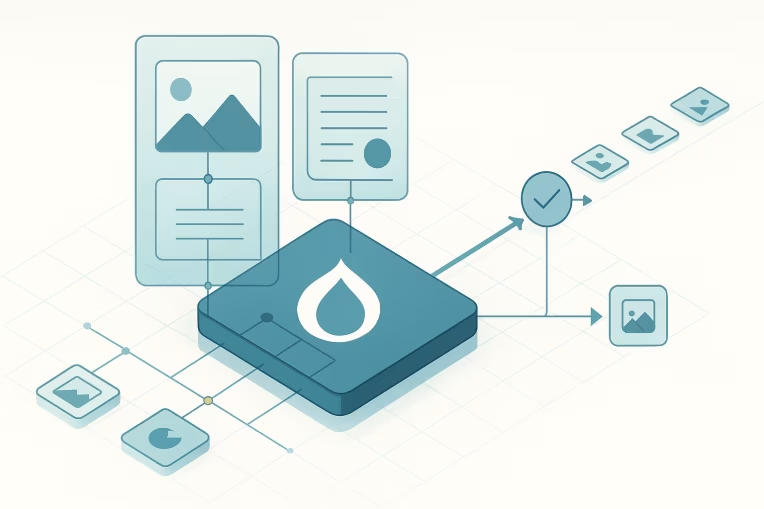
A DAM integration can look like a content supply chain improvement: centralize assets, sync them into Drupal, and make them easier for teams to reuse. In practice, the integration often amplifies whatever is still undefined in the CMS.
If the Drupal media model is unclear, a sync does not create order. It spreads ambiguity faster. Assets arrive at scale before teams have agreed on what a media entity represents, which metadata belongs in Drupal versus the DAM, how replacements should behave, or how editors should search for and trust what they find.
Check your Drupal media governance readinessRun a quick Drupal Platform Health CheckThat is why Drupal media model governance should be treated as a platform design activity, not a cleanup task that can wait until after integration. The core question is not only how files move between systems. It is how media should be represented, governed, discovered, approved, and reused across multiple teams and publishing contexts.
For enterprise CMS environments, especially multi-site or regional publishing platforms, that distinction matters. Once assets begin syncing in volume, every weak assumption becomes operational debt.
Why media becomes a platform problem before it becomes a DAM problem
Many organizations frame media challenges as a repository issue. They assume the DAM will solve duplication, metadata quality, or inconsistent use simply by becoming the authoritative source for assets.
But Drupal still has to answer platform-level questions:
- What types of media need distinct models?
- What editorial actions happen in Drupal even if the asset originates elsewhere?
- Which teams can reuse, replace, localize, or retire an asset?
- How do channel-specific needs affect image variants, alt text, or usage constraints?
- What should happen to referenced content when an asset changes upstream?
A DAM can store assets and expose metadata. It cannot, by itself, define how Drupal content architecture should use those assets safely and predictably.
This becomes especially important when multiple teams publish into the same platform. One group may treat an image as a brand-approved global asset. Another may expect to crop it for a campaign. A regional team may need localized rights, language variants, or expiry rules. Without governance, the same synced media can be interpreted differently depending on team, site, or workflow.
What starts as asset management quickly becomes a platform reliability issue:
- editors cannot tell which asset is safe to reuse
- content owners do not know who controls metadata
- replacements cause unexpected downstream changes
- migration teams discover that source assets do not map cleanly into Drupal media types
- search results become noisy because metadata standards were never aligned
The earlier these questions are addressed, the less likely integration will create a larger operational surface area than the organization can realistically govern.
Defining the Drupal media model: files, media entities, references, and reuse
Before integrating any external asset source, teams should define what Drupal media represents in their architecture.
At minimum, that means distinguishing four layers that are often blurred together:
- The file: the binary asset itself.
- The Drupal media entity: the structured representation editors interact with.
- The reference: where content points to media.
- The usage context: how that media appears in a specific page, component, or channel.
If those layers are not intentionally separated, governance becomes hard very quickly.
For example, a single image file may support multiple use cases:
- a hero image on a campaign landing page
- a thumbnail in a news listing
- a card image in a mobile-oriented component
- a region-specific variant with different legal or branding requirements
That does not automatically mean one file should map to one reusable Drupal media entity for all contexts. In some organizations, that model works well. In others, it creates risk because editorial intent, usage restrictions, or channel behavior differ too much.
A practical governance approach is to define:
- which media types exist in Drupal and why
- what each media type is allowed to represent
- whether media entities are global, site-scoped, or business-unit-scoped
- which fields are required for editorial readiness
- when teams should reuse an existing media entity versus create a new one
For enterprise media architecture, common media type boundaries might include:
- images
- documents
- videos
- audio
- embedded external media n- brand-approved shared assets
The exact list matters less than the reasoning behind it. Each type should have a clear lifecycle and clear field semantics.
It is also important to distinguish between reusable assets and contextual presentation choices. A crop applied globally at the media level may not be appropriate if different channels need different focal points. Conversely, allowing unlimited per-use variation may make governance impossible. Teams need a deliberate decision about where presentation flexibility belongs.
A good rule is that Drupal media entities should carry durable editorial meaning, not just act as thin wrappers around incoming files. If editors cannot understand what an entity represents and how it should be used, the model is too weak.

Find governance gaps before DAM integration scales them
Assess how your Drupal platform handles media models, metadata ownership, workflows, and asset reuse before sync complexity grows.
- Audit media model rules
- Review metadata ownership
- Spot reuse and workflow risks
Metadata ownership between Drupal and the DAM
One of the most common sources of integration friction is unclear metadata ownership.
Teams often assume the answer is simple: the DAM owns asset metadata and Drupal consumes it. In reality, enterprise publishing usually involves several categories of metadata with different owners and different change patterns.
A more useful model is to separate metadata into governance classes:
- Asset-source metadata: file properties, technical dimensions, format, source identifiers, rights-related data, or canonical brand classification that should typically originate upstream.
- Editorial publishing metadata: alt text, captions, teaser copy, local taxonomy tagging, campaign relevance, or contextual notes that may need to be maintained in Drupal.
- Operational metadata: sync status, timestamps, source references, moderation state, or lifecycle markers used by the platform.
- Channel-specific metadata: values needed for particular display contexts, locales, or site-specific experiences.
This separation helps teams avoid the worst ownership pattern: both systems appearing to own the same field.
Before integration, define for each important field:
- system of record
- whether Drupal can override the source value
- whether overrides are temporary or durable
- what happens when a source value changes
- whether downstream content needs review after changes
For example, alt text is rarely governed well through assumption alone. Some organizations want it centrally managed. Others need site editors to write alt text based on page context and audience. Both approaches can be reasonable, but the platform must support the chosen rule consistently.
The same applies to taxonomies. A DAM may expose controlled categories that are valuable for ingestion and governance, while Drupal may still need local classification optimized for content discovery and editorial workflows. Trying to force a single flat ownership rule across all metadata often produces poor searchability and frustrated teams.
The goal is not to duplicate metadata unnecessarily. It is to prevent silent collisions between source truth and publishing truth.
Renditions, crops, derivatives, and channel-specific constraints
Derivative handling is another area where hidden assumptions create long-term debt.
When teams say they want Drupal to "use the DAM asset," they may actually mean several different things:
- use the original binary and let Drupal generate derivatives
- consume pre-generated renditions from the source system
- support editorial crops in Drupal
- support only centrally approved renditions
- mix global renditions with local display transformations
These options have different implications for performance, governance, and editorial autonomy.
If Drupal is expected to serve many channels, teams should define how each of the following is handled:
- original asset preservation
- responsive image needs
- aspect-ratio variants
- focal point or crop rules
- localization variants
- format conversion requirements
- accessibility-related alternatives such as transcripts or captions
The main governance question is where display intent should live.
If all crops are centrally controlled upstream, Drupal editors may lose flexibility for layouts that were not anticipated. If all crops are ad hoc in Drupal, shared asset consistency can erode. A balanced model often works best:
- canonical source assets remain stable
- approved derivative patterns are standardized
- local exceptions are limited and auditable
- presentation rules are attached to components or display contexts, not improvised each time
This is particularly important on multi-site platforms. A globally shared asset may need to behave consistently across brand properties while still supporting site-level templates. Without clear derivative policy, teams either over-centralize and slow delivery or over-localize and lose control.
Editorial workflows for asset approval, replacement, and expiry
Asset governance is not complete when the model and metadata are defined. Teams also need workflow rules that reflect how media changes over time.
Three workflow events usually cause the most disruption:
- approval for editorial use
- replacement of an existing asset
- expiry or withdrawal
If an asset syncs into Drupal before it is approved for reuse, editors may treat it as available simply because it is visible. That creates trust problems in the media library. Availability should not be confused with editorial readiness.
A more robust pattern is to define explicit states such as:
- ingested
- review required
- approved for use
- restricted use
- expiring soon
- retired
These states may be implemented differently depending on workflow design, but the governance principle remains the same: editors should be able to understand whether an asset is safe to use and why.
Replacement policy is equally important. If a synced asset is updated upstream, teams need to know whether Drupal should:
- update all existing references automatically
- preserve the existing binary for already published content
- trigger review for impacted content owners
- create a new media record instead of mutating the old one
There is no single correct answer for every asset class. A brand logo may be intentionally replaced globally. A campaign image referenced in archived content may need immutability. Governance should define which classes of asset allow replacement-in-place and which require versioned handling.
Expiry rules matter for legal, brand, and editorial reasons. If rights-managed images, time-bound promotions, or outdated documents remain discoverable without visible lifecycle indicators, editors will eventually reuse assets they should not. Drupal should make restrictions visible where editorial decisions happen, not hide them as back-end metadata.
Search, taxonomy, and discoverability for large media libraries
Once a media library grows, governance succeeds or fails based on whether editors can reliably find the right asset.
Search quality is not only a technical indexing issue. It depends on whether the media model produces meaningful, consistent signals.
For Drupal media libraries connected to external sources, teams should define which fields support discovery, such as:
- title or label conventions
- descriptive summaries
- controlled categories
- usage rights markers
- locale or market applicability
- content type relevance
- campaign or product alignment
- asset status and approval state
The important governance decision is not simply to add more fields. It is to determine which fields editors actually trust when filtering and selecting assets.
If search exposes synced metadata that is technically present but editorially unreliable, discoverability degrades fast. Editors compensate by re-uploading known assets, maintaining offline lists, or overusing a small set of familiar media. That is how duplication spreads even when a DAM exists.
For multi-team platforms, it is also useful to define search visibility rules:
- which assets should be discoverable across all sites
- which assets are limited to a site, region, or business unit
- whether unpublished or restricted assets appear in search results
- how deprecated assets are labeled or demoted
This is not just convenience. It affects content quality and governance outcomes. A media library that surfaces too much without clear cues creates poor editorial decisions. One that hides too much undermines reuse.
Migration and sync risks when legacy assets are inconsistent
Search intent around this topic often starts with migration planning, and for good reason. Media governance issues are easiest to see when teams attempt to import or sync a large legacy asset set.
Legacy repositories frequently contain:
- duplicate files with inconsistent names
- missing alt text or captions
- conflicting tags and categories
- unclear rights or expiry information
- multiple near-identical renditions with no canonical source
- incomplete relationships between assets and content
If these inconsistencies are pushed directly into Drupal, the new media layer inherits old confusion in a more visible form.
That is why migration planning should include a governance assessment, not just a technical mapping exercise. Teams should evaluate:
- which legacy asset classes are worth migrating at all
- which metadata fields are trustworthy enough to map directly
- where normalization or cleanup is required before import
- how duplicates will be identified and resolved
- whether old usage patterns should be preserved or redesigned
- how source identifiers will be retained for auditability and sync integrity
In some cases, it is better to migrate a smaller, governed subset first rather than expose the full backlog immediately. A staged approach can reduce risk by allowing the editorial operating model to mature before the asset volume increases.
Sync design should also anticipate imperfect data. For example, what happens if required Drupal fields are missing in the source? What if upstream classification does not fit Drupal's media type rules? What if one source asset would need to map to multiple publishing contexts?
These are not edge cases. They are typical migration realities. Good governance makes them visible early enough to design sensible exceptions and escalation paths.
Governance checklist for multi-team Drupal platforms
Before connecting Drupal to a DAM or any large external asset source, enterprise teams should be able to answer the following questions clearly.
Media model
- What media types exist, and what does each represent?
- Is media global, site-scoped, or team-scoped?
- When should editors reuse an existing entity versus create a new one?
- Which fields are required for an asset to be considered publishable?
Ownership
- Which metadata is owned upstream?
- Which metadata is maintained in Drupal?
- Where are overrides allowed?
- What happens when source metadata changes after publication?
Derivatives and presentation
- Are crops and renditions managed centrally, locally, or through a hybrid model?
- Which variants are canonical, and which are contextual?
- How are responsive and channel-specific needs handled?
Workflow
- How is editorial approval represented?
- What does replacement-in-place mean for existing content references?
- How are expiry, retirement, and restrictions surfaced to editors?
Discovery
- Which fields drive search and filtering?
- Which taxonomies or classifications are actually trusted?
- How are shared versus restricted assets separated in the interface?
Migration and operations
- What legacy inconsistencies must be resolved before sync?
- How are duplicates and source identifiers managed?
- What exceptions are allowed when source data is incomplete?
- Who owns ongoing governance once integration is live?
If these questions do not yet have stable answers, the integration project may still move forward technically, but operational friction is likely to follow.
A DAM integration can absolutely improve enterprise publishing. It can strengthen reuse, support consistency, and reduce manual asset handling. But those benefits depend on Drupal being ready to receive assets into a model that reflects real editorial behavior.
Drupal platform assessment
See where media governance could break under integration
Use the Health Check to evaluate media architecture, approval states, discoverability, and migration readiness across your Drupal estate.
The most successful implementations usually treat Drupal not as a passive endpoint for synced files, but as an active publishing platform with its own governance requirements. When media entity design, metadata ownership, derivative policy, workflow rules, and discoverability standards are defined first, integration becomes a delivery accelerator. When they are not, asset chaos simply gets a more sophisticated route into production.
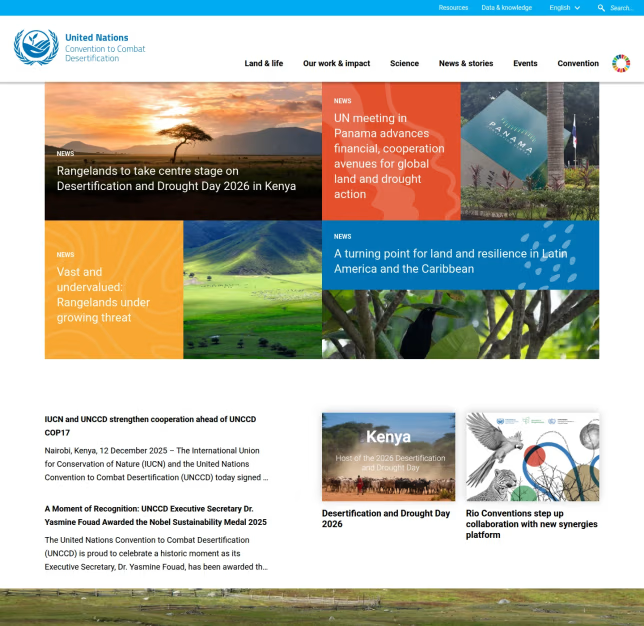
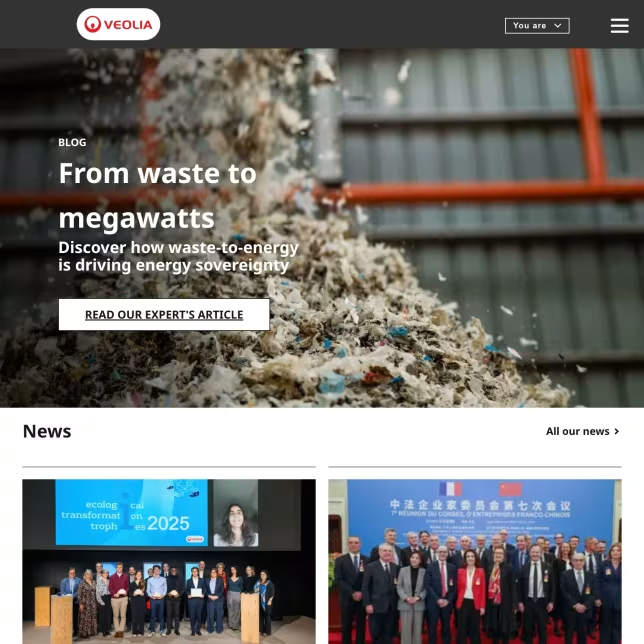
That pattern is especially visible on large multi-site estates such as Veolia, where governance and rollout discipline matter as much as the integration itself, and in consolidation programs like UNCCD, where migration quality and editorial workflow alignment determine whether a unified platform actually improves operations.
Tags: Drupal, Drupal media model governance, Drupal DAM integration, enterprise media architecture, asset metadata governance, Drupal content operations, media library governance, migration planning