



 [01]
[01]Discovery and Audit
Assess current Drupal architecture, content model, and existing API surface. Identify consumers, integration constraints, and non-functional requirements such as latency, throughput, and security posture.
Drupal REST API readiness
Run a Drupal health check to surface integration gaps, versioning weaknesses, governance drift, and upgrade blockers before API changes spread across consumers.
Useful when Drupal endpoints support multiple apps, services, or partner integrations.
No login required. Takes 2–3 minutes.
Drupal REST API development for enterprise platforms focuses on exposing Drupal content and capabilities through stable, secure, and well-modeled interfaces. This includes Drupal JSON:API engineering and REST patterns, defining resource boundaries, implementing authentication and authorization (including OAuth2 authentication for APIs), and establishing conventions for filtering, pagination, error handling, and backward compatibility.
Organizations need this capability when Drupal becomes part of a broader platform ecosystem: headless frontends, mobile apps, CRM/ERP integrations, search and analytics pipelines, and partner-facing services. Without a deliberate enterprise API architecture, teams often ship ad-hoc endpoints that are hard to evolve, difficult to secure, and expensive to operate.
A well-designed headless Drupal backend API layer supports scalable platform architecture by separating concerns between content modeling and delivery, enabling independent release cycles for consumers, and providing governance for API versioning strategy and deprecation. It also improves operational reliability through caching strategy, rate limiting considerations, observability, and predictable performance characteristics under load.
Core Focus
Best Fit For
Key Outcomes
Technology Ecosystem
Delivery Scope
As Drupal platforms grow, API consumers multiply: frontend applications, mobile clients, internal services, and external partners. Without consistent resource modeling and contract discipline, endpoints evolve organically around immediate needs. The result is a mix of patterns, inconsistent payloads, and unclear ownership of breaking changes.
These inconsistencies quickly become architectural friction. Backend engineers spend time reverse-engineering behavior across endpoints, while integration teams build brittle mappings and workarounds. Authentication and authorization often diverge between consumers, leading to duplicated logic and uneven security controls. Performance issues emerge when APIs are built on uncached entity loads, unbounded queries, or expensive serialization paths, making it difficult to predict capacity requirements.
Operationally, the platform becomes harder to change safely. Small content model adjustments can cascade into consumer failures, release coordination becomes tightly coupled, and incident response is slowed by limited observability into API usage, latency, and error rates. Over time, the API layer becomes a constraint on platform evolution rather than an enabler of new channels and integrations.
Review Drupal content models, existing endpoints, consumers, and integration constraints. Capture non-functional requirements such as latency targets, throughput, authentication needs, and data sensitivity to shape the API contract and operating model.
Define resource boundaries, naming conventions, payload shapes, filtering, pagination, and error semantics. Establish versioning and deprecation rules, and document consumer expectations to reduce coupling and prevent accidental breaking changes.
Design authentication and authorization flows aligned to enterprise identity requirements. Implement OAuth2 or token-based access patterns, scope/role mapping, and endpoint-level access control, including considerations for rate limiting and abuse prevention.
Implement REST and/or JSON:API endpoints using Drupal core capabilities and custom modules where needed. Add serialization rules, computed fields, and validation to ensure consistent behavior and predictable responses across consumers.
Support consumer onboarding with reference requests, response examples, and environment configuration. Validate integration paths with upstream/downstream systems and ensure data contracts align with business workflows and ownership boundaries.
Add automated tests for endpoint behavior, permissions, and edge cases. Include contract-level checks, regression coverage for versioned endpoints, and performance-focused tests for expensive queries and serialization paths.
Prepare deployment and runtime configuration, including caching strategy, Redis usage, and container settings. Establish logging, metrics, and tracing conventions to monitor latency, error rates, and consumer usage patterns.
Introduce processes for change management, version rollout, and deprecation communication. Maintain API documentation, track consumer adoption, and schedule periodic reviews to reduce drift and keep integrations maintainable.
This service establishes a Drupal API layer that behaves like a product interface: consistent, secure, and evolvable. The focus is on resource modeling, contract stability, and predictable runtime characteristics across REST and JSON:API. Engineering work emphasizes access control, versioning strategy, caching and performance design, and testable endpoint behavior. The result is an integration surface that supports headless delivery and enterprise system interoperability without coupling consumers to internal Drupal implementation details.
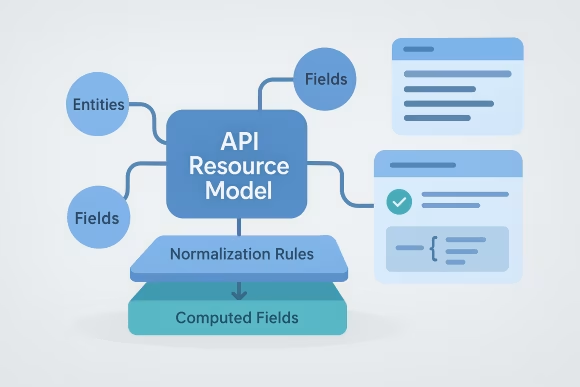
Define API resources around domain concepts rather than Drupal internals. Map entities, fields, and relationships into stable representations, including normalization rules, computed fields, and explicit inclusion strategies to control payload size and reduce consumer-side transformation logic.
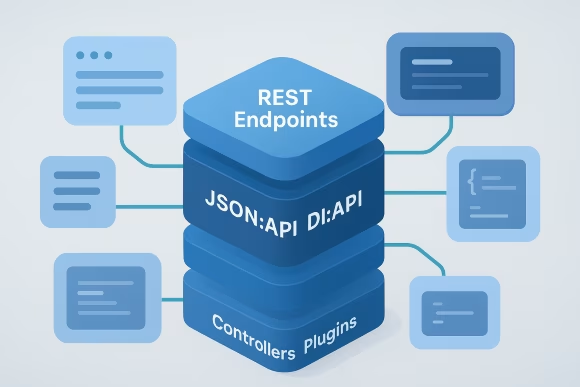
Implement endpoints using Drupal REST and JSON:API with clear conventions for routes, methods, and response formats. Extend core capabilities with custom normalizers, controllers, and plugins where required to support domain-specific behavior while keeping the interface consistent.
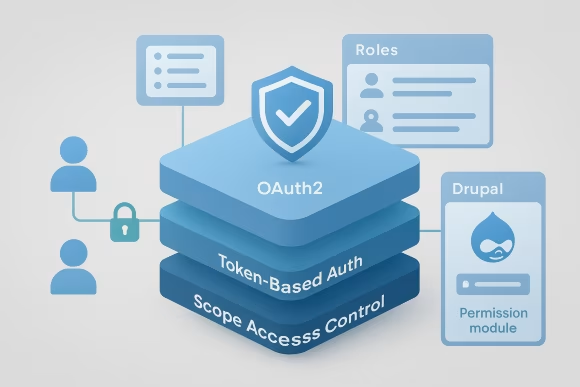
Design and implement OAuth2 or token-based authentication flows with scope-based access control. Align Drupal permissions and roles to consumer identities, enforce least-privilege access, and ensure sensitive resources are protected through consistent authorization checks.
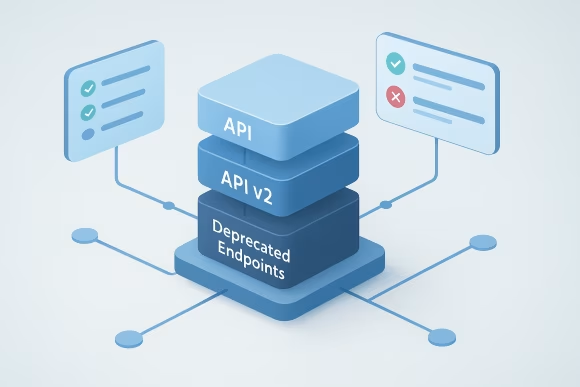
Introduce explicit versioning and compatibility rules to support independent consumer release cycles. Define deprecation policies, change classification, and migration paths so that content model evolution and endpoint enhancements do not create unplanned breaking changes.

Engineer predictable API performance through query design, pagination limits, and caching strategy. Use Drupal cache metadata, HTTP caching patterns, and Redis-backed caches where appropriate, and avoid expensive serialization paths that degrade under load.
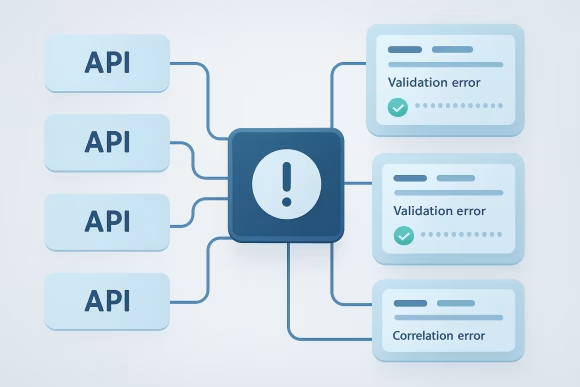
Standardize error responses, validation behavior, and status codes across endpoints. Provide consistent error structures that support client-side handling, troubleshooting, and observability, including correlation identifiers and safe exposure of diagnostic details.
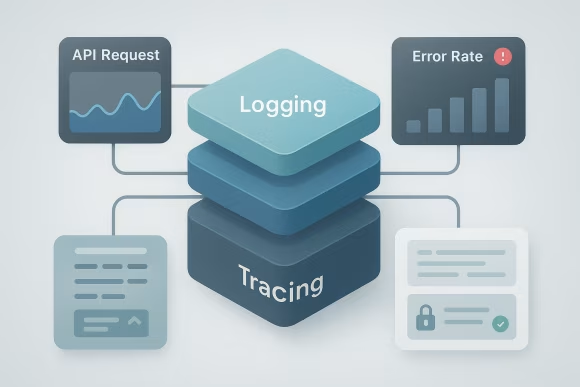
Add logging and metrics conventions for API requests, latency, and error rates, with attention to sensitive data handling. Enable tracing-friendly correlation across services so integration issues can be diagnosed without relying on consumer-side guesswork.
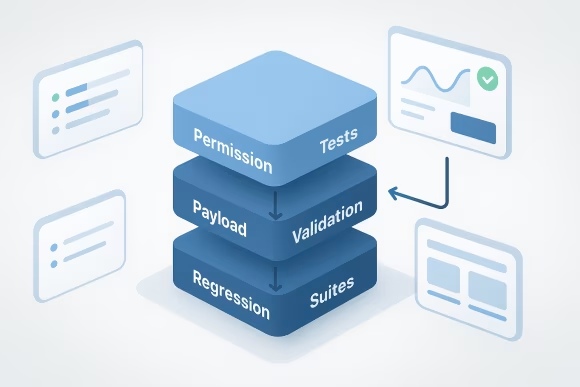
Design endpoints to be testable through automated suites that validate permissions, payload shapes, and edge cases. Establish regression coverage for versioned behavior and ensure changes to content models or serialization rules are detected before release.
Identify the highest-risk problems affecting schema consistency, authentication, caching, observability, and release coordination across Drupal integrations.
Engagements follow an engineering sequence from discovery and contract definition through Drupal REST API development and hardening for production. Delivery emphasizes testable interfaces, Drupal OAuth2 API security, API versioning strategy, and performance/caching design so integrations can evolve without repeated rework.
[01]Assess current Drupal architecture, content model, and existing API surface. Identify consumers, integration constraints, and non-functional requirements such as latency, throughput, and security posture.
 [02]
[02]Define resource boundaries, endpoint conventions, and contract rules. Establish versioning, deprecation policy, and documentation structure to support long-term evolution.
 [03]
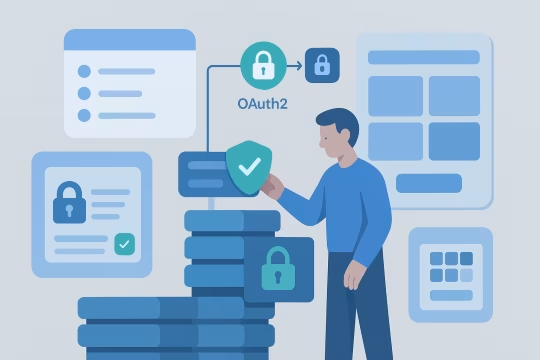
[03]Implement authentication and authorization aligned to enterprise identity needs. Configure OAuth2/token flows, scopes, and permission mapping, and validate access control across representative consumer scenarios.
 [04]
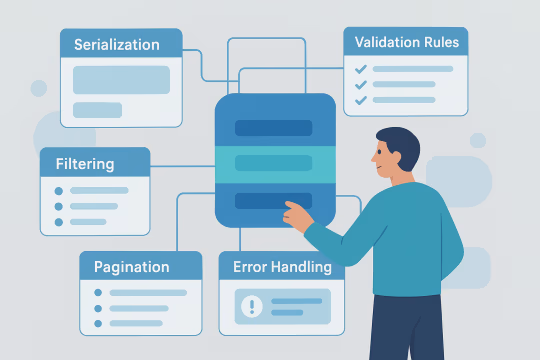
[04]Build and extend REST/JSON:API endpoints, including serialization, validation, and domain-specific behavior. Ensure consistent filtering, pagination, and error handling across the interface.
 [05]
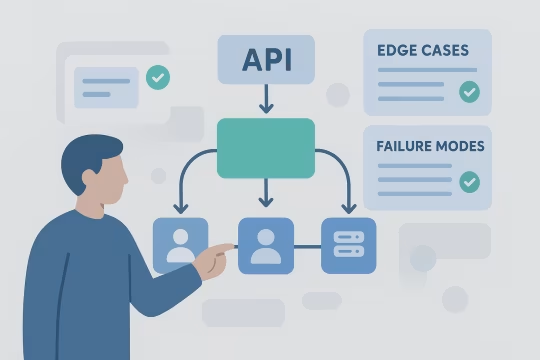
[05]Test with real consumer use cases and downstream systems to confirm contract fit. Validate data mappings, edge cases, and failure modes, and adjust resource modeling where necessary.
 [06]
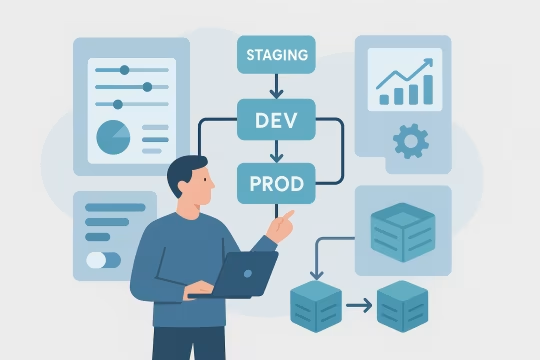
[06]Add automated tests for permissions, payload shapes, and versioned behavior. Include performance-focused checks for query patterns and serialization paths to prevent runtime degradation.
 [07]
[07]Prepare container and environment configuration, caching strategy, and operational controls. Establish logging and metrics conventions to support incident response and capacity planning.
 [08]
[08]Support iterative enhancements through governed change management. Maintain documentation, track consumer adoption, and plan deprecations to keep the API surface coherent over time.
A stable Drupal API layer reduces integration friction and enables independent delivery across channels. By treating the API as a governed interface with security, performance, and lifecycle controls, teams can evolve the platform without repeated coordination overhead and avoidable operational risk.
Clear contracts and reusable resources reduce time spent negotiating payloads and behaviors. Frontend and integration teams can build against stable interfaces with fewer backend changes per feature.
Versioning and deprecation policies reduce breaking changes across consumers. Controlled rollout patterns make platform evolution safer, especially when multiple teams depend on the same endpoints.
Consistent authentication and authorization reduces gaps created by ad-hoc endpoint implementations. Scope-based access and least-privilege design help protect sensitive content and administrative capabilities.
Caching strategy, pagination limits, and query design improve latency consistency under load. This supports capacity planning and reduces production incidents caused by expensive serialization or unbounded requests.
Standardized patterns for errors, filtering, and resource modeling reduce one-off implementations. Engineers spend less time debugging integration-specific behavior and more time improving shared platform capabilities.
Documented contracts and change management establish clear ownership and decision paths. This improves cross-team coordination and reduces architectural drift as the platform and consumer ecosystem grows.
Reusable modules, consistent conventions, and automated regression tests reduce rework. Teams can implement new resources and endpoints with confidence that existing consumers remain stable.
Before roadmap commitments
Use a Drupal health check to validate integration readiness, governance controls, and upgrade impact so teams can scope API work with fewer surprises.
Adjacent capabilities that extend Drupal API architecture into full platform delivery, including headless patterns, frontend integration, and broader API engineering.
Drupal API development services for secure integration layers
Drupal GraphQL schema design and schema-first integration
Drupal event tracking architecture, identity, and audience sync engineering
Secure Drupal Salesforce and HubSpot connectivity with enterprise data sync
Drupal GA4 event tracking and enterprise instrumentation
Connect Drupal with Your Enterprise Ecosystem
Drupal ecommerce API integration and data synchronization
Designing Scalable Digital Foundations
Drupal content architecture design and editorial operating design
Common questions about Drupal API architecture, security, integration patterns, governance, and how delivery typically works in enterprise environments.
JSON:API is typically the default choice when you want standardized, discoverable resource access with consistent filtering, relationships, and a well-known media type. It works well for headless delivery where consumers can adapt to a resource-oriented model and where you want to minimize custom endpoint code. Drupal REST is a better fit when you need purpose-built endpoints, command-style operations, or payloads that don’t map cleanly to entity resources. It’s common for integration scenarios such as pushing events, orchestrating workflows, or exposing aggregated views that combine multiple sources. In practice, many enterprise platforms use both: JSON:API for general content delivery and REST for specialized integration endpoints. The key is to define conventions so consumers understand which interface to use, and to avoid duplicating the same capability in two different styles without a clear reason. We typically decide based on domain boundaries, consumer needs, and long-term maintainability rather than developer preference.
Stability comes from treating the API as a contract independent of Drupal’s internal representation. We start by defining domain resources and relationships, then map Drupal entities/fields into those resources with explicit rules for naming, optionality, and computed values. To keep contracts stable, we avoid exposing implementation details that are likely to change (internal IDs, field machine names without abstraction, or deeply nested structures that mirror editorial configuration). Where change is expected, we design for compatibility: additive changes by default, explicit versioning for breaking changes, and clear deprecation windows. We also introduce governance around content model changes. Editorial or product-driven schema updates should include an API impact assessment: which consumers are affected, whether the change is additive or breaking, and what migration path exists. Automated regression tests that validate payload shapes and permissions help detect accidental contract drift before release.
For Drupal APIs, the most actionable metrics are request rate, latency percentiles (p50/p95/p99), error rate by status code, and cache effectiveness (hit ratio and cache-related headers). These show whether consumers are experiencing slowdowns, whether failures are systemic or consumer-specific, and whether caching strategy is working as intended. At the Drupal level, it’s also important to track database query volume and slow queries for API routes, PHP worker saturation, and queue/backlog metrics if asynchronous processing is involved. For JSON:API specifically, relationship includes and complex filters can create expensive query patterns that should be visible in monitoring. We recommend correlating API logs with request identifiers and capturing consumer identity (client ID, token subject, or application name) in a privacy-safe way. This enables targeted incident response: you can see which consumers are affected, whether a specific integration is misbehaving, and how changes impact real usage over time.
Authenticated responses can still be cached, but the strategy must respect variation by user, role, or scope. We typically start by classifying endpoints: public content delivery, authenticated-but-shared (e.g., per client scope), and truly user-specific responses. For public endpoints, HTTP caching with cache tags/contexts and a reverse proxy pattern is often effective. For authenticated-but-shared responses, we may cache by client identity or scope, ensuring that authorization decisions are part of the cache key. For user-specific responses, caching is usually limited to short-lived or internal caches unless the data can be safely generalized. In Drupal, correct cache metadata is critical. If cache contexts are incomplete, you risk serving incorrect data across users; if they are overly broad, you lose cache efficiency. We validate caching behavior with tests and runtime inspection, and we use Redis-backed caches where appropriate to reduce database load and improve response consistency.
Integration typically starts by selecting an authentication pattern that matches your identity provider and consumer types: OAuth2 authorization code for interactive clients, client credentials for service-to-service integrations, and token exchange patterns where required. The goal is to ensure Drupal can validate tokens, map identities to permissions/scopes, and enforce access consistently. We design how identity claims (groups, roles, scopes) translate into Drupal authorization decisions. This may involve mapping to Drupal roles, using custom access checks, or implementing scope-based permissions at the route/resource level. We also define token lifetimes, refresh behavior, and revocation expectations. Operational considerations matter: key rotation, clock skew, failure modes when the identity provider is unavailable, and audit logging. We implement and test these behaviors with representative consumers so that authentication is not only correct in isolation but reliable within the broader platform runtime.
Yes, but Drupal is usually one component in the pattern. For request/response, Drupal exposes REST/JSON:API endpoints. For event-driven integration, Drupal can publish events when content changes or workflows complete, typically via webhooks, queues, or integration middleware. We start by defining event boundaries and payload contracts: what constitutes an event, what data is included, and how consumers correlate events to resources. Then we decide on delivery mechanisms: direct webhooks for simpler integrations, or a message broker pattern for higher reliability and fan-out. Key engineering concerns include idempotency, retry behavior, ordering guarantees, and backpressure handling. We also ensure that event payloads do not leak sensitive data and that consumers can rehydrate full state via the API when needed. This combination—events for change notification and APIs for state retrieval—tends to be robust and maintainable.
We treat versioning as a policy first, then implement it consistently. The policy defines what counts as a breaking change, how versions are represented (URL path, header-based, or media type), and what the deprecation window looks like for consumers. In Drupal, implementation can vary: separate routes per version for custom REST endpoints, or controlled evolution of JSON:API resources with additive changes and explicit deprecation of fields/relationships. For breaking changes, we typically introduce a new versioned endpoint or resource representation rather than modifying behavior in place. Governance includes documentation updates, consumer communication, and telemetry to track adoption. We also recommend automated contract tests per version and a release checklist that includes backward compatibility review. This reduces accidental breaking changes and makes API evolution predictable across multiple teams and release cycles.
We maintain documentation that is contract-oriented and consumer-focused: resource definitions, endpoint conventions, authentication requirements, filtering/pagination rules, and error semantics. For each resource, consumers should see example requests/responses, relationship usage, and notes on optional fields and constraints. For operational clarity, we include rate limit expectations (if applicable), caching behavior, and environment configuration (base URLs, token endpoints, required headers). For versioned APIs, documentation must clearly show what changed, what is deprecated, and the migration path. Documentation should be treated as part of the delivery pipeline. We recommend updating it alongside code changes and validating examples against real environments. Where feasible, we generate parts of the documentation from source-of-truth definitions, but we still curate narrative guidance so integration teams can onboard without reverse-engineering behavior from trial and error.
Common risks include inconsistent authorization checks across endpoints, overexposure of fields or relationships, and insufficient separation between public and privileged operations. Another frequent issue is relying on consumer-side filtering rather than enforcing access control server-side, which can lead to data leakage. Token handling is also a risk area: accepting tokens without proper validation, missing audience/issuer checks, weak scope enforcement, or logging sensitive token data. For JSON:API, allowing unrestricted includes or filters can expose data indirectly or create denial-of-service vectors through expensive queries. We mitigate these risks by implementing centralized access control patterns, validating authentication flows end-to-end, and applying defensive constraints such as pagination limits, filter allowlists, and request size limits. We also recommend security reviews for new resources and routine audits of permissions and exposure as content models evolve.
Risk reduction starts with contract discipline: clear conventions, explicit compatibility rules, and a versioning strategy that avoids silent behavior changes. We prefer additive changes where possible and introduce new versions for breaking changes rather than modifying existing behavior in place. We also use automated regression tests that validate payload shapes, required fields, permissions, and edge cases. These tests act as a safety net when content models, serialization rules, or access control logic changes. For high-impact APIs, contract tests can be shared with consumers or run in CI to detect incompatibilities early. Operationally, we recommend staged rollouts and telemetry-driven validation. Monitoring consumer error rates and adoption of new versions provides early warning signals. Combined with deprecation windows and clear migration guidance, this approach reduces coordination overhead and prevents unexpected outages in dependent systems.
In the first 4–6 weeks, we aim to establish a usable contract and a production-ready foundation rather than a large volume of endpoints. Typical outputs include an API architecture decision set (REST vs JSON:API usage), resource modeling for priority domains, authentication/authorization design, and a versioning/deprecation policy aligned to your release process. Implementation usually includes a thin vertical slice: a small set of representative resources/endpoints with consistent filtering, pagination, and error semantics; security integrated with your identity approach; and initial automated tests covering permissions and contract behavior. We also set up baseline observability conventions so you can see latency, errors, and consumer usage. This foundation enables parallel work: consumer teams can start integrating against stable patterns, while the API surface expands iteratively with lower risk and less rework. The exact scope depends on platform complexity and the number of consumers that must be supported early.
We collaborate by establishing clear ownership boundaries and shared conventions early. Internal teams typically own product priorities and domain knowledge, while we focus on API architecture, implementation patterns, and operational readiness. If vendors are involved, we align on contract rules, change management, and integration testing responsibilities. Practically, we work through joint discovery workshops, architecture reviews, and an agreed backlog of resources/endpoints. We use code reviews and pairing sessions to transfer patterns into your codebase, and we document decisions so teams can apply them consistently after the engagement. We also recommend a lightweight governance cadence: periodic contract review, security review for new resources, and a release checklist that includes compatibility and observability checks. This keeps the API surface coherent even when multiple delivery streams contribute changes over time.
Editorial-driven changes are common in Drupal, and they can unintentionally break consumers if the API exposes field structures directly. We handle this by introducing an API impact assessment step into the content model change process. The assessment identifies which resources are affected, whether changes are additive or breaking, and what migration steps are required. Where possible, we decouple the API contract from editorial configuration by using stable resource representations, computed fields, and explicit mapping layers. This allows editorial teams to evolve content types and fields without forcing immediate consumer changes. For changes that must affect the contract, we apply versioning and deprecation rules. We document the change, provide a transition period, and use telemetry to track consumer adoption. Automated regression tests help detect accidental contract drift when configuration changes are deployed across environments.
A common pitfall is unbounded queries: filters that allow large result sets, missing pagination limits, or endpoints that load full entities and relationships without controlling depth. JSON:API includes can also trigger expensive query patterns if not constrained, especially when consumers request deep relationship graphs. Serialization overhead is another issue. Large payloads, computed fields that trigger additional loads, and lack of cache metadata can increase response times and reduce cache effectiveness. Permissions checks can also become expensive if implemented inconsistently or repeated across nested resources. We address these by designing allowlisted filters, enforcing pagination defaults and maximums, and optimizing entity loading strategies. We validate cache metadata and use Redis-backed caches where appropriate. Performance testing focuses on realistic consumer requests, not just single-resource happy paths, so the platform remains predictable under production traffic patterns.
Collaboration typically begins with a short discovery phase focused on consumers and constraints. We start by identifying who uses the API (frontends, mobile, integrations, partners), what data and operations they need, and what non-functional requirements apply (security, latency, throughput, compliance). Next, we review the current Drupal implementation: content model, existing endpoints, authentication approach, and operational setup. From this, we propose an initial contract and architecture plan: interface style selection (REST/JSON:API), resource boundaries, versioning policy, and a thin vertical slice to implement first. We then align on working practices: environments and access, code review workflow, documentation expectations, and a delivery cadence. The goal is to establish a shared contract and implementation pattern early so subsequent endpoint work can proceed iteratively with consistent governance and predictable operational behavior.
These case studies showcase advanced Drupal platform engineering with a focus on API architecture, secure integrations, and scalable content delivery. They highlight real-world implementations of Drupal REST API development, including authentication, resource modeling, and performance optimization that align closely with the service's core capabilities. Together, they provide practical insights into delivering robust, enterprise-grade Drupal API solutions with governance and operational excellence.
An advanced healthcare digital platform for LATAM was required to facilitate collaboration among radiology HCPs, distribute company knowledge, refine treatment methods, and streamline workflows. The solution needed secure medical website role-based access restrictions based on user role (HCP / non-HCP) and geographic region.
The platform enhanced collaboration, streamlined workflows, and empowered radiology professionals with advanced tools to gain insights and optimize patient care.
The existing marine data portal relied on three unaligned WordPress installations and embedded PHP code, creating inefficiencies and risks in content management and usability.
The new Drupal DXP streamlined content operations and improved accessibility, offering scientists and businesses a more efficient gateway to marine data services.
UNCCD operated four separate websites (two WordPress, two Drupal), leading to inconsistencies in design, content management, and user experience. A unified, scalable solution was needed to support a large-scale CMS migration project and improve efficiency and usability.
The modernization effort resulted in a cohesive, user-friendly, and scalable website, improving content management efficiency and long-term digital sustainability.
With Drupal 7 reaching end-of-life, Veolia needed a Drupal 7 to Drupal 10 enterprise migration for its Acquia Site Factory multisite platform—preserving region-specific content and multilingual capabilities across more than 200 sites.
The platform was modernized into a stable, scalable multisite foundation with improved performance, maintainability, and long-term upgrade readiness.
It was my pleasure working with Oleksiy (PathToProject) on a new Drupal website. He is a true full-stack developer—the ideal mix of DevOps expertise, deep front-end knowledge, and the structured thinking of a senior back-end developer.
He is well-organized and never lets anything slip. Oleksiy understands what needs to be done before being asked and can manage a project independently with minimal involvement from clients, product managers, or business analysts.
One of the best consultants I’ve worked with so far.

Andrei Melis
Technical Lead at Eau de Web
Oleksiy (PathToProject) and I worked together on a Digital Transformation project for Bayer LATAM Radiología. Oly was the Drupal developer, and I was the business lead. His professionalism, technical expertise, and ability to deliver functional improvements were some of the key attributes he brought to the project.
I also want to highlight his collaboration and flexibility—throughout the entire journey, Oleksiy exceeded my expectations.
It’s great when you can partner with vendors you trust, and who go the extra mile.

Axel Gleizerman Copello
Building in the MedTech Space | Antler
Oleksiy (PathToProject) is demanding and responsive. Comfortable with an Agile approach and strong technical skills, I appreciate the way he challenges stories and features to clarify specifications before and during sprints.

Olivier Ritlewski
Ingénieur Logiciel chez EPAM Systems
These articles expand on the architecture and governance decisions that shape enterprise Drupal integrations. They cover API lifecycle management, content model change control, and the platform patterns that help Drupal services stay secure, stable, and easier to evolve.
Let’s review your Drupal platform, API consumers, and security constraints, then define a versioned interface and delivery plan that supports long-term integration and headless growth.