Customer data platforms often fail in subtle ways long before they fail visibly. One of the most common examples is the late-arriving event: an event that occurred at one time but was not processed until much later.
In practice, that delay can be a few minutes, several hours, or multiple days. A mobile app may cache activity while the user is offline. An event collector may queue records during a traffic spike. A downstream API may recover after an outage and deliver accumulated events in a burst. A partner system may export a daily batch containing interactions that happened yesterday.
None of these situations is unusual in an enterprise environment. The real problem begins when the CDP treats delayed arrivals as if they were ordinary, on-time inputs without policy boundaries. When that happens, the system can rewrite audience membership unexpectedly, credit conversions to the wrong touchpoints, trigger journeys after the relevant moment has passed, or suppress communications too late to matter.
Good governance does not eliminate lateness. It makes lateness understandable, bounded, and operationally safe.
Why late-arriving events are inevitable in enterprise pipelines
Enterprise CDP programs depend on many systems that do not share the same reliability profile, clock behavior, or delivery cadence. Even well-designed pipelines experience timing variation because the end-to-end path spans collection, transport, transformation, identity resolution, storage, decisioning, and activation.
Common sources of routine lateness include:
- mobile sessions captured offline and uploaded later
- browser events delayed by network conditions or consent-state changes
- queue congestion during volume spikes
- API outages followed by recovery bursts
- vendor or internal batch imports delivered on a schedule rather than in real time
- transformation jobs that miss a processing cycle and catch up afterward
The key governance insight is that late events are not the same as a historical backfill or a deliberate replay. A replay is an intentional reprocessing action. A backfill is usually a known corrective or onboarding activity. Late-arriving events, by contrast, happen during normal operations and interact directly with live decision windows.
That distinction matters because the policy response is different. If teams govern late events only through broad replay or backfill controls, they often miss the narrower but more frequent decisions that affect real-time and near-real-time marketing outcomes.
Event time versus processing time and why the distinction matters
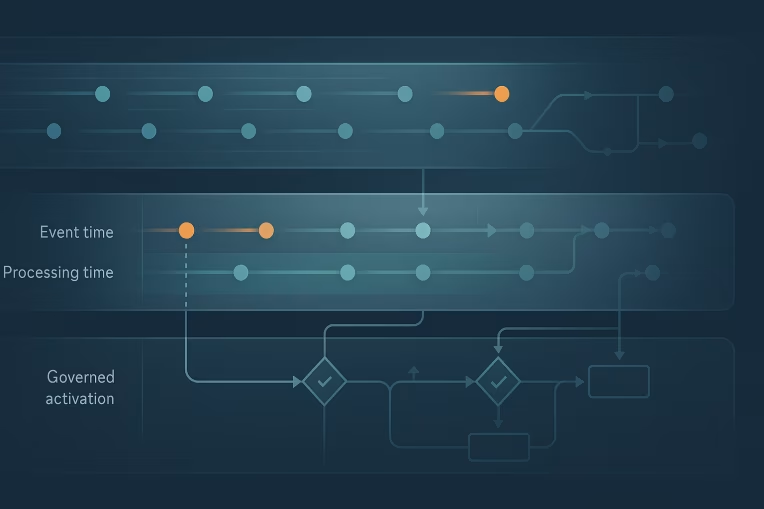
Any mature CDP needs a clear distinction between event time and processing time.
- Event time is when the customer action actually occurred.
- Processing time is when the platform ingested or made the event available for downstream logic.
Many business rules implicitly assume those moments are close together. In reality, they can diverge significantly.
Suppose a customer added a product to a cart at 9:00 AM while offline on a mobile app, and the event reached the CDP at 3:00 PM. If the platform evaluates audience eligibility using processing time, the customer may appear to have abandoned a cart six hours later than they really did. If a journey waits two hours after abandonment before sending a reminder, the communication may go out long after the optimal moment.
Attribution logic suffers the same problem. A delayed conversion event can arrive after reporting has already assigned credit elsewhere. If the system automatically reassigns that credit with no restatement policy, analysts see shifting reports. If the system never reassigns it, the attribution model is knowingly wrong. Neither outcome is acceptable without a defined governance choice.
For that reason, enterprise teams should explicitly document which decisions are based on event time, which are based on processing time, and which use a hybrid rule with a bounded grace period.
Failure patterns in attribution, segmentation, suppression, and journey orchestration
Late events cause more than latency. They create contradictions across systems unless downstream consumers share the same interpretation rules.
Attribution distortion often appears first. A delayed conversion can enter after a channel touch has already fallen outside a reporting window based on processing time, even though it was within the proper event-time window. Alternatively, a delayed impression or click can arrive after a conversion has already been reported, causing the model to shift credit unexpectedly.
Segmentation errors happen when audience qualification is evaluated before all relevant events are present. A customer may be excluded from a high-intent audience because the qualifying behavior arrived late. Or the reverse may happen: the customer enters an audience after the campaign window is effectively over.
Suppression failures are especially sensitive operationally. If an unsubscribe, purchase, service case, or fraud signal arrives late, the organization may continue outreach that should have been blocked. In most enterprises, suppression and compliance-related events deserve stricter handling than promotional qualifiers.
Journey orchestration problems occur when decision logic assumes freshness that the pipeline cannot consistently provide. An event that should have triggered step one may arrive after the person has already become ineligible, completed the journey elsewhere, or reached a different lifecycle stage.
These failure patterns are rarely caused by one bad component. They emerge when multiple teams define timing rules independently:
- engineering optimizes ingestion latency
- analytics defines reporting windows
- marketing operations configures audience refresh schedules
- channel teams enforce their own send eligibility rules
Without shared governance, the same delayed event can be treated as valid, invalid, actionable, and historical all at once, depending on where it lands.
Watermarks, grace periods, and recomputation boundaries
A practical late-event policy starts by defining how long the platform waits for expected completeness and when a dataset or decision window is considered stable enough to use.
A watermark is a time boundary that signals how complete the system believes event-time data is up to a certain point. Teams do not need vendor-specific terminology to apply the concept. The governance question is simple: how far behind event time are we willing to assume data may still arrive and materially change outcomes?
A grace period adds an operational buffer before finalizing calculations or eligibility decisions. For example:
- session-based behavioral audiences may tolerate a short grace period
- daily aggregates may close only after an overnight delay window
- attribution reports may remain provisional for a defined number of days
- suppression logic may apply immediate protections even if promotional eligibility waits for fuller data
A useful policy framework defines, for each major use case:
- the expected lateness profile
- the maximum accepted lateness for normal operations
- the decision point after which no automatic recomputation occurs
- the escalation path when lateness exceeds tolerance
This is where audience recomputation policy becomes essential. Not every late event should trigger unlimited retroactive recalculation.
For example, a CDP may allow audience recomputation for the current day and prior day, but not for prior weeks. Or it may recompute analytical metrics for seven days while freezing activation audiences after campaign launch. The goal is not theoretical accuracy at any cost. The goal is to preserve business trust while minimizing avoidable churn in downstream systems.
When to restate metrics and when to protect historical reports
One of the hardest governance choices is whether late events should restate previously published numbers.
In principle, restatement can improve accuracy. In practice, unrestricted restatement can create endless report drift. Business stakeholders lose confidence when yesterday's dashboard changes repeatedly without explanation.
A stronger approach is to classify reporting outputs by their tolerance for change.
Operational dashboards can often accept provisional values for a short period. These views support fast decision-making and may benefit from event-time corrections within a defined window.
Executive reports usually need greater stability. Once published, they often should not shift unless a threshold or incident process is triggered.
Financially adjacent or compliance-sensitive outputs typically need formal change control if they are corrected at all.
A sound restatement policy therefore defines:
- which reports are provisional
- how long they remain open to correction
- what degree of late-arrival impact warrants restatement
- who approves changes after a report is considered final
- how corrected periods are annotated for consumers
The most important step is transparency. If a metric uses event time and remains open for correction for three days, say so plainly. If an audience snapshot is fixed at send time and will not be revised, say that too. Governance succeeds when users understand the rule before exceptions occur.
Activation safeguards for delayed qualifiers and expired journeys
Activation systems need protection from the false precision that delayed events can create.
A customer who qualifies late is not always a customer who should still be activated.
Consider a few common cases:
- a cart-abandonment qualifier arrives after the purchase already happened in another system
- a browse event arrives after the campaign's promotional window closed
- a service issue event arrives late, after outreach already went out
- a batch import adds a high-intent signal for a segment whose daily sync already completed
In these cases, the CDP should not simply ask, did the user qualify? It should also ask, is the action still valid now?
That means activation governance should include:
- expiry checks so delayed qualifiers do not trigger stale journeys
- suppression precedence so protective signals override promotional logic whenever timing conflicts exist
- decision timestamps so teams can distinguish when the platform knew something from when it happened
- sync cutoffs for destinations that should not receive retroactive membership changes after a certain point
- idempotent downstream handling where possible, so repeated recalculation does not create duplicate actions
For journey orchestration, one useful pattern is to separate qualifying logic from send logic. A late event may still update the customer's state history, but the send step should verify that the customer remains within policy boundaries before any message is released. This is a core concern in customer journey orchestration.
This is especially important in enterprise environments where journeys span multiple platforms. The CDP may identify qualification, but the channel execution tool applies its own schedule and limits. If those systems do not share cutoff rules, delayed events can create inconsistent customer experiences. The same issue often surfaces in data activation architecture, where destination sync timing and contract rules determine whether a late qualifier should still propagate.
Operating runbooks for monitoring and recovery
Governance is incomplete unless the operating model can detect and respond to late-event conditions consistently.
Teams should maintain runbooks that answer four questions:
- How do we know lateness is increasing?
- Which decisions are at risk when it does?
- What automatic protections should activate?
- Who decides whether to recompute, restate, or hold downstream actions?
Monitoring should focus less on generic pipeline health alone and more on business-impactful lateness signals, such as:
- event-time lag relative to processing time
- percentage of events arriving outside normal windows
- queue age or import delay by source
- audience refreshes completed with incomplete source coverage
- suppression signals arriving after campaign execution milestones
Recovery actions should be pre-classified. For example:
- hold promotional audience syncs if a critical source exceeds lateness tolerance
- continue suppression updates even during broader activation holds
- flag attribution outputs as provisional when source completeness drops
- trigger incident review if late arrivals cross defined operational thresholds
Runbooks should also identify ownership boundaries. Engineering may remediate transport issues, but analytics may own restatement decisions, and marketing operations may own campaign holds. Late-event governance breaks down when every team assumes another team is making the timing decision. In practice, this is where customer data infrastructure and customer data governance need to meet: observable pipelines alone are not enough without explicit operating rules and accountable owners.
A practical governance model for enterprise CDP teams
For most organizations, a workable model includes five layers:
- Data contract layer: define required timestamps, source latency expectations, and acceptable clock behavior.
- Processing layer: apply watermarking, grace periods, and exception handling based on event-time reliability.
- Decision layer: document whether audiences, suppression, journeys, and attribution use event time, processing time, or bounded hybrids.
- Reporting layer: define provisional periods, restatement rules, and annotation standards.
- Operating layer: establish monitoring, incident thresholds, manual overrides, and accountable owners.
This approach keeps the enterprise operating model central. It treats lateness as a managed business condition rather than an engineering anomaly.
Conclusion
CDP late arriving event governance is ultimately about preserving trust in decisions made from imperfect timing. Enterprise systems will always have some degree of routine lateness. The question is not whether delayed event processing exists, but whether the organization has clear rules for what that lateness is allowed to change.
Teams that distinguish event time vs processing time, define watermarks and grace periods, set audience recomputation boundaries, and protect activation paths from stale qualifiers are far more likely to keep analytics and engagement systems aligned.
The right goal is not perfect historical reconstruction in every live workflow. It is consistent, explicit, and business-aware handling of delayed events so that audiences, attribution, suppression, and journey logic remain dependable even when the pipeline is not perfectly on time.
Tags: CDP, Customer data platforms, Data engineering, Event processing, Attribution, Audience governance, Marketing operations