


 [01]
[01]Discovery Sprint
Review the current Drupal estate, delivery processes, and constraints. Collect architecture inputs, pain points, and operational signals (incidents, release frequency, upgrade history) to ground decisions in evidence.
Drupal architecture readiness
Identify architecture drift, governance gaps, upgrade blockers, and integration risks across your Drupal estate before locking in delivery plans.
Built for multi-site, hybrid, and enterprise Drupal environments.
No login required. Takes 2–3 minutes.
Drupal experience platforms often evolve from a single site into a portfolio of sites, products, and channels with shared content, design systems, and integrations. A Drupal experience platform strategy defines the target state for that ecosystem: platform boundaries, architectural patterns, a Drupal platform governance model, and an Enterprise Drupal DXP roadmap that aligns engineering constraints with digital experience goals.
Organizations typically need this capability when delivery slows due to inconsistent implementations, unclear ownership, or integration sprawl across marketing, commerce, identity, and analytics. The strategy provides a reference architecture and decision framework for headless and hybrid Drupal patterns, multi-site topology, content modeling, and API contracts.
The outcome is a platform plan that supports scalable delivery: clear standards for Drupal core and contributed modules, frontend integration approaches (including Next.js/React where appropriate), security and compliance controls, and a platform operating model that enables teams to ship changes safely while reducing long-term maintenance overhead.
Core Focus
Best Fit For
Key Outcomes
Technology Ecosystem
Platform Integrations
As Drupal platforms expand from a single implementation into multiple sites and teams, decisions are often made locally to meet immediate delivery needs. Over time, this creates divergent patterns for content modeling, module selection, frontend integration, and deployment practices. The platform becomes harder to reason about because there is no shared target architecture or agreed boundaries between Drupal, frontend applications, and surrounding services.
Engineering teams then inherit a fragmented system: integrations are implemented inconsistently, API contracts are undocumented or unstable, and environments differ across sites. Cross-cutting concerns such as authentication, caching, search, analytics, and consent management are solved repeatedly with different assumptions. This increases coupling and makes upgrades, security patching, and performance tuning more complex than necessary.
Operationally, the lack of governance and an operating model leads to unclear ownership, slow decision-making, and higher change failure rates. Roadmaps become reactive, with delivery plans disrupted by unplanned remediation work, dependency conflicts, and platform incidents. The result is reduced delivery throughput and a platform that is expensive to evolve safely.
Assess the current Drupal estate, delivery workflows, and integration landscape. Capture constraints such as hosting, security requirements, release cadence, and team topology, and identify where architectural drift is creating cost or risk.
Facilitate working sessions with engineering, product, and digital experience leadership to clarify goals, non-functional requirements, and decision drivers. Establish measurable success criteria for scalability, maintainability, and operational performance.
Define the reference architecture for Drupal within the wider DXP, including boundaries between CMS, frontend applications, and shared services. Document key patterns for content delivery, caching, identity, and data flows.
Map critical integrations and define integration patterns, API contracts, and ownership. Specify approaches for synchronous and asynchronous communication, error handling, observability, and versioning to reduce coupling across systems.
Create a Drupal platform governance model with standards for module selection, custom code boundaries, content modeling, and frontend integration. Define decision records, review gates, and documentation practices that keep implementations consistent across teams and sites.
Translate the target state into an Enterprise Drupal DXP roadmap with dependencies, migration paths, and risk controls. Prioritize work that reduces operational risk early while enabling incremental delivery and measurable platform improvements.
Review the strategy with delivery teams and validate feasibility against constraints. Produce actionable artifacts such as reference diagrams, backlog epics, and acceptance criteria that can be executed within delivery programs.
This service establishes the architectural and operational foundations required to run Drupal as a sustainable digital experience platform. It focuses on defining clear platform boundaries, repeatable integration patterns, and governance mechanisms that keep multi-team delivery consistent over time. The work results in a reference architecture and roadmap that supports hybrid and headless approaches, reduces upgrade friction, and improves operational predictability across environments and sites.
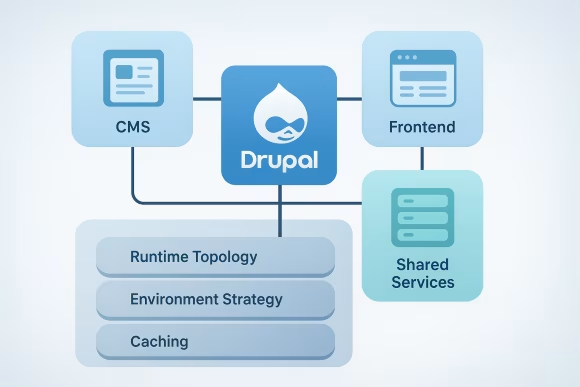
Define a Drupal-centric reference architecture that clarifies responsibilities across CMS, frontend, and shared services. Includes runtime topology, environment strategy, caching layers, and key non-functional requirements so teams can implement consistently across multiple sites and products.

Specify when to use traditional Drupal rendering versus decoupled delivery, and how to combine both safely. Covers routing, preview, personalization boundaries, and content delivery approaches for Next.js/React frontends without creating duplicated logic or inconsistent user experiences.
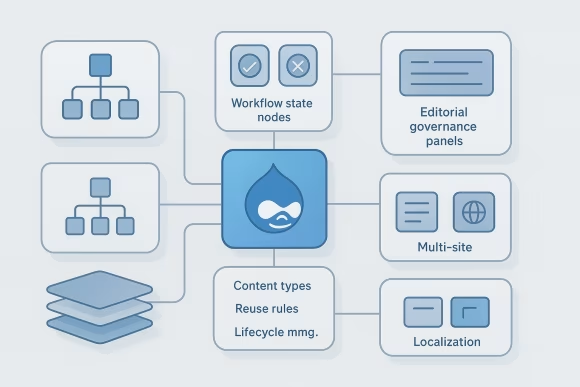
Establish content types, taxonomy, workflow states, and editorial governance aligned to channel needs. Defines modeling conventions, reuse rules, and lifecycle management to reduce content debt and support multi-site distribution and localization.
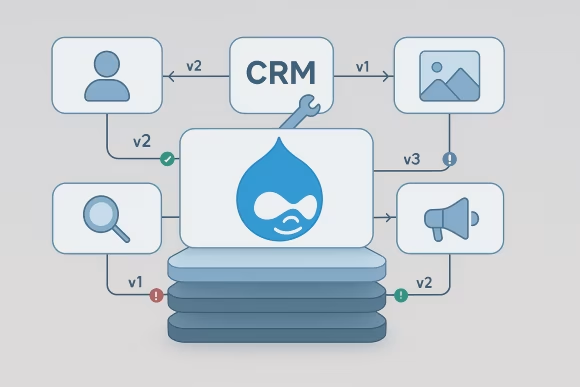
Design integration patterns for identity, CRM, DAM, search, analytics, and marketing tools. Defines API contracts, versioning, error handling, and data ownership to reduce coupling and make integrations testable and operable across environments.
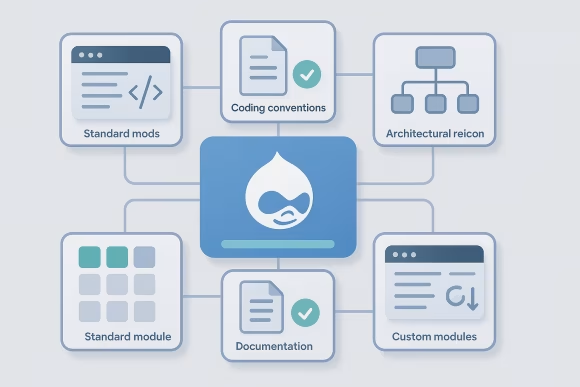
Create standards for Drupal core/contrib usage, custom module boundaries, coding conventions, and architectural decision records. Defines review processes and documentation expectations that prevent drift while still allowing teams to deliver independently.

Define security controls and operational requirements such as patching policy, access models, secrets management, and audit logging. Aligns platform design with enterprise compliance needs, including data handling, consent, and identity integration constraints.

Translate the target state into a phased plan that addresses upgrades, re-platforming, and deprecations. Includes dependency mapping, risk management, and sequencing guidance so delivery programs can evolve the platform without large-bang rewrites.
Use the health check to pinpoint where architecture, governance, and integration decisions are creating delivery friction and upgrade risk.
Engagements follow a clear engineering sequence from discovery through architecture definition, governance design, and roadmap validation with delivery teams. The focus is on producing executable strategy artifacts—reference architecture, a Drupal platform governance model, and an Enterprise Drupal DXP roadmap—that can be adopted incrementally and evolved over time.
[01]Review the current Drupal estate, delivery processes, and constraints. Collect architecture inputs, pain points, and operational signals (incidents, release frequency, upgrade history) to ground decisions in evidence.
 [02]
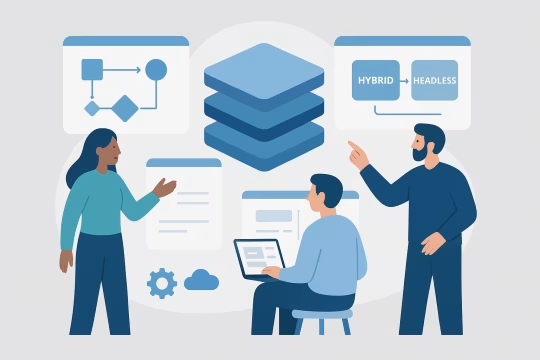
[02]Run structured sessions to define platform boundaries, non-functional requirements, and key patterns. Produce initial reference diagrams and decision options with trade-offs for hybrid and headless approaches.
 [03]
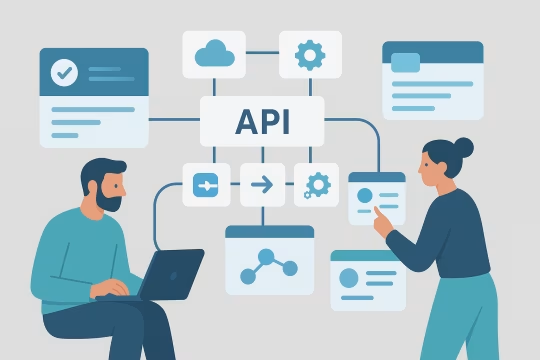
[03]Document the integration landscape and data flows across systems. Define ownership, API contracts, and operational requirements such as retries, rate limits, and observability for critical dependencies.
 [04]
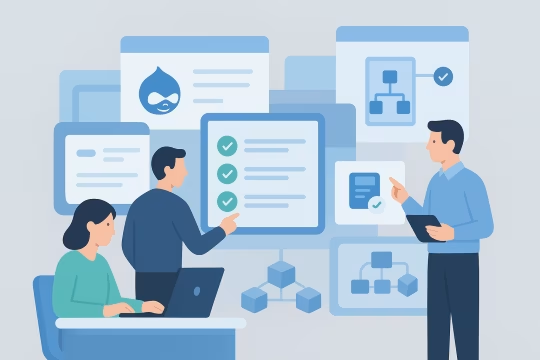
[04]Establish standards for Drupal core/contrib, custom development, and frontend integration. Define decision records, review gates, and documentation practices that scale across teams and vendors.
 [05]
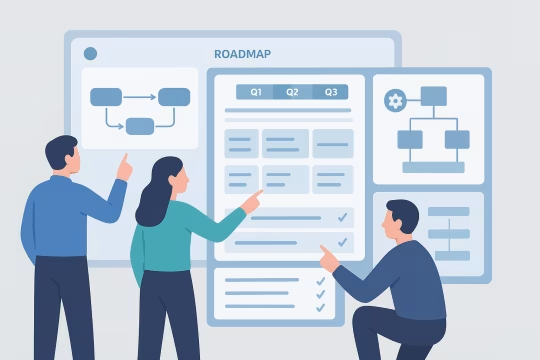
[05]Convert the target architecture into a phased roadmap with dependencies and sequencing. Provide backlog-level epics and acceptance criteria to support program planning and procurement where needed.
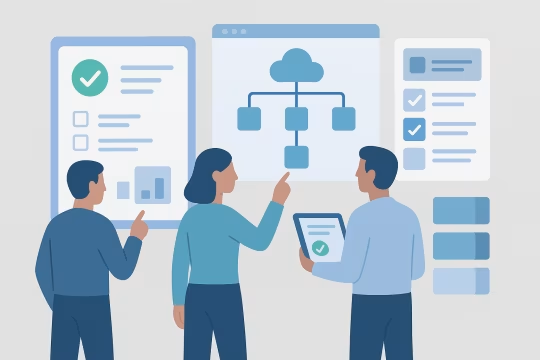 [06]
[06]Review the strategy with engineering and operations teams to confirm feasibility. Adjust patterns and sequencing based on delivery realities, and identify early pilot candidates to de-risk adoption.
 [07]
[07]Deliver architecture artifacts, governance templates, and planning outputs in reusable formats. Provide enablement sessions so teams can apply standards consistently and evolve the strategy through controlled change.
A clear Drupal experience platform strategy reduces platform ambiguity and creates a shared engineering direction across teams. It improves delivery predictability by standardizing integration patterns, a Drupal platform governance model, and lifecycle planning, while lowering operational risk through explicit security and compliance planning. For multi-site portfolios, this translates into more consistent implementations and a roadmap that is easier to execute and maintain.
Shared reference architecture and standards reduce time spent debating implementation approaches. Teams can reuse patterns for content modeling, integrations, and frontend delivery, improving throughput across a multi-site portfolio.
A planned lifecycle strategy reduces surprises during Drupal core upgrades and security patching. Clear dependency management and custom code boundaries make maintenance work more predictable and less disruptive.
Governance mechanisms and decision records keep implementations aligned as teams and vendors change. This limits divergence across sites and prevents long-term fragmentation that increases cost of change.
Defined API contracts, ownership, and operational requirements reduce integration failures and unclear responsibilities. Better observability and error-handling patterns improve stability across dependent systems.
Roadmap sequencing and reuse strategies reduce duplicated engineering effort across sites. Standardized patterns help avoid parallel solutions for identity, search, analytics, and content distribution.
Explicit security and compliance planning clarifies access models, audit requirements, and patching policies. This reduces operational exposure and supports enterprise governance expectations.
A phased plan with dependencies and risk controls improves planning accuracy. Programs can deliver incremental value while steadily moving toward the target state without large-bang re-platforming.
Before you commit the roadmap
Review how your Drupal architecture, operating model, and integration patterns support scale, change, and future upgrades.
Adjacent capabilities that extend Drupal DXP strategy into implementation, modernization, and operations across the platform lifecycle.
Roadmaps, governance model design, and platform decision frameworks
Enterprise Drupal DXP Architecture & Engineering
Designing Scalable Digital Foundations
Drupal content architecture design and editorial operating design
Entity modeling and durable data structures
Drupal editorial workflow engineering and permissions model design
Headless Drupal Development Services for API-First Front-Ends
One Platform. Multiple Brands. Infinite Scalability.
Drupal GA4 event tracking and enterprise instrumentation
Common questions from enterprise teams planning or evolving Drupal-based digital experience platforms, including architecture, operations, integrations, governance, risk, and engagement expectations.
We start by documenting the current-state topology (sites, environments, hosting, release process) and the surrounding ecosystem (identity, DAM, search, analytics, marketing tools). From there we define non-functional requirements that drive architecture decisions: performance targets, availability, compliance constraints, editorial workflows, and expected scale across sites and teams. The target architecture is expressed as a reference model rather than a single implementation diagram. It typically includes: platform boundaries (what Drupal owns vs what is delegated to frontend apps or shared services), content delivery patterns (rendered, headless, or hybrid), caching strategy, integration patterns, and environment strategy. We also define “decision rules” such as when to use Drupal theming vs Next.js, how to handle preview, and where business logic should live. Finally, we validate the target state against delivery realities: team topology, vendor involvement, and upgrade cadence. The goal is an architecture that is implementable incrementally, supports multi-site reuse, and reduces long-term maintenance risk.
The choice depends on channel requirements, performance constraints, editorial workflows, and the cost of operating multiple runtimes. Traditional rendering can be appropriate when Drupal is the primary web runtime and the team benefits from a single stack for routing, theming, and preview. Headless is often justified when multiple channels consume the same content, when frontend teams need independent release cycles, or when a modern frontend framework is required for product-like experiences. Hybrid approaches are common in enterprise portfolios: some experiences are served by Drupal (e.g., content-heavy sections), while others are delivered by Next.js/React (e.g., application-like journeys). The strategy defines clear boundaries so the platform doesn’t duplicate responsibilities. We address preview and authoring experience, routing ownership, caching layers, and where personalization or experimentation is implemented. A key output is a decision framework: criteria and trade-offs that teams can apply consistently, preventing ad-hoc choices that create long-term fragmentation.
We typically recommend an operating model that separates platform responsibilities from product delivery while keeping feedback loops tight. A platform team owns shared capabilities such as Drupal core lifecycle, CI/CD standards, security patching policy, baseline observability, and reference implementations. Product or site teams own feature delivery, content modeling within agreed constraints, and local integrations where appropriate. The model should define ownership and escalation paths for incidents, release coordination, and change approvals. It also needs a clear approach to managing contributed modules and custom code: who approves additions, how vulnerabilities are handled, and how deprecations are communicated across teams. For multi-vendor environments, we define interface points: coding standards, review gates, documentation expectations, and how architectural decisions are recorded. The goal is to reduce operational risk and avoid “shared responsibility gaps” that cause delays and production instability.
Upgrade planning starts with an inventory of the current platform: Drupal core version, contributed modules, custom modules, themes, and integration dependencies. We assess upgrade blockers (unsupported modules, custom patches, deprecated APIs) and identify where architectural changes are required rather than simple version bumps. The strategy defines a lifecycle policy: target support windows, patching cadence, and how upgrades are tested and rolled out across sites. For multi-site portfolios, we recommend aligning on a shared baseline and using reference implementations to reduce divergence. We also define how to manage technical debt: deprecation plans, module rationalization, and criteria for retiring legacy patterns. Finally, we translate this into a phased roadmap with sequencing and risk controls. That includes early work that reduces upgrade friction (test automation, CI/CD consistency, dependency management) so future upgrades become routine rather than disruptive programs.
We begin by mapping systems of record and systems of engagement: identity, CRM, DAM, search, analytics, marketing automation, and any commerce or product services. For each integration we define ownership, data contracts, latency expectations, and operational requirements such as retries, rate limits, and monitoring. The strategy specifies integration patterns suitable for the landscape: direct API calls, middleware/API gateway, event-driven messaging, or batch pipelines. We also define how secrets are managed, how environments are configured, and how integration failures are handled in user-facing journeys. A key focus is reducing coupling. We prefer stable contracts, versioning, and clear boundaries so that changes in one system don’t cascade into platform-wide incidents. The output is a set of patterns and guidelines that delivery teams can apply consistently across sites and features.
We define what Drupal exposes (content, navigation, configuration, personalization signals) and what the frontend owns (routing, rendering, client-side state). The API layer is designed around stable contracts that support caching and predictable performance. Depending on needs, this may involve REST, JSON:API, GraphQL, or a BFF layer that aggregates multiple upstream services. We address preview and draft content access early because it affects authentication, caching, and editorial workflows. We also define how to handle localization, multi-site content reuse, and media delivery (often involving a DAM or image transformation service). Operational considerations are part of the design: rate limiting, error handling, observability, and versioning. The goal is an API architecture that supports independent frontend delivery without creating hidden dependencies that make Drupal upgrades or content model changes risky.
Governance needs to be lightweight enough to be followed, but explicit enough to prevent drift. We typically produce a reference architecture pack (diagrams and patterns), coding and module standards (including criteria for contributed modules), and an architectural decision record (ADR) template with a process for review and approval. For content governance, we define modeling conventions, workflow rules, and ownership boundaries between central platform teams and site teams. For frontend integration, we define standards for component usage, routing ownership, and API contract management. We also recommend operational governance: release gates, security patching policy, and documentation expectations. The artifacts are designed to be used in delivery—e.g., as acceptance criteria in epics, checklists in pull request templates, and baseline requirements in vendor statements of work—so governance is embedded in execution rather than treated as separate documentation.
Preventing drift requires both technical and process controls. On the technical side, we recommend shared baselines: a reference distribution or shared modules, standardized CI/CD templates, and consistent environment configuration. Where feasible, we define reusable packages for integrations and shared services so teams don’t re-implement the same patterns differently. On the process side, we establish decision-making mechanisms: ADRs, architecture reviews for high-impact changes, and clear ownership for platform standards. We also define “allowed variation” so teams can move quickly without breaking platform consistency—for example, permitting local content types while enforcing shared taxonomy conventions or integration patterns. Finally, we set up feedback loops: regular platform health reviews, upgrade readiness checks, and metrics such as change failure rate and lead time. Drift becomes visible early, and remediation can be planned before it turns into a major rework program.
A common risk is producing a target architecture that is theoretically sound but not executable within the organization’s constraints. We mitigate this by grounding decisions in current-state evidence, validating assumptions with delivery teams, and explicitly documenting trade-offs and prerequisites. Another risk is over-committing to a single pattern (for example, “everything headless”) without considering editorial workflows, preview requirements, or operational complexity. We mitigate this by defining a decision framework and clear boundaries that support hybrid approaches where appropriate. A third risk is governance that is too heavy, leading teams to bypass it. We mitigate this by designing governance artifacts that integrate into delivery workflows: CI checks, templates, and acceptance criteria. Finally, we address dependency risk by mapping integrations and upgrade blockers early, ensuring the roadmap includes sequencing that reduces platform fragility before major migrations.
We start by identifying regulatory and organizational requirements: authentication and authorization model, audit needs, data classification, retention policies, and any constraints on hosting or third-party services. We then map these requirements to platform controls: access management, secrets handling, logging, patching cadence, and vulnerability management for Drupal core and contributed modules. For integrations, we define data ownership and flows, including where personal data is stored and processed. We also address consent and tracking requirements when analytics and marketing tools are involved, because these often affect frontend architecture and tag management. The strategy includes operational controls: incident response expectations, environment segregation, and release gates for security updates. The goal is not to “bolt on” security later, but to ensure the target architecture and operating model can meet compliance requirements without creating delivery bottlenecks or fragile manual processes.
Deliverables are designed to be executed by delivery teams. Typically this includes a current-state assessment summary, a target-state reference architecture (diagrams plus written patterns), and a decision framework for key choices such as headless vs hybrid, multi-site topology, and integration approaches. You should also expect governance artifacts: standards for Drupal core/contrib usage, custom code boundaries, documentation expectations, and an ADR process. For integrations, we provide an integration map and recommended patterns, including ownership and operational requirements. Finally, we deliver a phased roadmap with sequencing, dependencies, and risk controls. Where helpful, we translate roadmap items into backlog epics with acceptance criteria so the strategy can move directly into implementation planning. The emphasis is on clarity and usability: artifacts that reduce ambiguity and support consistent decisions over time.
We run strategy as a collaborative engineering process, not a detached review. Internal teams provide context on constraints, delivery realities, and operational pain points. Existing vendors often hold critical implementation knowledge, so we include them where appropriate to validate feasibility and surface hidden dependencies. We structure collaboration through workshops and focused interviews, then iterate on artifacts with review checkpoints. Decisions are documented transparently, including trade-offs and assumptions, so stakeholders can align without relying on informal knowledge. Where vendor boundaries exist, we define interface points: standards, review gates, and ownership for shared components and integrations. The goal is to produce a strategy that improves coordination across parties and can be adopted incrementally without disrupting ongoing delivery.
Success metrics should reflect both delivery performance and platform health. We typically define a small set of measurable indicators tied to the problems the strategy is addressing. Delivery metrics often include lead time for changes, deployment frequency, and change failure rate across sites. Platform health metrics can include upgrade readiness (dependency posture, module currency), incident volume related to platform components, and performance indicators such as cache hit rates or page-level latency targets. We also define governance adoption signals: percentage of changes using approved patterns, number of ADRs created for high-impact decisions, and consistency of CI/CD and environment configuration across sites. For content operations, metrics may include workflow cycle time, content reuse rates, and localization throughput. The strategy should include a baseline assessment and a plan for how metrics are collected (tooling, dashboards, ownership). This ensures the roadmap can be adjusted based on evidence rather than opinion.
We start by clarifying the portfolio model: how many sites, brands, regions, and languages are expected, and what level of autonomy each site needs. From there we define the multi-site topology (single codebase vs multiple, shared distribution vs shared modules) and the governance model that supports it. Content strategy is central: we define what content is shared, what is localized, and how reuse is managed across brands. We also address shared services such as identity, search, DAM, and analytics, because inconsistent integration approaches are a common source of drift in multi-site environments. Operationally, we define release coordination and upgrade strategy across sites, including how to roll out security updates and platform changes safely. The goal is to enable reuse where it reduces cost, while preserving enough flexibility for brands or regions to deliver independently within agreed constraints.
Collaboration typically begins with a short alignment phase to confirm scope, stakeholders, and the decisions the strategy must enable. We agree on the platform boundaries to assess (sites, environments, integrations), the constraints that must be respected (security, compliance, hosting, timelines), and the artifacts you need at the end (reference architecture, governance, roadmap). Next, we run a structured discovery sprint. This includes reviewing existing documentation and repositories where possible, interviewing key roles (CTO or architecture leadership, platform engineers, operations, product, and editorial leads), and mapping the integration landscape. We also collect operational signals such as incident themes, release cadence, and upgrade history. Within the first few weeks, we share an initial current-state assessment and a draft set of architectural options with trade-offs. This creates an early feedback loop and ensures the strategy is built with your teams, validated against delivery realities, and ready to translate into an executable roadmap.
These case studies showcase comprehensive Drupal platform modernization, governance, and multi-site strategies that align closely with Drupal Experience Platform Strategy. They highlight real-world delivery of scalable architectures, platform governance models, integration patterns, and migration roadmaps essential for enterprise Drupal DXPs. The selected work demonstrates measurable outcomes in platform stability, editorial governance, and scalable multi-site operations.
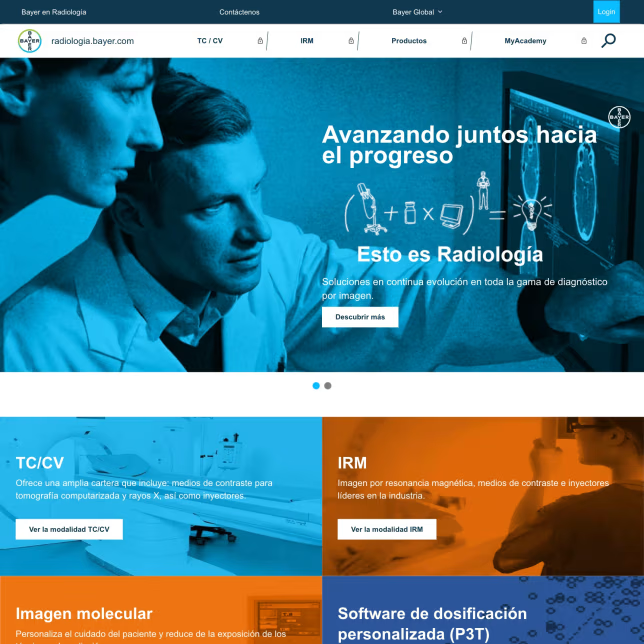
An advanced healthcare digital platform for LATAM was required to facilitate collaboration among radiology HCPs, distribute company knowledge, refine treatment methods, and streamline workflows. The solution needed secure medical website role-based access restrictions based on user role (HCP / non-HCP) and geographic region.
The platform enhanced collaboration, streamlined workflows, and empowered radiology professionals with advanced tools to gain insights and optimize patient care.
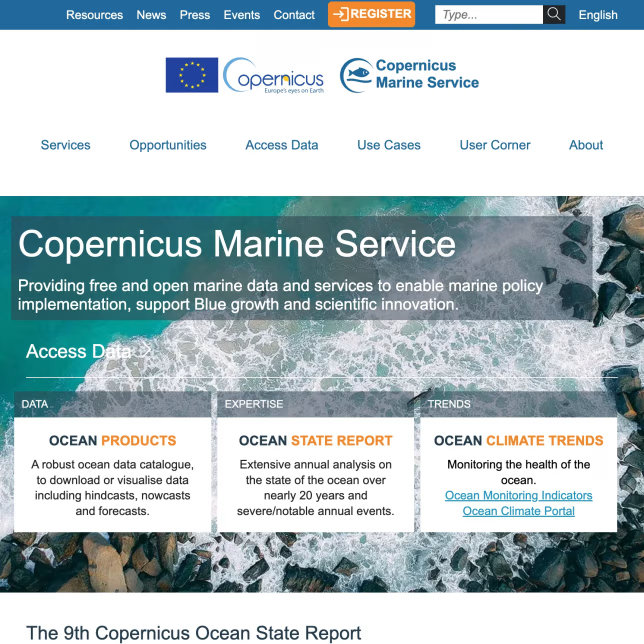
The existing marine data portal relied on three unaligned WordPress installations and embedded PHP code, creating inefficiencies and risks in content management and usability.
The new Drupal DXP streamlined content operations and improved accessibility, offering scientists and businesses a more efficient gateway to marine data services.
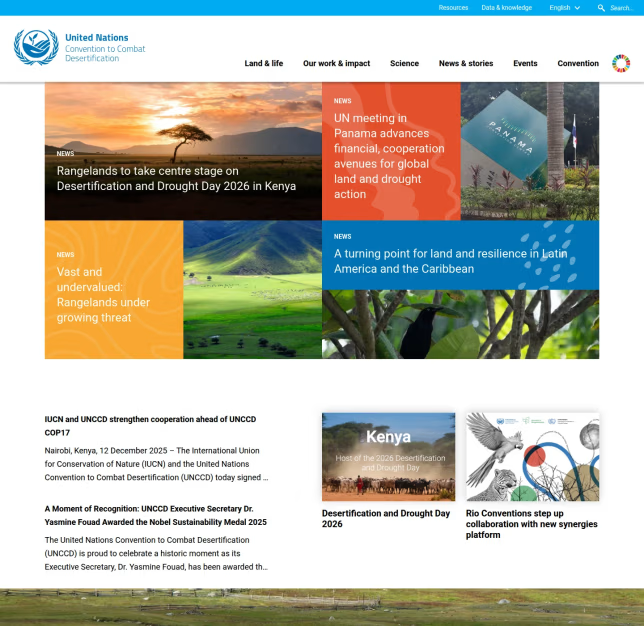
UNCCD operated four separate websites (two WordPress, two Drupal), leading to inconsistencies in design, content management, and user experience. A unified, scalable solution was needed to support a large-scale CMS migration project and improve efficiency and usability.
The modernization effort resulted in a cohesive, user-friendly, and scalable website, improving content management efficiency and long-term digital sustainability.
With Drupal 7 reaching end-of-life, Veolia needed a Drupal 7 to Drupal 10 enterprise migration for its Acquia Site Factory multisite platform—preserving region-specific content and multilingual capabilities across more than 200 sites.
The platform was modernized into a stable, scalable multisite foundation with improved performance, maintainability, and long-term upgrade readiness.
It was my pleasure working with Oleksiy (PathToProject) on a new Drupal website. He is a true full-stack developer—the ideal mix of DevOps expertise, deep front-end knowledge, and the structured thinking of a senior back-end developer.
He is well-organized and never lets anything slip. Oleksiy understands what needs to be done before being asked and can manage a project independently with minimal involvement from clients, product managers, or business analysts.
One of the best consultants I’ve worked with so far.

Andrei Melis
Technical Lead at Eau de Web
Oleksiy (PathToProject) and I worked together on a Digital Transformation project for Bayer LATAM Radiología. Oly was the Drupal developer, and I was the business lead. His professionalism, technical expertise, and ability to deliver functional improvements were some of the key attributes he brought to the project.
I also want to highlight his collaboration and flexibility—throughout the entire journey, Oleksiy exceeded my expectations.
It’s great when you can partner with vendors you trust, and who go the extra mile.

Axel Gleizerman Copello
Building in the MedTech Space | Antler
Oleksiy (PathToProject) is demanding and responsive. Comfortable with an Agile approach and strong technical skills, I appreciate the way he challenges stories and features to clarify specifications before and during sprints.

Olivier Ritlewski
Ingénieur Logiciel chez EPAM Systems
These articles expand on the architecture, governance, and migration decisions that shape an enterprise Drupal experience platform. They cover multisite standardization, upgrade planning, content and media governance, and the frontend and caching boundaries that affect long-term maintainability.
Let’s review your current Drupal estate, define a target architecture, and produce a roadmap and governance model your teams can execute incrementally.