In enterprise Drupal platforms, search problems are often framed as relevance issues, indexing failures, or performance bottlenecks. But one of the more persistent and underdiagnosed risks is simpler: the search layer and the access model stop agreeing.
That is the core of Drupal search access drift. Over time, permissions change, editorial workflows evolve, content states multiply, and integration assumptions harden inside indexing pipelines. Search may still run. The index may still complete successfully. Queries may still return results. Yet what users see in search can gradually diverge from what they are actually allowed to access.
This is not always a dramatic security incident, and it is not always a pure outage. More often, it presents as a credibility problem for the platform:
- editors cannot find content they know exists
- internal users see stale or incomplete result sets
- restricted content becomes discoverable in metadata or snippets
- customer service or sales teams lose trust in search behavior
- governance teams struggle to explain why visibility differs across channels
In multi-team environments, drift happens because no single team owns the full chain from content state to rendered result. Editorial teams manage workflow. Platform teams adjust roles and permissions. Search engineers tune schemas and indexing logic. Operations teams monitor jobs and infrastructure. Each change can be reasonable on its own, while the combined effect quietly breaks visibility expectations.
Why search access problems are usually discovered late
Access drift tends to surface late because standard operational signals do not catch it well.
A successful indexing run only proves that documents were processed. It does not prove that the right users will see the right documents at the right time. Likewise, application smoke tests may confirm that a content page respects Drupal permissions while never testing whether that page should have been indexed, removed, or filtered in search.
There are a few reasons these issues often remain hidden:
- Search is an abstraction layer. Users interact with a result set, not the underlying access evaluation. A wrong result may look plausible.
- Permissions are cumulative and contextual. Drupal access can depend on roles, content type, moderation state, publication state, language, or custom business rules.
- Indexing pipelines simplify reality. To improve performance, search systems often flatten access assumptions into fields or flags that are only as accurate as the rules used to generate them.
- Testing is usually role-light. Teams may test anonymous and admin experiences, but not the many real-world roles in between.
- Failures are asymmetrical. Overexposure and underexposure do not create the same urgency. Missing results may be misdiagnosed as search quality issues, while limited overexposure may hide in internal use cases for a long time.
The result is a class of problem that can survive for months because every component appears healthy when inspected in isolation.
How Drupal permissions and search indexes fall out of sync
Drupal is flexible enough to support sophisticated access models, but that flexibility is exactly why alignment with search requires discipline.
At a high level, the search pipeline often makes a series of assumptions:
- which content items qualify for indexing
- which fields are safe to expose in the index
- which audiences can discover each document
- when documents must be updated or removed
- how result filtering should behave for authenticated and anonymous users
Drift occurs when those assumptions no longer match Drupal's current access behavior.
For example, a platform may initially index all published content and use a simple anonymous-versus-authenticated model. Later, the organization introduces new audience roles, moderation exceptions, or region-specific visibility rules. If the index still relies on the old model, search can start returning content under rules that no longer exist in Drupal, or fail to return content that is now valid for specific audiences.
This problem can emerge in either direction:
- Overexposure: a document is indexed or returned to a user segment that should not discover it
- Underexposure: a document is excluded, filtered out, or left stale even though the intended audience should be able to find it
Both matter. Overexposure raises governance and trust concerns. Underexposure damages findability, editorial confidence, and business usefulness. In enterprise CMS environments, the second issue is often more common, but the first is usually more sensitive.
Search stacks such as Solr or Elasticsearch do not create this drift on their own. The issue sits in the governance and translation layer between Drupal's access logic and the indexed representation of that logic.
Common drift patterns in workflows, roles, and content states
The most common forms of drift are not exotic. They usually arise from normal platform change.
Role model expansion
A site may begin with a small role model and later add partner, regional, subscriber, or internal audience roles. Search indexing logic that originally stored a coarse access flag can become inadequate once visibility depends on combinations of roles or derived entitlements.
Typical symptom: pages render correctly when accessed directly, but search results appear inconsistent across user groups because indexed access fields were never updated to reflect the new role model.
Workflow state complexity
Drupal editorial workflows often become more nuanced over time. Content may move through draft, in review, approved, scheduled, archived, or legally held states. Teams sometimes assume only "published" and "unpublished" matter for search, but operational workflows frequently introduce exceptions.
Typical symptom: content in special moderation states remains searchable when it should be hidden, or disappears because the indexing rules do not understand an approved-but-not-yet-public state.
Unpublished and scheduled content edge cases
Many teams think of unpublished content as simple non-searchable content. In practice, there may be internal previews, staged launches, scheduled publishing, or synchronization delays across environments and queues.
Typical symptom: search results temporarily expose titles or snippets from content that was scheduled, reverted, or unpublished, because deindexing was delayed or conditional logic was incomplete.
Field-level assumptions
Even when document-level access is correct, the index may contain fields that should not have been included for certain audiences. Summary text, taxonomy terms, attachments, or internal labels can reveal more than intended if they are indexed without the same governance applied to rendered pages.
Typical symptom: a restricted document is not directly accessible, but enough metadata is exposed in search results to create confusion or governance risk.
Custom access logic outside core publishing rules
Enterprise Drupal implementations often add business-specific access rules through custom modules, integrations, or middleware. Search implementations can drift if those rules are not reflected in indexing and query-time filtering.
Typical symptom: content behaves correctly in page requests because custom access checks run there, but search results ignore those checks because the index only captured baseline publication status.
Incremental indexing blind spots
Some changes affect content visibility without modifying the content entity in ways that trigger reindexing. Role updates, taxonomy permission changes, inherited access rules, or external entitlement changes may alter who should see a document while leaving the indexed document untouched.
Typical symptom: the platform appears stable until a permission model update suddenly causes broad visibility mismatches that only a full audit or reindex uncovers.
Validation checks beyond 'the index completed successfully'
If access drift is a real risk, validation has to go beyond operational job status.
A mature validation approach checks whether search behavior still matches Drupal's intended access model. That requires tests that are audience-aware, state-aware, and lifecycle-aware.
A practical validation set often includes the following.
Role-based search result testing
Test representative search queries across meaningful user roles, not just anonymous and administrator accounts. The goal is not exhaustive permutation testing for every account, but coverage of the actual audience model.
Useful checks include:
- whether expected content appears for a role that should see it
- whether restricted content is absent for a role that should not discover it
- whether result counts materially differ from baseline expectations after permission changes
- whether snippets and metadata remain appropriate even when the document itself is filtered
State transition testing
Search validation should include content moving through real workflow transitions.
Examples:
- published to unpublished
- review to approved
- scheduled to live
- live to archived
- role-restricted to broadly visible
The key question is not only whether the page access changes, but whether the index updates quickly and correctly enough to reflect the new state.
Direct-access versus search-discovery comparison
A valuable control is comparing page access with search discoverability. If a user can access a page directly but cannot find it in search, or can find it in search but cannot legitimately access it, that mismatch is a strong signal of drift.
This comparison is especially important for enterprise knowledge bases, documentation hubs, and authenticated portals where discoverability is part of the product experience.
Indexed field review
Validation should inspect which fields are actually stored or returned by the search system. Teams sometimes focus only on whether a document is present, while overlooking what its indexed payload contains.
Review:
- titles and summaries
- tags and categories
- attachment text or extracted body content
- hidden administrative labels
- internal-only descriptors copied from source fields
Event coverage review
Not every access-relevant change is a content edit. Validation should ask whether the pipeline reacts to permission changes, workflow configuration updates, or external entitlement changes that may require reindexing or cache invalidation.
This is where search index access control becomes a platform operations concern rather than just a search feature.
Recovery patterns for reindexing, access testing, and governance repair
Once drift is found, the right recovery pattern depends on the source of the mismatch. The response should repair both the current index and the process that allowed the gap.
1. Reconstruct the visibility model
Start by documenting how visibility is supposed to work now, not how it worked when the search implementation was originally designed.
That means identifying:
- relevant roles and audience segments
- content states that affect discoverability
- custom access rules and exceptions
- fields that are safe or unsafe to expose in search
- whether access is enforced at index time, query time, or both
Without a current visibility model, teams can fix symptoms while leaving the underlying mismatch intact.
2. Audit indexed documents against policy
Sample high-risk content types and compare source state to indexed representation. Look for documents that should be excluded, documents missing expected access markers, and fields that no longer meet governance expectations.
This audit is often more useful than immediately tuning relevance or query syntax, because it tells you whether the search corpus itself is trustworthy.
3. Trigger the right reindex strategy
Not every issue requires a full rebuild, but some do. If access-related fields or filtering logic changed structurally, incremental repair may leave stale documents behind.
Reindex decisions typically depend on:
- whether the schema or document model changed
- whether access flags were historically incorrect
- whether the triggering event coverage was incomplete
- whether stale documents may persist outside normal update paths
In Drupal Solr governance or Drupal Elasticsearch indexing programs, the governance question is as important as the technical one: what conditions require a full reindex, who approves it, and how is search quality validated afterward? That is usually where Drupal Search Architecture and Search Platform Integration decisions need to be aligned rather than treated as separate workstreams.
4. Add role-aware regression checks
Recovery should produce durable tests. If a platform has already experienced access drift, manual spot checks are not enough.
Useful regression practices include:
- test accounts aligned to real audience groups
- saved validation queries for critical content types
- pre-release checks after workflow or permission changes
- post-reindex audits for representative restricted and public content
- monitoring alerts for unusual shifts in document counts by category or audience marker
5. Repair ownership boundaries
Many drift issues are organizational before they are technical. A search engineer may not be notified when editorial governance changes. A platform owner may approve a new role structure without considering indexing consequences. Operations may monitor job failures but not visibility integrity.
Recovery is stronger when ownership is explicit:
- who owns the visibility model
- who reviews access-affecting changes
- who decides reindex scope
- who validates audience-specific search outcomes
- who signs off after governance changes
In practice, this is also where Drupal Governance Architecture becomes inseparable from search reliability.
Operating rules to keep search visibility aligned over time
Preventing drift is less about a single perfect configuration and more about operational discipline. Enterprise Drupal teams benefit from a small set of durable rules.
Treat search visibility as a governed output
Search is not just a technical mirror of content storage. It is a governed publishing surface. If content can be discovered through search, that visibility should be treated with the same seriousness as page delivery.
Design for change in the access model
Role structures, workflows, and governance rules almost always evolve. Indexing logic should assume change rather than encode a one-time understanding of permissions.
This often means preferring explicit, reviewable access mappings over hidden assumptions spread across custom code and pipeline configuration.
Define what triggers revalidation
Certain changes should automatically trigger search validation, even if indexing jobs look healthy. Examples include:
- new roles or audience segments
- workflow state additions or renames
- changes to moderation policy
- new restricted content types
- updated field exposure rules
- external entitlement or SSO mapping changes
Separate relevance tuning from access integrity
Teams often blend these concerns because both show up as "search issues." But access integrity should be evaluated first. A highly relevant result set is still broken if it is returning the wrong corpus to the wrong audience.
This distinction helps keep enterprise Drupal search architecture focused on trust before optimization.
Monitor for drift, not just failure
Operational monitoring should look for signs of content visibility drift, not merely infrastructure outages. Depending on the platform, that can include:
- sudden changes in indexed counts for sensitive content types
- divergence between published counts and searchable counts
- unexplained spikes in zero-result searches for authenticated users
- abnormal differences between audience segments after releases
These are indirect signals, but they help detect quiet degradation earlier.
Keep governance documentation current
A search implementation that depends on tribal knowledge will eventually drift. The platform should maintain living documentation for:
- visibility rules by content type and audience
- index inclusion and exclusion rules
- field-level indexing decisions
- reindex triggers and playbooks
- validation procedures after governance changes
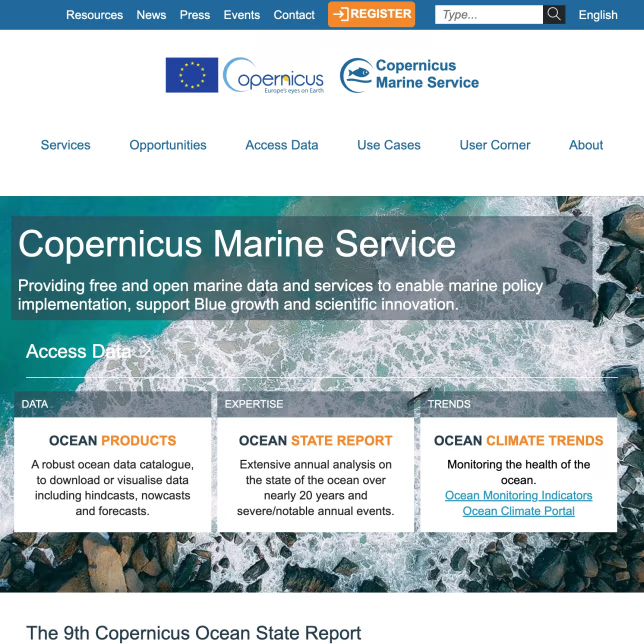
This is especially important in multi-team environments where responsibilities span editorial governance, Drupal architecture, and platform operations. Large, access-sensitive Drupal programs such as Copernicus Marine Service show how search, SSO, and publishing governance can become tightly coupled over time.
Drupal search reliability is not only about whether an index runs or whether a query feels relevant. It is also about whether search and access control continue to describe the same reality.
That alignment can weaken slowly as teams change roles, workflows, integrations, and assumptions. When it does, the platform starts producing search experiences that are technically functional but operationally misleading. Some users lose access to content they should find. Others discover content in ways the governance model did not intend.
The practical response is not alarmism. It is disciplined visibility governance: define the access model clearly, translate it deliberately into the index, validate it across real user contexts, and revisit it whenever platform change occurs. In large Drupal environments, that is what keeps search trustworthy over time.
Tags: Drupal, Enterprise CMS, Search Architecture, Drupal Search, Governance, Solr, Elasticsearch, Access Control