



 [01]
[01]Discovery and Audit
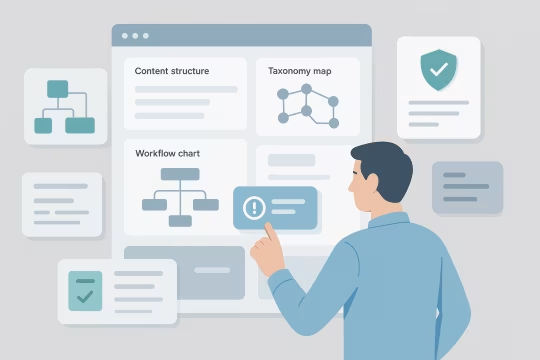
Assess current content structures, taxonomy usage, workflows, and editorial pain points. We inventory integrations and consumers to understand schema constraints and identify high-risk coupling to existing models.
Drupal content architecture
Run a Drupal health check to uncover taxonomy drift, workflow gaps, API structure issues, and upgrade blockers before you commit to architecture changes.
Built for teams reviewing governance, integration readiness, and model evolution in Drupal.
No login required. Takes 2–3 minutes.
Drupal content architecture design defines how content types, fields, relationships, taxonomy, and editorial workflows work together as an operating system for publishing. It turns business concepts into structured models that can be validated, reused, searched, translated, and delivered consistently across pages, channels, and products. For enterprise teams, this is the foundation for structured content strategy for Drupal platforms and reliable API delivery.
As Drupal platforms grow, content often accumulates as one-off types, inconsistent field semantics, duplicated taxonomies, and ad-hoc workflows. This increases editorial friction, makes integrations brittle, and forces engineering teams to encode business rules in templates and custom code. A clear content architecture reduces ambiguity, supports governance, and keeps the platform evolvable.
We design content models and enterprise editorial architecture in Drupal that align information architecture with implementation constraints: entity relationships, revisioning, moderation, permissions, multilingual needs, and GraphQL/REST delivery patterns. The result is a platform foundation that supports scalable authoring, predictable integrations, and long-term maintainability across teams.
Core Focus
Best Fit For
Key Outcomes
Technology Ecosystem
Delivery Scope
As Drupal platforms expand, content structures often evolve through incremental requests rather than deliberate modeling. Teams add new content types for each initiative, reuse fields with different meanings, and create overlapping taxonomies to meet immediate publishing needs. Over time, the platform accumulates inconsistent semantics, unclear ownership, and content that cannot be reliably reused across sites, languages, or channels.
These issues surface as architectural friction. Search and personalization become difficult because metadata is incomplete or inconsistent. Integrations depend on unstable field names and ad-hoc transformations, increasing coupling between Drupal and downstream systems. Frontend teams compensate by hardcoding assumptions in templates or API consumers, which makes redesigns and headless delivery more expensive. Editorial operations suffer from confusing forms, unclear workflow states, and permission models that do not reflect real responsibilities.
Operationally, the platform becomes harder to change safely. Small model adjustments can trigger migration complexity, content regressions, and broken integrations. Governance becomes reactive, and delivery slows as teams negotiate exceptions instead of relying on shared structures and rules.
Review existing content types, fields, taxonomies, workflows, and editorial pain points. We map current usage, identify duplication and semantic conflicts, and capture constraints such as multilingual, compliance, and integration requirements.
Translate business concepts into a domain model and information architecture. We define content boundaries, shared entities, and relationships, and establish naming conventions and field semantics that can be governed over time.
Design target content types, reference patterns, taxonomy vocabularies, and metadata standards. We validate the model against key journeys, search and filtering needs, and API delivery scenarios to avoid template-driven modeling.
Define moderation states, transitions, roles, and responsibilities aligned to editorial operations. We design permission boundaries that support delegation, review, and auditability without creating bottlenecks or excessive administrative overhead.
Implement the model using Drupal configuration: content types, fields, entity reference settings, vocabularies, form/display modes, and moderation configuration. We ensure configuration is environment-safe and compatible with CI/CD workflows.
Align the model with GraphQL/REST exposure, serialization rules, and integration contracts. We define stable identifiers, predictable shapes, and versioning considerations to reduce coupling for consumers and downstream systems.
Validate model behavior with representative content, editorial scenarios, and permission tests. We check revisioning, translations, moderation transitions, and edge cases such as archiving, redirects, and content lifecycle rules.
Establish rules for introducing new types, fields, and taxonomy terms, including review checkpoints and documentation. We define a change process that supports iterative evolution without breaking integrations or creating long-term model drift.
This service focuses on Drupal content architecture design: a structured, governable foundation that remains stable as teams, sites, and channels grow. We emphasize clear semantics, explicit relationships, Drupal taxonomy architecture, and enterprise editorial workflow architecture that reflects real operations. The model supports API delivery, search and filtering, multilingual publishing, and predictable change management aligned to Drupal configuration management.
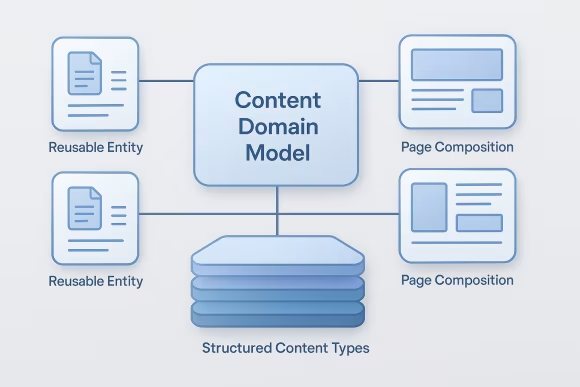
Define a domain model that separates reusable entities from page composition. We design content types and shared entities with clear boundaries, stable identifiers, and explicit relationships so content can be reused across sites and channels without duplicating structures or embedding business rules in templates.
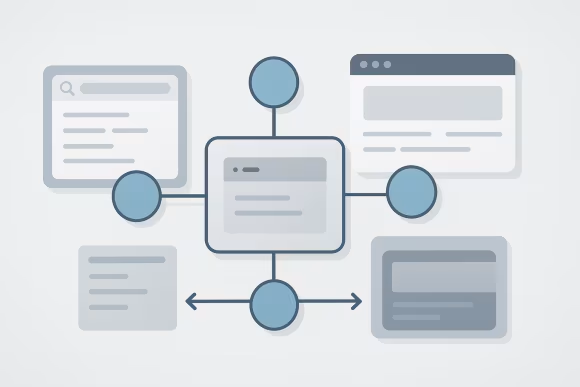
Implement reference patterns that scale: entity references, paragraphs or component-like structures where appropriate, and controlled cardinality rules. We design for maintainable querying and rendering, avoiding deep nesting and ambiguous relationships that make migrations, APIs, and editorial UX fragile.
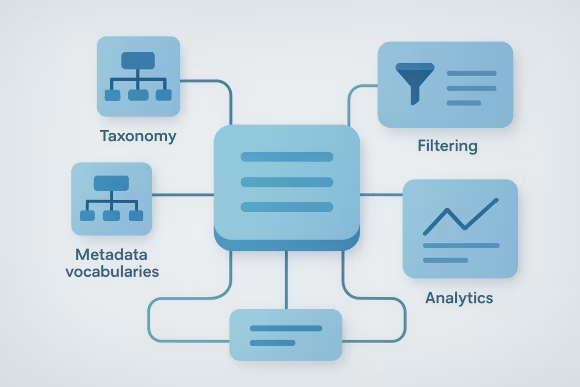
Design vocabularies, term hierarchies, and tagging rules that support navigation, filtering, search, and analytics. We reduce overlap between vocabularies, define governance for term lifecycle, and ensure metadata is consistent enough to drive downstream systems and personalization logic.
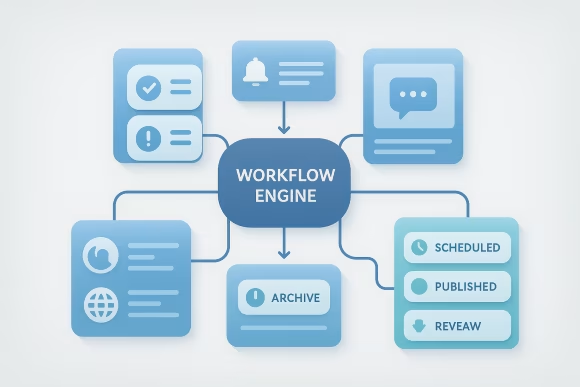
Configure moderation states, transitions, and notifications aligned to editorial roles and compliance needs. We design workflows that support review and auditability while keeping throughput predictable, including multilingual review patterns, scheduled publishing, and content lifecycle states such as archive and retire.
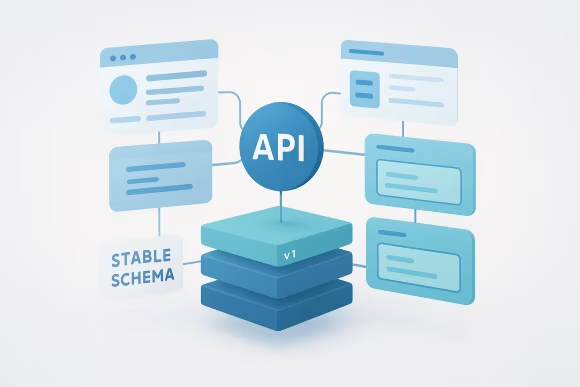
Shape content models for GraphQL and REST consumption with predictable, stable schemas. We define exposure rules, normalization patterns, and versioning considerations so consumers can rely on consistent payloads while the platform evolves through controlled, backward-compatible changes.
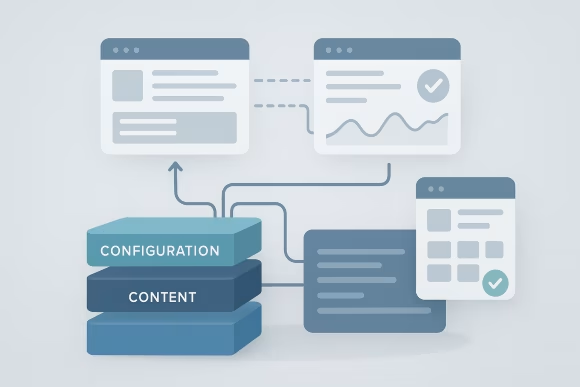
Implement content architecture using Drupal configuration management with clear separation of config and content. We design for repeatable deployments, reduce configuration drift across environments, and ensure model changes can be reviewed, tested, and promoted through CI/CD pipelines.
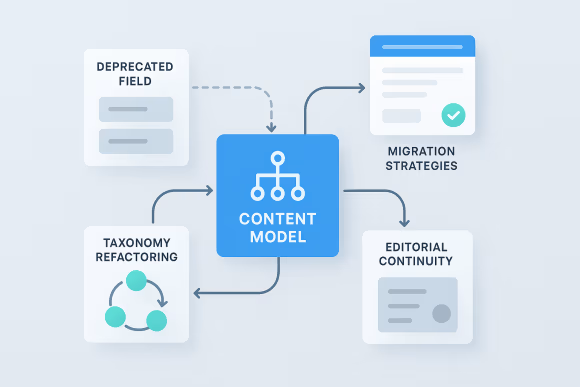
Plan model changes with migration and refactoring in mind, including deprecation paths for fields and taxonomies. We define strategies for content backfills, redirects, and data transformations so the platform can evolve without breaking editorial operations or integration contracts.
Identify the highest-risk content architecture problems affecting governance, integrations, and future Drupal upgrades so your team can prioritize fixes with confidence.
Delivery follows a clear engineering sequence—from discovery and current-state audit through Drupal content architecture design, implementation, and validation—so the resulting model is usable in day-to-day editorial operations. We align Drupal content modeling, taxonomy, workflows, and API contracts with configuration management and a practical plan for ongoing evolution.
[01]Assess current content structures, taxonomy usage, workflows, and editorial pain points. We inventory integrations and consumers to understand schema constraints and identify high-risk coupling to existing models.
 [02]
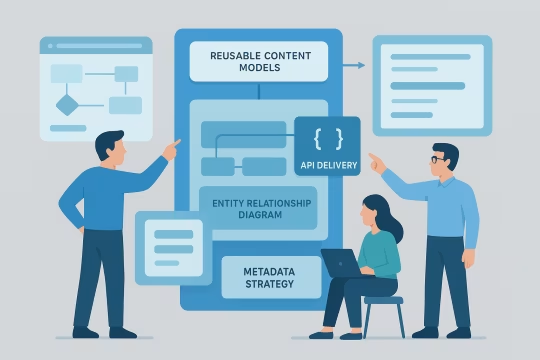
[02]Define the target content domain model, entity relationships, and metadata strategy. We produce a model that supports key journeys, reuse scenarios, and API delivery requirements without overfitting to current templates.
 [03]
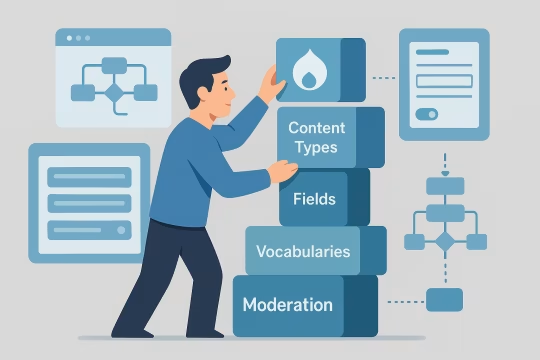
[03]Implement content types, fields, vocabularies, display/form modes, and moderation configuration in Drupal. We align implementation with configuration management practices to support repeatable deployments across environments.
 [04]
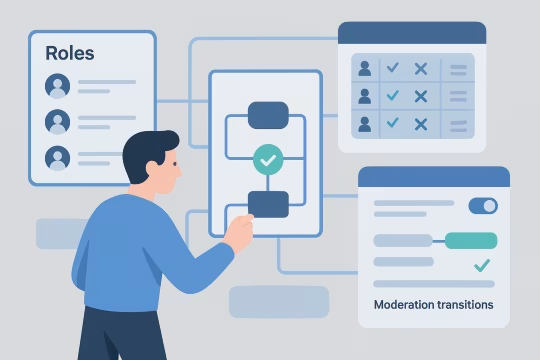
[04]Configure roles, permissions, and moderation transitions to match editorial responsibilities. We validate that the workflow supports real operational paths, including multilingual publishing and review/audit requirements.
 [05]
[05]Validate GraphQL/REST exposure, serialization rules, and consumer expectations. We define stable identifiers and payload shapes, and document constraints to reduce downstream breakage during future model changes.
 [06]
[06]Run scenario-based validation with representative content and editorial users. We test moderation paths, translation behavior, revisioning, and edge cases such as archiving, redirects, and content lifecycle rules.
 [07]
[07]Deliver model documentation, naming conventions, and decision records. We establish a lightweight governance process for approving new fields, types, and taxonomy changes with clear ownership and review checkpoints.
 [08]
[08]Support iterative improvements after initial rollout, including refactoring and deprecation planning. We help teams manage model changes safely through migration scripts, backfills, and controlled API/schema evolution.
A well-designed Drupal content architecture reduces platform friction and makes change safer across enterprise teams. Clear Drupal content modeling and Drupal taxonomy architecture improve editorial throughput, stabilize GraphQL/REST integrations, and create a reusable foundation for multi-site and omnichannel delivery without accumulating avoidable model debt.
Clear content structures and workflows reduce time spent navigating forms and resolving ambiguity. Editorial teams can publish consistently with fewer exceptions and less manual coordination across roles.
Stable content semantics and predictable API shapes reduce coupling between Drupal and consuming systems. Downstream teams spend less time handling edge cases caused by inconsistent fields and overlapping taxonomies.
Reusable entities and governed metadata reduce the need to create new content types for each initiative. Teams can extend the platform through controlled evolution rather than repeated restructuring.
Shared models and taxonomy governance support consistent experiences across sites while allowing controlled variation. This reduces divergence that typically increases maintenance and complicates cross-site reporting.
Structured metadata and consistent tagging improve filtering, navigation, and internal search relevance. This also enables more reliable analytics and segmentation based on content attributes.
Configuration-managed models and documented evolution paths reduce risk when introducing new fields or refactoring structures. Teams can test and deploy changes with clearer impact analysis and rollback options.
A deliberate model reduces one-off structures and template-driven exceptions that become hard to maintain. Engineering effort shifts from patching inconsistencies to building platform capabilities.
Drupal architecture readiness
Use a Drupal health check to validate content structure, governance controls, and integration readiness before redesign, migration, or model expansion work begins.
Related services that extend Drupal content architecture design into adjacent platform concerns—governance, multisite, headless delivery, search, and API implementation—when the content model needs to scale across more teams, sites, and integrations.
Designing Scalable Digital Foundations
Entity modeling and durable data structures
Drupal editorial workflow engineering and permissions model design
Headless Drupal Development Services for API-First Front-Ends
One Platform. Multiple Brands. Infinite Scalability.
Scalable indexing and relevance design
Drupal API development services for secure integration layers
Drupal event tracking architecture, identity, and audience sync engineering
Drupal GraphQL schema design and schema-first integration
Answers to common questions about Drupal content architecture design, including Drupal content modeling and taxonomy design, enterprise editorial workflow architecture in Drupal, integration contracts (GraphQL/REST), governance, risk, and engagement approach.
We start from the domain model: what is a durable business concept that should exist independently (for example, a person, location, product, or policy), and what is a presentation or page composition concern. Reusable entities are appropriate when the concept is referenced in multiple contexts, needs its own lifecycle, or must be queried independently for APIs, search, or reporting. We then evaluate Drupal-specific constraints: revisioning and moderation needs, translation behavior, access control boundaries, and how the entity will be rendered across channels. If a concept is mostly a layout container with limited reuse, we typically avoid creating a standalone entity and instead use a composition pattern that remains governable. Finally, we validate the choice against operational cost. Too many content types increases training and maintenance overhead; too few can create overloaded types with ambiguous fields. The goal is a model that is explicit enough for governance and integration, but not so granular that it becomes difficult to operate.
We treat page composition as a controlled assembly problem rather than an unbounded nesting problem. In Drupal, deep nesting can make editorial UX difficult, increase rendering complexity, and create API payloads that are hard to version. We design composition with clear limits: constrained component sets, explicit cardinality rules, and predictable reference patterns. Where component-like structures are needed, we define a small number of composition patterns and document when each is allowed. We also separate reusable content from layout containers so that content can be referenced across pages without copying. For API delivery, we ensure that composed structures can be queried efficiently and that consumers can handle optionality without complex conditional logic. We validate the design with representative pages and editorial scenarios, including translation and moderation. If a structure becomes too flexible to govern, we tighten the model by introducing stronger types, reducing nesting depth, or moving certain concerns to the frontend where appropriate.
We begin by mapping the editorial operating model: roles, responsibilities, handoffs, review requirements, and the content lifecycle (draft, review, legal/compliance, publish, update, retire). We then translate that into Drupal moderation states and transitions, ensuring each transition has a clear owner and that permissions reflect actual accountability. We pay attention to operational bottlenecks. Overly strict workflows can slow publishing; overly permissive workflows can reduce auditability. We design workflows that support parallel work (for example, content editing while media is being finalized) and that handle common exceptions such as urgent updates or partial translations. We also validate workflow behavior in the platform: revisioning rules, scheduled publishing, notifications, and how moderation interacts with preview environments. The output is a workflow that is enforceable in Drupal, understandable to editors, and maintainable as teams and governance requirements evolve.
We treat multilingual as a first-class modeling constraint, not an add-on. We decide which entities and fields are translatable, which are shared across languages, and how references behave when translations are missing. This includes defining fallback behavior and editorial rules for when content can be published with partial translations. We also design taxonomy and metadata with localization in mind. Some vocabularies require translation; others may be language-neutral identifiers with localized labels. We document these decisions because inconsistent handling of taxonomy translation is a common source of editorial confusion and integration errors. Operationally, we align moderation workflows with translation workflows: who triggers translation, who reviews localized content, and how updates propagate across languages. We validate the model with real scenarios such as updating a shared entity referenced by multiple pages, and we ensure API consumers can reliably determine language availability and content completeness.
Stability comes from clear semantics and controlled change. We define canonical identifiers for entities and fields, avoid overloading fields with multiple meanings, and design relationships so consumers can traverse content predictably. For GraphQL, we consider query shapes and ensure the schema reflects durable concepts rather than page-template artifacts. We also define exposure rules: which fields are public, which are internal, and how to represent optional or conditional data. Where consumers require a simplified shape, we prefer explicit view models or well-defined endpoints rather than ad-hoc transformations embedded in multiple clients. For change management, we establish a versioning and deprecation approach. Instead of renaming or repurposing fields, we introduce new fields, backfill content, and deprecate old fields with a documented timeline. This reduces breaking changes and keeps integrations maintainable as the platform evolves.
We start by identifying the dimensions required for reporting and activation: content categories, topics, audiences, regions, lifecycle states, and any compliance-related attributes. We then design taxonomy and metadata so those dimensions are captured consistently, with controlled vocabularies and clear tagging rules. We avoid creating analytics-only fields that editors cannot maintain reliably. Instead, we design metadata that serves editorial and user-facing needs while also being exportable to analytics pipelines. We define which attributes must be mandatory, which can be inferred, and which require governance review. On the integration side, we document mappings from Drupal fields and taxonomy terms to analytics events or CDP schemas. This includes stable identifiers for terms, handling of term renames, and strategies for historical continuity in reporting when taxonomy evolves over time.
Model drift usually happens when teams add fields and types to meet immediate needs without shared rules. We establish a lightweight governance process that defines ownership, review checkpoints, and decision criteria for changes. This typically includes naming conventions, field semantics guidelines, and a requirement to document why a new type or field is needed rather than reusing an existing structure. We also define a change workflow that fits delivery cadence: how requests are submitted, who reviews them (often a content architect and a platform engineer), and how changes are validated against integrations and editorial operations. For larger platforms, we recommend a periodic model review to identify duplication and opportunities to consolidate. Governance is supported by documentation and tooling: model diagrams, configuration inventories, and decision records. The goal is not bureaucracy; it is to keep the model coherent so the platform remains maintainable and integrations remain stable.
We document at three levels. First, a conceptual model: key entities, relationships, and the meaning of each content type and taxonomy. Second, an implementation view: field definitions, cardinality, validation rules, and which fields are translatable or required. Third, operational guidance: who owns which parts of the model, how workflows work, and how to request changes. Documentation is most useful when it is tied to real tasks. We include examples of correct usage, common anti-patterns, and guidance for composing pages or referencing shared entities. For API consumers, we document stable identifiers, payload expectations, and deprecation policies. We also align documentation with configuration management so it stays current. Where possible, we generate inventories from Drupal configuration exports and keep decision records alongside platform repositories to make model evolution traceable and reviewable.
The main risks are data loss, broken integrations, and editorial disruption. Refactoring often involves changing field structures, consolidating content types, or reorganizing taxonomy. If changes are applied without a migration plan, content can become orphaned, references can break, and historical revisions may not behave as expected. Integrations are another high-risk area. API consumers may rely on specific field names, term IDs, or implicit assumptions about relationships. Even “small” changes can cause downstream failures if contracts are not managed. We mitigate this by inventorying consumers, defining compatibility requirements, and using deprecation paths rather than in-place repurposing. Operationally, editors can lose confidence if forms change unpredictably or workflows behave differently. We reduce this risk with staged rollouts, representative content testing, training notes, and clear communication about what changes and why. The goal is controlled evolution with measurable impact analysis.
Performance issues often come from overly deep relationship graphs, high-cardinality references, and unbounded component nesting. We design relationships with query patterns in mind: what needs to be loaded together, what can be lazy-loaded, and what should be denormalized into derived fields when appropriate. On Drupal, we consider how entity rendering and API serialization interact with caching layers. We design for predictable cache tags and invalidation behavior, and we avoid patterns that cause frequent cache churn (for example, a single shared entity referenced everywhere that changes often). Where Redis is used, we ensure cache configuration aligns with the model’s invalidation characteristics. For GraphQL/REST, we validate typical queries and payload sizes, and we document recommended query patterns for consumers. The objective is a model that remains expressive without creating pathological query behavior or cache invalidation storms as content volume grows.
A typical engagement delivers a target content model, taxonomy and metadata design, workflow and permissions design, and an implemented Drupal configuration baseline. You also receive documentation: model definitions, naming conventions, governance rules, and integration notes for API consumers. If refactoring is involved, we include an evolution plan with migration and deprecation steps. From your side, we need access to the current Drupal configuration (or a representative export), examples of key content and page types, and a list of integrations and consumers (frontends, search, analytics, CDP, downstream services). We also need time with stakeholders: content owners, editorial operations, platform engineering, and any compliance reviewers. We work best when there is a clear decision path for trade-offs. Content architecture involves choices between flexibility and governance, and between editorial autonomy and operational control. We structure workshops to make those decisions explicit and traceable.
Duration depends on platform complexity and whether the work is net-new modeling or refactoring. For a focused scope (a single product area or a small set of content types), discovery and target modeling can often be completed in a few weeks, followed by implementation and validation. For multi-site ecosystems with multilingual workflows and multiple integrations, the work typically expands to include more stakeholder alignment and staged rollout planning. Refactoring existing models adds time because it requires inventorying current usage, mapping consumers, and planning migrations and deprecations. The implementation timeline is also influenced by release governance and CI/CD constraints, since model changes should be tested and promoted safely. We usually propose a phased plan: initial architecture and a baseline implementation, then iterative increments aligned to product delivery. This reduces risk and allows teams to adopt the model without blocking ongoing roadmap work.
Collaboration typically starts with a short alignment phase to confirm scope, constraints, and decision-makers. We run an initial workshop with platform engineering and content stakeholders to understand current pain points, key content journeys, and the most critical integrations (frontends, search, analytics, and downstream APIs). Next, we perform a structured audit of the existing Drupal configuration and representative content. We identify duplication, semantic conflicts, workflow gaps, and integration coupling. Based on that, we propose a target modeling plan with clear milestones: model design, workflow design, implementation approach, validation, and governance. Once the plan is agreed, we establish working sessions and review checkpoints. We keep decisions traceable through documentation and change logs, and we align implementation with your delivery process so the content model can be deployed safely through environments and adopted by editorial teams with minimal disruption.
These case studies showcase advanced Drupal content modeling, editorial workflow design, and governance implementations that align closely with Drupal content architecture principles. They highlight real-world delivery of scalable, API-ready content structures, taxonomy governance, and editorial workflow engineering across enterprise and multi-site Drupal ecosystems. The selected examples demonstrate measurable improvements in platform maintainability, content governance, and integration readiness relevant to Drupal content architecture services.
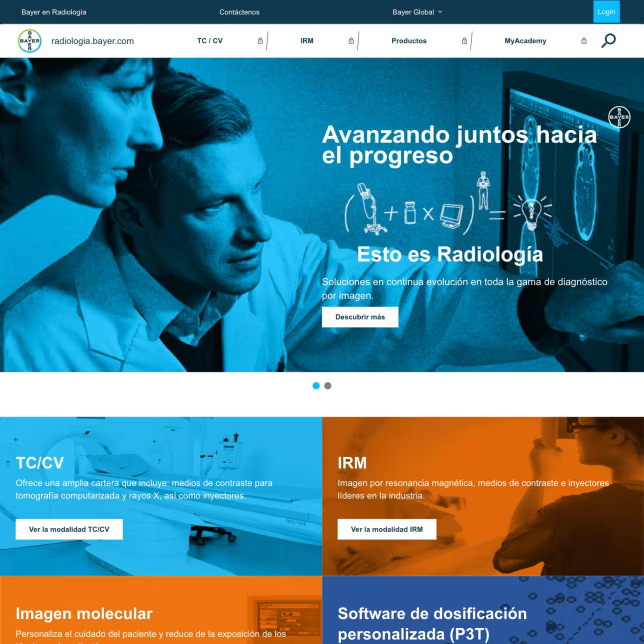
An advanced healthcare digital platform for LATAM was required to facilitate collaboration among radiology HCPs, distribute company knowledge, refine treatment methods, and streamline workflows. The solution needed secure medical website role-based access restrictions based on user role (HCP / non-HCP) and geographic region.
The platform enhanced collaboration, streamlined workflows, and empowered radiology professionals with advanced tools to gain insights and optimize patient care.
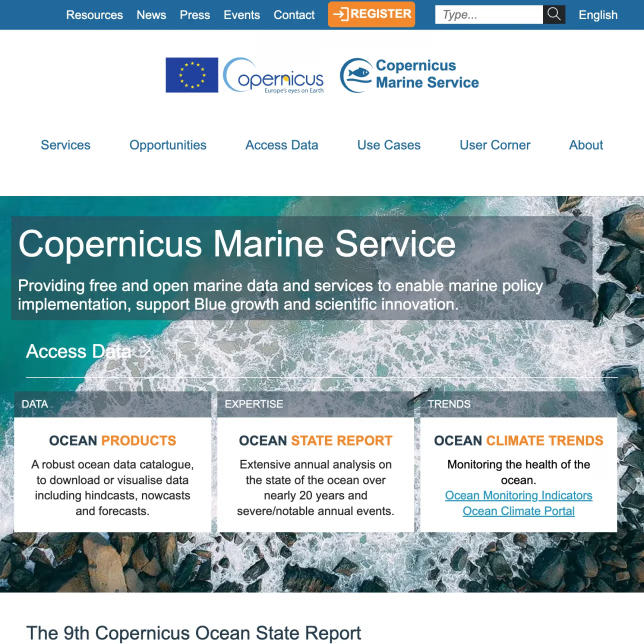
The existing marine data portal relied on three unaligned WordPress installations and embedded PHP code, creating inefficiencies and risks in content management and usability.
The new Drupal DXP streamlined content operations and improved accessibility, offering scientists and businesses a more efficient gateway to marine data services.
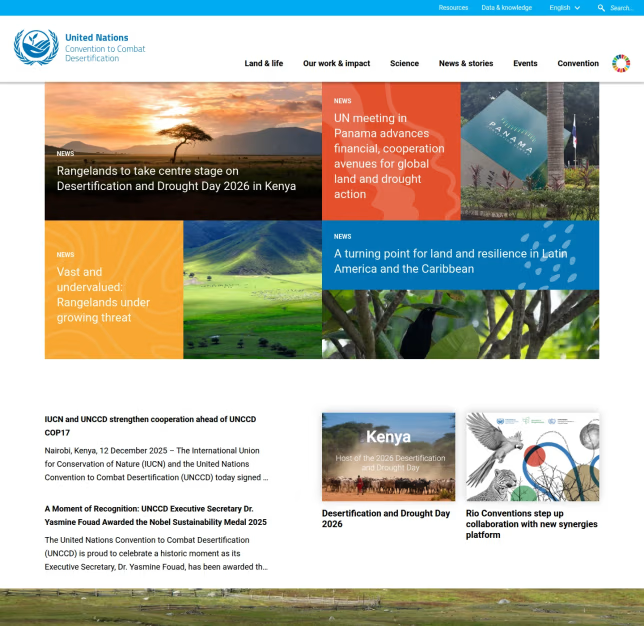
UNCCD operated four separate websites (two WordPress, two Drupal), leading to inconsistencies in design, content management, and user experience. A unified, scalable solution was needed to support a large-scale CMS migration project and improve efficiency and usability.
The modernization effort resulted in a cohesive, user-friendly, and scalable website, improving content management efficiency and long-term digital sustainability.
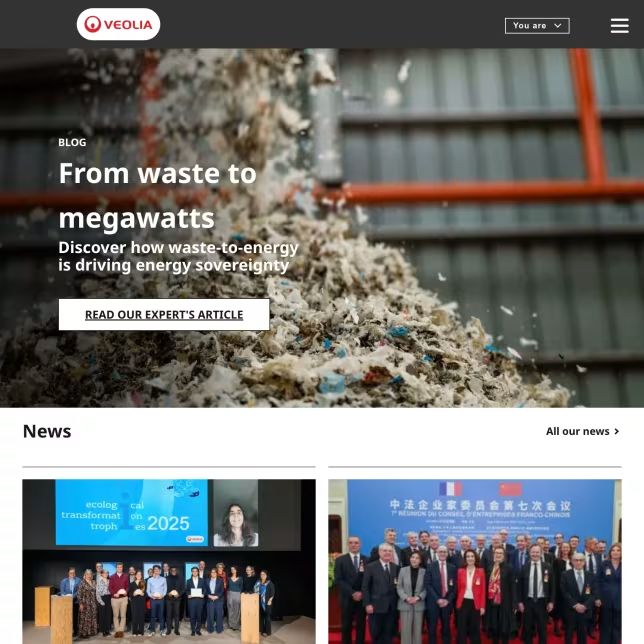
With Drupal 7 reaching end-of-life, Veolia needed a Drupal 7 to Drupal 10 enterprise migration for its Acquia Site Factory multisite platform—preserving region-specific content and multilingual capabilities across more than 200 sites.
The platform was modernized into a stable, scalable multisite foundation with improved performance, maintainability, and long-term upgrade readiness.
It was my pleasure working with Oleksiy (PathToProject) on a new Drupal website. He is a true full-stack developer—the ideal mix of DevOps expertise, deep front-end knowledge, and the structured thinking of a senior back-end developer.
He is well-organized and never lets anything slip. Oleksiy understands what needs to be done before being asked and can manage a project independently with minimal involvement from clients, product managers, or business analysts.
One of the best consultants I’ve worked with so far.

Andrei Melis
Technical Lead at Eau de Web
Oleksiy (PathToProject) and I worked together on a Digital Transformation project for Bayer LATAM Radiología. Oly was the Drupal developer, and I was the business lead. His professionalism, technical expertise, and ability to deliver functional improvements were some of the key attributes he brought to the project.
I also want to highlight his collaboration and flexibility—throughout the entire journey, Oleksiy exceeded my expectations.
It’s great when you can partner with vendors you trust, and who go the extra mile.

Axel Gleizerman Copello
Building in the MedTech Space | Antler
Oleksiy (PathToProject) is demanding and responsive. Comfortable with an Agile approach and strong technical skills, I appreciate the way he challenges stories and features to clarify specifications before and during sprints.

Olivier Ritlewski
Ingénieur Logiciel chez EPAM Systems
These articles expand on the governance, modeling, and migration decisions that shape a durable Drupal content architecture. They are useful for teams evaluating how content structure, workflows, search, and platform dependencies affect reuse and API delivery.
Let’s review your current Drupal content structures and editorial workflows, then design a governed model that supports reuse, integrations, and safe long-term change.