


 [01]
[01]Discovery Workshops
Facilitate domain and workflow sessions with engineering and content stakeholders. Capture concepts, relationships, lifecycle states, and non-functional requirements such as search, performance, and integration constraints.
Drupal data architecture
Use the Drupal health check to surface entity model gaps, taxonomy drift, integration fragility, and upgrade blockers before committing to structural changes.
Built for teams evaluating schema cleanup, governance decisions, search indexing changes, and integration readiness.
No login required. Takes 2–3 minutes.
Drupal platforms often fail or slow down due to data structures that were optimized for early delivery rather than long-term evolution. Drupal data architecture design focuses on creating scalable Drupal entity architecture and data models—entity relationships, taxonomy, and storage patterns—that support complex editorial needs, integrations, and search without creating brittle coupling or uncontrolled duplication.
This capability aligns Drupal’s Entity API with a clear domain model: what the platform stores, how it relates, and how it is queried. It includes decisions about entity types vs. bundles, field cardinality, reference strategies, normalization boundaries, revisioning, and multilingual considerations. It also covers how data is exposed to other systems and how search indexing is designed for predictable relevance and performance, including Drupal search indexing with Solr and Elasticsearch.
A well-structured data architecture reduces downstream complexity in migrations, integrations, and frontend delivery. It enables stable APIs, consistent governance across teams, and a platform that can evolve through new features and content types without repeated refactoring of core data structures.
Core Focus
Best Fit For
Key Outcomes
Technology Ecosystem
Delivery Scope
As Drupal platforms grow, data models often expand through incremental field additions, ad-hoc taxonomies, and inconsistent entity relationships. What begins as a workable content model can become a dense graph of references, duplicated fields, and unclear ownership boundaries. Teams then struggle to answer basic questions such as where a concept should live, how it should be reused, and which structures are safe to change.
These issues surface as architectural friction. Query patterns become unpredictable, Views configurations become fragile, and search indexing requires compensating logic to make sense of inconsistent classification. Integrations inherit ambiguity: external systems receive unstable payloads, and mapping rules multiply as each content type evolves independently. Over time, the platform accumulates implicit coupling between editorial workflows, storage structures, and downstream consumers.
Operationally, the cost shows up in delivery bottlenecks and risk. Small changes to fields or references can trigger regressions across search, APIs, migrations, and permissions. Performance tuning becomes reactive because the underlying model does not align with access patterns. The result is slower delivery, higher maintenance overhead, and reduced confidence in platform evolution.
Run structured workshops to identify core domain concepts, lifecycle states, and ownership boundaries. Capture editorial workflows, integration consumers, and reporting/search needs to ensure the data model aligns with real platform usage.
Assess existing entities, bundles, fields, taxonomies, and reference graphs. Identify duplication, inconsistent naming, cardinality issues, and areas where the current model conflicts with query patterns, permissions, or integration contracts.
Define entity types, bundles, and field schemas with clear responsibilities. Specify reference patterns, normalization boundaries, revisioning strategy, and multilingual considerations to support predictable evolution and content reuse.
Design controlled vocabularies, hierarchies, and tagging strategies that support navigation, personalization, and search facets. Establish governance rules for term creation, synonym handling, and cross-site consistency where applicable.
Define index mappings, analyzers, and field projections for Solr or ElasticSearch. Specify facet strategy, relevance tuning inputs, and update triggers so indexing remains consistent with entity changes and editorial workflows.
Design stable payload shapes and identifiers for APIs and downstream systems. Document mapping rules, versioning approach, and constraints so integrations can evolve without breaking changes or hidden coupling.
Validate the model against representative content volumes and access patterns. Review query plans, caching implications, and indexing throughput, then adjust schemas and projections to reduce hotspots and operational risk.
Deliver model documentation, naming conventions, and change-control practices. Establish review checkpoints for new content types and taxonomy changes to keep the model coherent as teams and requirements grow.
This service strengthens the data foundations of Drupal through Drupal data architecture design that aligns Drupal entity architecture, taxonomy, and search indexing with platform access patterns and integration needs. The focus is on durable schemas, explicit relationships, and predictable query behavior across MySQL/PostgreSQL-backed storage. We emphasize maintainability through clear governance, stable identifiers, and documented contracts so platform teams can extend the model without repeated structural refactoring.
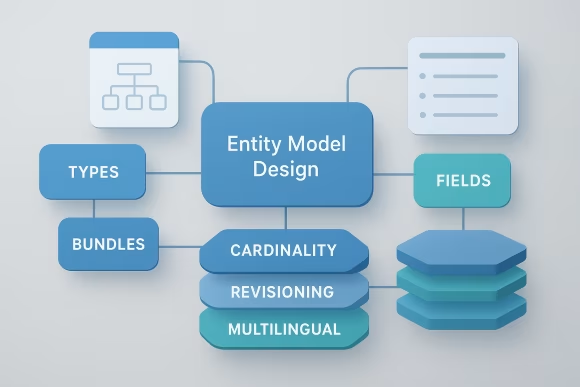
Design entity types, bundles, and field schemas that reflect domain concepts rather than page templates. This includes field cardinality, revisioning implications, and multilingual modeling so content can evolve without introducing inconsistent structures or breaking downstream consumers.
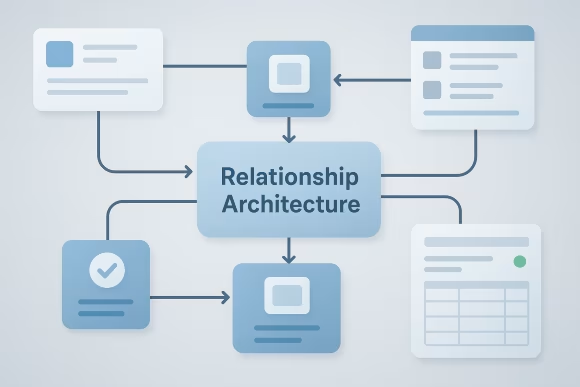
Define reference patterns for entity relationships, including ownership, aggregation, and reuse. We establish when to use entity references, paragraphs, or dedicated entities, and how to avoid circular dependencies, uncontrolled duplication, and permission complexity.
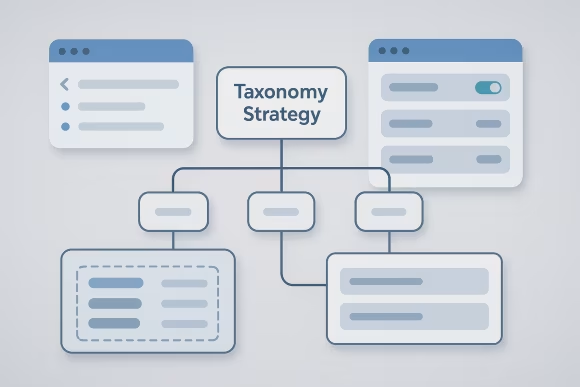
Engineer controlled vocabularies and taxonomy and content modeling approaches that support navigation, filtering, and editorial governance. This includes term hierarchy design, normalization rules, and conventions for tagging vs. categorization to keep classification consistent across teams and sites.
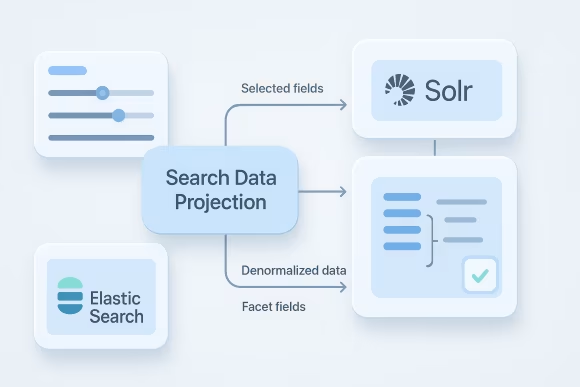
Design how Drupal entities are projected into Solr or ElasticSearch indexes, including field selection, denormalization boundaries, and facet fields. The goal is a stable index schema that supports relevance tuning and avoids brittle, per-content-type indexing logic.

Align the model with relational storage behavior in MySQL or PostgreSQL and with Drupal’s query APIs. We review access patterns, identify high-cost joins or over-referenced structures, and adjust schemas to improve predictability for Views, APIs, and batch operations.
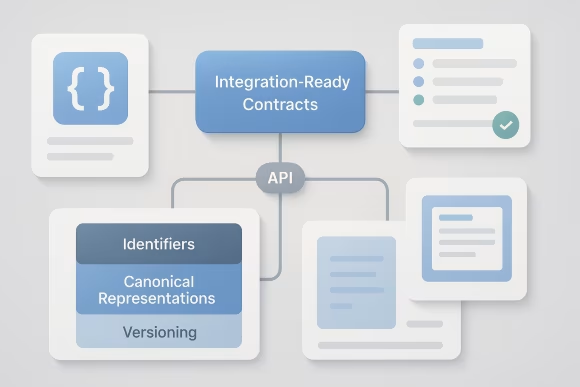
Define identifiers, canonical representations, and versioning approaches for data exchanged via APIs or feeds. This reduces mapping churn, supports incremental migrations, and enables other systems to rely on stable semantics even as Drupal content types evolve.
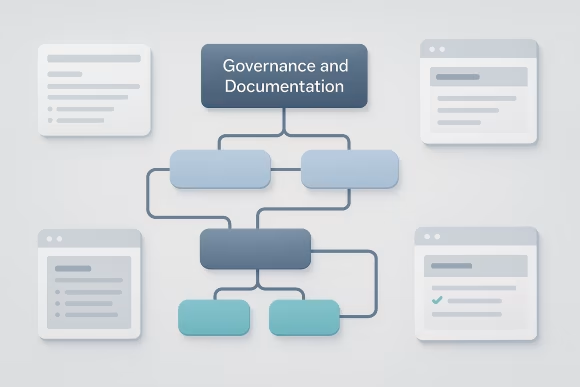
Provide naming conventions, modeling guidelines, and change-control workflows for new entities, fields, and taxonomies. This creates a shared engineering and editorial language, reduces accidental divergence, and keeps platform evolution aligned with architectural intent.
The Drupal health check highlights where data structures, governance rules, and downstream dependencies are increasing complexity across search, APIs, migrations, and editorial workflows.
Engagements follow a clear engineering sequence to reduce modeling risk early and validate the Drupal data architecture design against real access patterns. We work from current-state assessment through target model design, then support implementation guidance, Drupal Solr/Elasticsearch index design, and governance so the model remains coherent as the platform evolves.
[01]Facilitate domain and workflow sessions with engineering and content stakeholders. Capture concepts, relationships, lifecycle states, and non-functional requirements such as search, performance, and integration constraints.
 [02]
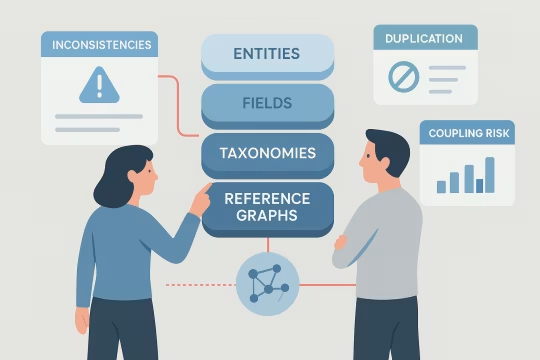
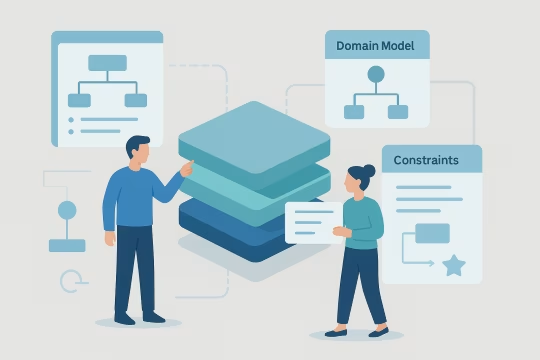
[02]Review existing entities, fields, taxonomies, and reference graphs. Identify inconsistencies, duplication, and high-risk coupling, and document where the model conflicts with delivery, search, or integration needs.
 [03]
[03]Produce a target entity and taxonomy model with clear boundaries and naming conventions. Define reference patterns, revisioning and translation approach, and constraints that keep the model stable under change.
 [04]
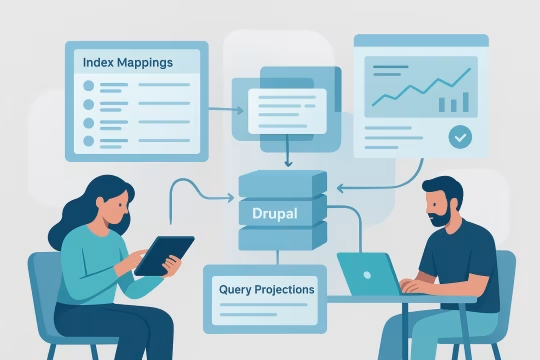
[04]Design Solr/ElasticSearch mappings and define projections from Drupal entities into the index. Validate query patterns for Views and APIs, and identify optimizations or schema adjustments needed for predictable performance.
 [05]
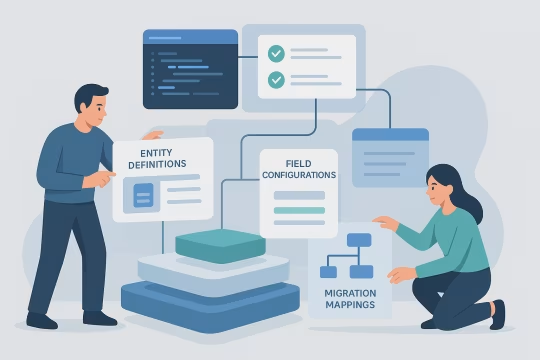
[05]Support teams implementing the model in Drupal, including entity definitions, field configuration, and migration mapping. Provide review checkpoints to ensure the implemented structures match the intended architecture.
 [06]
[06]Test the model with representative content volumes and workflows. Review indexing throughput, query behavior, and edge cases such as revisions, translations, and permission-driven filtering.
 [07]
[07]Deliver documentation and lightweight governance processes for model changes. Establish review criteria for new content types, taxonomy updates, and integration contract changes to prevent drift over time.
A coherent Drupal data architecture reduces delivery friction and lowers platform risk by making data structures predictable, governed, and integration-ready. It improves the reliability of Drupal Solr/Elasticsearch search indexing and APIs, supports enterprise relational data integrity in MySQL/PostgreSQL-backed Drupal platforms, and shortens the feedback loop for new features while limiting the operational cost of ongoing platform evolution.
Teams spend less time debating where data should live and how it should be reused. Clear modeling conventions and stable relationships reduce rework when introducing new content types, workflows, or channels.
Stable identifiers and explicit data contracts reduce mapping changes for downstream systems. Integrations become easier to version and maintain because payload semantics remain consistent as the platform evolves.
Well-defined projections into Solr or ElasticSearch reduce index drift and inconsistent facet behavior. Relevance tuning becomes more systematic because indexed fields and analyzers are designed around clear content semantics.
A governed model reduces the chance that small schema changes cascade into regressions across APIs, search, and editorial workflows. This improves confidence in releases and lowers the cost of platform maintenance.
Schemas aligned with access patterns reduce expensive joins, over-referenced structures, and inefficient Views configurations. Performance work shifts from reactive tuning to proactive design decisions that scale with content volume.
Explicit boundaries and modeling standards prevent uncontrolled duplication and one-off structures. Over time, the platform accumulates fewer special cases, making upgrades and refactoring more manageable.
Shared documentation and governance create a common language across engineering, content, and search stakeholders. Decisions become traceable, and new contributors can extend the model without introducing structural inconsistencies.
Before you redesign Drupal structures
Review how entity relationships, taxonomy governance, search indexing, and data contracts are affecting maintainability, integration readiness, and future Drupal upgrades.
These related services extend enterprise Drupal platform data design into adjacent areas—platform architecture, content architecture, governance, search architecture, and integration delivery—so the data model, APIs, and indexing strategy evolve together.
Designing Scalable Digital Foundations
Drupal content architecture design and editorial operating design
Drupal editorial workflow engineering and permissions model design
Headless Drupal Development Services for API-First Front-Ends
Scalable indexing and relevance design
Drupal API development services for secure integration layers
Drupal event tracking architecture, identity, and audience sync engineering
Secure Drupal Salesforce and HubSpot connectivity with enterprise data sync
Connect Drupal with Your Enterprise Ecosystem
Answers to common questions about Drupal data architecture design—covering Drupal entity architecture, Entity API design, governance, integration contracts, operational risk, and Drupal search indexing with Solr and Elasticsearch.
We decide based on lifecycle, reuse, ownership, and query/indexing needs rather than on page layout convenience. If a concept needs independent permissions, revisions, translations, or reuse across multiple parents, a dedicated entity type is usually appropriate. Paragraphs work well for structured, repeatable content blocks that are owned by a single parent and rarely queried independently. We also evaluate operational concerns: migration complexity, editorial UX, and how the data will be exposed via APIs. Deeply nested structures can simplify editing but often complicate integration payloads and search projection. Conversely, over-entity-izing can create excessive joins and administrative overhead. The outcome is a documented modeling decision: what is canonical, what is embedded, and what is referenced. We validate the decision against representative use cases such as listing pages, faceted search, personalization inputs, and downstream consumers so the model remains stable as new requirements arrive.
We start by clarifying which parts of the domain are language-dependent and which are language-neutral. In Drupal, this typically means deciding which entities and fields are translatable, how revisions are managed, and how editorial workflows interact with translation states. We avoid duplicating entities per language unless there is a strong domain reason, because it increases reference complexity and makes canonical identifiers harder to maintain. We design translation boundaries so shared concepts (for example, a product, location, or taxonomy term) can remain stable while language-specific fields vary. We also consider how revisions affect integrations and search: whether downstream systems need draft vs. published states, and how to prevent indexing of unintended revisions. Finally, we document a consistent approach for new content types: translation settings, fallback rules, and how to handle mixed-language relationships. This reduces drift and prevents teams from implementing one-off translation patterns that later become expensive to unify.
Drupal performance is strongly shaped by the number of joins and the predictability of query patterns created by the data model. Overuse of entity references, high-cardinality fields, and deeply nested structures can lead to expensive queries in Views, API responses, and batch operations. A sound data architecture aligns relationships with real access patterns and defines where denormalization is acceptable, especially for search and read-heavy experiences. Operational stability is also affected by how changes propagate. If multiple features depend on implicit assumptions about fields, taxonomy, or reference graphs, small schema changes can break indexing, integrations, or editorial workflows. We reduce this risk by defining stable identifiers, clear ownership boundaries, and documented contracts for how data is represented. We also consider indexing throughput and cache behavior. For example, projecting the right fields into Solr/ElasticSearch can reduce runtime query complexity, but it requires disciplined mapping and update triggers. The goal is a model that scales without constant reactive tuning.
We treat model change as an evolution problem: preserve continuity for editors and consumers while moving toward a target structure. The first step is impact analysis: which entities, fields, and taxonomies are used by templates, Views, APIs, search indexes, and integrations. We then design a migration or transformation plan that can run incrementally and be validated in non-production environments with representative datasets. Common patterns include introducing new fields/entities alongside existing ones, backfilling data via batch processes, and switching consumers over behind feature flags. For high-risk changes, we define compatibility layers in APIs or indexing so downstream systems can transition without a hard cutover. We also plan for governance during the transition: freezing certain schema changes, documenting mapping rules, and defining rollback strategies. The objective is to avoid “big bang” refactors and instead deliver controlled, testable steps that keep the platform operational throughout the change.
We design the Drupal model and the search index together, with explicit projection rules. Not every relational detail should be indexed, and not every indexed field should be a direct mirror of storage. We identify search use cases first: facets, filters, sorting, autocomplete, and relevance signals. Then we define which entity fields and related entities should be denormalized into the index to support those use cases efficiently. For Solr/ElasticSearch, we specify field mappings, analyzers, and normalization rules (for example, keyword vs. text fields, stemming, and case handling). We also define how taxonomy and relationships become facet fields, and how to handle multilingual indexing. Finally, we design update triggers and reindex strategies. Index stability depends on predictable change detection and consistent mapping. The result is a search architecture that is resilient to content model evolution and avoids per-content-type special cases that are hard to maintain.
We establish a canonical domain model and then define explicit API contracts that are versioned and documented. In Drupal, this often means deciding how JSON:API resources are exposed, how relationships are represented, and which fields are considered stable vs. internal. We avoid leaking implementation details such as editorial-only fields or unstable taxonomy structures into external contracts. When the underlying model changes, we use compatibility strategies: additive changes first, deprecation windows, and parallel representations where necessary. For example, a new entity relationship can be introduced while keeping an older field-based representation until consumers migrate. We also emphasize stable identifiers and consistent semantics. If IDs change or meaning shifts, downstream systems incur ongoing mapping cost. By defining identifier strategy, ownership boundaries, and change-control rules, we reduce integration churn and make platform evolution safer for dependent products and services.
Data model drift usually happens when teams add fields, taxonomies, and relationships to meet immediate needs without a shared set of constraints. Governance does not need to be heavy, but it must be explicit. We typically define modeling standards (naming, field reuse rules, reference patterns), a lightweight review process for new entities and vocabularies, and documentation that explains the domain concepts and their intended usage. We also recommend establishing ownership: who approves changes to core entities, who can create new vocabularies, and how cross-cutting concepts are managed in multi-site environments. For search, governance includes index schema ownership and rules for adding facets or relevance signals. Finally, we align governance with delivery workflows. For example, schema changes should be reviewed alongside API and indexing impacts, and tested in CI where possible. The goal is to keep the model coherent while still enabling teams to deliver features without unnecessary process overhead.
We start by defining the purpose of each vocabulary: navigation, classification, tagging, access control, or integration mapping. Each purpose implies different governance. Navigation vocabularies usually require tighter control and hierarchy rules, while tagging vocabularies may allow broader contribution but need normalization practices (synonyms, duplicates, and term lifecycle management). We define conventions for term naming, hierarchy depth, and when to introduce new terms vs. reuse existing ones. For enterprise platforms, we often add term metadata to support integration mapping or search behavior, and we document how terms should be used across content types. Operationally, we recommend periodic taxonomy hygiene: review unused terms, merge duplicates, and validate that facets remain meaningful. We also ensure taxonomy changes are treated as platform changes with downstream impact, because term structure affects search facets, API payloads, and analytics consistency.
Upgrades become risky when the platform relies on fragile assumptions: undocumented field usage, inconsistent entity relationships, and custom logic that compensates for unclear modeling. A strong data architecture reduces that fragility by making structures explicit and coherent. When entities and taxonomies follow consistent patterns, it is easier to assess upgrade impact, update custom code, and validate behavior across environments. Search and integrations are common upgrade risk areas. If indexing logic is tightly coupled to specific content type quirks, or if API payloads reflect internal implementation details, upgrades can trigger unexpected regressions. By defining stable projections and contracts, you isolate consumers from internal change. Additionally, clear governance and documentation reduce dependency on tribal knowledge. Teams can run targeted regression tests against known model invariants (relationships, identifiers, translation rules), which shortens upgrade cycles and improves confidence in release readiness.
Over-modeling happens when the platform introduces too many entity types, overly granular relationships, or abstractions that do not reflect real workflows. This can increase join complexity, slow down editorial operations, and make the system harder to understand. It also raises the cost of migrations and increases the surface area for permissions and revisioning issues. We avoid over-modeling by grounding decisions in concrete use cases: how editors create and reuse content, how the frontend queries and renders it, how search needs to facet and rank it, and how integrations consume it. If a concept is not reused, not queried independently, and not governed separately, embedding it (for example via paragraphs) may be more appropriate. We also design for evolution. A model should be extensible, but not speculative. We prefer a small number of well-defined entities with clear boundaries, plus documented patterns for when to introduce new entities as requirements become proven and stable.
Deliverables depend on scope and platform maturity, but typically include a target entity and taxonomy model, documented relationship patterns, and a set of modeling standards that teams can apply consistently. We also provide search index architecture artifacts when Solr or ElasticSearch is in scope, such as mapping recommendations, facet strategy, and projection rules from Drupal entities into the index. For integration-heavy platforms, we include data contract guidance: identifier strategy, canonical representations, and versioning considerations for APIs. If the engagement includes evolution of an existing model, we provide an impact assessment and a migration or transition plan that outlines incremental steps, validation points, and rollback considerations. We aim for artifacts that are usable by engineering teams: diagrams or structured documentation, decision records for key trade-offs, and review checklists that support ongoing governance. Where helpful, we also provide implementation notes aligned with Drupal configuration and code patterns.
We collaborate as an extension of your platform team, with clear roles and decision-making paths. Early in the engagement, we align on stakeholders: Drupal architects, data architects, search owners, and integration teams. We run focused workshops to capture domain concepts and constraints, then iterate on a proposed model with structured reviews rather than long, open-ended discussions. During implementation, we typically use a review-and-enable approach. Your engineers implement entities, fields, and taxonomy changes, while we provide architecture reviews, validate alignment with the target model, and flag downstream impacts on search and APIs. This keeps knowledge inside your team and avoids creating a dependency on external contributors. We also establish lightweight governance practices: how new content types are proposed, how taxonomy changes are reviewed, and how integration contracts are versioned. The goal is to make the model sustainable after the engagement ends, with clear documentation and repeatable decision criteria.
Collaboration usually begins with a short discovery phase designed to establish a shared understanding of the current model and the target outcomes. We start with stakeholder alignment (platform, search, integrations, and content operations) and a review of existing Drupal structures: entity types, bundles, fields, taxonomies, and key Views or API consumers. We also identify the highest-risk areas, such as unstable identifiers, inconsistent classification, or search/indexing pain points. Next, we define scope and decision boundaries. This includes which domains are in scope, whether the work is greenfield or an evolution of production content, and what constraints exist around migrations, release windows, and downstream systems. We agree on the artifacts to produce (target model, standards, index design, migration plan) and the cadence for reviews. From there, we move into iterative modeling: propose a target structure, validate it against real use cases, and refine until it is implementable. The first implementation step is typically a thin vertical slice that proves the model through one representative content flow, search projection, and API exposure.
These case studies showcase real-world applications of Drupal data modeling, entity architecture design, and search indexing strategies. They highlight scalable content structures, integration-ready contracts, and governance practices that align with complex editorial and multilingual requirements. Each example demonstrates measurable improvements in platform stability, performance, and maintainability relevant to Drupal data architecture challenges.
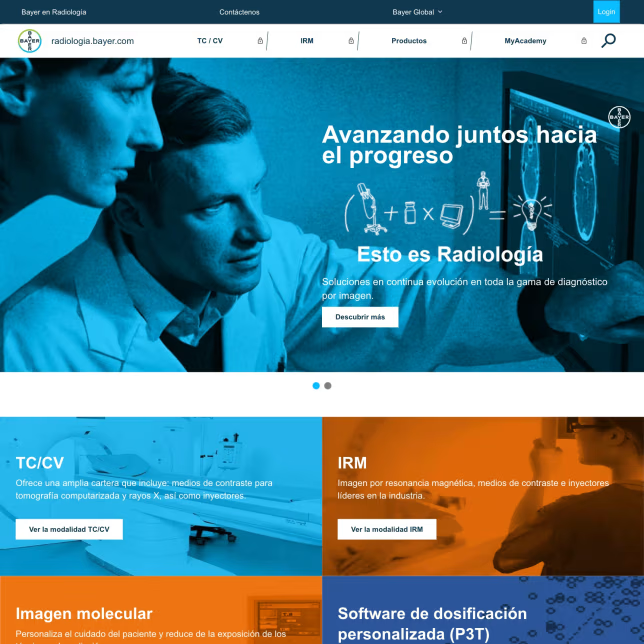
An advanced healthcare digital platform for LATAM was required to facilitate collaboration among radiology HCPs, distribute company knowledge, refine treatment methods, and streamline workflows. The solution needed secure medical website role-based access restrictions based on user role (HCP / non-HCP) and geographic region.
The platform enhanced collaboration, streamlined workflows, and empowered radiology professionals with advanced tools to gain insights and optimize patient care.
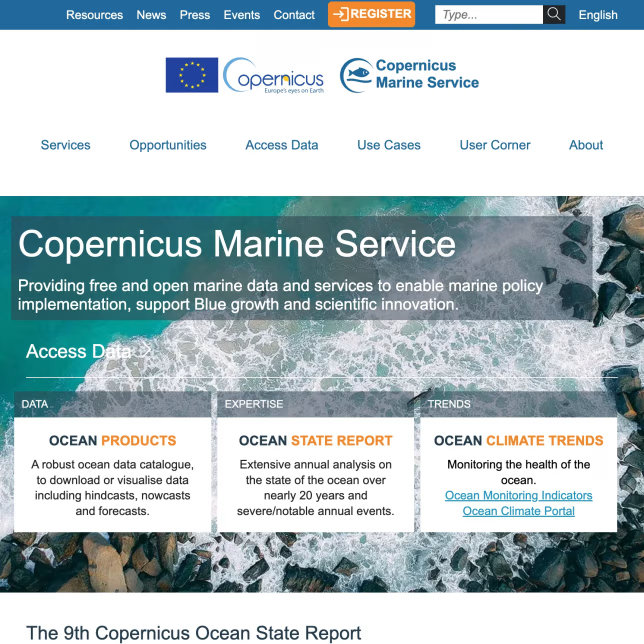
The existing marine data portal relied on three unaligned WordPress installations and embedded PHP code, creating inefficiencies and risks in content management and usability.
The new Drupal DXP streamlined content operations and improved accessibility, offering scientists and businesses a more efficient gateway to marine data services.
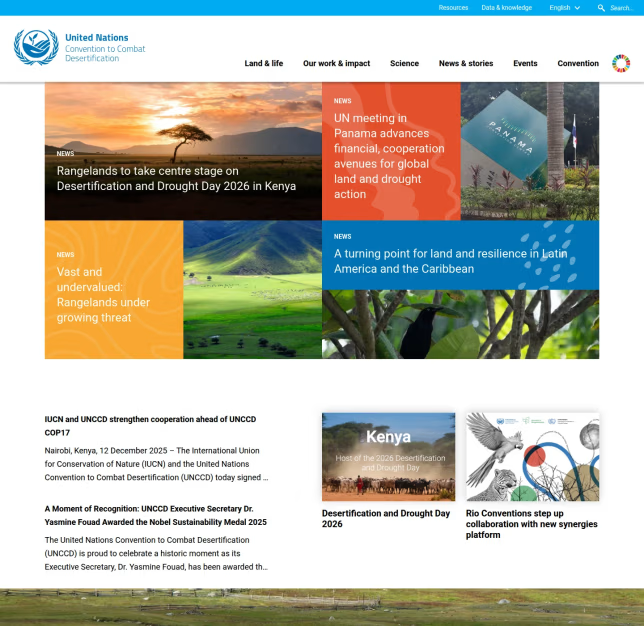
UNCCD operated four separate websites (two WordPress, two Drupal), leading to inconsistencies in design, content management, and user experience. A unified, scalable solution was needed to support a large-scale CMS migration project and improve efficiency and usability.
The modernization effort resulted in a cohesive, user-friendly, and scalable website, improving content management efficiency and long-term digital sustainability.
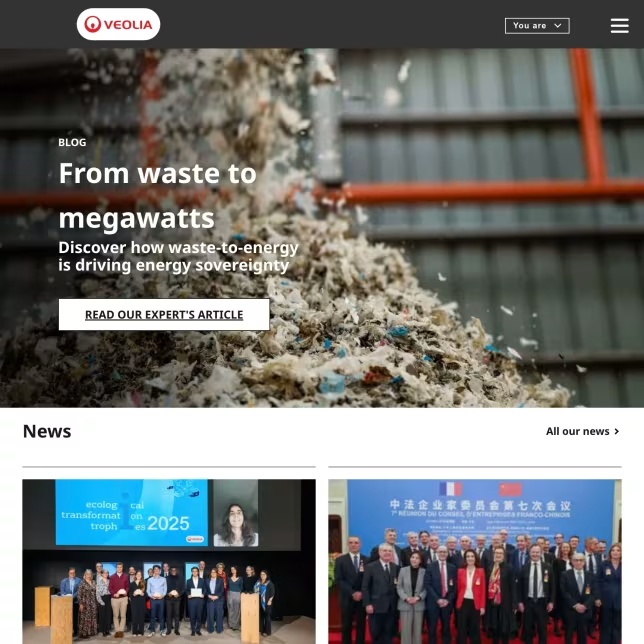
With Drupal 7 reaching end-of-life, Veolia needed a Drupal 7 to Drupal 10 enterprise migration for its Acquia Site Factory multisite platform—preserving region-specific content and multilingual capabilities across more than 200 sites.
The platform was modernized into a stable, scalable multisite foundation with improved performance, maintainability, and long-term upgrade readiness.
Oleksiy (PathToProject) and I worked together on a Digital Transformation project for Bayer LATAM Radiología. Oly was the Drupal developer, and I was the business lead. His professionalism, technical expertise, and ability to deliver functional improvements were some of the key attributes he brought to the project.
I also want to highlight his collaboration and flexibility—throughout the entire journey, Oleksiy exceeded my expectations.
It’s great when you can partner with vendors you trust, and who go the extra mile.

Axel Gleizerman Copello
Building in the MedTech Space | Antler
Oleksiy (PathToProject) is demanding and responsive. Comfortable with an Agile approach and strong technical skills, I appreciate the way he challenges stories and features to clarify specifications before and during sprints.

Olivier Ritlewski
Ingénieur Logiciel chez EPAM Systems
As Dev Team Lead on my project for 10 months, Oleksiy (PathToProject) demonstrated excellent technical skills and the ability to handle complex Drupal projects. His full-stack expertise is highly valuable.

Laurent Poinsignon
Domain Delivery Manager Web at TotalEnergies
These articles expand on the data, search, and governance decisions that shape a durable Drupal content architecture. They are especially useful for teams evaluating entity modeling, reference integrity, and how search behavior stays aligned as vocabularies and permissions change.
Let’s review your current entity architecture, taxonomy strategy, and search/indexing requirements, then define a target model that supports integrations and long-term platform evolution.