 [01]
[01]Discovery and Audit
Assess current search behavior, data sources, and consumer requirements. Identify constraints around latency, freshness, and availability, and document failure modes and operational gaps that affect reliability.
Search platform integration services connect headless content and domain systems to a dedicated search engine through reliable indexing, query patterns, and operational controls. This headless search architecture covers how data is extracted and normalized, how indexes are structured, and how applications consume search through stable APIs that support filtering, facets, personalization signals, and multilingual requirements.
Organizations need this capability when search becomes a platform concern rather than a UI feature: multiple frontends, multiple content sources, and evolving schemas require a consistent integration layer. This is often the practical answer to how to integrate search platforms with headless CMS and adjacent domain systems without duplicating logic across channels. Without clear contracts and pipelines, teams struggle with brittle indexing jobs, inconsistent relevance behavior, and unpredictable performance under load.
A well-structured integration supports scalable platform architecture by separating search concerns from upstream systems, enforcing versioned schemas, and enabling controlled evolution of relevance and ranking. It also establishes observability and operational runbooks so search quality and performance can be managed as part of the broader headless platform lifecycle.
Core Focus
Best Fit For
Key Outcomes
Technology Ecosystem
Operational Benefits


As headless platforms grow, search often evolves organically: each frontend implements its own query logic, upstream systems emit inconsistent fields, and indexing jobs are built as one-off scripts. Over time, content models and product schemas change, new sources are added, and multilingual or regional requirements introduce additional complexity. The result is a search experience that is difficult to reason about and expensive to modify.
Engineering teams then face architectural friction. Index mappings drift from source-of-truth schemas, relevance changes are deployed without repeatable evaluation, and query patterns become tightly coupled to a specific UI or vendor feature. When multiple consumers depend on search, even small changes to analyzers, synonyms, or facet behavior can cause regressions that are hard to detect and harder to roll back.
Operationally, fragile pipelines increase risk: reindexing can require downtime, backfills overload upstream APIs, and partial failures lead to stale or inconsistent results. Without observability, teams lack clear signals for index freshness, query latency, error rates, and relevance quality, turning search into a persistent delivery bottleneck and a platform reliability concern.
Review content and domain sources, existing search behavior, and consumer applications. Capture query use cases, filtering and faceting needs, language requirements, and non-functional constraints such as latency, throughput, and availability targets.
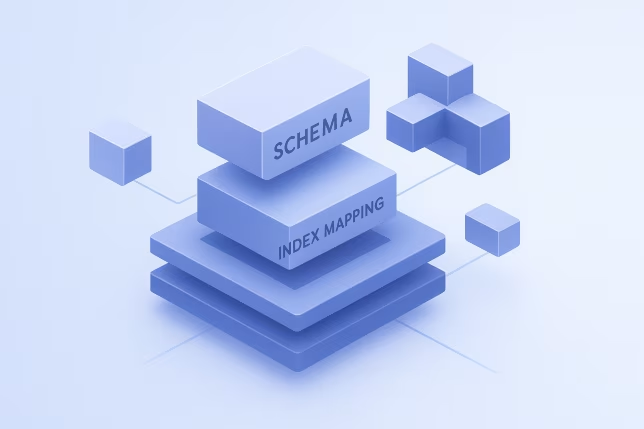
Define canonical search documents and field semantics across sources. Establish normalization rules, identifiers, and join strategies (denormalized documents, nested fields, or lookup patterns) aligned to the chosen search engine capabilities.
Design index topology, mappings, analyzers, and shard strategy for performance and evolution. Define schema versioning and migration approach, including aliasing patterns and compatibility rules for consumers.
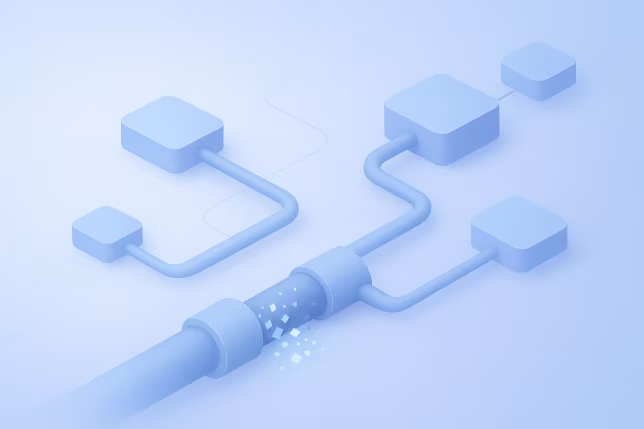
Implement ingestion via batch, event-driven, or hybrid pipelines. Add enrichment steps, deduplication, and idempotency controls, and define backfill and replay mechanisms to keep indexes consistent with upstream systems.
Build a stable query interface for applications, including filtering, facets, pagination, and sorting. Add request validation, rate limiting, and response shaping to decouple consumers from vendor-specific query DSLs.
Establish ranking strategy, synonym and stopword management, and query-time boosting rules. Implement evaluation workflows using representative queries, click signals where available, and controlled rollout of tuning changes.
Add automated tests for mappings, analyzers, and query behavior, plus pipeline tests for indexing correctness. Validate performance with load profiles and define acceptance thresholds for latency, freshness, and error budgets.
Set up monitoring for index freshness, ingestion lag, query latency, and failure modes. Document runbooks, define change control for schema and relevance updates, and establish ownership boundaries across platform teams.
This service establishes a headless search architecture that treats search as a dependable platform capability. It emphasizes durable data contracts, Search API design and indexing pipelines, and an integration layer that decouples consumers from vendor-specific implementations. The approach supports Elasticsearch/Algolia integration patterns, safe schema evolution, and enterprise search relevance tuning with operational controls for performance, freshness, and governance.
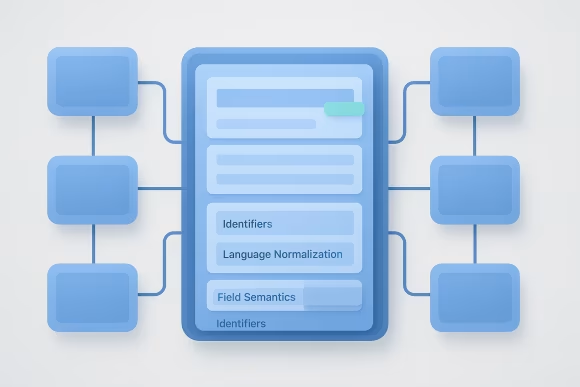
Define a canonical document model that represents searchable entities consistently across multiple sources. This includes field semantics, identifiers, language handling, and normalization rules so that indexing and querying remain stable even as upstream systems evolve. Schema versioning is treated as a first-class concern to support safe migrations.
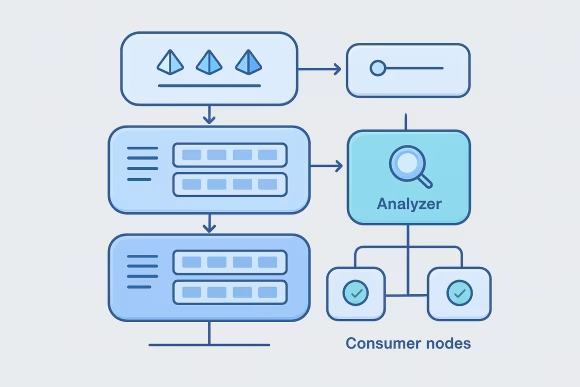
Design index structure, mappings, analyzers, and shard/replica strategy appropriate for scale and query patterns. The capability includes alias-based versioning, rollover strategies where applicable, and compatibility constraints for consumers. It enables predictable performance and controlled evolution of index definitions.
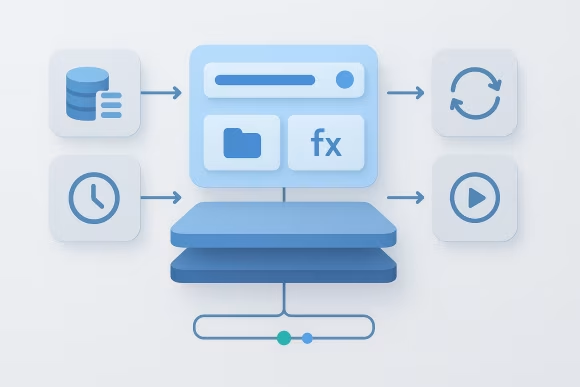
Implement ingestion pipelines that extract, transform, and load data into the search engine using batch, event-driven, or hybrid approaches. Enrichment steps can include taxonomy resolution, computed fields, and denormalization strategies. Idempotency, retries, and replay support are built in to handle partial failures safely.
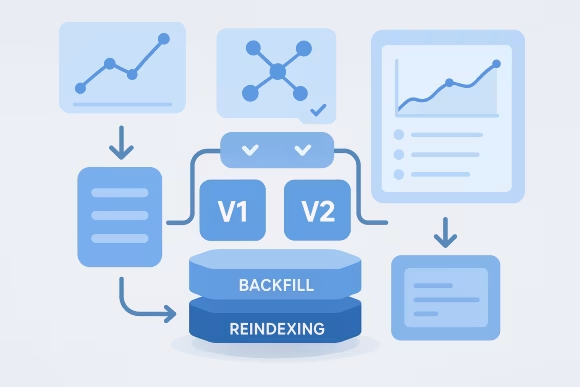
Provide reindexing patterns that avoid downtime and minimize consumer disruption. This includes dual-write or backfill strategies, index alias switching, and validation gates before cutover. The approach reduces risk when mappings change or when large backfills are required after upstream corrections.
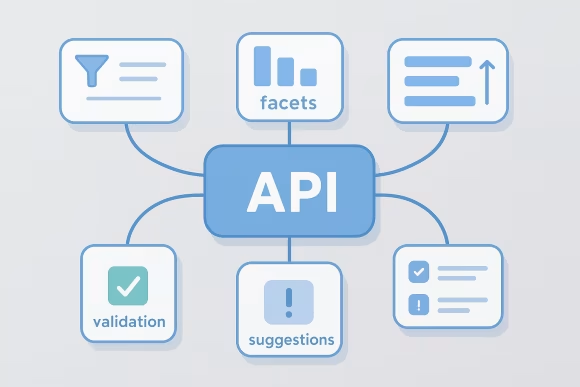
Create a stable API layer that exposes search capabilities—filters, facets, sorting, pagination, and suggestions—without leaking vendor-specific query DSLs. The API includes validation, consistent error handling, and response shaping to keep consumers decoupled. This supports multiple frontends and gradual evolution of query behavior.
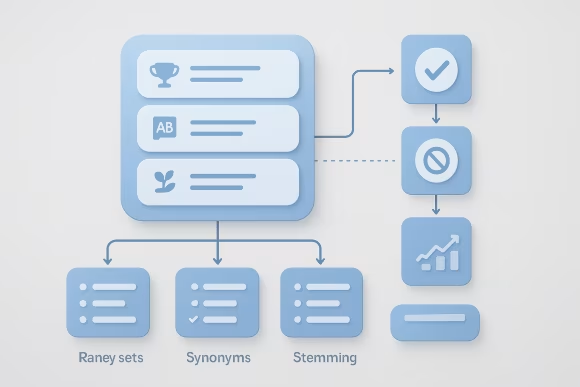
Establish mechanisms to manage ranking rules, synonyms, stemming behavior, and boosting strategies with traceability. Changes are evaluated against representative query sets and can be rolled out progressively. This reduces regressions and makes relevance tuning an engineering process rather than ad-hoc adjustments.

Instrument ingestion and query paths with metrics and logs for latency, error rates, index freshness, and pipeline lag. Dashboards and alerts are defined around operational thresholds and error budgets. This enables platform teams to diagnose issues quickly and to manage search reliability over time.
Delivery follows an engineering sequence from discovery and data modeling through Search API design and indexing pipeline implementation, then verification, cutover, and ongoing tuning. The focus is on repeatable integration patterns (including Elasticsearch/Algolia integration where applicable), versioned schemas, and operational readiness so search can evolve safely across a headless platform.
[01]Assess current search behavior, data sources, and consumer requirements. Identify constraints around latency, freshness, and availability, and document failure modes and operational gaps that affect reliability.
 [02]
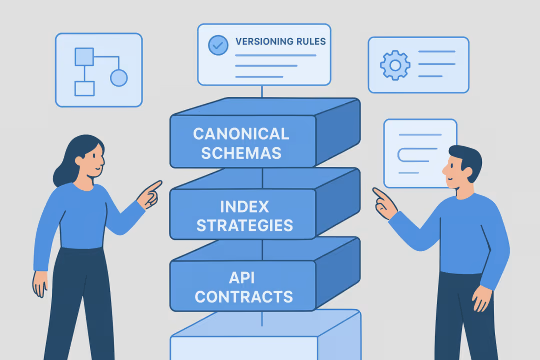
[02]Define canonical schemas, index strategy, and API contracts. Establish versioning rules and compatibility expectations so multiple teams can evolve sources and consumers without breaking changes.
 [03]
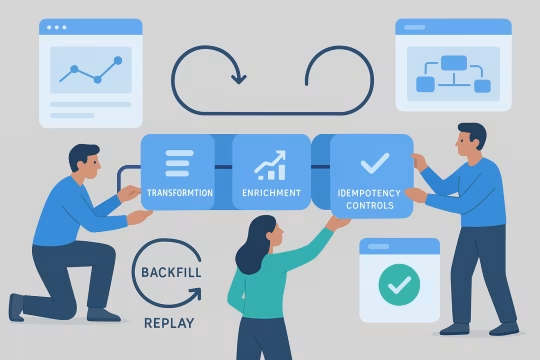
[03]Build ingestion pipelines with transformation, enrichment, and idempotency controls. Implement backfill and replay mechanisms and validate correctness against upstream systems and representative datasets.
 [04]
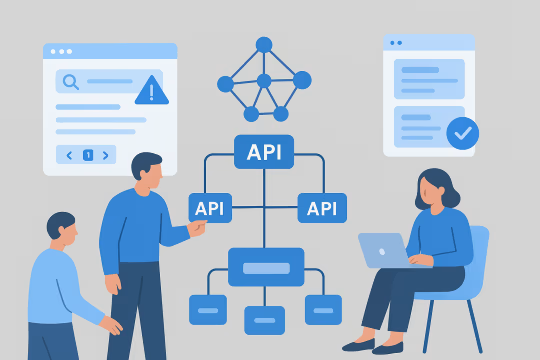
[04]Implement the Search API layer and integrate with consuming applications. Add validation, pagination and facet conventions, and consistent error handling to keep consumers decoupled from engine-specific details.
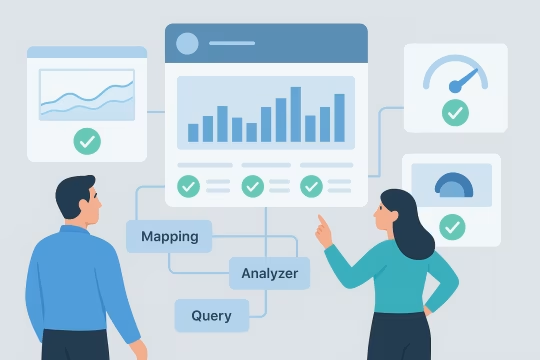 [05]
[05]Add automated tests for mappings, analyzers, and query behavior, plus pipeline tests for indexing correctness. Run performance and load verification to confirm latency and throughput targets under realistic traffic patterns.
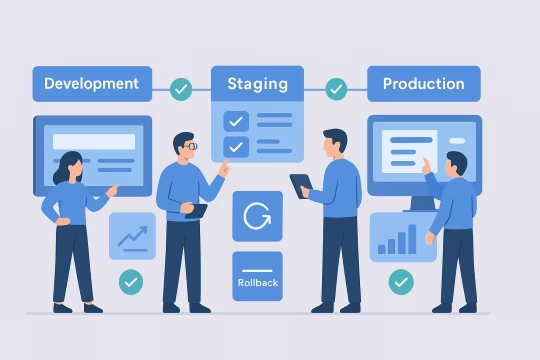 [06]
[06]Deploy using alias-based index versioning and controlled cutover procedures. Validate index freshness and query parity before switching traffic, and ensure rollback paths are documented and tested.
 [07]
[07]Set up dashboards and alerts for ingestion lag, index freshness, query latency, and error rates. Provide runbooks and on-call guidance for common incidents such as failed backfills or query timeouts.
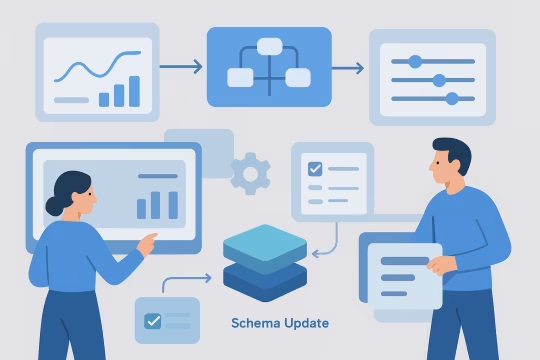 [08]
[08]Establish an ongoing workflow for relevance adjustments and schema evolution. Use query analytics and evaluation sets to manage changes safely, with staged rollouts and measurable acceptance criteria.
Search platform integration reduces platform risk by making search behavior predictable, testable, and operable across multiple consumers. By standardizing Search API design and indexing, teams can evolve schemas and relevance with fewer regressions, support multi-source content search more consistently, and reduce the operational risk of changes through practices like zero-downtime reindexing.
A stable Search API and canonical schema reduce rework when new frontends or sources are added. Teams can implement new filters, facets, and result types without duplicating vendor-specific query logic across applications.
Repeatable ingestion pipelines and zero-downtime reindexing reduce the chance of outages during schema changes or backfills. Clear rollback paths and monitoring improve incident response and recovery time.
Index topology and query patterns are designed for predictable performance under growth. Sharding, caching strategies, and request shaping help maintain latency targets as traffic and content volume increase.
Centralized relevance controls and shared query conventions reduce fragmentation across channels. This makes search results more consistent between web, mobile, and internal consumers while still allowing controlled variations when required.
Decoupling consumers from engine-specific DSLs and ad-hoc scripts prevents long-term lock-in to brittle implementations. Versioned schemas and documented contracts make future migrations and upgrades more manageable.
Metrics for freshness, ingestion lag, and query latency provide actionable signals for platform operations. Teams can detect regressions early and correlate changes in relevance or performance with deployments and tuning updates.
Evaluation workflows and staged rollouts allow relevance changes to be tested and measured before broad release. This reduces regressions and makes tuning a controlled engineering activity rather than reactive adjustments.
These related services are common extensions to search platform integration services—covering adjacent headless platform architecture, API layers, integration engineering, and the DevOps/observability practices needed to operate search reliably.
Enterprise API design for scalable, secure foundations
API-first platform design with clear domain boundaries
Composable DXP content architecture and API-first platform design
API-first enterprise headless CMS platform architecture for content delivery
Structured schemas for an API-first content strategy
Contract-first headless API development for enterprise delivery
Headless CMS API integration, contracts, and integration layer engineering
Enterprise GraphQL schema design and governance
Headless CMS CI/CD pipelines for decoupled web platforms
Metrics, traces, and alerts across APIs
Reduce latency across rendering and APIs
CDN architecture and configuration, caching, and global routing
Answers to common questions about headless search architecture, Elasticsearch/Algolia integration, Search API design and indexing, relevance tuning, zero-downtime reindexing, observability, governance, and engagement approach.
The choice depends on control, operational model, and the types of search experiences you need to support. Elasticsearch typically fits when you need deep control over mappings, analyzers, custom scoring, and data locality, or when search must run within your infrastructure and compliance boundaries. It also suits complex multi-index strategies and advanced aggregation patterns, but it requires more operational ownership. Algolia often fits when you want a managed service with strong out-of-the-box relevance tooling, fast iteration on ranking rules, and simplified operations. It can be effective for teams that prioritize time-to-iterate and predictable performance without managing clusters. The trade-offs are less control over low-level analysis and a different cost model tied to records and operations. In practice, we evaluate query patterns (facets, suggestions, typo tolerance), data volume and update frequency, latency targets, multi-region needs, and governance requirements. We also consider integration constraints: how data is produced, how often schemas change, and how many consumers need stable contracts.
A robust architecture separates concerns into three layers: ingestion, index design, and consumption. Ingestion pipelines extract and normalize data from upstream systems (CMS, PIM, commerce, DAM, or custom services), apply enrichment, and write to the search engine with idempotency and replay support. Index design defines canonical documents, mappings/analyzers, and versioning patterns so schema changes can be introduced safely. On the consumption side, a Search API layer provides stable contracts to frontends and other services. This layer standardizes filtering, facets, pagination, sorting, and error handling, and prevents consumers from coupling directly to a vendor-specific query DSL. It also becomes the place to implement cross-cutting concerns such as rate limiting, caching, and request validation. Operationally, the architecture includes observability for index freshness, ingestion lag, query latency, and error rates, plus runbooks for reindexing and backfills. The goal is to make search evolvable: new sources and new consumers can be added without rewriting pipelines or breaking existing clients.
We treat search as both a reliability surface and a quality surface. For platform health, we instrument ingestion and query paths with metrics such as indexing throughput, ingestion lag, failed document counts, retry rates, and index freshness (time since last successful update per source). On the query side we track latency percentiles, error rates, timeouts, and saturation signals (queue depth, thread pools, rate limits). For search quality, we establish measurable indicators that can be monitored over time. Depending on available data, this can include zero-result rate, click-through rate on top results, refinement rate (how often users apply filters after an initial query), and abandonment signals. Where click analytics are not available, we use curated evaluation sets and regression tests for representative queries. We also recommend correlating relevance and performance changes with deployments and tuning updates via structured change logs. Dashboards should support incident response (what broke) and continuous improvement (what to tune next), with alerts focused on actionable thresholds rather than noisy vanity metrics.
Zero-downtime reindexing is primarily a versioning and cutover problem. We typically use index aliases (or equivalent routing mechanisms) so consumers always query a stable alias while the underlying index version changes. A new index is built in parallel, validated for completeness and query parity, and then traffic is switched by updating the alias. Rollback is achieved by switching the alias back to the previous index version. For large backfills, we design pipelines to be resumable and to avoid overwhelming upstream systems. This includes checkpointing, rate limiting, and incremental fetch strategies. If upstream APIs are fragile, we introduce staging storage or event logs to decouple extraction from indexing. Validation gates are critical: document counts by type, sampling checks for key fields, and automated query regression tests. We also plan for partial failures by making writes idempotent and by supporting replay from a known point in time. The objective is to make reindexing a routine operation rather than a high-risk event.
We start by defining the search domain: what entities should be searchable (pages, articles, products, locations, documents) and how they should appear together. Then we design a canonical schema that can represent these entity types consistently, including shared fields (title, summary, tags) and type-specific fields. This schema becomes the contract for ingestion and for the Search API. Integration can be implemented as denormalized documents (preferred for query performance), or as separate indexes with a federated query layer, depending on the engine and the use case. Denormalization requires careful handling of relationships (e.g., product to category) and update propagation. Federated approaches can reduce duplication but add complexity to ranking and pagination. We also define identity and deduplication rules, language and locale handling, and freshness expectations per source. Finally, we ensure the API layer can expose consistent facets and filters across entity types, while still allowing type-specific filtering where it makes sense.
The Search API layer can be implemented as REST, GraphQL, or as a service behind an existing gateway, but the key is to keep the contract stable and vendor-agnostic. In GraphQL environments, we often expose search as a dedicated query with typed filters and facet structures, while keeping engine-specific constructs out of the schema. This helps frontend teams evolve independently of search vendor changes. If you already have an API gateway, search endpoints can be routed through it to reuse authentication, rate limiting, and observability. In some cases, the gateway is not the best place for search-specific logic (like query rewriting or relevance experimentation), so we keep that logic in a dedicated search service and use the gateway for cross-cutting concerns. We also address caching strategy carefully: caching can improve latency for common queries, but it must respect personalization signals, authorization constraints, and rapidly changing inventory or content. The design balances performance with correctness and maintainability.
Schema governance starts with treating the canonical search document as a versioned contract. We define which fields are stable, which are experimental, and what deprecation rules apply. Changes are introduced through additive evolution where possible (new fields, new facets), while breaking changes (renames, type changes, analyzer changes) are handled via new index versions and controlled cutovers. We also establish ownership boundaries: who can change mappings, who can change ingestion transformations, and who can change relevance rules. Changes should be reviewed with both platform and consumer stakeholders because search behavior affects multiple products. Practically, governance includes automated checks in CI for mapping validity, pipeline tests for required fields, and query regression tests for representative use cases. Release notes and change logs are maintained so teams can correlate behavior changes with deployments. The goal is to make schema evolution predictable and to avoid “silent” changes that only surface as production incidents or relevance regressions.
We treat relevance as an iterative engineering process with controls, not as ad-hoc adjustments. First, we define a baseline ranking strategy and document the intent: what should rank higher and why (freshness, popularity, exact match, field importance). Then we create evaluation assets: representative query sets, expected result characteristics, and where possible, click analytics or conversion signals. Tuning changes—synonyms, boosts, typo tolerance, filters, or scoring functions—are introduced with traceability and staged rollout. For Elasticsearch, this may involve query templates and controlled parameter changes; for Algolia, ranking rules and synonyms can be managed through configuration with review workflows. We also recommend separating “global” tuning from “campaign” or time-bound tuning to reduce long-term drift. Regression prevention relies on automated query tests, dashboards for zero-result and refinement rates, and a change log that ties tuning updates to measurable outcomes. Over time, this creates a feedback loop that improves relevance while keeping behavior stable for consumers.
Common risks include unstable upstream data, unclear ownership of relevance decisions, and underestimating operational requirements. Upstream instability shows up as missing identifiers, inconsistent taxonomies, or frequent schema changes that break indexing. We mitigate this by defining canonical schemas, enforcing validation in pipelines, and introducing idempotent ingestion with replay support. Another risk is coupling consumers directly to vendor-specific query DSLs. This makes migrations and upgrades expensive and spreads query logic across teams. We mitigate by implementing a Search API layer with stable contracts and by centralizing query templates and relevance controls. Operational risks include reindexing downtime, silent ingestion failures, and performance degradation under load. We mitigate through alias-based versioning, monitoring for freshness and lag, load testing, and runbooks for backfills and incident response. Finally, we address governance risk by establishing change control for mappings and tuning, with review processes and measurable acceptance criteria.
Security starts with deciding what should not be indexed. We classify fields and define explicit allowlists for searchable and retrievable attributes, ensuring sensitive data is excluded or tokenized before it reaches the search engine. For systems with authorization constraints, we design either per-tenant/per-role indexes or query-time filtering strategies, depending on scale and the capabilities of the chosen engine. We also secure the integration path: ingestion credentials are managed via secret stores, network access is restricted, and audit logs are enabled where available. If search is exposed through an API layer, we enforce authentication, authorization, and rate limiting there, and avoid exposing the search engine directly to clients. For compliance, we address data retention and deletion requirements. Pipelines must support delete propagation and reindexing strategies that can remove data reliably. We also define operational procedures for incident response and access reviews. The objective is to make search a controlled extension of your data governance model, not an uncontrolled copy of sensitive datasets.
We typically need four categories of inputs. First, data source details: what systems provide searchable entities, how to access them (APIs, events, exports), and what identifiers and taxonomies exist. Sample payloads and current schemas are important, along with known data quality issues. Second, consumer requirements: which applications will use search, what query patterns they need (facets, sorting, suggestions), and any constraints such as personalization, authorization, or multi-language behavior. If you have analytics, we also want representative queries and user journeys. Third, non-functional requirements: latency targets, expected traffic, freshness expectations (near-real-time vs scheduled), availability requirements, and operational constraints (cloud policies, regions, compliance). This informs index topology and pipeline design. Finally, delivery context: existing CI/CD, environments, observability tooling, and team ownership boundaries. With these inputs, we can define a practical architecture, prioritize risks, and create an implementation plan that fits your platform operating model.
Collaboration usually begins with a short discovery and architecture alignment phase designed to reduce downstream rework. We start with stakeholder sessions involving platform architects, search engineers (if present), and representatives from key consuming applications. The goal is to agree on the search domain, primary use cases, and the operational expectations for freshness, latency, and availability. Next, we run a technical audit of data sources and current search behavior. This includes reviewing sample data, existing indexes or configurations, ingestion jobs, and any API contracts already in use. We identify data quality gaps, coupling points, and the highest-risk areas (for example, authorization constraints or complex multi-source joins). We then produce an architecture package: canonical schema proposal, index and ingestion strategy, API contract outline, and an incremental delivery plan with validation gates (query regression tests, load targets, and cutover approach). From there, implementation proceeds in iterations, typically starting with one high-value entity type to establish the patterns before scaling to additional sources and consumers.
These case studies showcase practical implementations of headless search architectures, including Elasticsearch integration and scalable indexing pipelines. They highlight how search APIs and relevance controls were designed and delivered to support multi-source content discovery and operational stability. The selected work demonstrates measurable improvements in search performance, indexing reliability, and platform scalability aligned with the service's core capabilities.
Users were abandoning the website before fully engaging with content due to slow loading times and an overall poor performance experience.
The updated platform significantly improved speed and usability, resulting in higher user engagement, longer session durations, and increased content exploration.
Arvesta required a modern, scalable headless CMS for enterprise corporate marketing—supporting rapid updates, structured content operations, and consistent UI delivery across multiple teams and repositories.
The platform enabled faster delivery of marketing updates, improved UI consistency across pages, and strengthened editorial operations through structured content models and reusable components.
It was my pleasure working with Oleksiy (PathToProject) on a new Drupal website. He is a true full-stack developer—the ideal mix of DevOps expertise, deep front-end knowledge, and the structured thinking of a senior back-end developer.
He is well-organized and never lets anything slip. Oleksiy understands what needs to be done before being asked and can manage a project independently with minimal involvement from clients, product managers, or business analysts.
One of the best consultants I’ve worked with so far.

Andrei Melis
Technical Lead at Eau de Web
Oleksiy (PathToProject) worked with me on a specific project over a period of three months. He took full ownership of the project and successfully led it to completion with minimal initial information.
His technical skills are unquestionably top-tier, and working with him was a pleasure. I would gladly collaborate with Oleksiy again at any opportunity.

Nikolaj Stockholm Nielsen
Strategic Hands-On CTO | E-Commerce Growth
Oleksiy (PathToProject) is demanding and responsive. Comfortable with an Agile approach and strong technical skills, I appreciate the way he challenges stories and features to clarify specifications before and during sprints.

Olivier Ritlewski
Ingénieur Logiciel chez EPAM Systems
These articles expand on the platform and delivery concerns that shape reliable search integration in headless environments. They cover publish-event governance, downstream dependency visibility, and the operational controls needed to keep search indexes and related systems in sync.
Let’s review your data sources, search requirements, and operational constraints, then define an integration architecture that supports scalable headless delivery and controlled relevance evolution.