Customer data teams often invest heavily in identity resolution, but many still treat householding as an afterthought. That works until activation starts producing results that look inconsistent, unfair, or simply wrong.
A family streaming subscription receives a promotion intended for a single lapsed user. A suppression meant for one individual blocks outreach to everyone tied to a shared email. A household-level value score gets attached to an individual journey without anyone noticing. Reporting says an audience performed well, but the audience definition quietly mixed people, accounts, and service locations.
These are not just data quality issues. They are modeling and governance issues.
In CDP environments, householding becomes important when multiple people share some identifiers or commercial relationships but should not automatically share all data, eligibility, or treatment. The challenge is not merely linking records. The challenge is deciding what level of entity a rule applies to, what can be inherited across related entities, and what must stay isolated.
When those rules remain implicit, activation quality degrades quickly.
Why householding is different from basic identity resolution
Basic identity resolution asks a familiar question: which records likely refer to the same person? Householding asks a different question: which people, accounts, devices, addresses, or subscriptions belong in a meaningful shared relationship, and for which business purposes?
That distinction matters because a household is not simply a larger person profile.
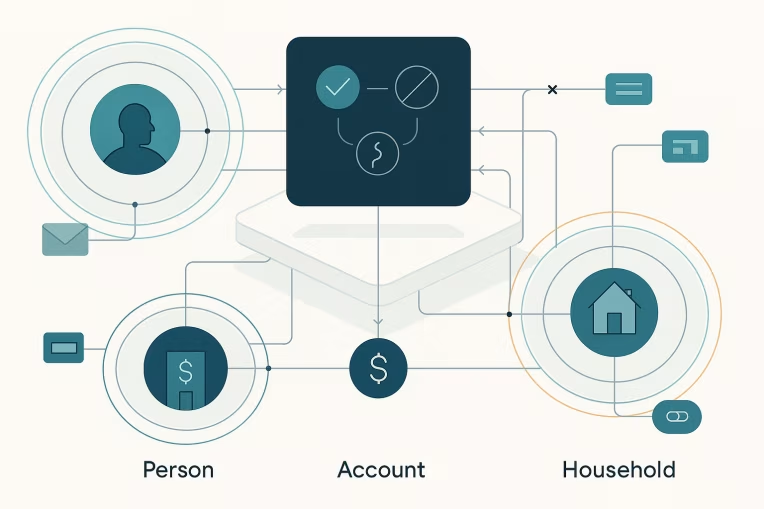
A person entity usually represents an individual human with attributes, behaviors, permissions, and engagement history. A household entity typically represents a shared context such as:
- a family at the same residential address
- multiple people under one subscription or billing relationship
- members of a loyalty arrangement with shared benefits
- related individuals linked through a partner or service account structure
An account entity is different again. It often represents a commercial or service relationship, such as a subscription, policy, utility service, or partner-managed customer record. An account can have one person, many people, or change ownership over time.
These differences create governance implications:
- A household can exist without a shared account.
- An account can exist without a stable household.
- A person can belong to more than one relevant grouping over time.
- An address can indicate co-location without indicating shared consent or shared eligibility.
So while identity resolution focuses on match and merge logic, householding requires explicit decisions about entity boundaries, relationship types, and activation scope.
Common failure modes: shared emails, family accounts, B2B2C relationships, and service addresses
Householding problems often surface in ordinary operating conditions rather than exotic edge cases.
Shared emails are a classic example. A parent may create an account using one email address, while another family member later uses the same address for support, preferences, or purchase follow-up. If the CDP treats the email as a strict person identifier, the result can be an over-merged profile. If it treats the email as a simple contact point with no governance, duplicate activation may follow instead.
Family accounts create a different issue. A streaming, telecom, travel, or retail membership may have one billing owner and several active users. If all usage events are pushed into a single profile, personalization becomes noisy. If all members inherit the account owner's status or preferences without rules, the platform may over-target or suppress the wrong people.
B2B2C relationships can be even more complex. A partner, employer, franchise, or intermediary may own the commercial relationship while end users carry the engagement behavior. In those models, the account entity is real and operationally important, but it should not replace the person entity.
Service addresses introduce another source of confusion. A service location may connect multiple individuals to the same property, contract, or service line, but that does not mean they are interchangeable for messaging or consent purposes. Service addresses can be useful relationship evidence without being sufficient proof of a household treatment boundary.
The common failure pattern is simple: a shared identifier or shared relationship is mistaken for a universal right to merge, inherit, or activate.
Individual profile vs household entity: when to model each
Not every customer data program needs a formal household entity. In some cases, adding one creates more complexity than value. The right decision depends on whether shared context materially improves measurement or activation.
A household model can add value when the business needs to:
- avoid duplicate outreach to people in the same residence
- evaluate reach or conversion across related individuals
- coordinate offer strategy for shared plans, memberships, or subscriptions
- manage communications where a household-level benefit or status matters
- separate residential context from person-level behavior
A household model can add risk when:
- the relationship evidence is weak or unstable
- data refresh is slow and household composition changes often
- consent and preference handling are immature
- activation teams cannot see which rules are household-based versus person-based
- downstream tools only support person-level audiences and messages
A practical modeling approach usually starts with three distinct concepts:
- Person: the individual customer or known contact.
- Account: the commercial, contractual, subscription, or service relationship.
- Household: a shared residential or family-like grouping used for limited business purposes.
Those concepts do not need identical technical treatment in every platform. Some CDPs support multiple entity types directly. Others require relationship tables, derived views, graph layers, or curated activation datasets. The implementation pattern can vary. The governance principle should not: do not collapse different business entities into one profile just because the platform makes one profile easier to work with.
A useful decision test is this: if the same record set must support eligibility, personalization, reporting, and suppression, can your team always explain whether a given rule applies to a person, an account, or a household? If not, the model is probably too implicit.
Attribute inheritance, survivorship, and conflict handling across identity layers
The moment you introduce more than one entity layer, you also introduce inheritance questions.
Should an individual inherit household income range? Should the household inherit a preferred language if only one member expressed it? Should an account status such as active, delinquent, or premium be visible to all related people for activation? There is no universal answer. There must be explicit policy.
In practice, teams should define inheritance rules by attribute class, not one attribute at a time in isolation. A simple governance structure can classify attributes into groups such as:
- person-only attributes: date of birth, individual preferences, direct engagement behavior, authentication state
- account-scoped attributes: subscription status, billing tier, service entitlement, plan type
- household-scoped attributes: residential reach counts, deduplication keys, household-level propensity summaries used only for selected use cases
- derived cross-entity attributes: indicators created from combined logic, such as "has another active member on plan" or "household already exposed to campaign"
Survivorship also needs care. Many CDP teams are comfortable defining survivorship within a person profile, such as trusted source priority or latest update wins. But cross-entity survivorship is more dangerous. A household should not become a dumping ground for unresolved person conflicts.
For example:
- If two people in the same household have different communication preferences, that is not a conflict to "resolve" into one household value.
- If one account owner is premium and another member is basic, that may reflect different scopes rather than bad data.
- If one person is active and another is dormant, a blended lifecycle status can make activation less accurate for both.
A better pattern is to preserve original scope and derive only the minimum shared attributes needed for a known business purpose.
Documenting conflict handling is especially important for derived audiences. If a campaign uses "household has active subscription" plus "person has no recent engagement," someone should be able to inspect how those conditions were sourced and at what entity level they were resolved.
Consent, suppression, and activation boundaries for shared entities
This is where implicit household logic creates the most operational risk.
Consent, preference, and suppression signals are often collected from individuals, but activation teams may be tempted to apply them at broader levels for convenience. That can create under-messaging, over-messaging, or inconsistent treatment.
A safe operating principle is to treat activation boundaries as a first-class design decision. For each use case, define:
- which entity qualifies for the audience
- which entity carries the contactability signal
- which entity carries suppression or exclusion logic
- whether exposure should be capped at person, account, or household level
- whether any household-level rule is a delivery optimization or a business requirement
Consider a few examples.
Example 1: household-level deduplication
A retailer may want only one physical mail piece per residential household. That does not require merging all people into one person profile. It requires a household grouping used specifically for deduplication and distribution logic.
Example 2: account-level eligibility with person-level messaging
A telecom offer might depend on account plan status, but the message is sent to a specific known contact. In that case, account data helps determine eligibility, while person-level permissions still govern outreach.
Example 3: suppression after one household conversion
A shared subscription acquisition campaign may choose to suppress other household members after one member converts. That can be a sensible business rule, but it should be explicit, time-bound, and visible in reporting. It should not happen accidentally because conversion data rolled up into a blended profile.
Teams do not need to make legal conclusions in the data model, but they do need operational clarity. If the system cannot distinguish individual permissions from household-level treatment policies, activation becomes hard to trust.
Reporting and audience design pitfalls when household logic is hidden
When household logic is hidden, reporting often looks cleaner than reality.
An audience may appear larger because duplicate related people were included. A conversion rate may look higher because one household purchase is attributed across multiple targeted individuals. Frequency controls may seem intact even though several people at the same address all received near-identical outreach.
This creates two serious issues.
First, teams can no longer diagnose performance accurately. Was the uplift driven by person-level targeting, account status, or household spillover? Without entity-aware reporting, the answer is unclear.
Second, governance breaks silently. Analysts and marketers may assume a segment is person-based because it lives in a person-centric CDP UI, even though parts of its logic are household-derived.
To reduce this risk, audience design should include explicit metadata such as:
- primary audience entity: person, account, or household
- qualifying entity: where eligibility was determined
- delivery entity: who or what receives treatment
- deduplication entity: where exposure control happens
- attribution entity: where outcomes are counted first
This kind of metadata may live in naming conventions, workflow documentation, semantic layers, or activation catalogs. The exact tool matters less than the discipline. If a segment cannot be described in these terms, it is likely too ambiguous for reliable reuse.
Reporting should also be able to answer simple but important questions:
- How many unique people were targeted?
- How many unique households were represented?
- How many account relationships were involved?
- Were suppressions triggered by person rules or shared-entity rules?
- Did outcome attribution happen at the same entity level as targeting?
Without these views, household-aware activation often produces apparent precision with hidden distortion.
A governance model for safer household-aware activation
A workable governance model does not need to be heavy, but it does need to be explicit.
A practical starting framework can include seven components.
1. Entity definition standard
Create plain-language definitions for person, account, household, address, service location, device, and any other relevant shared entity. Include examples and non-examples. Most confusion starts because teams use the same word differently.
2. Relationship taxonomy
Define what kinds of links are allowed between entities. For example:
- person belongs to account
- person is associated with household
- account is serviced at address
- person is billing contact for account
- person is beneficiary or user on account
This helps prevent teams from over-interpreting weak ties.
3. Scope-based attribute policy
Classify attributes by their native scope and define whether they can be copied, derived, aggregated, or exposed across entities. This is the foundation for trustworthy activation datasets.
4. Use-case approval criteria
Do not model householding just because it seems sophisticated. Approve household-aware use cases only when there is a measurable business reason, sufficiently reliable relationship data, and a clear method for handling suppression and reporting.
5. Segment and activation guardrails
Require audience builders to declare entity scope. Restrict certain fields from use outside their intended level. If household-level fields are exposed in person-level segmentation, label them clearly and document safe usage patterns.
6. Monitoring and exception review
Track signs that household logic is drifting or overreaching, such as:
- rising profile merge reversals
- unexplained suppression growth
- high rates of shared identifier reuse
- inconsistent counts across campaign, analytics, and service systems
- repeated disputes over who qualified for an audience
These are usually governance symptoms before they become major operational issues.
7. Decision ownership
Assign clear owners across architecture, governance, analytics, and activation. Householding decisions sit at the intersection of all four. If no one owns the cross-functional consequences, implicit rules will fill the gap.
Implementation guidance for CDP teams
For teams operationalizing this work, a phased approach is often more effective than trying to build a universal household model all at once.
Phase 1: clarify existing entity confusion
Audit current segments, activation feeds, and reporting outputs. Identify where person, account, and household logic are already mixed. Many organizations discover they already have householding behavior even though they have never named it that way.
Phase 2: prioritize a narrow use case
Start with one scenario where shared context clearly matters, such as direct mail deduplication, family plan upsell suppression, or account-based eligibility with person-level contactability.
Phase 3: define minimal relationship data
Use only the evidence needed for the chosen use case. Do not assume every shared address means a household, and do not assume every account relationship implies equal activation rights.
Phase 4: publish explicit business rules
Document qualification, inheritance, suppression, and attribution rules in language that marketers, analysts, and engineers can all validate.
Phase 5: test with parallel reporting
Before scaling, compare outcomes at multiple entity levels. Validate person counts, household counts, and account counts separately so distortion becomes visible early.
Phase 6: expand only when governance keeps pace
If a new use case requires different household logic, treat it as a new decision rather than reusing the first model by default.
This approach keeps householding grounded in business utility instead of turning it into an abstract modeling exercise.
Conclusion
Householding in a CDP is not just an identity resolution enhancement. It is a governance choice about where shared context should influence activation and where it should not.
The most important discipline is not building the largest possible identity graph. It is preserving clear boundaries between person, account, and household so each can be used intentionally. When those layers blur together, segmentation becomes harder to trust, suppressions become harder to explain, and personalization starts reflecting data structure accidents instead of business logic.
The organizations that handle household-aware activation well usually do something simple but uncommon: they make their identity rules explicit. They define which entity qualifies, which entity inherits, which entity can be contacted, and which entity owns the outcome.
That clarity does not remove every edge case. But it does make shared accounts, family profiles, and related customer structures far safer to operationalize at scale.
Tags: CDP, CDP householding governance, Identity resolution, Data governance, Segmentation, Customer profiles, Activation architecture