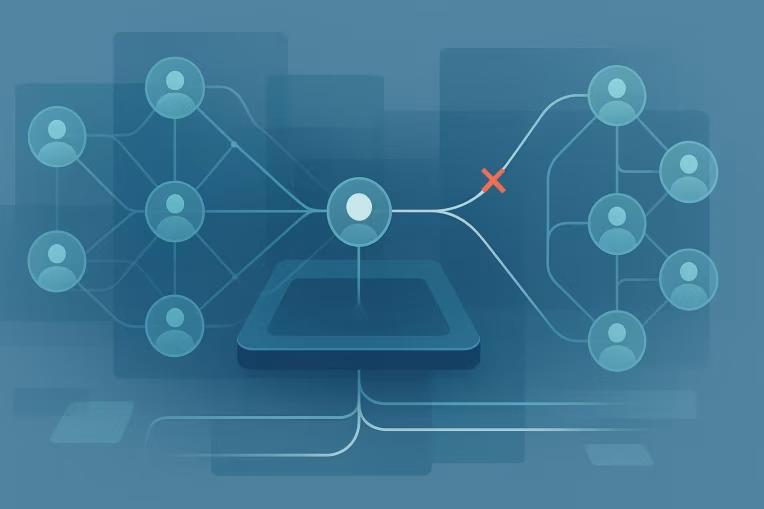
Identity resolution programs usually spend most of their design energy on matching: linking identifiers, combining events, and producing a usable customer profile for analytics and activation. That focus makes sense. But it leaves an operational blind spot.
When matching rules create a false merge, the problem is not only that two people were linked incorrectly. The harder problem is that the bad link can propagate into audiences, CRM updates, personalization decisions, suppression logic, and consent enforcement. By the time someone notices, the issue is no longer just in the identity graph. It is distributed across the operating model.
That is why CDP unmerge workflows matter. They are not a niche administrative feature. They are part of identity resilience. Mature programs need a governed way to investigate suspicious links, separate profiles safely, restore downstream state where possible, and document exactly what happened.
A good unmerge process does not pretend history never happened. It preserves lineage, protects compliance controls, and makes remediation explicit. In practice, that means treating unmerge as a controlled recovery workflow rather than a simple delete or reset action.
Why bad merges require a recovery model
A false merge can happen for ordinary reasons:
- a shared device creates ambiguous behavioral signals
- a reused email address gets imported from an old system
- household members are mistaken for one person
- CRM data arrives with weak keys or duplicated records
- legacy survivorship rules over-trust one source over another
In each case, the issue is not just incorrect linkage. The merged profile may already have:
- inherited attributes from both people
- combined consent states that should remain separate
- entered audiences based on mixed behaviors
- triggered personalization or messaging on the wrong assumptions
- updated downstream systems with incorrect profile identifiers
That is why recovery must be designed as a workflow. Teams need to answer several questions in sequence:
- Is the merge actually wrong?
- Which identifiers and records should be separated?
- What historical evidence should remain attached to lineage?
- Which downstream systems must be repaired?
- Who approves the change, and how is it audited?
Without a recovery model, teams often improvise. One group manually edits a record in the CDP, another removes a person from an audience, and a third updates CRM independently. The result is partial remediation, inconsistent history, and recurring confusion.
Common causes of false merges that surface late
Some identity issues show up quickly. Others remain hidden until activation outcomes make the problem visible.
A few common patterns surface late in enterprise environments.
Shared device or browser behavior can create linking signals that look persuasive in the short term. If a family tablet, retail kiosk, call center device, or shared workplace terminal is involved, anonymous events may attach to the wrong known person after login.
Reused or recycled contact points are another source. A secondary email address, temporary phone number, or dormant account can be reassigned or reintroduced through batch imports. If matching logic overweights that field, separate individuals may collapse into one profile.
Household confusion often appears when multiple people share an address, payment method, or subscription context. The graph may blur household-level signals with person-level identity.
CRM imports and legacy migrations can introduce duplicate customer records with inconsistent identifiers. Once loaded into the CDP, survivorship rules may choose the wrong dominant value or pull too many records under a single profile.
Overly aggressive stitching thresholds are also common. When programs push for broader match rates, they sometimes accept weak combinations of signals that are not stable enough for person-level identity.
These issues surface late because business users usually discover them indirectly:
- audience membership looks wrong
- consent handling seems inconsistent
- one customer receives messaging intended for another
- analytics show impossible journeys or blended lifecycle states
- service teams notice conflicting account details in downstream tools
By that stage, the organization does not need better theory about matching alone. It needs a repeatable path for false merge remediation.
What an unmerge workflow must preserve: lineage, consent, activation state
The central design principle is simple: separate profiles without rewriting operational truth.
A robust unmerge workflow should preserve at least three things.
1. Lineage
Teams need to know:
- which identifiers were linked
- when the merge occurred
- which rule or process caused it
- what evidence supported the original link
- when and why the split was executed
This lineage matters for debugging, governance, and future rule tuning. If teams only restore the current profile state but lose the causal trail, they make the same mistakes again.
2. Consent and policy state
Consent is especially sensitive during unmerge. If one merged profile had email permission and the other did not, the combined state may have already influenced activation. Unmerge should not simply recalculate consent from scratch without a documented basis. Teams need to reattach policy-relevant facts to the right subject, source, and timestamp wherever possible.
That often means preserving:
- original consent events and their source systems
- jurisdiction or policy context
- channel-level preferences
- effective dates and updates
- uncertainty flags where attribution cannot be fully reconstructed
3. Activation state
Downstream systems may have consumed the merged profile as if it were valid. Unmerge must account for that by identifying which audience memberships, suppressions, traits, or personalization decisions need review or rollback.
Not every downstream action can be perfectly reversed. Some communications will already have been sent. Some model features may already have been scored. Some exports may have been consumed externally. The goal is not to erase the past. The goal is to restore forward-looking correctness and document residual impact.
Investigation steps: evidence, confidence signals, and impact radius
Before splitting anything, teams should run an investigation process that distinguishes suspicion from confirmed error.
A practical workflow typically includes the following steps.
Step 1: Open a case with a clear trigger
Triggers may come from service teams, marketing operations, governance reviews, analytics anomalies, or automated exception monitoring. The case should capture the reason for review, the affected profile ID, and the systems likely involved.
Step 2: Review the identity evidence
Investigators should inspect the linking basis used to connect the records. Important signals include:
- shared identifiers
- event chronology
- device usage patterns
- source-system reliability
- whether the link came from deterministic or probabilistic logic
- survivorship outcomes after the merge
The purpose is not just to ask whether two records are different. It is to understand why the system believed they were the same.
Step 3: Score confidence in the false merge finding
Not every ambiguous profile should be split immediately. Teams need decision thresholds. For example, a review may require contradictory legal names across trusted systems, mutually exclusive account ownership, or evidence that a shared device drove the link.
This is where governance matters. The organization should define what constitutes enough evidence to unmerge, especially when downstream impact is high.
Step 4: Assess impact radius
Once the false merge is considered likely, the team should map impact across:
- source records and identifiers
- consent and preference state
- audience memberships
- CRM synchronization
- analytics reporting
- personalization and recommendation inputs
- service workflows and support tools
The impact radius determines urgency and the order of remediation.
Step 5: Decide remediation path
Some cases require a straightforward split of two distinct individuals. Others reveal broader data quality problems that need upstream fixes first. If the same weak identifier will just cause a re-merge tomorrow, the team should pause and address the root cause before executing the split.
Designing profile split rules without rewriting history
The technical challenge in unmerge design is that a merged profile usually contains mixed assets:
- identifiers
- traits and golden record fields
- event history
- consent facts
- audience states
- derived scores or classifications
A naive split can create as many problems as it solves.
The better approach is to define profile split rules that separate what can be reassigned confidently from what should remain historically attributed with lineage.
A few principles help.
Separate identifiers from historical events
Identifiers such as email addresses, account IDs, CRM IDs, device IDs, and login IDs should be reassigned based on evidence and source authority. Historical events may require more care. Some events can be clearly reattached to one person; others may need to remain linked to an audit trail if attribution is uncertain.
Use effective-dated state where possible
If the platform and operating model support temporal lineage, keep track of when identity associations were considered valid. This allows teams to represent that a profile was merged at one point, then split later, without pretending the system always knew the right answer.
Preserve source truth rather than overwriting it
If CRM and commerce systems provide conflicting attributes, the split process should not invent a new truth manually unless governance explicitly allows it. Prefer restoring fields based on authoritative source records and survivorship policies.
Flag unresolved ambiguity
In some cases, not every event or trait can be confidently assigned after a false merge. Rather than forcing certainty, mature teams create review flags, quarantine specific attributes, or limit activation eligibility until confidence is restored.
Prevent immediate re-merge
An unmerge action is incomplete if the same matching logic can recombine the profiles in the next processing cycle. The workflow should include temporary exclusion logic, rule overrides, identifier suppression, or upstream corrections so the recovery holds.
This is why identity resolution recovery is not just an operations task. It feeds directly back into graph design, matching thresholds, and data governance policy.
Downstream repair across CRM, audiences, analytics, and personalization
Splitting the profile in the CDP is only the midpoint. The rest of the work is downstream repair.
CRM and service systems
If the merged profile pushed updates into CRM or support tooling, teams may need to:
- restore correct account ownership or contact mapping
- reassign activities or notes where possible
- correct segmentation or lifecycle fields
- notify service teams of residual ambiguity
The exact mechanics vary, but the principle is consistent: do not assume the CDP is the only system that needs correction.
Audiences and campaign eligibility
Audience repair is often the most urgent marketing concern. After unmerge, teams should reevaluate:
- current audience inclusion and exclusion
- suppression lists
- journey entry criteria
- frequency caps and contact policies
- lookalike or seed audiences if affected
Some programs benefit from a temporary hold state so that recently unmerged profiles do not activate until recalculation finishes.
Analytics and reporting
Analytics remediation depends on purpose. Operational dashboards may need refreshed profile counts or audience numbers. Long-term historical reporting may require annotation instead of restatement, especially if downstream reports have already been distributed.
The key is to define which metrics are recomputed and which are preserved with an explanation. Otherwise, teams can create confusion by silently changing numbers after the fact.
Personalization and decisioning
Personalization systems may have cached traits, affinities, or recommendations derived from the merged profile. These should be refreshed or invalidated if they are likely to continue driving incorrect experiences.
In high-risk contexts, teams may choose a conservative fallback experience until enough clean signals accumulate for each separated profile.
This downstream work is where data activation architecture becomes a real operating concern. It is rarely a single click. It is usually a coordinated repair process across systems with different refresh cycles, APIs, and ownership models.
Operational ownership, approvals, and audit logs
Because profile splitting affects customer data governance, unmerge should not be an unrestricted admin action.
A sustainable model usually assigns clear roles:
- operations or platform teams manage execution mechanics
- data governance teams define evidence standards and approval paths
- marketing operations or CRM owners assess campaign impact
- privacy, risk, or compliance stakeholders advise on sensitive cases where consent or regulated data is involved
Approval depth should match impact. A low-risk split of duplicate internal test data does not need the same scrutiny as a production profile with broad omnichannel activation.
Audit logs should capture:
- initiating user or team
- timestamp of review and execution
- reason code for unmerge
- evidence summary
- affected identifiers and records
- systems notified or repaired
- temporary rule suppressions or overrides applied
- follow-up actions and closure status
This record creates accountability, but it also improves the identity program over time. Patterns in unmerge cases can reveal weak match rules, poor source quality, or insufficient policy controls.
Metrics and runbooks for identity recovery readiness
Many teams only discover they lack an unmerge capability when a high-visibility incident occurs. A better approach is to measure readiness before that happens.
Useful operational metrics can include:
- number of suspected false merges opened for review
- percentage confirmed after investigation
- average time to triage and time to remediate
- downstream systems affected per incident
- repeat incidents caused by the same upstream source or rule
- percentage of cases requiring manual exception handling
- rate of re-merge after corrective action
These metrics should not be used to chase zero incidents unrealistically. Identity systems operate under ambiguity. The goal is to reduce avoidable errors, improve detection, and make recovery safer.
Runbooks are equally important. A strong runbook should define:
- triggers for investigation
- minimum evidence required
- escalation thresholds
- execution sequence across systems
- rollback or hold controls for activation
- post-incident review steps
- rule tuning and governance feedback loops
Teams that document these steps are usually better positioned to handle growth in channels, identifiers, and activation complexity.
Building unmerge into CDP architecture from the start
The most common mistake is to treat unmerge as an afterthought. In reality, it should influence architecture decisions early.
When evaluating identity models and operating processes, teams should ask:
- Can we trace why two profiles were linked?
- Can we separate identifiers without destroying lineage?
- Can we quarantine uncertain state?
- Can we prevent immediate re-merge?
- Can we identify every downstream dependency that consumed the merged profile?
- Can we prove what was changed, by whom, and why?
If the answer to those questions is unclear, the identity graph may be optimized for matching speed but not for operational trust.
For organizations investing in customer data platforms, that distinction matters. A customer identity graph is not only a unification engine. It is also part of the governance layer that supports consent, activation reliability, and business accountability.
Path to Project often works with teams on exactly this boundary: aligning CDP platform architecture, customer identity graph architecture, and customer data governance so that operational edge cases are handled deliberately rather than informally. False merge remediation is one of the clearest tests of whether that operating model is mature.
Conclusion
Bad identity links are inevitable in real-world customer data ecosystems. Shared devices, reused identifiers, household ambiguity, and source-system inconsistencies can all create false merges, even when matching logic is well designed.
What separates mature programs from fragile ones is not whether errors ever occur. It is whether the organization can investigate them, split profiles safely, repair downstream impact, and preserve an auditable record of what changed.
That is the real value of CDP unmerge workflows. They turn identity resolution recovery into a governed capability instead of a manual scramble. And as activation grows more personalized, regulated, and cross-channel, that capability becomes essential to trust in the platform itself.
Tags: CDP, CDP unmerge workflows, identity resolution recovery, false merge remediation, customer identity graph, customer data governance