
 [01]
[01]Discovery Sprint
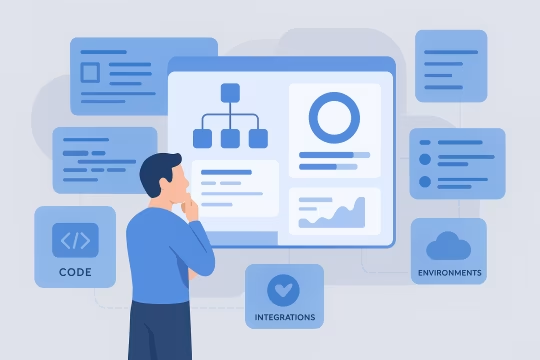
Time-boxed assessment of the current platform, constraints, and delivery workflows. Outputs include architectural drivers, key risks, and an inventory of code, plugins, integrations, and environments.
Enterprise WordPress architecture
Assess codebase structure, environment consistency, integration boundaries, and upgrade risk across your enterprise platform.
Built for multi-site, composable, and security-conscious WordPress estates.
No login required. Takes 2–3 minutes.
Enterprise WordPress architecture defines how code, content, infrastructure, and integrations fit together so the platform can evolve without destabilizing delivery. This WordPress platform architecture design work covers decisions such as multi-site topology, plugin and theme boundaries, dependency management, environment parity, data and cache strategy, and how external systems (identity, search, analytics, CRM) connect to WordPress using consistent patterns.
Organizations need this capability when WordPress moves beyond a single marketing site into a platform supporting multiple brands, regions, or product lines. Without explicit architectural constraints, teams tend to accumulate one-off plugins, inconsistent deployment paths, and environment drift that makes changes risky—especially in scalable WordPress multisite environments.
A well-defined architecture establishes repeatable patterns for building and operating WordPress at scale: a composable codebase managed with Composer, predictable runtime configuration across environments, clear extension points, and integration contracts. This reduces coupling between teams, improves upgradeability, and creates a foundation for reliable operations, WordPress security and governance, and long-term platform evolution.
Core Focus
Best Fit For
Key Outcomes
Technology Ecosystem
Platform Integrations
As WordPress platforms expand to support multiple sites, teams, and release streams, architectural decisions often remain implicit. Plugins and themes accumulate without clear boundaries, environment configuration diverges between local, staging, and production, and deployment processes become a mix of manual steps and ad-hoc scripts. Over time, the platform becomes harder to reason about because there is no shared reference for how the system should be composed and operated.
These conditions create architectural coupling: a change intended for one site affects others, plugin conflicts surface late, and upgrades to WordPress core or PHP become high-risk events. Integration work also becomes brittle when external systems are connected through inconsistent patterns, undocumented credentials, or direct database access. Engineering teams spend increasing effort diagnosing environment-specific issues rather than improving the platform.
Operationally, the platform becomes difficult to scale and secure. Performance tuning is reactive, caching layers are inconsistently applied, and incident response is slowed by limited observability and unclear ownership. Delivery slows as teams introduce more approvals and workarounds to compensate for uncertainty, increasing both lead time and operational risk.
Review the current WordPress estate, delivery workflows, hosting/runtime constraints, and key business domains. We map site topology, plugin/theme inventory, integration touchpoints, and operational pain points to establish architectural drivers and non-functional requirements.
Define target-state principles and constraints: tenancy model (single vs multisite), extension boundaries, configuration strategy, and environment parity. We document decision records and identify where standardization is required to reduce coupling and upgrade risk.
Design a composable repository structure using Composer for dependency management and repeatable builds. Establish conventions for mu-plugins, custom plugins, themes, and shared libraries, including versioning and release branching aligned to enterprise change control.
Specify integration patterns for identity, search, analytics, and upstream/downstream APIs. Define authentication approaches, data ownership, error handling, and retry semantics so integrations remain stable across releases and can be validated in non-production environments.
Define runtime configuration, secrets handling, caching layers, and MySQL strategy (indexes, query patterns, backups, and replication where relevant). Establish performance budgets and operational guardrails to prevent regressions as features and content grow.
Model threat surfaces and define controls: least-privilege access, plugin supply-chain constraints, update policies, and hardening for admin and API endpoints. Align architecture with enterprise security requirements and incident response expectations.
Introduce architecture validation through automated checks: dependency scanning, configuration linting, and environment build verification. Where applicable, define smoke tests for critical user journeys and integration health to catch regressions before release.
Establish governance for architectural decisions, plugin intake, and lifecycle management. Define upgrade paths for WordPress core, PHP, and dependencies, and set a cadence for reviewing metrics, incidents, and technical debt to guide ongoing evolution.
This service focuses on the architectural foundations required to run WordPress as an enterprise platform rather than a single site. It defines composable code structures, clear extension boundaries, and integration contracts that reduce coupling and improve upgradeability. The approach emphasizes operability: environment parity, predictable configuration, security controls, and performance-aware data design. The result is a platform that can scale across teams and sites while remaining maintainable under continuous change.

A documented target-state architecture that defines platform principles, constraints, and decision records. It clarifies site topology, responsibility boundaries, and the expected runtime model so teams can implement features consistently and evaluate changes against agreed architectural drivers.

Architecture for single-site, multisite, or hybrid estates, including tenancy boundaries, shared services, and content governance implications. The design addresses how code and configuration are shared, how releases are coordinated, and how isolation is maintained between brands or regions.

A repository and packaging model that supports repeatable builds and controlled change. Composer is used to manage WordPress core, plugins, and shared libraries, with conventions for custom plugins, mu-plugins, and themes to keep extension points explicit and maintainable.

Clear rules for what belongs in themes versus plugins, how shared functionality is packaged, and how dependencies are managed to avoid conflicts. This includes plugin intake criteria, version constraints, and patterns that reduce tight coupling to WordPress internals.
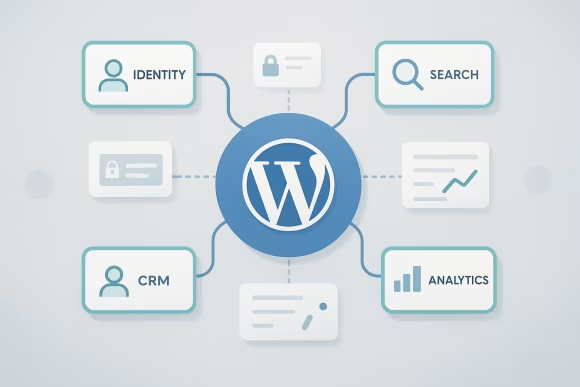
Standardized patterns for connecting WordPress to identity, search, analytics, and external APIs. The capability defines authentication and authorization approaches, data contracts, error handling, and observability signals so integrations can be tested and operated reliably.
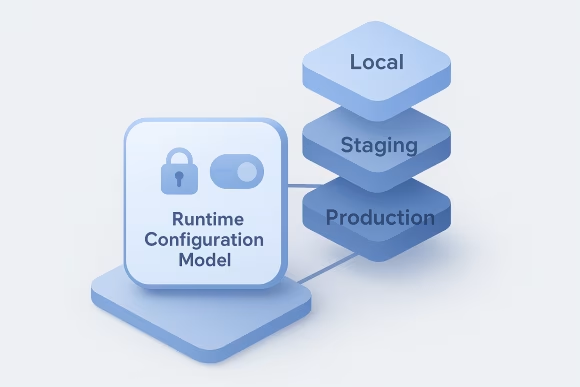
A consistent approach to environment configuration, secrets, and operational toggles across local, staging, and production. The model reduces environment drift and supports predictable deployments, while keeping sensitive configuration out of the codebase.
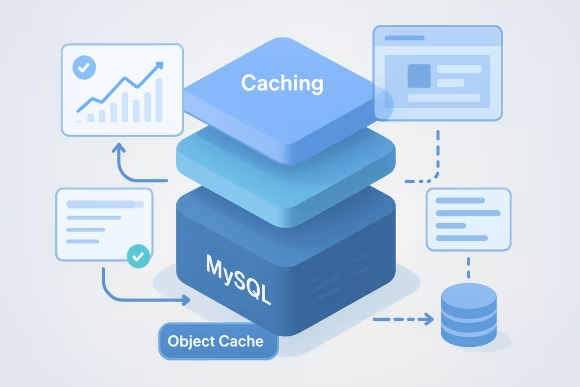
Architecture for caching layers, object cache strategy, and MySQL performance considerations aligned to content and traffic patterns. It includes guidance on query behavior, indexing, background processing, and performance budgets to prevent regressions during ongoing development.

Controls that reduce platform risk over time: dependency and plugin governance, hardening guidance, and upgrade paths for WordPress core and PHP. The capability focuses on minimizing breaking changes, validating updates in representative environments, and maintaining a secure operational posture.
Use the Health Check to surface weak boundaries, inconsistent environments, and architecture decisions that increase operational risk.
Engagements follow a clear engineering sequence from discovery through target architecture design and implementation validation. Depending on scope, work is delivered as an assessment, a co-designed reference architecture, or embedded support during a platform build or modernization program—covering scalable WordPress multisite architecture, WordPress security and governance, and high availability WordPress hosting considerations where relevant.
[01]Time-boxed assessment of the current platform, constraints, and delivery workflows. Outputs include architectural drivers, key risks, and an inventory of code, plugins, integrations, and environments.
 [02]
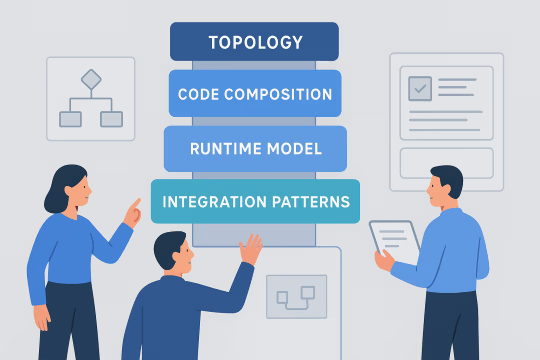
[02]Define the target-state architecture and decision records covering topology, code composition, runtime model, and integration patterns. The result is a set of standards teams can implement and validate against.
 [03]
[03]Translate architecture into a pragmatic roadmap with milestones, dependencies, and risk-reduction steps. This includes upgrade sequencing, deprecation plans, and work packages aligned to team capacity.
 [04]
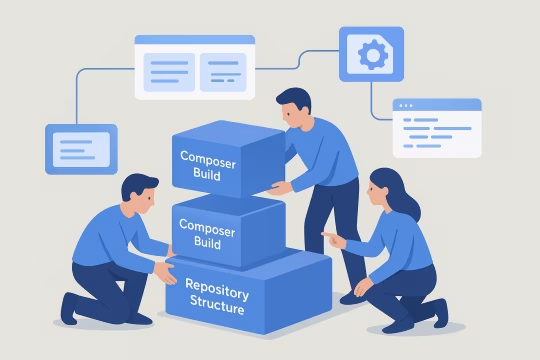
[04]Implement a thin vertical slice to validate the architecture in code: repository structure, Composer build, environment configuration, and a representative integration. This reduces uncertainty before broader rollout.
 [05]
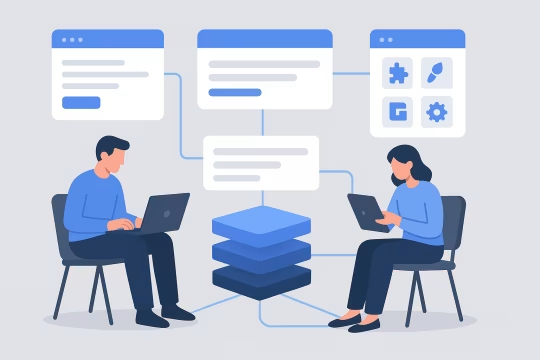
[05]Support engineering teams with reviews, pairing, and templates to apply standards consistently. Establish contribution guidelines and patterns for new plugins, themes, and integrations.
 [06]
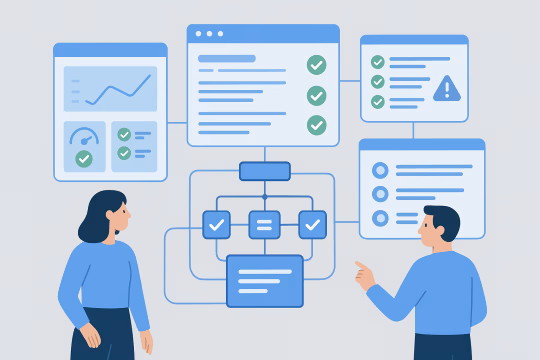
[06]Introduce automated checks for dependency health, configuration consistency, and environment builds. Define smoke tests and operational readiness criteria to catch regressions early.
 [07]
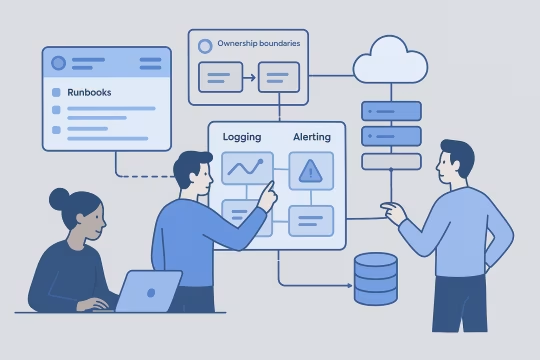
[07]Align logging, metrics, alerting, and runbooks with the architecture so incidents can be diagnosed quickly. Define ownership boundaries and escalation paths across platform and product teams.
 [08]
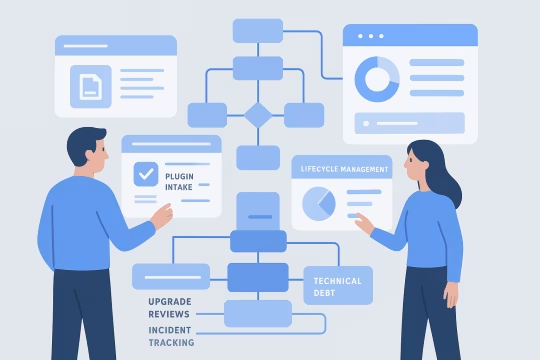
[08]Set up lightweight governance for architectural decisions, plugin intake, and lifecycle management. Establish a cadence for reviewing upgrades, incidents, and technical debt to keep the platform maintainable.
Enterprise WordPress architecture services reduce delivery friction by making platform behavior predictable across teams and environments. They lower operational risk by standardizing WordPress integration patterns for enterprise, security controls, and upgrade paths, while improving maintainability as the WordPress estate grows. When availability requirements are high, a clearer architecture also supports more consistent decisions around high availability WordPress hosting and operability.
Clear dependency management and extension boundaries reduce surprises during WordPress core, PHP, and plugin upgrades. Teams can validate changes in representative environments and roll forward with controlled release sequencing.
Standardized architecture patterns reduce time spent debating implementation approaches and diagnosing environment-specific issues. Teams can ship changes with fewer regressions and less rework across sites.
A consistent runtime model, caching strategy, and observability signals improve platform stability. Incidents are easier to triage because configuration, ownership, and failure modes are better defined.
Defined tenancy and release boundaries help organizations scale to multiple brands or regions without uncontrolled coupling. Governance rules for plugins and shared code reduce cross-site impact from local changes.
Architecture-level controls for access, secrets, and dependency intake reduce common WordPress risk vectors. Security requirements can be implemented as repeatable patterns rather than one-off fixes.
Integration contracts and standardized patterns reduce brittle point-to-point implementations. External system changes are easier to accommodate because authentication, data ownership, and error handling are explicit.
Composable codebases and lifecycle governance reduce long-term maintenance costs. Teams spend less time managing plugin conflicts and more time improving product capabilities.
Documented standards and decision records clarify responsibilities across platform, product, and operations teams. This improves coordination, reduces duplicated effort, and supports consistent technical decision-making.
Architecture review path
Identify the architecture gaps affecting scalability, security, and operability, then review the findings with a focused architecture discussion.
No login required. Takes 2–3 minutes.
Adjacent services that extend enterprise WordPress architecture into implementation, scalable WordPress multisite architecture execution, integrations, operations, and long-term platform evolution.
WordPress content architecture design for content models, taxonomies, and editorial structure
Enterprise WordPress network design for multi-site ecosystems
Enterprise WordPress extensibility with controlled dependencies
Enterprise WordPress migration and replatforming services
Upgrade-ready architecture, WordPress CI/CD and DevOps, and operational hardening
Modernize CMS architecture and delivery workflows
GA4 event tracking WordPress with governed measurement
WordPress REST API engineering and GraphQL API design
WordPress lead contact sync with secure lead capture
Common architecture, operations, integration, governance, and engagement questions for enterprise WordPress platforms.
We evaluate the decision as a tenancy and governance problem rather than a purely technical preference. Multisite can simplify shared code, shared user management, and centralized governance, but it also increases coupling: a release, plugin change, or configuration issue can impact many sites at once. Separate installations improve isolation and allow different release cadences, but they increase duplication and operational overhead. We typically assess: (1) how much code and functionality must be shared, (2) the required level of isolation between brands/regions, (3) differences in compliance requirements, (4) expected release frequency and ownership model, and (5) operational maturity for managing many environments. We also consider data boundaries, media handling, and how identity and SSO should work across properties. The output is a recommendation with explicit trade-offs, plus a target topology and migration path. In some enterprises, a hybrid model is appropriate: multisite for closely related properties and separate installations for high-risk or independently governed sites.
A reference architecture is a set of documented decisions and constraints that make the platform predictable to build and operate. It typically includes: the site topology (single, multisite, or hybrid), the codebase composition model (Composer strategy, repository layout, and how custom code is packaged), and extension boundaries (what belongs in themes vs plugins, and how shared functionality is managed). It also covers runtime architecture: environment parity, configuration and secrets handling, caching layers, and MySQL considerations aligned to traffic and content patterns. For integrations, it defines standard patterns for authentication, data contracts, error handling, and observability signals so external dependencies are not implemented differently by each team. Finally, it includes governance: plugin intake criteria, lifecycle management, upgrade policy for WordPress core/PHP/dependencies, and decision records (ADRs) that explain why choices were made. The goal is not heavy documentation; it is enough structure that teams can implement consistently and evaluate changes without re-litigating fundamentals.
Environment parity is achieved by making the runtime reproducible and configuration-driven. We typically standardize on containerized local development (often Docker) and align PHP extensions, web server behavior, and key dependencies with non-production and production environments. Configuration is externalized so that code artifacts remain the same across environments, while environment-specific values (domains, credentials, feature flags) are injected securely. We also define a clear build and release artifact: what is built, when it is built, and how it is promoted. Composer lockfiles and deterministic build steps reduce “works on my machine” drift. For WordPress specifically, we pay attention to filesystem write behavior, media handling, cron/background tasks, and caching configuration because these often differ between environments and cause late-stage defects. Operationally, parity includes observability: consistent logging and metrics across environments, and smoke tests that validate critical paths after deployment. The objective is to make staging a reliable predictor of production behavior, not just a place to click around.
The highest-leverage practices are those that reduce uncertainty during change and incidents. First, establish a repeatable release process with clear artifacts, rollback/roll-forward strategy, and automated checks for dependency health and configuration consistency. Second, implement observability that is actionable: structured logs, key performance metrics (TTFB, cache hit rate, DB query behavior), and alerts tied to user-impacting symptoms. Third, define caching and data practices explicitly. WordPress performance issues are often caused by inconsistent object caching, unbounded queries, or background tasks that compete with request traffic. A documented caching strategy and MySQL tuning approach (indexes, query patterns, backups, and capacity planning) prevents reactive firefighting. Finally, clarify ownership and runbooks. Enterprises often have multiple teams touching the platform; incident response improves when responsibilities, escalation paths, and operational procedures are explicit. These practices are architecture-adjacent because they depend on consistent runtime and integration patterns.
We start by defining the identity boundary: which system is the source of truth for users, roles, and authentication events, and what WordPress is allowed to store or manage locally. For SSO, the implementation approach depends on the identity provider and the required user experience (front-end login, admin access, API access). The architecture should also address session handling, logout propagation, and how to handle users that exist in one system but not the other. From an engineering standpoint, we prefer integration patterns that are testable and observable: explicit authentication flows, well-defined role mapping, and clear error handling when the identity provider is unavailable. We also define how privileged access is managed for administrators, including MFA requirements and least-privilege role design. Where possible, we avoid direct coupling to identity internals by using standard protocols and well-maintained integration components, combined with governance for updates. The goal is an SSO integration that is secure, operable, and resilient during partial outages.
We treat integrations as contracts with explicit ownership, data boundaries, and failure modes. For search, we define what content is indexed, how updates propagate (batch vs near-real-time), and how to handle reindexing and schema changes. For analytics, we define event models, consent and privacy constraints, and how data is validated so reporting remains consistent across sites. For external APIs, we standardize on patterns for authentication, retries, timeouts, and circuit-breaking behavior. We also define how integration credentials are managed and rotated, and how errors are surfaced in logs and metrics. Where asynchronous processing is needed (e.g., syncing content or user data), we define queueing/background job patterns and operational monitoring. The architecture includes test strategy: contract tests or smoke tests that validate integration health in non-production and after deployments. This reduces brittle point-to-point implementations and makes integrations maintainable as both WordPress and external systems evolve.
Governance starts with clear extension boundaries and an intake process. We define what qualifies as acceptable third-party plugins (maintenance activity, security posture, compatibility, licensing constraints, and architectural fit) and when functionality should be implemented as custom code. We also define where custom code lives: custom plugins for business logic, themes for presentation, and shared libraries for cross-cutting concerns. Composer-based dependency management helps enforce consistency by pinning versions and making dependencies explicit. We typically recommend maintaining an approved plugin catalog and a deprecation process for plugins that become unmaintained or conflict with platform direction. For multisite estates, governance also includes rules for network-activated plugins and how site-level overrides are handled. Finally, we establish review practices: architecture reviews for new plugins and major changes, automated scanning for known vulnerabilities, and a lifecycle plan for WordPress core and PHP upgrades. The goal is to reduce long-term entropy without blocking delivery.
Configuration and secrets governance is essential because many WordPress incidents originate from drift and unmanaged changes. We recommend separating configuration from code and defining a controlled mechanism for changes: who can change what, how changes are reviewed, and how they are promoted across environments. Secrets should be managed in a dedicated secrets system or platform mechanism, not stored in repositories or shared documents. We also define conventions for environment variables, configuration files, and runtime toggles, including naming standards and documentation expectations. For enterprises, auditability matters: changes to sensitive configuration should be traceable, and access should follow least privilege. From an operational perspective, governance includes validation: automated checks that detect missing configuration, invalid values, or differences between environments that should not exist. This reduces late-stage deployment failures and makes incident response faster because the configuration surface is known and controlled.
Risk reduction is primarily about controlling change and validating behavior early. We start by making dependencies explicit (typically via Composer) and defining a supported version policy for WordPress core, PHP, and key plugins. We then assess compatibility constraints, including deprecated APIs, plugin conflicts, and runtime changes that may affect caching, sessions, or database behavior. A representative staging environment is critical: it should mirror production configuration and data characteristics as closely as feasible. We recommend automated checks such as dependency scanning, build verification, and smoke tests for critical journeys (publishing, search, authentication, key integrations). For larger estates, we also plan phased rollouts or canary deployments where possible. Finally, we define rollback/roll-forward strategy and operational readiness: monitoring for regressions, clear ownership during the upgrade window, and documented remediation paths. The objective is to turn upgrades from “events” into repeatable maintenance work.
Common risks include uncontrolled plugin sprawl, unclear boundaries between themes and plugins, and environment drift that makes deployments unpredictable. These issues increase coupling and make upgrades difficult because the platform’s behavior depends on hidden assumptions and inconsistent configuration. Another frequent risk is brittle integrations: direct database access by external systems, undocumented credentials, or inconsistent patterns for authentication and error handling. These integrations tend to fail during upgrades or traffic spikes and are hard to test outside production. Performance risk is also common when caching strategy is inconsistent or when MySQL query behavior is not managed proactively. WordPress can perform well at scale, but it requires explicit decisions about object caching, page caching, background processing, and how content models drive query patterns. Security risk often comes from outdated plugins, excessive admin privileges, and insufficient hardening of endpoints. Architecture work reduces these risks by standardizing extension patterns, enforcing lifecycle governance, and making runtime controls repeatable across the estate.
Deliverables depend on scope, but a typical engagement produces a practical architecture baseline and a roadmap that engineering teams can execute. This often includes a target-state reference architecture document, a set of decision records (ADRs) for key choices, and standards for codebase composition (Composer strategy, repository layout, and how custom code is packaged). You should also expect integration patterns and contracts for key systems (identity, search, analytics, APIs), plus runtime guidance covering configuration/secrets handling, caching strategy, and MySQL considerations. For governance, we usually provide plugin intake criteria, lifecycle and upgrade policy, and lightweight review processes that fit enterprise change control. Where appropriate, we recommend a reference implementation: a thin vertical slice that proves the architecture in code and validates build and environment assumptions. The goal is to leave you with artifacts that reduce ambiguity and accelerate delivery, not documentation that becomes shelfware.
Collaboration usually begins with a short discovery phase to align on objectives, constraints, and the current state of the WordPress estate. We start by identifying stakeholders (platform, product, operations, security), collecting existing documentation, and gaining access to representative repositories and environments. We then run structured workshops focused on topology, release process, integrations, and non-functional requirements such as availability, performance, and compliance. Next, we produce an initial architecture baseline: key risks, architectural drivers, and a small set of high-impact decisions that need to be made early (for example multisite vs single-site strategy, Composer approach, and integration patterns). We review this with your technical leadership to confirm trade-offs and priorities. From there, we agree on the delivery mode: architecture-only guidance, a co-designed target architecture with decision records, or a reference implementation to validate the approach in code. The engagement is planned around your release calendar and operational constraints so architecture work supports near-term delivery while improving long-term maintainability.
These case studies showcase scalable multisite architectures, composable codebases, and integration-ready patterns that align with enterprise WordPress platform design. They highlight real-world delivery of multi-site topologies, secure environments, and governance models that support long-term maintainability and operational control. The selected work demonstrates practical application of architectural standards, runtime configuration, and upgradeability in complex WordPress environments.
UNCCD operated four separate websites (two WordPress, two Drupal), leading to inconsistencies in design, content management, and user experience. A unified, scalable solution was needed to support a large-scale CMS migration project and improve efficiency and usability.
The modernization effort resulted in a cohesive, user-friendly, and scalable website, improving content management efficiency and long-term digital sustainability.
It was my pleasure working with Oleksiy (PathToProject) on a new Drupal website. He is a true full-stack developer—the ideal mix of DevOps expertise, deep front-end knowledge, and the structured thinking of a senior back-end developer.
He is well-organized and never lets anything slip. Oleksiy understands what needs to be done before being asked and can manage a project independently with minimal involvement from clients, product managers, or business analysts.
One of the best consultants I’ve worked with so far.

Andrei Melis
Technical Lead at Eau de Web
As Dev Team Lead on my project for 10 months, Oleksiy (PathToProject) demonstrated excellent technical skills and the ability to handle complex Drupal projects. His full-stack expertise is highly valuable.

Laurent Poinsignon
Domain Delivery Manager Web at TotalEnergies
Oleksiy (PathToProject) was the Lead Developer on a number of client projects which I managed. He is highly skilled and incredibly hardworking. When assigning work to him, I could always rely on it being completed to a high quality and on time.
His technical expertise was valued across the team and he was often our 'go to' for technical challenges, which he loved to get stuck into. Oleksiy is proactive and engaged in a professional manner with our clients.
I have no hesitation in recommending him.

Daniela Graf
Senior Project Manager | Change Mgmt Practitioner | Process Improvement Geek
These articles expand on the architectural and governance decisions that shape enterprise WordPress delivery. They cover reference architecture, multisite boundaries, plugin control, integration patterns, and the operational risks that emerge as platforms scale.
Let’s review your current WordPress estate, identify architectural risks, and define a practical target architecture and roadmap for scalable delivery and operations.