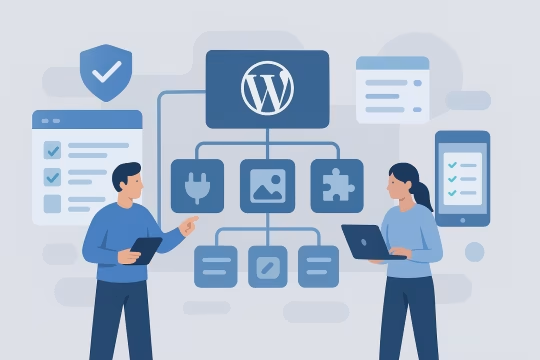
Core Focus

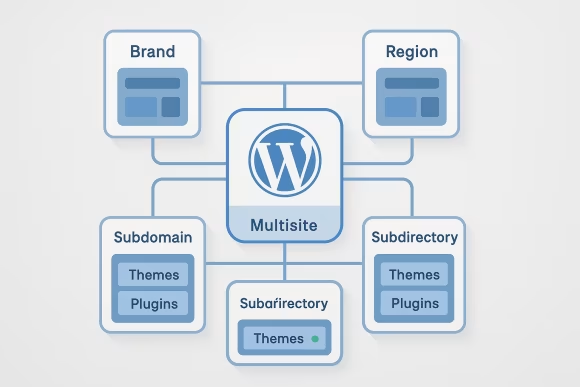
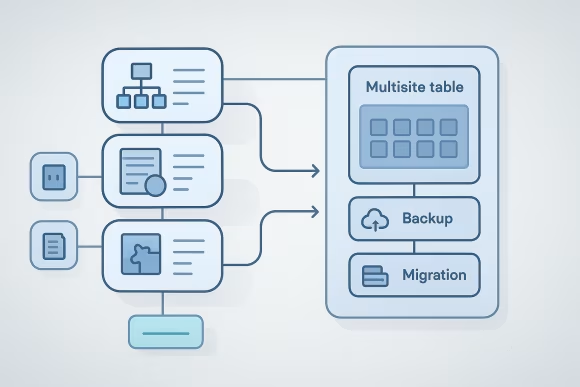
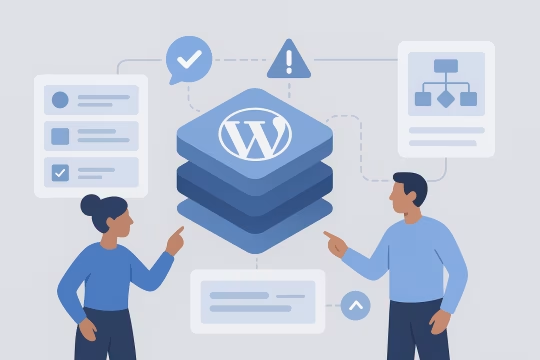
Network topology and tenancy design
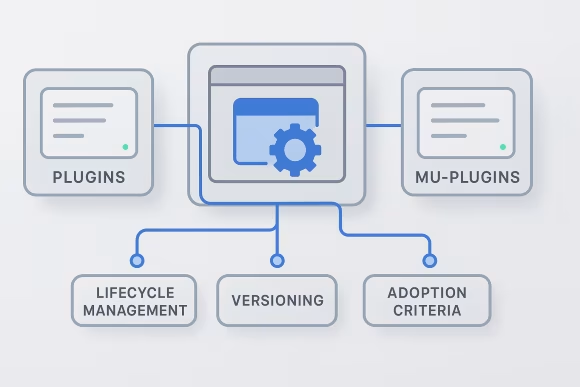
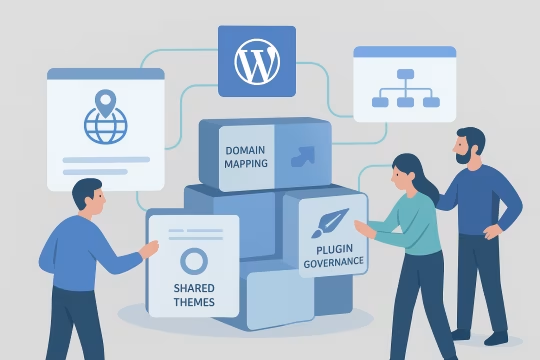
Shared themes and plugins strategy
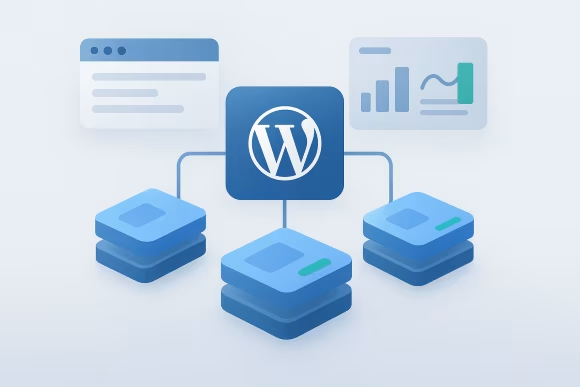
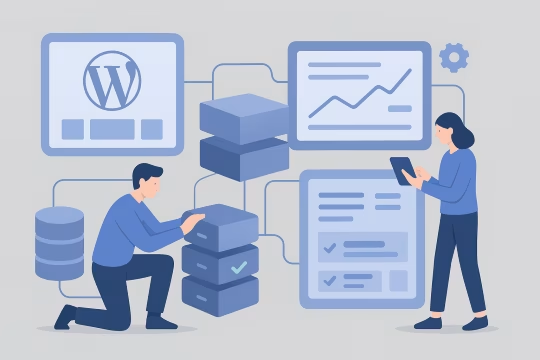
Performance and caching architecture
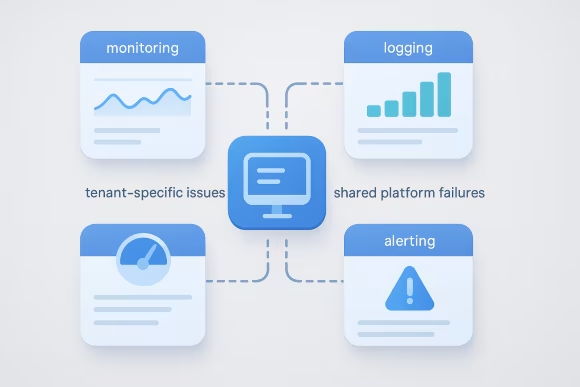
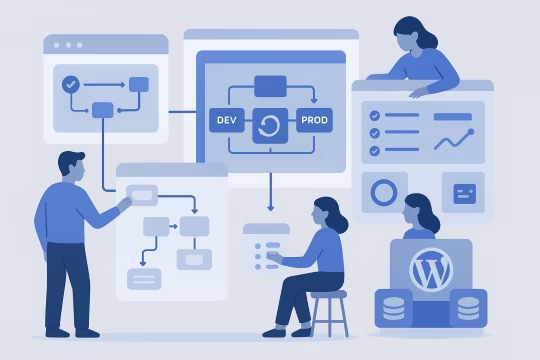
Governance and operational patterns

Best Fit For

  • Multi-brand digital platforms
  • Multi-region content operations
  • Centralized platform teams
  • Distributed editorial organizations

Key Outcomes

  • Reduced cross-site coupling
  • Predictable release and rollback
  • Consistent security controls
  • Scalable content operations

Technology Ecosystem

  • WordPress Multisite core
  • MySQL data model constraints
  • Redis object caching
  • Dockerized environments

Platform Integrations

  • SSO and identity providers
  • CDN and edge caching
  • Search and indexing services
  • Analytics and tag governance

Multisite Growth Creates Hidden Coupling and Risk

As WordPress networks grow from a handful of sites to dozens or hundreds, teams often inherit an architecture that was never designed for multi-tenant scale. Domain mapping, theme inheritance, and plugin usage evolve organically, creating implicit dependencies between sites. Small configuration changes can have network-wide impact, and the lack of clear boundaries makes it difficult to reason about blast radius.

Engineering teams typically see this as increasing friction in delivery: releases require extended coordination, regression risk rises, and troubleshooting becomes slow because performance and functional issues can originate from shared code, shared tables, or shared infrastructure. Without an explicit model for tenancy, permissions, and configuration, teams overcompensate with manual processes, ad-hoc exceptions, and duplicated implementations that undermine the benefits of consolidation.

Operationally, the platform becomes harder to secure and operate. Plugin sprawl, inconsistent caching, and database growth patterns can degrade performance across the network. Incidents become harder to isolate, and platform upgrades are delayed because the cost of validating changes across many sites is too high.

WordPress Multisite Architecture Methodology

Platform Discovery

Review the current WordPress topology, site inventory, domain model, and operational constraints. Capture non-functional requirements such as performance targets, isolation needs, compliance constraints, and release cadence across teams.

Tenancy Model Design

Define what “tenant” means for the network: brands, regions, business units, or products. Specify boundaries for configuration, content, users, and capabilities, including what must be shared versus what must be isolated.

Shared Component Strategy

Design how themes, child themes, plugins, and mu-plugins are managed across the network. Establish rules for extension points, versioning, and deprecation to avoid unbounded divergence and plugin sprawl.

Data and Domain Architecture

Specify domain mapping, routing, and environment parity across dev/stage/prod. Document data growth considerations, table usage patterns, and constraints that influence migrations, backups, and restore procedures.

Performance Architecture

Define caching layers and invalidation strategy, including Redis object cache behavior and page caching responsibilities. Identify hotspots such as expensive queries, cron workloads, and shared services that can create network-wide contention.

Delivery and Release Design

Design deployment workflows that support safe rollouts across many sites, including feature flags where appropriate. Establish rollback paths, configuration management practices, and validation steps aligned to the multisite blast radius.

Security and Governance

Define permission models, admin boundaries, and operational controls for plugin/theme changes. Establish governance for approvals, auditability, and emergency change procedures to keep the network stable under distributed ownership.

Operational Runbooks

Produce runbooks for incident response, performance triage, backup/restore, and upgrade execution. Align monitoring signals to the multisite architecture so teams can isolate issues to a tenant, shared component, or infrastructure layer.

Core Multisite Architecture Capabilities

This service establishes the architectural foundations required to run WordPress Multisite as a governed platform rather than a collection of loosely related sites. The focus is on tenancy boundaries, shared component design, and operational patterns that reduce cross-site coupling. It also addresses performance and reliability constraints specific to multisite, including cache behavior, database growth, and safe release mechanics. The result is an architecture that supports controlled autonomy for teams while keeping the network maintainable over time.

Capabilities
  • Multisite network topology design
  • Tenancy and permission architecture
  • Shared theme and plugin strategy
  • Domain mapping and routing model
  • Caching and performance engineering
  • Database growth and migration planning
  • Release governance and rollback design
  • Operational runbooks and observability
Target Audience
  • Platform Architects
  • Engineering Managers
  • Digital Platform Teams
  • Web Operations Teams
  • Product Owners for multi-brand platforms
  • Security and Compliance stakeholders
  • Content Operations leadership
Technology Stack
  • WordPress Multisite
  • PHP
  • MySQL
  • Redis
  • Docker
  • Nginx or Apache
  • WP-CLI
  • Object cache drop-ins
  • CDN and edge caching
  • Git-based deployment workflows

Delivery Model

Engagements are structured to produce an actionable architecture that engineering teams can implement and operate. Outputs typically include architecture decisions, reference configurations, governance rules, and a prioritized implementation plan aligned to platform constraints and delivery timelines.

Delivery card for Discovery and Inventory[01]

Discovery and Inventory

Map the current site landscape, integrations, and operational workflows. Identify constraints such as compliance requirements, editorial workflows, and release cadence, and capture performance and reliability expectations for the network.

Delivery card for Architecture Definition[02]

Architecture Definition

Define the target multisite topology, tenancy model, and shared component strategy. Produce decision records that clarify trade-offs, boundaries, and non-functional requirements that will drive implementation choices.

Delivery card for Reference Implementation[03]

Reference Implementation

Implement or prototype critical architectural elements such as domain mapping patterns, shared theme structure, and plugin governance mechanisms. Validate assumptions early to reduce risk before broad rollout across sites.

Delivery card for Performance Engineering[04]

Performance Engineering

Design and tune caching layers, database access patterns, and background processing behavior. Establish performance baselines and identify hotspots that can create network-wide degradation under load.

Delivery card for Operationalization[05]

Operationalization

Define monitoring, alerting, backup/restore procedures, and incident runbooks aligned to the multisite architecture. Ensure responsibilities and escalation paths are clear for both platform and site-owning teams.

Delivery card for Release Enablement[06]

Release Enablement

Set up deployment and validation workflows that support safe rollouts across many sites. Define rollback strategies, change windows where needed, and test coverage expectations for shared components.

Delivery card for Governance and Controls[07]

Governance and Controls

Establish rules for plugin/theme onboarding, security updates, and exception handling. Create lightweight review processes that enable autonomy while protecting network stability and upgradeability.

Delivery card for Evolution Roadmap[08]

Evolution Roadmap

Deliver a prioritized roadmap for consolidation, migrations, and modernization steps. Align the roadmap to platform milestones such as WordPress core upgrades, infrastructure changes, and organizational delivery capacity.

Business Impact

A clear multisite architecture reduces platform risk while enabling faster, more consistent delivery across brands and regions. The impact is primarily realized through controlled change management, improved performance predictability, and lower operational overhead for shared services.

Faster Multi-Site Delivery

Shared components and clear extension points reduce duplicated work across sites. Teams can ship changes with less coordination overhead because the blast radius of shared updates is understood and managed.

Lower Operational Risk

Defined tenancy boundaries and governance reduce accidental network-wide outages. Runbooks, monitoring, and rollback paths make incidents easier to isolate and resolve under production pressure.

Improved Performance Predictability

A documented caching and data model reduces performance regressions caused by plugin changes or content growth. Baselines and observability help teams detect degradation early and attribute it to the correct layer.

Reduced Platform Fragmentation

A shared theme and plugin strategy limits uncontrolled divergence across sites. This keeps the network upgradeable and reduces the long-term cost of maintaining many near-duplicate implementations.

Stronger Security Posture

Centralized controls for plugin adoption, admin permissions, and update processes reduce exposure from inconsistent site-level practices. The platform can enforce minimum standards without blocking legitimate site-specific needs.

Simplified Upgrades and Migrations

Architecture decisions and governance rules make WordPress core upgrades and infrastructure changes more predictable. Migration paths for sites joining the network are clearer, reducing onboarding time and rework.

Clear Ownership and Governance

Defined responsibilities between platform and site teams reduce ambiguity during delivery and incidents. Governance mechanisms provide a repeatable way to approve exceptions and manage lifecycle changes.

FAQ

Common architecture, operations, integration, governance, and engagement questions for WordPress Multisite ecosystems.

How do you decide between subdomains and subdirectories in WordPress Multisite?

The decision is primarily architectural, not cosmetic. Subdomains tend to align better with strong tenant separation (brand.region.example.com), clearer DNS ownership, and easier integration with edge/CDN rules. Subdirectories can simplify URL management for a single brand with many sections, but can complicate domain mapping when brands or regions require distinct hostnames. We evaluate domain requirements (existing domains, redirects, SEO constraints), certificate management, CDN behavior, and how environments are provisioned. We also consider operational needs such as isolating traffic patterns, applying WAF rules per tenant, and supporting region-specific routing. In many enterprise networks, the practical outcome is a domain-mapped multisite where each site has its own hostname, regardless of the internal multisite mode. The key is to document the routing model, canonical URL rules, and how domain changes are tested and rolled out across environments to avoid cross-site leakage and redirect loops.

What architectural boundaries matter most in a large multisite network?

The most important boundaries are (1) configuration boundaries, (2) permission boundaries, and (3) shared-code boundaries. Configuration boundaries define what can vary per site (features, integrations, branding) and how that configuration is stored and deployed. Permission boundaries define who can install plugins, change themes, manage users, and access network-level settings. Shared-code boundaries determine what is truly shared across the network (core, shared theme layers, mu-plugins) and what must remain site-specific. Without explicit rules, teams often introduce hidden coupling: a plugin update for one site changes behavior for all sites, or a shared theme change breaks a subset of tenants. We formalize these boundaries using a combination of governance rules, code structure (parent/child themes, mu-plugins), and operational controls (deployment gates, approval workflows). The goal is to make the blast radius of any change predictable and to keep the network upgradeable over time.

How do you handle performance tuning for WordPress Multisite at scale?

Performance tuning starts with identifying which resources are shared and therefore become contention points: database connections, object cache capacity, PHP workers, cron/background jobs, and shared plugins that run on every request. In multisite, a single inefficient query pattern or cache-miss-heavy feature can degrade many sites simultaneously. We define a performance model that includes Redis object caching behavior, cache key strategy, and invalidation rules. We also review database growth patterns (options, postmeta, term relationships) and identify hotspots introduced by plugins or theme logic. Where needed, we adjust cron execution strategy and background processing to avoid synchronized spikes across tenants. Operationally, we establish baselines and observability: response times per site, cache hit ratios, slow query logging, and error rates. This lets teams attribute issues to a specific tenant, shared component, or infrastructure layer rather than treating the network as a single opaque system.

What does a reliable backup and restore strategy look like for multisite?

A reliable strategy treats backup/restore as an operational capability with tested procedures, not just scheduled dumps. For multisite, the main complexity is that many sites share one database and one codebase, so restoring “one site” is not always straightforward without planning. We define recovery objectives (RPO/RTO) and then design procedures for full-network restore and, where required, tenant-level recovery. Tenant-level recovery typically requires additional tooling and conventions, such as consistent media handling, clear mapping of site IDs, and documented steps to extract and rehydrate a subset of tables or content. We also align backups with deployment workflows: schema changes, plugin updates, and content migrations should have clear rollback paths. Finally, we require periodic restore drills in non-production environments to validate that backups are usable and that the team can execute recovery under time pressure.

How do integrations work in multisite when different sites need different vendors?

Integrations should be modeled as configurable capabilities with explicit boundaries. In multisite, the risk is implementing integrations as shared code with hard-coded assumptions, which forces all tenants into the same vendor or creates fragile conditional logic scattered across themes and plugins. We typically define an integration abstraction layer: shared interfaces and common plumbing (auth handling, retries, logging), with per-tenant configuration selecting the vendor implementation. Configuration must be managed consistently across environments and deployments, with secrets handled through the platform’s secret management approach rather than stored in the database. We also document data ownership and failure modes. For example, if one tenant’s CRM is down, it should not degrade unrelated sites. This often leads to architectural decisions around async processing, circuit breakers, and isolating integration workloads so that a single tenant cannot exhaust shared resources.

How do you approach SSO and identity in a multisite ecosystem?

SSO in multisite requires clarity on whether identity is shared across tenants or segmented by tenant. A shared identity model can simplify user management for global editorial teams, but it increases the importance of role design and least-privilege access. A segmented model can reduce cross-tenant risk but increases administrative overhead. We design the identity architecture around roles, groups, and provisioning flows, and we define how network admins differ from site admins. We also address session handling, logout behavior, and how authentication interacts with caching layers. Operationally, we document onboarding/offboarding processes, audit requirements, and how access changes are propagated. The goal is to avoid ad-hoc user management that becomes unmanageable at scale while ensuring that tenant boundaries are respected and that privileged actions are tightly controlled.

How do you govern plugins and themes without blocking delivery teams?

Governance works when it is explicit, lightweight, and tied to operational risk. We define a plugin and theme policy that categorizes components: approved shared components, tenant-optional components, and prohibited components. Each category has clear criteria such as security posture, maintenance status, performance impact, and compatibility with the network’s architecture. We also define an onboarding workflow: how a team requests a new plugin, what evaluation is required (security review, performance checks, licensing/compliance), and how the component is maintained over time. For shared components, we establish versioning and deprecation rules so changes can be rolled out predictably. To avoid blocking teams, we provide extension points and patterns for tenant-specific needs (child themes, site-scoped configuration, integration adapters). The objective is to enable autonomy while preventing exceptions from accumulating into long-term platform fragility.

What governance is needed for configuration and environment parity?

Multisite platforms fail operationally when configuration is inconsistent across environments or when changes are made manually in production. We define which configuration belongs in code, which belongs in environment variables/secrets, and which (if any) can live in the database. The rules must be enforceable through deployment workflows. Environment parity includes consistent domain mapping behavior, caching configuration, and integration endpoints across dev/stage/prod. We also define how tenant-specific configuration is represented so that new sites can be provisioned repeatably without manual steps. Governance mechanisms include change control for network-level settings, review requirements for shared components, and auditability for privileged actions. The goal is not bureaucracy; it is to keep the network upgradeable and to ensure that incidents can be diagnosed with confidence because the running system matches the documented architecture.

What are the main risks when consolidating many sites into multisite?

The main risks are hidden coupling, migration complexity, and operational overload. Hidden coupling occurs when sites that previously evolved independently are forced to share themes, plugins, or infrastructure without clear boundaries. This can create regressions and slow delivery if the blast radius of changes is not managed. Migration complexity includes URL and redirect correctness, content model differences, media handling, and integration differences. If these are not modeled early, teams end up with one-off exceptions that undermine standardization. Operational overload happens when the platform team inherits responsibility for many tenants without governance, runbooks, and automation. We mitigate these risks by defining a target tenancy model, a shared component strategy with explicit exceptions, and a phased migration plan. We also require validation gates: performance baselines, security checks, and rollback procedures. Consolidation should be treated as platform engineering work, not just content migration.

How do you reduce the blast radius of changes in a shared multisite codebase?

Reducing blast radius starts with architecture: clear separation between shared platform code and tenant-specific overrides. We design theme and plugin structures so that shared layers are stable and changes are introduced through controlled extension points rather than ad-hoc conditionals. We then align delivery mechanics to the architecture. This includes staged rollouts, automated regression testing for shared components, and the ability to disable or roll back a change quickly. Where appropriate, feature flags can be used for high-risk changes, but they must be governed to avoid permanent complexity. Operationally, observability must be tenant-aware. If monitoring only reports network-wide averages, teams miss tenant-specific failures until they become incidents. We define metrics and logs that can be segmented by site, and we ensure runbooks describe how to isolate whether an issue originates in shared code, a tenant configuration, or infrastructure.

What deliverables should we expect from a multisite architecture engagement?

Deliverables are designed to be implementable by engineering teams and usable by operations. Typical outputs include an architecture blueprint describing network topology, tenancy boundaries, domain mapping, and shared component strategy. We also provide architecture decision records that capture trade-offs and constraints so future teams understand why choices were made. On the operational side, we deliver governance rules for plugins/themes and privileged actions, plus runbooks for incident response, backup/restore, and upgrade execution. Where needed, we include reference configurations for caching (Redis), environment setup (often Docker-based), and deployment workflow requirements. We also produce a prioritized implementation roadmap: what to change first to reduce risk, what can be phased, and what depends on organizational readiness. The goal is to leave you with a clear plan and the operational controls required to keep the network stable as it grows.

How long does WordPress Multisite architecture work typically take?

Timing depends on network size, existing constraints, and whether you are consolidating from multiple installations. A focused architecture assessment and target design typically takes 2–6 weeks, including discovery, decision records, and a roadmap. If reference implementation or proof-of-concept work is included, add time based on the number of critical risks to validate. For consolidation programs, architecture work often runs in parallel with migration planning. In that case, the architecture phase establishes standards (themes, plugins, domain mapping, caching, governance) that migrations can follow. The overall program can span months, but the architecture decisions should be made early to avoid rework. We structure the engagement so you get usable outputs incrementally: early findings and constraints, then target design, then operational and delivery enablement. This reduces the risk of producing documentation that is disconnected from delivery reality.

How does collaboration typically begin for a multisite architecture engagement?

Collaboration usually begins with a short scoping phase to align on goals, constraints, and stakeholders. We identify the current platform owners, the teams that ship changes, and the operational stakeholders responsible for uptime, security, and compliance. We also agree on what “tenant” means in your organization and what success looks like (performance targets, autonomy model, upgrade cadence). Next, we run discovery: site inventory, domain and environment mapping, plugin/theme analysis, integration review, and operational workflow review (deployments, incident response, backups). We capture risks and constraints as decision inputs rather than jumping to a predefined target state. From there, we propose a target architecture and a phased roadmap, review it with engineering and operations, and refine it into implementable decisions and runbooks. If you want us to continue, the next step is typically a reference implementation or enabling work on delivery workflows and governance controls.

Evaluate your multisite architecture

Let’s review your current WordPress network, define tenancy boundaries, and map the operational controls needed for safe multi-site delivery.

Oleksiy (Oly) Kalinichenko

Oleksiy (Oly) Kalinichenko

CTO at PathToProject

Do you want to start a project?