



 [01]
[01]Discovery and Inventory
Assess current API usage, consumers, and integration points. Review content models, plugin dependencies, and operational constraints. Produce a prioritized backlog of interfaces and risks to address first.
WordPress API architecture
Assess REST and GraphQL contracts, auth patterns, versioning, and performance risks across your WordPress platform.
Built for teams supporting multiple consumers, environments, and evolving content models.
No login required. Takes 2–3 minutes.
WordPress API development services focus on designing and implementing stable, secure interfaces that expose content and platform capabilities to other systems. This includes WordPress REST API engineering, WordPress GraphQL API design where appropriate, and defining contracts that support multiple consumers such as web frontends, mobile apps, search, and automation services.
As WordPress platforms scale, ad hoc endpoints and inconsistent payloads create coupling between teams and increase integration risk. A structured API layer provides predictable schemas, explicit versioning, and clear ownership boundaries. It also enables headless WordPress content APIs, integration with enterprise identity providers, and controlled access to content and workflows.
The capability supports scalable platform architecture by treating APIs as long-lived contracts: documented, tested, monitored, and evolved with backward compatibility. This reduces friction between product teams, improves reliability across environments, and allows WordPress to operate as a composable service within a broader digital ecosystem.
Core Focus
Best Fit For
Key Outcomes
Technology Ecosystem
Platform Integrations
As WordPress platforms grow beyond a single website, more systems start depending on content and platform behaviors: multiple frontends, mobile apps, personalization services, search, and internal tools. Without a deliberate API strategy, teams often add endpoints opportunistically, reuse admin-oriented data structures, and ship payloads that reflect internal implementation details rather than stable contracts.
This creates tight coupling between consumers and WordPress internals. Small changes to plugins, content models, or serialization logic can break downstream applications. Inconsistent authentication patterns and permission checks introduce security gaps, while missing versioning forces “big bang” changes that are difficult to coordinate across teams and environments. Documentation tends to drift, making onboarding slow and increasing reliance on tribal knowledge.
Operationally, the lack of observability and performance controls leads to unpredictable latency, cache inefficiency, and noisy failure modes during traffic spikes. Engineering teams spend time debugging integration regressions, building one-off adapters, and negotiating breaking changes rather than evolving the platform. Over time, the API surface becomes harder to govern, and the platform’s ability to support new channels and products slows down.
Review existing consumers, endpoints, and data models. Identify contract gaps, coupling points, and security constraints. Define target use cases such as headless delivery, automation, or third-party integration, and map them to a prioritized API surface.
Define resource boundaries, naming conventions, payload shapes, and error semantics. Establish versioning rules and compatibility expectations. Select REST, GraphQL, or a hybrid approach based on consumer needs, caching strategy, and governance requirements.
Design API authentication and authorization aligned to enterprise identity and WordPress roles/capabilities. Implement token flows, nonce handling, and permission checks. Define rate limiting and abuse protections appropriate for public, partner, or internal APIs.
Implement custom REST routes, controllers, and serializers, or extend GraphQL schemas and resolvers. Normalize data access patterns, avoid N+1 queries, and ensure consistent pagination, filtering, and field selection. Keep implementation decoupled from theme concerns.
Where needed, introduce Node.js middleware or edge adapters to aggregate services, enforce policies, or transform payloads. Implement WordPress webhook integration and event-driven flows for downstream systems, and define retry and idempotency strategies.
Add automated tests for permissions, schema stability, and backward compatibility. Validate payloads against schemas and run consumer-driven checks where feasible. Include performance tests for high-traffic endpoints and cache behavior verification.
Publish OpenAPI documentation for WordPress integration (REST) and schema documentation for GraphQL. Provide examples, SDK guidance, and environment details. Establish local development workflows and CI checks that prevent undocumented breaking changes.
Deploy with controlled rollout, monitoring, and alerting. Track usage, deprecations, and error rates. Establish ownership, change review, and lifecycle policies so the API surface can evolve predictably across releases.
This service focuses on WordPress API development services that treat REST and GraphQL interfaces as governed platform contracts rather than incidental endpoints. Capabilities include contract-first design, API authentication and authorization, and a practical WordPress API authentication and versioning approach so multiple consumers can integrate safely. Engineering emphasizes performance-aware data access, cache-friendly response patterns, and observable runtime behavior. The result is an API surface that can evolve with content models and plugin changes while maintaining compatibility and operational clarity.
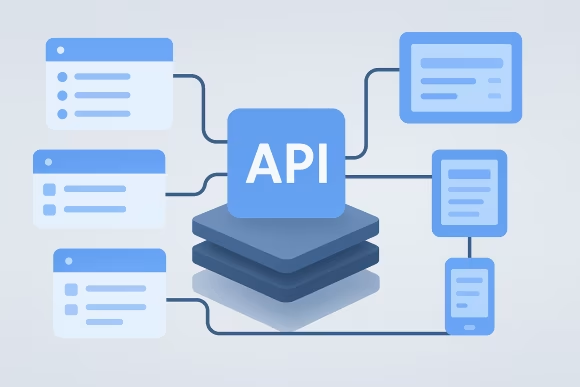
Define API resources and representations that reflect domain concepts rather than WordPress internals. Establish consistent conventions for naming, pagination, filtering, and error responses. This reduces consumer coupling and makes changes to themes, plugins, or storage less likely to break downstream applications.

Implement custom REST routes with explicit controllers, validation, and serialization. Add field selection, pagination, and filtering patterns that scale with content volume. Ensure endpoints are cache-aware and avoid exposing admin-only structures that create brittle dependencies.
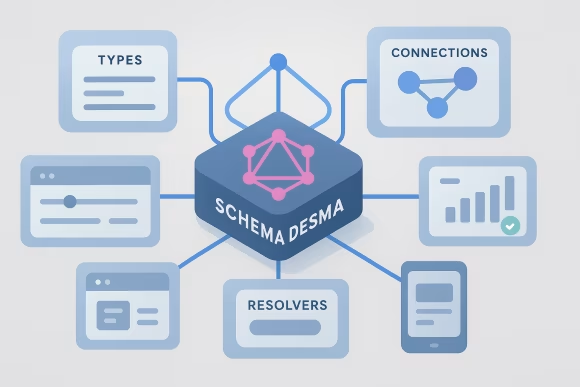
Model GraphQL types, connections, and resolvers to support consumer-driven queries while controlling complexity. Implement query cost controls, depth limits, and resolver optimizations to prevent expensive requests. Align schema evolution with deprecation policies to keep consumers stable over time.

Implement authentication flows and authorization checks aligned to WordPress capabilities and enterprise identity requirements. Enforce least-privilege access, validate inputs, and provide consistent permission error semantics. Support patterns such as application passwords, JWT/OAuth integrations, or gateway-mediated access where appropriate.
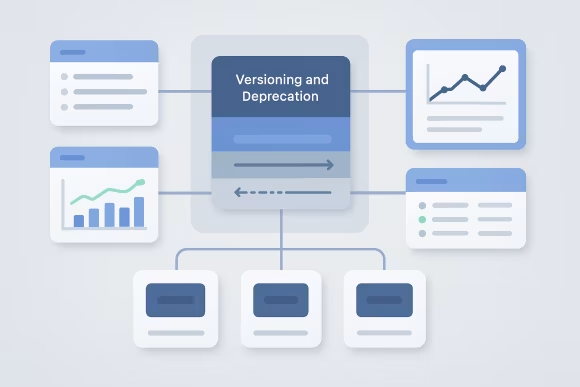
Introduce explicit versioning strategies for endpoints and schemas, including compatibility rules and deprecation windows. Provide migration guidance and telemetry to understand consumer usage. This enables parallel evolution of interfaces without forcing coordinated releases across multiple product teams.
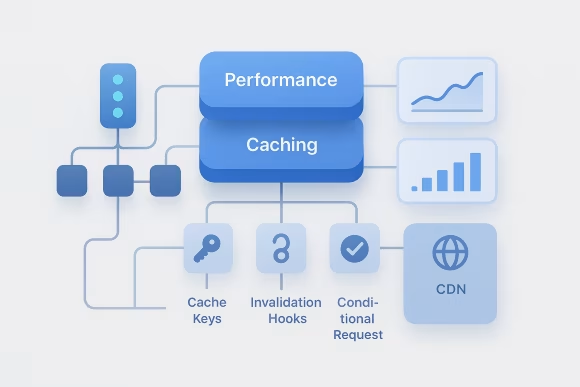
Optimize data access to reduce query counts and avoid N+1 patterns, especially for relational content and taxonomies. Design responses to work with CDN and application caching, including cache keys, invalidation hooks, and conditional requests. Validate performance under realistic traffic and content sizes.

Implement webhook delivery and event patterns for content changes, publishing workflows, and integrations. Provide signing, retries, and idempotency to make downstream processing reliable. Where needed, integrate with message queues or middleware to decouple WordPress from consumer availability.

Add structured logging, correlation identifiers, and metrics for latency, error rates, and authorization failures. Expose health checks and integration diagnostics to reduce mean time to recovery. Use monitoring data to guide capacity planning and identify breaking changes early.
Review contract design, permission controls, caching behavior, and integration readiness for WordPress API delivery.
Engagements are structured around interface discovery, contract design, and incremental implementation with measurable integration and operational checkpoints. Delivery emphasizes compatibility, security, and performance so APIs can be adopted by multiple consumers without creating long-term coupling or governance gaps.
[01]Assess current API usage, consumers, and integration points. Review content models, plugin dependencies, and operational constraints. Produce a prioritized backlog of interfaces and risks to address first.
 [02]
[02]Define resource boundaries, schemas, and versioning approach. Document authentication and authorization models and identify where middleware or gateways are required. Align contracts with consumer needs and caching strategy.
 [03]
[03]Build endpoints, schemas, and supporting services in small increments. Validate payloads and permission checks early with representative consumers. Keep changes isolated and reviewable to reduce regression risk.
 [04]
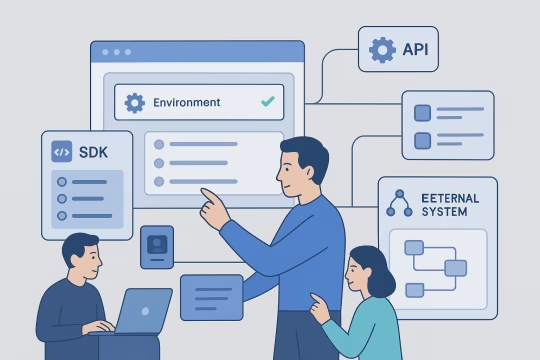
[04]Support consumer teams with examples, environment configuration, and SDK guidance where appropriate. Implement webhooks, event flows, or adapters for downstream systems. Validate end-to-end behavior across staging and production-like environments.
 [05]
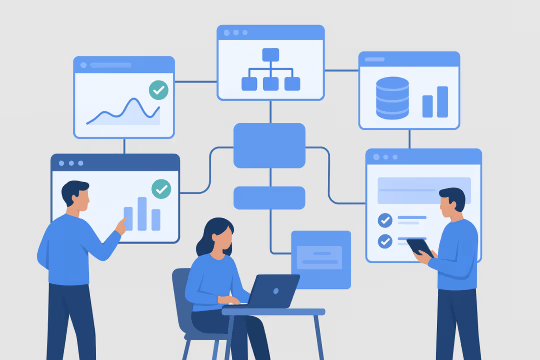
[05]Add automated tests for schema stability, permissions, and regression coverage. Run performance checks for high-traffic endpoints and validate cache behavior. Ensure monitoring and alerting are in place before release.
 [06]
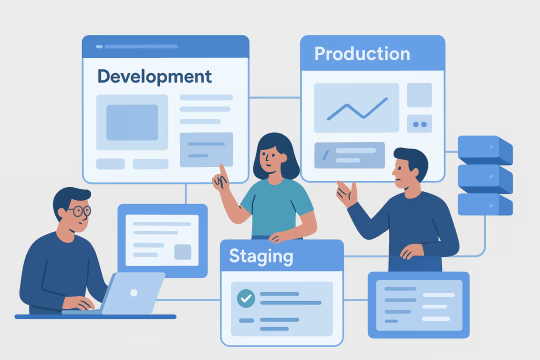
[06]Deploy using controlled rollout strategies and backward-compatible releases. Track usage and error rates, and manage deprecations with clear timelines. Provide release notes focused on contract changes and migration steps.
 [07]
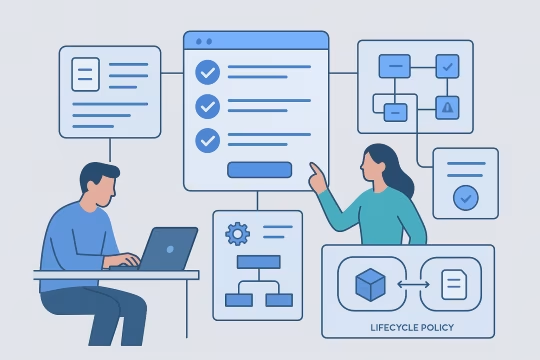
[07]Establish ownership, review processes, and documentation standards for API changes. Add CI checks that detect breaking changes and schema drift. Define lifecycle policies for endpoints and fields to keep the surface manageable.
 [08]
[08]Use telemetry and consumer feedback to refine performance, reliability, and usability. Plan iterative improvements to contracts and integration patterns as content models evolve. Periodically reassess security posture and dependency updates.
A governed WordPress API layer reduces integration volatility and enables teams to deliver new channels and features with fewer coordination costs. By treating interfaces as contracts with security, performance, and observability built in, organizations can scale platform usage while controlling operational risk and long-term maintenance overhead.
Clear contracts and documentation reduce time spent reverse-engineering payloads and permissions. New frontends and services can integrate with predictable patterns, lowering dependency on specific individuals and shortening delivery lead times.
Versioning and deprecation policies prevent unplanned breaking changes. Automated contract checks and regression tests catch incompatibilities earlier, reducing production incidents caused by plugin updates or content model changes.
Consistent authentication and authorization patterns reduce accidental data exposure. Centralized policy enforcement and audit-friendly controls make it easier to meet enterprise security requirements across multiple consumers and environments.
Performance-aware endpoints and cache-friendly responses reduce load on WordPress under traffic spikes. Optimized data access patterns improve latency and stability for high-volume content delivery scenarios.
Observability and diagnostics shorten incident investigation and reduce mean time to recovery. Teams can distinguish consumer errors from platform issues and identify hotspots before they become outages.
Contract-first design limits consumer coupling to internal implementation details. This makes it safer to modernize themes, plugins, and data structures without rewriting every integration at the same time.
Defined change control and lifecycle policies keep the API surface coherent as teams grow. Governance reduces duplication of endpoints and prevents inconsistent patterns from spreading across products.
Stable interfaces reduce cross-team coordination overhead for releases. Product teams can plan changes with known compatibility windows and migration paths, improving delivery predictability across the platform ecosystem.
WordPress integration readiness
Use the Health Check to surface unstable interfaces, weak auth decisions, and performance bottlenecks before they impact downstream systems.
No login required. Takes 2–3 minutes.
Adjacent services that extend WordPress API development into headless WordPress content APIs, enterprise integration architecture, and operational reliability patterns such as documentation, versioning, and webhook integration.
GA4 event tracking WordPress with governed measurement
WordPress lead contact sync with secure lead capture
WordPress integration services for secure API connections
Custom WordPress REST endpoints, schemas, and authentication patterns
Schema-first APIs for headless content delivery
Upgrade-ready architecture, WordPress CI/CD and DevOps, and operational hardening
Enterprise WordPress network design for multi-site ecosystems
Enterprise WordPress extensibility with controlled dependencies
Enterprise WordPress Platform Engineering
Common questions about engineering, operating, and governing WordPress APIs in enterprise environments.
Use REST when you need cache-friendly, resource-oriented endpoints with predictable response shapes, strong CDN compatibility, and simple operational characteristics. REST is often a good fit for public content delivery, integrations that prefer stable URLs, and systems that benefit from explicit versioned endpoints. Use GraphQL when consumers need flexible field selection, multiple related resources in a single request, and rapid iteration on UI requirements without proliferating endpoints. GraphQL can reduce over-fetching for complex pages, but it requires governance around query complexity, depth limits, and resolver performance to avoid expensive requests. In enterprise platforms, a hybrid approach is common: REST for high-volume, cacheable content delivery and operational integrations, and GraphQL for experience-layer consumers that need tailored data shapes. The decision should consider caching strategy, consumer diversity, security model, and how you will manage schema evolution and deprecations over time.
Versioning should reflect contract changes, not internal implementation changes. For REST, this typically means versioned routes (for example, /v1/, /v2/) or media-type versioning, with clear rules about what constitutes a breaking change (field removal, semantic changes, permission changes, pagination changes). For GraphQL, versioning is usually handled through additive changes plus deprecation: add new fields/types, deprecate old ones with timelines, and remove only after consumers have migrated. A practical strategy includes: a compatibility policy, a deprecation window, and telemetry to understand which consumers still use deprecated fields or endpoints. Release notes should focus on contract deltas and migration steps. In WordPress specifically, versioning must also account for plugin updates and content model evolution. We recommend contract tests and CI checks that detect schema drift, plus a change review process so new endpoints follow consistent conventions and do not leak internal structures.
At minimum, monitor latency (p50/p95/p99), error rates by endpoint or operation, and authentication/authorization failures. Track request volume, cache hit ratios (CDN and application), and database query counts for key endpoints to detect regressions. For GraphQL, also monitor query complexity metrics such as depth, resolver timings, and top operations by cost. Logging should be structured and include correlation identifiers so you can trace a request across WordPress, middleware, and downstream services. Capture key dimensions such as consumer identity, route/operation name, response status, and timing breakdowns. Operationally, define SLOs for critical APIs and alert on symptoms that impact consumers: sustained latency increases, elevated 4xx/5xx rates, webhook delivery failures, and authentication anomalies. Monitoring should be paired with runbooks that describe common failure modes (plugin regressions, cache invalidation issues, database contention) and the steps to isolate and mitigate them.
Performance improvements should preserve contract semantics while changing internal execution paths. Common techniques include reducing N+1 queries through preloading, optimizing WP_Query usage, limiting expensive meta queries, and introducing object caching where appropriate. For REST, support field selection and efficient pagination to reduce payload size and processing time. For GraphQL, optimize resolvers and implement batching and caching at resolver boundaries. Caching strategy is usually the biggest lever. We design responses to be cache-friendly (stable URLs, predictable query parameters, conditional requests) and define invalidation hooks tied to content changes. For authenticated or personalized responses, we separate public cacheable content from private data and use edge or middleware patterns to avoid disabling caching entirely. To avoid breaking consumers, changes are validated with regression tests and performance baselines. We also recommend canary rollouts and monitoring comparisons so improvements can be verified under real traffic before full deployment.
Not always. If WordPress can provide the required contracts with acceptable performance and security controls, direct consumption is simpler and easier to operate. However, middleware becomes valuable when you need aggregation across multiple backends, centralized policy enforcement, response shaping for specific channels, or advanced caching and rate limiting that is difficult to implement safely inside WordPress. A Node.js layer can also help isolate consumers from WordPress plugin churn by providing a stable façade, translating between internal and external schemas, and implementing orchestration logic. It is particularly useful in headless architectures where the experience layer needs data from WordPress plus search, personalization, or commerce services. The decision should be based on operational ownership, latency budgets, security requirements, and how many downstream systems must be coordinated. If introduced, middleware should be treated as a product with its own CI/CD, observability, and versioning discipline.
Reliable webhooks require more than firing HTTP requests on publish events. We implement signing (shared secret or asymmetric signatures) so consumers can verify authenticity, and we define idempotency keys so retries do not create duplicate side effects. Delivery should include retry policies with backoff, dead-letter handling, and clear visibility into failures. In WordPress, webhook triggers often come from hooks tied to content lifecycle events. We ensure events are emitted at the correct stage (after persistence, with stable identifiers) and that payloads are versioned. For high-volume sites, we avoid synchronous delivery during user requests; instead, we queue webhook jobs and process them asynchronously. Where enterprise reliability is required, we may integrate with a message broker or middleware service that handles delivery guarantees and consumer fan-out. This decouples WordPress availability from downstream processing and improves operational control.
Documentation stays accurate when it is generated or validated from the same source as the implementation. For REST, we recommend maintaining an OpenAPI specification that is updated alongside code changes and validated in CI. For GraphQL, schema documentation should be derived from the schema itself, with descriptions and deprecation notices treated as required fields during review. We also add automated checks that detect breaking changes, missing documentation, and inconsistent naming conventions. Examples and integration guides should be versioned and tied to environments (local, staging, production) so consumers know what to expect. Governance is the other half: define ownership for endpoints, require change reviews for contract modifications, and publish release notes focused on consumer impact. Over time, usage telemetry helps prioritize which parts of the documentation need the most attention and which deprecated areas can be safely removed.
API sprawl is usually a symptom of unclear ownership and missing standards. Governance starts with conventions: resource naming, pagination, filtering, error formats, authentication patterns, and how custom fields are exposed. Establish a lightweight review process so new endpoints and schema changes are evaluated for overlap, security, and long-term maintainability. Define an API catalog that lists endpoints/operations, owners, consumers, and lifecycle status (active, deprecated, sunset). Require versioning and deprecation policies so teams can evolve interfaces without breaking consumers. For GraphQL, governance should include query complexity limits and a process for approving new types and connections. In WordPress environments with many plugins, governance should also cover dependency management: which plugins are allowed to expose APIs, how updates are tested, and how schema drift is detected. The goal is not bureaucracy; it is predictable evolution and reduced cross-team friction.
Common risks include overly permissive endpoints, inconsistent authorization checks, and accidental exposure of private fields (user data, drafts, internal metadata). Authentication shortcuts, weak token handling, and missing rate limiting can also lead to abuse. For GraphQL, unbounded queries can become a denial-of-service vector if complexity controls are not enforced. Mitigations include strict permission checks aligned to WordPress capabilities, input validation, and consistent error handling that does not leak sensitive details. Implement rate limiting and abuse detection at the edge or gateway, and ensure TLS and secure headers are configured correctly. Operational security matters as well: keep WordPress core and plugins updated, monitor for anomalous traffic patterns, and audit API changes. For enterprise contexts, integrate with centralized identity where appropriate and ensure logs support incident investigation without storing sensitive tokens or personal data unnecessarily.
First, avoid exposing plugin-specific internal structures directly as external contracts. Use a stable representation layer (serializers, DTOs, or schema mapping) so internal changes can be absorbed without changing the API. Second, implement contract tests that validate response shapes, required fields, and permission behaviors across environments. For GraphQL, enforce additive-only changes by default and use deprecations with timelines. For REST, use explicit versioning and keep older versions available until consumers migrate. Maintain a staging environment that mirrors production plugin versions and content model complexity, and run automated regression suites during updates. Finally, use telemetry to understand consumer usage. If you know which endpoints and fields are actively used, you can prioritize compatibility work and communicate changes with evidence. This turns plugin updates from risky events into controlled releases with measurable impact.
We treat API work as a cross-team contract exercise. Early in the engagement, we identify API owners, consumer representatives, and operational stakeholders. We run short workshops to capture use cases, data requirements, and constraints such as caching, identity, and release cadence. Delivery typically proceeds in increments: define a minimal contract, implement it, and validate with at least one real consumer. We establish a shared change process (PR reviews for contract changes, release notes, deprecation tracking) so both platform and product teams can plan safely. We also align on operational responsibilities: who monitors which metrics, how incidents are triaged, and how rollbacks are handled. The goal is to reduce coordination overhead by making interfaces explicit, testable, and observable, while keeping ownership clear across WordPress and the systems that depend on it.
In the first phase, we aim to establish a stable foundation rather than implement every endpoint. Typical outputs include: an inventory of existing endpoints and consumers, a target contract design for priority use cases, and a security model aligned to roles and identity requirements. We also set up documentation scaffolding (OpenAPI and/or GraphQL schema docs) and CI checks to prevent undocumented breaking changes. Implementation usually focuses on a small set of high-value interfaces: for example, content delivery for a headless frontend, a webhook for content updates, or a set of integration endpoints for downstream systems. These are built with automated tests, performance baselines, and monitoring hooks. By the end of 4–8 weeks, teams should have at least one production-ready API slice with clear versioning and governance, plus a repeatable pattern for adding more endpoints safely. The exact scope depends on existing platform maturity and consumer readiness.
Collaboration typically begins with a short discovery focused on consumers and constraints. We start by identifying who consumes WordPress data today (frontends, mobile, search, automation, partners), what contracts they rely on, and where integration pain exists. In parallel, we review the WordPress setup: content models, plugin landscape, authentication approach, caching layers, and current operational tooling. From that, we propose a small, testable API slice to implement first. This includes a contract draft (REST/OpenAPI and/or GraphQL schema), a security model for the slice, and an implementation plan that fits your release cadence. We also define how changes will be reviewed and how deprecations will be communicated. Practically, the first step is usually a working session with platform and consumer engineers to agree on one or two priority use cases and success criteria (latency targets, caching expectations, compatibility rules). Then we set up repo access, environments, and CI so delivery can proceed in incremental, reviewable changes.
These case studies showcase advanced API engineering, including WordPress and Drupal integration, secure authentication, and scalable headless content delivery. They highlight real-world implementations of structured API layers, webhook integrations, and GraphQL schema design that align closely with WordPress API development services. The selected work demonstrates measurable improvements in platform interoperability, governance, and performance across complex digital ecosystems.
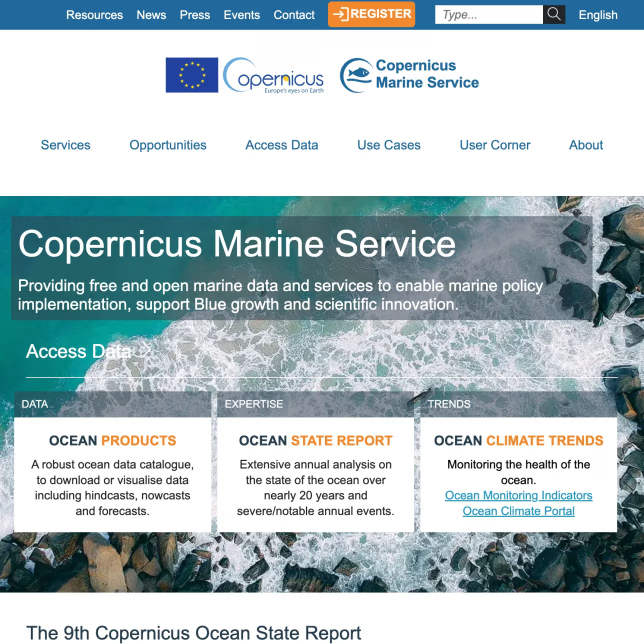
The existing marine data portal relied on three unaligned WordPress installations and embedded PHP code, creating inefficiencies and risks in content management and usability.
The new Drupal DXP streamlined content operations and improved accessibility, offering scientists and businesses a more efficient gateway to marine data services.
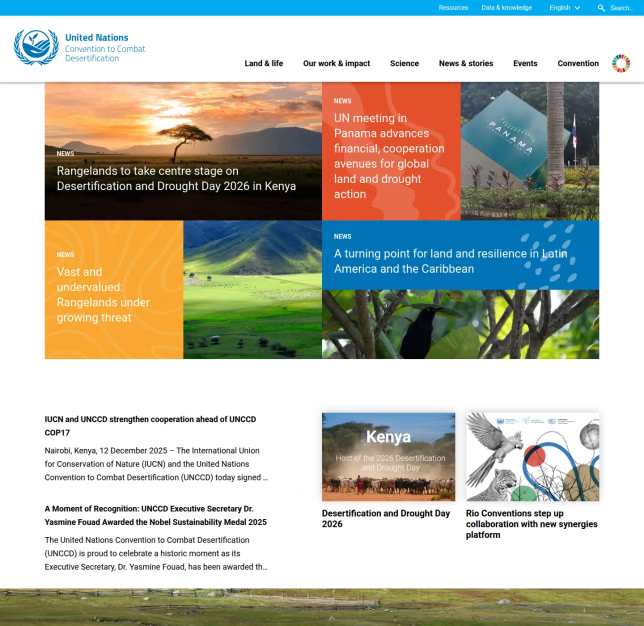
UNCCD operated four separate websites (two WordPress, two Drupal), leading to inconsistencies in design, content management, and user experience. A unified, scalable solution was needed to support a large-scale CMS migration project and improve efficiency and usability.
The modernization effort resulted in a cohesive, user-friendly, and scalable website, improving content management efficiency and long-term digital sustainability.
It was my pleasure working with Oleksiy (PathToProject) on a new Drupal website. He is a true full-stack developer—the ideal mix of DevOps expertise, deep front-end knowledge, and the structured thinking of a senior back-end developer.
He is well-organized and never lets anything slip. Oleksiy understands what needs to be done before being asked and can manage a project independently with minimal involvement from clients, product managers, or business analysts.
One of the best consultants I’ve worked with so far.

Andrei Melis
Technical Lead at Eau de Web
Oleksiy (PathToProject) was the Lead Developer on a number of client projects which I managed. He is highly skilled and incredibly hardworking. When assigning work to him, I could always rely on it being completed to a high quality and on time.
His technical expertise was valued across the team and he was often our 'go to' for technical challenges, which he loved to get stuck into. Oleksiy is proactive and engaged in a professional manner with our clients.
I have no hesitation in recommending him.

Daniela Graf
Senior Project Manager | Change Mgmt Practitioner | Process Improvement Geek
Oleksiy (PathToProject) worked with us at Domain7 as a consultant Drupal developer, and was an integral part of our team. Oleksiy is dedicated and hard-working.
He is helpful, taking time to support other team members when needed, and was always a friendly face in our meetings. He is an excellent developer and someone who I could confidently assign work to and know that he would work hard to complete it on time and to the highest standard.
Our clients really enjoyed working with him, and I will take the opportunity to work with him again anytime I can in the future.

Kirstie Adam
Experienced Head of Projects & Change | Operations Manager | IT Projects Specialist
These articles expand on the platform, governance, and operational decisions that shape reliable WordPress APIs. They cover composable integration patterns, contract and schema change control, and the runtime practices that keep integrations stable as the platform evolves.
Let’s review your current consumers, security constraints, and performance requirements, then define a versioned REST and/or GraphQL interface that your teams can evolve safely.