WordPress GraphQL architecture
Stress-test your WordPress GraphQL API architecture
Check schema design, query performance, caching strategy, and change safety for headless delivery at scale.
Built for teams running WPGraphQL across multiple content types, relationships, and frontend consumers.
No login required. Takes 2–3 minutes.

WordPress GraphQL
Schema-first APIs for headless content delivery
Stable contracts, secure access, and predictable query performance
Enabling multi-channel WordPress platforms with governed API evolution
WordPress GraphQL provides a typed API layer that allows frontend applications to query exactly the content and relationships they need, while keeping WordPress as the editorial system of record. For organizations adopting headless or composable architectures, a Headless WordPress GraphQL API becomes the contract between content models, frontend delivery, and downstream integrations.
As platforms scale, the API layer must handle more than query execution. It needs WPGraphQL schema design and API architecture discipline, authentication and security aligned to enterprise identity, caching and persisted queries to control performance, and clear governance and versioning strategies to support parallel product teams. Without these controls, GraphQL can become a source of breaking changes, unpredictable load, and fragile frontend dependencies.
This service focuses on designing a WordPress GraphQL architecture that is maintainable under continuous change. We align content modeling with schema design, implement Next.js WordPress GraphQL integration patterns for Next.js and React, and establish operational guardrails so the API remains reliable as editorial complexity, traffic, and integration surface area grow.
Core Focus
Best Fit For
- Headless WordPress frontends
- Multi-site content platforms
- Teams with multiple consumers
- Platforms with strict change control
Key Outcomes
- Stable API contracts
- Predictable query performance
- Reduced frontend coupling
- Controlled schema evolution
Technology Ecosystem
- WordPress and WPGraphQL
- Next.js and React clients
- CDN and edge caching
- OAuth or SSO integration
Platform Integrations
- Search and indexing services
- Analytics event pipelines
- Digital asset management
- Enterprise identity providers
Common problems with headless WordPress GraphQL APIs at scale
Teams often adopt WordPress GraphQL to accelerate headless delivery, but the API layer can become a bottleneck as the number of content types, relationships, and consumers grows. Without deliberate WPGraphQL schema design and API architecture, schemas drift as features ship, field naming becomes inconsistent, and query patterns proliferate. Frontend teams then depend on fragile assumptions about shape and behavior, increasing the risk of breaking changes and slowing delivery across Next.js and React applications.
Operationally, performance becomes harder to predict. Unbounded queries, deeply nested relationships, and inconsistent caching controls can create uneven load on WordPress and downstream services. When a WordPress GraphQL caching strategy is not defined, teams may compensate with ad-hoc CDN rules or client-side workarounds that are difficult to reason about and maintain. Observability gaps—limited tracing, unclear error surfaces, and missing query-level metrics—make it difficult to diagnose regressions or enforce performance budgets.
Security and change management are also frequent pain points. WordPress GraphQL authentication and security requirements often extend beyond basic roles and capabilities, especially when enterprise identity, SSO, or multiple audiences are involved. Without clear governance and versioning, schema changes can’t be coordinated across multiple consumers, and teams struggle to introduce new fields safely, deprecate old ones, or manage access rules consistently. The result is higher maintenance overhead, increased operational risk, and slower iteration as the platform scales.

Find the bottlenecks in your WPGraphQL stack
Review the API decisions affecting schema stability, frontend reliability, and predictable performance.
- Audit schema consistency
- Surface query hotspots
- Tighten caching controls
Business impact of a governed WordPress GraphQL API
A well-governed WordPress GraphQL layer reduces delivery friction for headless teams by stabilizing API contracts and lowering the risk of breaking changes. Clear authentication and security patterns, a defined WordPress GraphQL caching strategy, and better operational visibility help improve reliability and performance under load. Over time, consistent schema design and versioning practices reduce maintenance overhead and make it easier to scale Next. js WordPress GraphQL integration across multiple products and channels.
Review your API foundation
Make WordPress GraphQL easier to scale and govern
Identify weak points in schema contracts, access patterns, and observability before they slow delivery or trigger regressions.
No login required. Takes 2–3 minutes.
These related services extend WordPress GraphQL work into adjacent integration and modernization areas—REST and broader WordPress integrations, analytics and CRM connectivity, and platform strategy—so the API layer aligns with the wider enterprise WordPress architecture.
WordPress API Development
WordPress REST API engineering and GraphQL API design
WordPress Analytics Integration
GA4 event tracking WordPress with governed measurement
WordPress CRM Integration
WordPress lead contact sync with secure lead capture
WordPress Integrations
WordPress integration services for secure API connections
WordPress REST API
Custom WordPress REST endpoints, schemas, and authentication patterns
WordPress Platform Modernization
Upgrade-ready architecture, WordPress CI/CD and DevOps, and operational hardening
WordPress DXP
Enterprise WordPress Platform Engineering
WordPress Digital Experience Strategy
Enterprise WordPress DXP architecture and operating model
WordPress Platform Strategy
WordPress platform strategy consulting: architecture principles, governance, and roadmap definition
Headless WordPress GraphQL API Case Studies
These case studies showcase real-world implementations of headless CMS architectures with GraphQL integration, focusing on scalable content delivery, schema design, and frontend integration patterns. They highlight practical approaches to building maintainable API layers, secure access controls, and performance optimization in environments similar to WordPress GraphQL. The selected work demonstrates how GraphQL APIs serve as a contract between content models and frontend applications, ensuring reliable and efficient content operations.
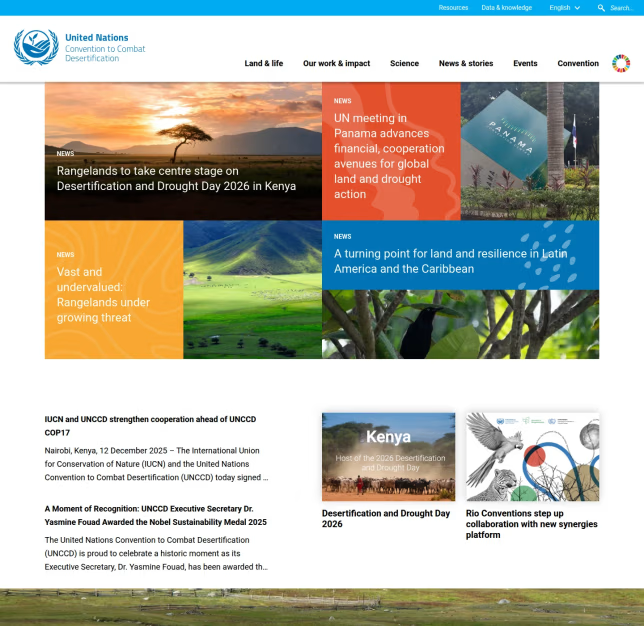
UNCCD operated four separate websites (two WordPress, two Drupal), leading to inconsistencies in design, content management, and user experience. A unified, scalable solution was needed to support a large-scale CMS migration project and improve efficiency and usability.
- Migrating all sites into a single, structured Drupal-based platform (government website Drupal DXP approach). - Implementing Storybook for a design system and consistency, reducing content development costs by 30–40%. - Managing input from 27 stakeholders while maintaining backend stability. - Integrating behavioral tracking, A/B testing, and optimizing performance for strong Google Lighthouse scores. - Converting Adobe InDesign assets into a fully functional web experience.
The modernization effort resulted in a cohesive, user-friendly, and scalable website, improving content management efficiency and long-term digital sustainability.
It was my pleasure working with Oleksiy (PathToProject) on a new Drupal website. He is a true full-stack developer—the ideal mix of DevOps expertise, deep front-end knowledge, and the structured thinking of a senior back-end developer.
He is well-organized and never lets anything slip. Oleksiy understands what needs to be done before being asked and can manage a project independently with minimal involvement from clients, product managers, or business analysts.
One of the best consultants I’ve worked with so far.

Andrei Melis
Technical Lead at Eau de Web
Oleksiy (PathToProject) is demanding and responsive. Comfortable with an Agile approach and strong technical skills, I appreciate the way he challenges stories and features to clarify specifications before and during sprints.

Olivier Ritlewski
Ingénieur Logiciel chez EPAM Systems
Oleksiy (PathToProject) was the Lead Developer on a number of client projects which I managed. He is highly skilled and incredibly hardworking. When assigning work to him, I could always rely on it being completed to a high quality and on time.
His technical expertise was valued across the team and he was often our 'go to' for technical challenges, which he loved to get stuck into. Oleksiy is proactive and engaged in a professional manner with our clients.
I have no hesitation in recommending him.

Daniela Graf
Senior Project Manager | Change Mgmt Practitioner | Process Improvement Geek
Further reading on WordPress GraphQL architecture
These articles expand on the architecture, governance, and delivery concerns that shape a reliable headless WordPress GraphQL layer. They cover integration patterns, content modeling, schema and contract governance, caching, and the operational issues that affect frontend and downstream systems.