

 [01]
[01]Discovery and Audit
Assess existing integrations, data flows, and operational pain points. Produce an integration inventory, dependency map, and prioritized backlog aligned to platform constraints and business workflows.
WordPress integration architecture
Identify weak API contracts, auth risks, and failure points across WordPress integrations before they disrupt delivery.
Focused on integration boundaries, resilience, observability, and governance.
No login required. Takes 2–3 minutes.
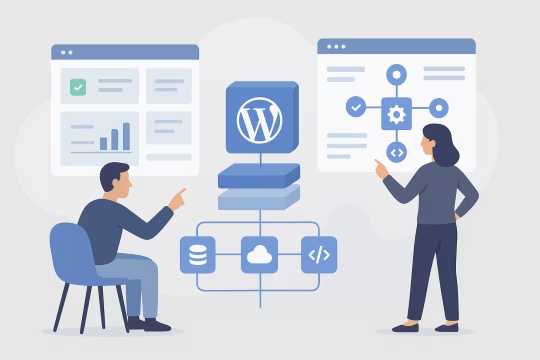
WordPress integrations connect your web platform to the systems that run the business: identity providers and SSO, CRM and marketing automation, product data, and internal APIs. In enterprise environments, these connections must be designed as part of the platform architecture, not as one-off plugins or theme-level code, because integration surfaces become long-lived dependencies.
This capability focuses on defining stable interfaces, implementing secure authentication and authorization, and establishing predictable data flows between WordPress and external services. Typical patterns include WordPress REST GraphQL integrations, webhook-driven eventing, background processing for synchronization, and contract-driven payload validation.
Organizations need this when WordPress becomes a core channel in a broader ecosystem and must participate in governed workflows. Well-structured integrations reduce coupling, make failures observable and recoverable, and allow teams to evolve WordPress, upstream systems, and APIs independently without breaking critical business processes.
Core Focus
Best Fit For
Key Outcomes
Technology Ecosystem
Platform Integrations
As WordPress platforms grow, integrations often accumulate through ad hoc plugin choices, theme-level API calls, and undocumented data contracts. What starts as a simple connection to a CRM or identity provider becomes a mesh of implicit dependencies across content models, user flows, and deployment environments. Small changes in upstream APIs, authentication policies, or data schemas can cascade into production incidents.
Engineering teams then spend disproportionate time diagnosing failures that are hard to reproduce: intermittent timeouts, rate limiting, token expiry, and inconsistent payloads. Without clear boundaries, integration logic leaks into templates and editorial workflows, making refactoring risky. Observability is typically limited to application logs, with little correlation across systems, so root-cause analysis becomes slow and uncertain.
Operationally, fragile integrations increase release risk and constrain platform evolution. Teams avoid upgrades, delay security changes, and implement workarounds that add technical debt. The result is a platform that cannot reliably participate in enterprise workflows, where data quality, access control, and auditability are required for compliance and predictable delivery.
Review current integrations, business workflows, and system boundaries. Identify data owners, interface consumers, failure modes, and non-functional requirements such as latency, availability, and audit needs.
Define integration contracts: endpoints, payload schemas, error semantics, and versioning approach. Establish ownership and compatibility expectations between WordPress and upstream/downstream systems.
Design authentication and authorization flows using OAuth2, token exchange, and least-privilege scopes. Document secrets management, rotation, and environment separation for development, staging, and production.
Build integration modules using WordPress hooks, services, and client abstractions. Implement retries, backoff, idempotency, and validation to handle real-world API behavior and partial failures.
Implement webhook ingestion, background jobs, and scheduled synchronization where appropriate. Define reconciliation strategies, conflict handling, and data lineage to keep systems consistent over time.
Add contract tests, integration tests, and mocked upstream dependencies. Validate edge cases such as rate limits, token expiry, schema changes, and degraded upstream availability.
Instrument logging, metrics, and alerting around integration health. Define runbooks, dashboards, and on-call signals for failures, backlog growth, and data drift.
Establish change management for interfaces, including deprecation policies and release coordination. Create documentation and review practices so integrations remain maintainable as teams and systems evolve.
This service provides the engineering foundations required to connect WordPress to enterprise systems without creating brittle coupling. The focus is on explicit contracts, secure access patterns, and resilient data flows that tolerate upstream change and operational variance. Integrations are implemented with observability and failure handling as first-class concerns, enabling teams to evolve APIs, authentication policies, and content models with controlled risk.

Structured API clients that isolate transport, authentication, and serialization from business logic. This enables consistent handling of timeouts, retries, pagination, and rate limits while keeping integration code testable and maintainable across multiple endpoints and services.

Explicit request/response schemas with validation and clear error semantics. Contracts reduce ambiguity between systems, support backward-compatible evolution, and prevent silent failures caused by unexpected fields, type changes, or partial payloads.
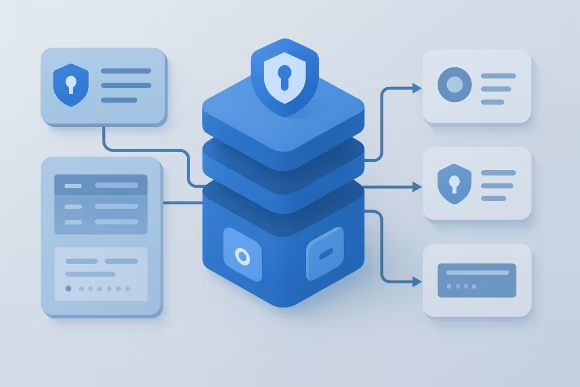
Implementation of OAuth2 patterns appropriate to the integration context, including client credentials, authorization code, and token refresh. Scope design, least-privilege access, and secure secret handling are built into the integration layer rather than scattered across code paths.

Reliable webhook endpoints with signature verification, replay protection, and idempotent processing. Events are queued for asynchronous handling to protect frontend performance and to provide consistent processing under burst traffic or upstream retries.
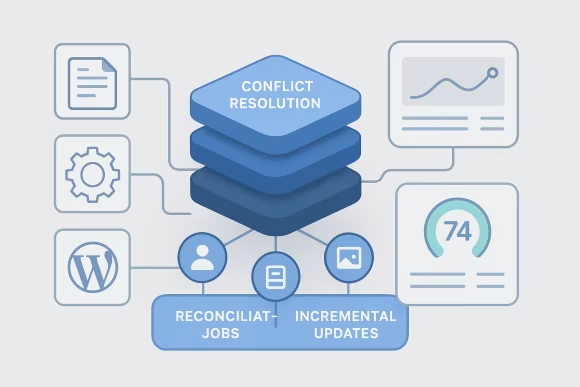
Background synchronization for entities such as users, accounts, and content metadata. Includes reconciliation jobs, conflict strategies, and incremental updates to avoid full reimports, while maintaining traceability and predictable load on upstream systems.

Circuit breakers, retry policies with backoff, and graceful degradation strategies to keep the platform stable during upstream incidents. Failures are surfaced with actionable diagnostics, and recovery paths are designed to avoid duplicate writes and inconsistent state.
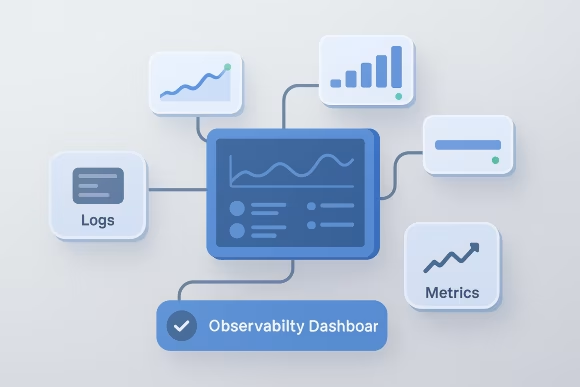
Correlation-friendly logs, metrics, and health checks that expose integration latency, error rates, queue depth, and data drift indicators. This supports operational monitoring, incident response, and capacity planning across the full integration path.
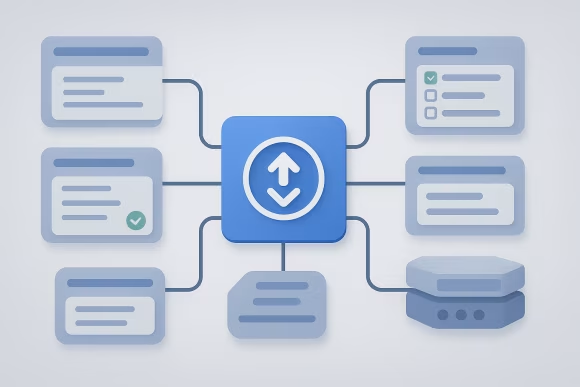
Interface versioning, deprecation policies, and documentation that allow multiple consumers to coexist. Governance practices define ownership, review gates, and release coordination so integration changes remain controlled and auditable.
Use the Health Check to assess API design, token flows, webhook handling, and operational resilience across your WordPress platform.
Engagements are structured to reduce integration risk early, then incrementally implement and harden interfaces. We prioritize explicit contracts, security design, and operational readiness so integrations remain stable through platform upgrades and upstream API changes.
[01]Assess existing integrations, data flows, and operational pain points. Produce an integration inventory, dependency map, and prioritized backlog aligned to platform constraints and business workflows.
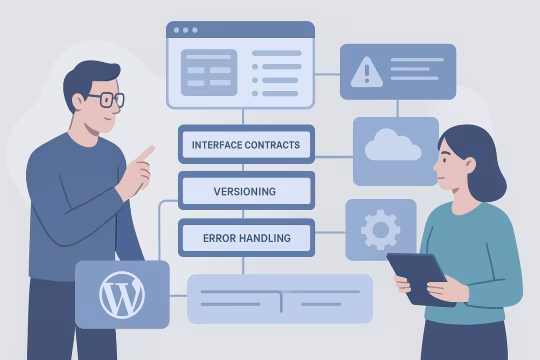 [02]
[02]Define target integration architecture, interface contracts, and data ownership. Establish versioning, error handling conventions, and non-functional requirements such as latency budgets and availability expectations.
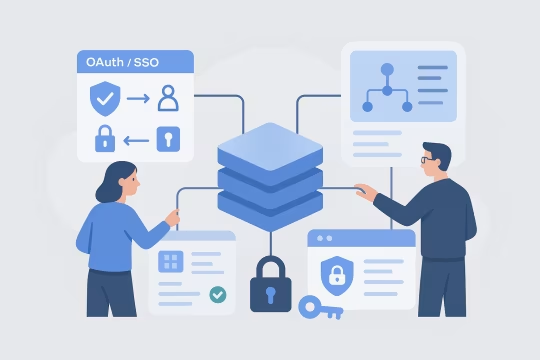 [03]
[03]Design OAuth/SSO flows, scope models, and secrets management aligned to enterprise policies. Validate audit requirements, data retention constraints, and access control boundaries across systems.
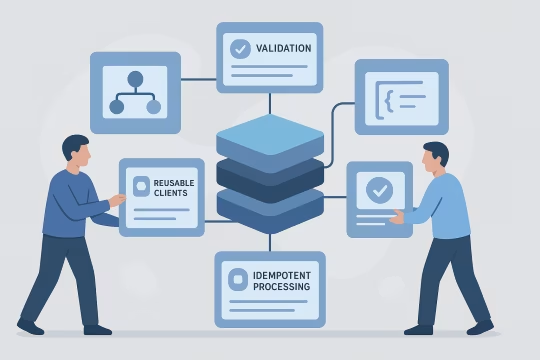 [04]
[04]Build or refactor integration modules with reusable clients, validation, and idempotent processing. Remove theme-level coupling and consolidate integration logic into maintainable components.
 [05]
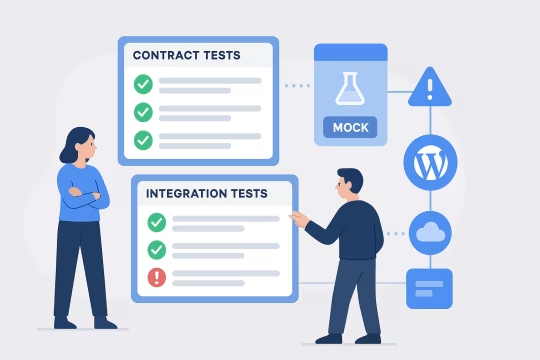
[05]Implement contract tests and integration tests with controlled mocks and staging dependencies. Validate failure scenarios including upstream outages, schema drift, and rate limiting to reduce production surprises.
 [06]
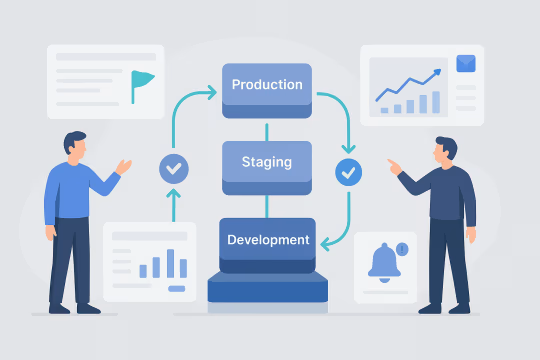
[06]Plan rollout with feature flags, staged traffic, and rollback paths. Coordinate cutover with upstream system owners and verify telemetry, dashboards, and alerting during release windows.
 [07]
[07]Deliver runbooks, dashboards, and alert thresholds for integration health. Train teams on incident response patterns, replay/reconciliation procedures, and safe operational changes.
 [08]
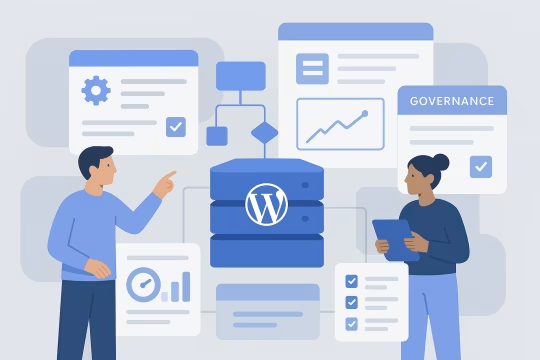
[08]Support ongoing changes through governance, interface reviews, and deprecation planning. Iterate on performance, reliability, and maintainability as new systems and workflows are introduced.
Well-engineered integrations reduce delivery friction and operational risk by making cross-system workflows predictable, observable, and governed. The result is a WordPress platform that can evolve alongside enterprise systems without repeated rework or fragile dependencies.
Clear contracts and reusable integration components reduce coordination overhead. Teams can ship changes to WordPress and upstream systems with fewer regressions and less rework.
Resilience patterns and explicit failure handling prevent upstream instability from cascading into site outages. Operational signals make issues detectable earlier and easier to triage.
Centralized OAuth and token handling reduces accidental exposure of secrets and inconsistent authorization checks. Least-privilege scopes and rotation practices support enterprise security requirements.
Consolidating scattered API calls into a governed integration layer makes refactoring feasible. Documentation and versioning prevent one-off fixes from becoming permanent architecture.
Versioning and deprecation policies allow interfaces to change without breaking consumers. This supports upgrades, vendor changes, and new product capabilities with controlled impact.
Validation, reconciliation, and idempotent processing reduce duplicate writes and inconsistent records. Synchronization becomes measurable and correctable rather than implicit and fragile.
Metrics and logs provide visibility into latency, error rates, and backlog growth across integration paths. This enables capacity planning and objective reliability improvements.
Reduce integration risk
Pinpoint architectural gaps in data flows, observability, and versioning so teams can ship changes with less risk.
No login required. Takes 2–3 minutes.
Adjacent capabilities that extend integration architecture, API design, and operational reliability for WordPress platforms.
WordPress lead contact sync with secure lead capture
WordPress REST API engineering and GraphQL API design
Schema-first APIs for headless content delivery
Custom WordPress REST endpoints, schemas, and authentication patterns
GA4 event tracking WordPress with governed measurement
Upgrade-ready architecture, WordPress CI/CD and DevOps, and operational hardening
Enterprise WordPress network design for multi-site ecosystems
Enterprise WordPress extensibility with controlled dependencies
Enterprise WordPress Platform Engineering
Common questions about architecture, operations, governance, risk, and engagement for enterprise WordPress integrations.
We start by defining explicit boundaries: what WordPress owns (presentation, content workflows, channel-specific logic) versus what external systems own (customer records, product truth, identity). From there we design an integration layer that isolates transport and authentication from business logic, typically using dedicated service classes and well-defined interfaces rather than theme-level calls. Decoupling is reinforced through contracts: stable endpoint definitions, payload schemas, and error semantics. Where possible we prefer asynchronous patterns (webhooks plus background processing) for non-interactive workflows, and we introduce caching and read models when upstream latency would otherwise leak into page rendering. We also plan for change by introducing versioning and compatibility rules. That includes how WordPress handles unknown fields, optional attributes, and deprecations. The goal is to allow upstream systems to evolve without forcing urgent WordPress releases, while still keeping data correctness and access control explicit and testable.
REST is usually the default for system-to-system integration because it maps cleanly to resource ownership, caching, and operational tooling. It is often simpler to secure and observe, and it aligns well with webhook-driven eventing and background synchronization. GraphQL can be a good fit when consumers need flexible query shapes, when multiple upstream sources must be composed into a single response, or when frontend teams need to reduce over-fetching and coordinate fewer endpoint changes. In WordPress contexts, GraphQL is commonly used for content delivery and aggregation patterns, but it can also be used as an integration facade if governance is strong. The decision is less about preference and more about constraints: rate limits, caching strategy, authorization model, and schema governance. If GraphQL is chosen, we put controls in place for query complexity, schema versioning, and field-level authorization to avoid operational and security surprises.
We instrument integrations around four signals: latency, traffic, errors, and saturation/backlog. Practically, that means structured logs with correlation identifiers, metrics for request duration and status codes, counters for retries and circuit-breaker trips, and gauges for queue depth and job age when asynchronous processing is used. We also add health checks that reflect real dependency status, not just “PHP is running.” For example, a health endpoint may validate token acquisition, DNS resolution, or a lightweight upstream call, while still avoiding expensive operations. Alerts are tuned to actionable thresholds, such as sustained error rate increases, token refresh failures, or backlog growth beyond a recovery window. Finally, we provide runbooks that describe common failure modes (rate limiting, expired credentials, schema drift) and the safe recovery steps (replay, reconciliation, rollback). This reduces mean time to restore and makes integration reliability measurable over time.
We separate interactive paths from background work. Any integration that is not required to render a page or complete an editorial action synchronously is moved to asynchronous processing using queues or scheduled jobs. For interactive calls that must remain synchronous, we apply timeouts, caching, and graceful degradation so upstream slowness does not cascade into a poor user experience. We also design for predictable load: batching where appropriate, incremental sync instead of full reimports, and rate-limit aware clients. For editorial workflows, we avoid hard dependencies on upstream availability by persisting drafts and using eventual consistency patterns, with clear UI feedback when external data is pending. Performance is validated with realistic test scenarios, including upstream latency injection and rate limiting. The outcome is a platform that remains responsive even when upstream systems are degraded or under maintenance.
We design the identity integration around the enterprise’s chosen protocols and policies, commonly OAuth2/OIDC with an external identity provider. The key is to treat identity as a platform concern: token handling, session management, and authorization mapping must be consistent across environments and aligned with security requirements. Implementation typically includes configuring the authentication flow, validating tokens, mapping claims to WordPress roles/capabilities, and defining how user provisioning works (just-in-time creation versus pre-provisioning). We also address edge cases such as account linking, deprovisioning, and multi-tenant scenarios. Operationally, we implement safe secret storage and rotation, clear error handling for login failures, and monitoring for token refresh or metadata discovery issues. The goal is a predictable SSO experience without embedding fragile identity logic into themes or individual plugins.
CRM integrations usually fall into three categories: lead capture, profile enrichment, and lifecycle event tracking. Lead capture focuses on form submissions and consent handling, typically implemented with validated payloads, idempotent writes, and retryable background processing to avoid losing submissions during transient failures. Profile enrichment involves reading CRM attributes to personalize experiences or to drive editorial segmentation. Here we pay attention to caching, data freshness, and authorization boundaries so sensitive fields are not exposed unintentionally. Lifecycle event tracking often uses webhooks or event APIs to record actions such as registrations, downloads, or account changes. Across all patterns, we define data ownership and reconciliation: which system is the source of truth, how conflicts are resolved, and how to backfill or replay events. This prevents “silent drift” where WordPress and the CRM gradually diverge without detection.
We define ownership at three levels: interface ownership (who controls the contract), implementation ownership (who maintains the code), and operational ownership (who responds to incidents). In enterprise environments these are often different teams, so we document responsibilities and escalation paths explicitly. Governance includes a change process for contracts: how new fields are introduced, how breaking changes are avoided, and how deprecations are communicated and enforced. We recommend semantic versioning for APIs where applicable, plus a compatibility policy that defines what “non-breaking” means in practice. We also establish documentation standards (endpoint catalogs, payload examples, error codes), review gates for integration changes, and release coordination practices. The goal is to make integrations a managed product surface rather than an accumulation of one-off connections.
We start by classifying plugin dependencies: critical-path versus optional, and runtime versus build-time. For critical integrations, we prefer to minimize reliance on opaque plugins and instead implement thin, auditable integration modules where we control contracts, security handling, and observability. When a third-party plugin is necessary, we evaluate its maintenance history, security posture, extensibility points, and upgrade behavior. We isolate plugin usage behind an internal abstraction so that replacing the plugin later does not require rewriting business logic. We also pin versions, test upgrades in CI, and monitor for security advisories. Governance includes defining who approves plugin changes, how updates are scheduled, and what rollback paths exist. This reduces the risk that a plugin update or abandonment becomes a platform blocker.
We design integrations with idempotency, validation, and reconciliation as core requirements. Idempotency prevents duplicate writes when retries occur. Validation ensures payloads meet contract expectations before they affect downstream systems. Reconciliation jobs compare records across systems to detect drift and to correct it in a controlled way. We also define sources of truth and conflict rules up front. For example, if the CRM owns customer attributes, WordPress should not overwrite them except through an explicit workflow. For event-driven flows, we ensure events are durable (queued) and replayable, with clear deduplication keys. Finally, we make inconsistency observable by tracking sync status, last-updated timestamps, and error queues. This turns data quality from an assumption into an operationally managed aspect of the platform.
Common risks include leaked credentials, overly broad OAuth scopes, insecure webhook endpoints, and unintended data exposure through logs or cached responses. Another frequent issue is inconsistent authorization checks when integration logic is spread across templates, plugins, and custom code. We address these by centralizing credential handling, using secure storage and rotation, and enforcing least-privilege scopes. Webhooks are protected with signature verification, replay protection, and strict validation. We also implement consistent authorization mapping from identity claims to WordPress capabilities, and we ensure sensitive data is redacted from logs. From an operational perspective, we add monitoring for authentication failures, unusual traffic patterns, and token refresh issues. Security is treated as part of the integration architecture and delivery workflow, not as a final hardening step.
A typical scope starts with an integration audit and target architecture, then moves into implementing one or more prioritized integration paths end-to-end. “End-to-end” usually includes contract definition, security design, implementation, testing, and operational readiness (dashboards, alerts, runbooks). We often structure work around integration domains such as identity, CRM, product data, or analytics. Each domain has clear acceptance criteria: contract coverage, failure handling behavior, and measurable operational signals. If there are existing integrations, we include refactoring to remove theme-level coupling and to consolidate logic into maintainable modules. The engagement can be delivered as a fixed set of integration epics or as a platform engineering stream with a rolling backlog. In both cases, we align with your release process and coordinate with upstream system owners to avoid surprises during cutover.
We work with internal engineering teams to establish shared contracts, coding standards, and operational expectations. Collaboration typically includes joint design sessions for interfaces and security flows, plus regular technical checkpoints to validate assumptions against upstream constraints such as rate limits, data models, and change windows. With external system owners (CRM, IAM, data platforms), we align on ownership and support boundaries: who provides sandbox environments, how credentials are managed, and what SLAs or maintenance windows apply. We also agree on how changes are communicated and tested, including staging environments and contract tests. Day-to-day, we keep integration work transparent through an interface catalog, documented payload examples, and a clear backlog of risks and dependencies. This reduces coordination friction and makes cross-team delivery more predictable.
Collaboration usually begins with a short discovery phase focused on integration reality rather than assumptions. We gather an inventory of current integrations (plugins, custom code, external endpoints), map critical workflows (authentication, lead capture, content syndication, personalization), and identify the systems of record and data ownership rules. Next, we define a target integration architecture and prioritize one or two high-value integration paths to implement as reference patterns. This includes agreeing on contracts, security approach (OAuth/OIDC, scopes, secrets management), and operational requirements (logging, metrics, alerting, runbooks). We also confirm environments, access needs, and test data availability with upstream system owners. The output is a concrete plan: a backlog with acceptance criteria, a delivery sequence aligned to your release cadence, and a clear definition of responsibilities across teams. From there, implementation starts with the highest-risk interfaces first to reduce uncertainty early.
These case studies showcase advanced integration architectures involving WordPress and Drupal platforms, focusing on API-driven content delivery, secure authentication flows, and scalable data synchronization. They highlight real-world implementations of OAuth, GraphQL, webhook processing, and contract-driven payload validation, demonstrating how governed workflows and platform stability are achieved in enterprise environments. The selected work provides measurable proof of delivering reliable, maintainable integrations that align closely with the WordPress Integrations service capabilities.
The existing marine data portal relied on three unaligned WordPress installations and embedded PHP code, creating inefficiencies and risks in content management and usability.
The new Drupal DXP streamlined content operations and improved accessibility, offering scientists and businesses a more efficient gateway to marine data services.
UNCCD operated four separate websites (two WordPress, two Drupal), leading to inconsistencies in design, content management, and user experience. A unified, scalable solution was needed to support a large-scale CMS migration project and improve efficiency and usability.
The modernization effort resulted in a cohesive, user-friendly, and scalable website, improving content management efficiency and long-term digital sustainability.
It was my pleasure working with Oleksiy (PathToProject) on a new Drupal website. He is a true full-stack developer—the ideal mix of DevOps expertise, deep front-end knowledge, and the structured thinking of a senior back-end developer.
He is well-organized and never lets anything slip. Oleksiy understands what needs to be done before being asked and can manage a project independently with minimal involvement from clients, product managers, or business analysts.
One of the best consultants I’ve worked with so far.

Andrei Melis
Technical Lead at Eau de Web
Oleksiy (PathToProject) has been a valuable developer resource over the past six months for us at LSHTM. This included coming on board to revive and complete a stalled Drupal upgrade project, as well as carrying out work to improve our site accessibility and functionality.
I have found Oleksiy to be very knowledgeable and skilful and would happily work with him again in the future.

Ali Kazemi
Web & Digital Manager at London School of Hygiene & Tropical Medicine
Oleksiy (PathToProject) is demanding and responsive. Comfortable with an Agile approach and strong technical skills, I appreciate the way he challenges stories and features to clarify specifications before and during sprints.

Olivier Ritlewski
Ingénieur Logiciel chez EPAM Systems
These articles expand on the architecture, governance, and operational patterns that make enterprise WordPress integrations reliable. They cover durable integration design, scheduled job governance, observability, and the data ownership issues that often determine whether CRM and automation links hold up over time.
Share your current integration landscape and critical workflows. We will assess interface contracts, security flows, and operational readiness, then define a practical roadmap for resilient, governed integrations.