
 [01]
[01]Kickoff and Alignment
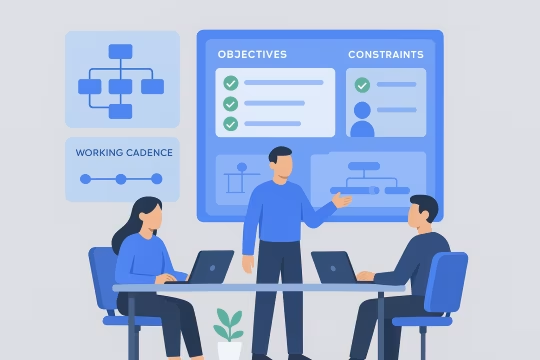
Confirm objectives, constraints, and decision-makers across engineering, product, and content operations. Establish working cadence, artifacts to be produced, and how architectural decisions will be reviewed and approved.
WordPress DXP strategy
Identify governance drift, integration risk, and delivery gaps across your WordPress platform estate.
Use the Health Check to surface architecture priorities before a strategy review.
No login required. Takes 2–3 minutes.
A WordPress digital experience strategy defines how your WordPress platform supports content, journeys, and product delivery across channels while remaining governable and evolvable. For enterprise teams, it connects experience goals to Enterprise WordPress DXP architecture: what belongs in WordPress, what should be externalized (search, personalization, identity, commerce), and how systems integrate through stable APIs and event flows.
Organizations need this when WordPress has grown into a multi-team platform: multiple sites, shared components, varied editorial workflows, and an expanding integration surface. This is especially common in a WordPress multisite DXP strategy, where inconsistent patterns across brands quickly create delivery friction and operational risk.
A strategy-led approach establishes a reference architecture, DXP integration patterns, WordPress composable platform governance, and a roadmap that fits enterprise constraints. It clarifies ownership, environments, release processes, and measurement so that WordPress can function as a durable DXP foundation rather than a collection of loosely coupled sites.
Core Focus
Best Fit For
Key Outcomes
Technology Ecosystem
Platform Integrations
As WordPress platforms expand from a single site into a multi-brand, multi-team ecosystem, architectural decisions tend to accumulate without a shared reference model. Teams add plugins, custom themes, and point integrations to meet immediate needs. Over time, the platform becomes a mix of patterns: different content models, inconsistent component implementations, and uneven performance and accessibility characteristics across properties.
This drift affects engineering and architecture in predictable ways. Integration surfaces become brittle because APIs are not treated as products, authentication and caching strategies vary by team, and data ownership is unclear. Editorial workflows diverge, making shared governance difficult. Frontend delivery becomes fragmented when some teams adopt headless patterns while others remain theme-based, leading to duplicated logic and inconsistent release practices.
Operationally, the platform becomes harder to change safely. Upgrades are delayed due to plugin risk and unknown dependencies, incidents take longer to diagnose, and delivery throughput drops as teams spend time reconciling conflicting standards. Without a strategy that defines boundaries, governance, and a roadmap, WordPress can struggle to support consistent digital experiences at enterprise scale.
Assess the current WordPress estate, delivery workflows, and integration landscape. Capture constraints such as hosting, security requirements, compliance, and release cadence. Identify where experience goals conflict with current architecture or operating model.
Translate business journeys into experience capabilities such as search, personalization, localization, and content syndication. Map capabilities to systems and teams to clarify ownership and identify gaps in the current platform design.
Define target-state architecture for WordPress within a composable DXP. Establish system boundaries, deployment topology, and runtime concerns such as caching, rendering strategy, and identity integration. Document key architectural decisions and trade-offs.
Design content types, taxonomies, and reusable patterns that support multiple channels and sites. Define editorial workflows, governance rules, and migration considerations to reduce fragmentation and improve reuse across teams.
Standardize API and event integration approaches, including authentication, versioning, error handling, and observability. Define when to use REST, GraphQL, webhooks, or event streams, and how integrations are tested and operated.
Create decision-making and standards for themes/components, plugins, security, and performance budgets. Define contribution workflows, review gates, and ownership so teams can move quickly while maintaining platform consistency.
Convert the target state into a phased roadmap with dependencies, risk reduction steps, and measurable milestones. Sequence work to protect delivery while enabling modernization, including upgrade paths and deprecation plans.
Define KPIs and instrumentation needs across performance, reliability, accessibility, and content operations. Align analytics and experimentation requirements with the architecture so improvements can be validated and sustained.
This service establishes the architectural and operational foundations required for WordPress to function as an enterprise digital experience platform. It focuses on Enterprise WordPress DXP architecture, including composable boundaries, integration contracts, and WordPress composable platform governance that reduce drift as teams scale. The outcome is a reference model for how experiences are built, operated, and evolved across sites and channels, with clear standards for content, frontend delivery, and measurement.
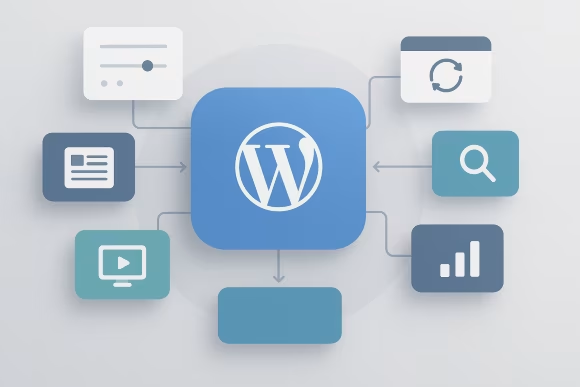
Define how WordPress fits into a composable DXP, including which capabilities remain in WordPress and which are provided by external services. Establish clear boundaries for content, presentation, identity, search, and analytics to reduce coupling and enable independent evolution of subsystems.

Create a target-state reference architecture with documented decision records for rendering strategy, caching layers, environment topology, and security controls. This provides a consistent basis for implementation across teams and reduces rework caused by undocumented trade-offs.

Design content types, taxonomies, and reusable patterns that support multi-site reuse and multi-channel delivery. Define rules for structured content, localization, and media handling so content remains portable and resilient as frontend implementations evolve.

Establish when to use theme-based rendering versus headless delivery with Next.js, and how to keep shared UI patterns consistent. Define a Next.js and React component strategy for WordPress, including component ownership, build pipelines, and integration contracts between WordPress content APIs and frontend applications.

Standardize API design and operational requirements: authentication, authorization, versioning, rate limits, caching semantics, and error handling. Define how integrations are tested, monitored, and changed safely to reduce breakage across dependent systems.
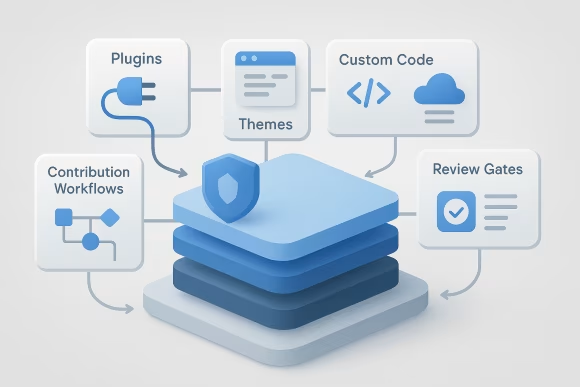
Define platform governance across plugins, themes, custom code, and third-party services. Establish contribution workflows, review gates, and ownership boundaries so multiple teams can deliver changes without undermining security, performance, or maintainability.

Specify logging, tracing, and metrics requirements across WordPress, edge layers, and frontend applications. Align analytics instrumentation, consent requirements, and performance budgets so experience improvements can be measured and operational issues diagnosed quickly.
Run a focused Health Check to evaluate composable boundaries, integration standards, and governance consistency.
Engagements are structured to produce an actionable reference architecture and WordPress DXP roadmap and modernization planning—not a slide-only strategy. Work is evidence-driven: current-state assessment, target-state design, and implementation sequencing with WordPress composable platform governance and measurement defined upfront.
[01]Confirm objectives, constraints, and decision-makers across engineering, product, and content operations. Establish working cadence, artifacts to be produced, and how architectural decisions will be reviewed and approved.
 [02]
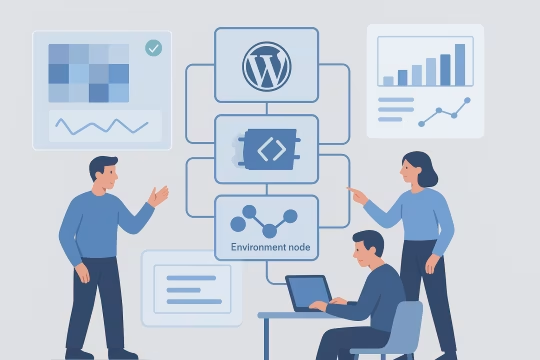
[02]Review platform topology, codebase patterns, plugin/theme landscape, environments, and release processes. Identify architectural hotspots, operational risks, and sources of inconsistency across sites and teams.
 [03]
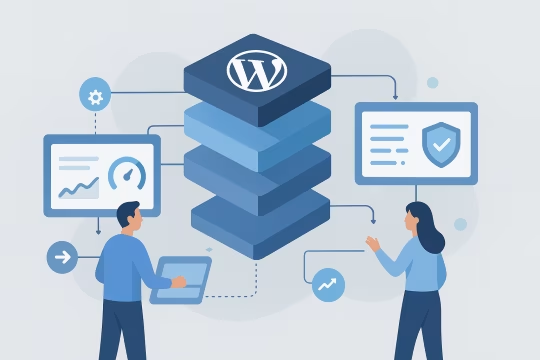
[03]Design the reference architecture for WordPress within the broader DXP ecosystem. Define system boundaries, integration points, rendering approach, and non-functional requirements such as performance, security, and availability.
 [04]
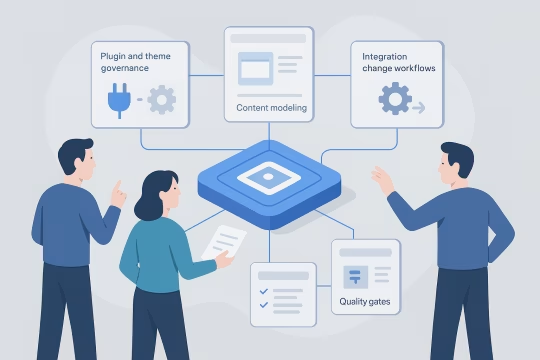
[04]Define governance for plugins, themes/components, content modeling, and integration changes. Establish ownership, contribution workflows, and quality gates that fit enterprise delivery realities.
 [05]
[05]Create a phased roadmap with dependencies, milestones, and risk-reduction steps. Prioritize work that enables safe upgrades, reduces coupling, and improves delivery throughput without disrupting ongoing product work.
 [06]
[06]Translate architecture into actionable epics and acceptance criteria for delivery teams. Define reference implementations, documentation needs, and how standards will be adopted across multiple teams and repositories.
 [07]
[07]Define KPIs and instrumentation requirements, then validate that the roadmap supports measurable outcomes. Establish a review cycle for architecture and governance to keep the strategy current as the platform evolves.
A clear WordPress digital experience strategy reduces architectural drift and makes platform evolution predictable across enterprise teams. It improves delivery throughput by standardizing patterns, clarifying ownership, and reducing integration fragility—especially in multi-site environments. It also lowers operational risk by defining WordPress composable platform governance, measurement, and upgrade paths that fit enterprise constraints.
Shared reference architecture and standards reduce time spent reconciling inconsistent patterns. Teams can reuse content models and integration approaches, shortening lead time for new features across multiple sites.
Governance and dependency visibility reduce surprises during WordPress core and plugin updates. Clear policies for plugin selection and custom code boundaries make upgrades more routine and less disruptive.
Documented decisions and platform boundaries prevent ad-hoc divergence as new teams join. The platform evolves through controlled changes rather than accumulating incompatible implementations.
Standard integration contracts and operational requirements reduce breakage between WordPress and external services. Monitoring and versioning expectations improve stability as APIs and dependencies change over time.
A unified approach to frontend delivery and component governance reduces UI fragmentation. Performance and accessibility requirements become enforceable across properties rather than handled inconsistently per team.
Defined operating model clarifies who owns platform decisions, integrations, and content standards. This reduces decision latency and improves incident response by making responsibilities explicit.
A measurement framework ties experience goals to instrumentation and KPIs. Teams can validate improvements, prioritize roadmap items based on evidence, and avoid changes that do not move agreed metrics.
WordPress DXP strategy
Benchmark your current platform approach, then review the findings with an architecture-focused discussion.
No login required. Takes 2–3 minutes.
Adjacent services that extend Enterprise WordPress DXP architecture into implementation, integration, and composable delivery patterns—especially for multisite and headless programs.
WordPress platform strategy consulting: architecture principles, governance, and roadmap definition
WordPress multi-site operating model and enterprise governance
Enterprise WordPress Platform Engineering
WordPress content architecture design for content models, taxonomies, and editorial structure
Enterprise WordPress extensibility with controlled dependencies
GA4 event tracking WordPress with governed measurement
WordPress REST API engineering and GraphQL API design
WordPress lead contact sync with secure lead capture
WordPress integration services for secure API connections
Answers to common questions about how to define a WordPress digital experience strategy, including Enterprise WordPress DXP architecture consulting topics such as integrations, governance, operating model, risk, and engagement approach.
We start by mapping experience capabilities (content authoring, search, personalization, identity, experimentation, analytics, localization) to systems and teams. WordPress is typically positioned as the system of record for editorial content and content workflows, while other capabilities may be better served by specialized services. Boundary definition is expressed as a reference architecture: what data is owned by WordPress, what is mastered elsewhere, and how data moves between systems. We document integration contracts (APIs, events, caching semantics), non-functional requirements (latency, availability, security), and operational responsibilities. The goal is not to “externalize everything,” but to reduce coupling and clarify change impact. For example, search may be externalized for scale and relevance tuning, while content modeling remains in WordPress. The boundary is validated against constraints such as hosting model, compliance, editorial needs, and the skills of delivery teams.
Headless delivery is usually justified when you need multi-channel reuse, stronger frontend performance control, or independent deployment of the presentation layer. It can also help when multiple products share a component system and you want consistent UI governance across sites. However, headless introduces additional architecture: API design, caching strategy, preview workflows, authentication flows, and observability across more moving parts. We evaluate whether those costs are offset by the benefits, and whether the organization can operate the resulting system reliably. In practice, many enterprises adopt a hybrid model: some properties remain theme-based for speed and editorial simplicity, while others use Next.js for high-traffic or application-like experiences. The strategy defines criteria for choosing each approach, plus shared standards so teams do not create incompatible patterns across the platform.
We analyze how code and configuration move from development to production, including how plugins, themes, and infrastructure changes are promoted. The strategy defines an environment model (dev/test/stage/prod), release cadence expectations, and the controls needed for enterprise risk management. For WordPress, environment consistency often breaks down due to manual plugin changes, inconsistent configuration, and differences in data. We recommend a controlled approach to configuration management, repeatable deployments, and clear separation of responsibilities between platform and product teams. We also define operational requirements such as rollback strategy, incident response expectations, and change windows. The output is a practical operating model that delivery teams can implement with CI/CD and infrastructure tooling appropriate to the hosting context.
We define metrics across reliability, performance, delivery, and content operations. On the runtime side, this typically includes availability, error rates, cache hit ratios, latency percentiles, and resource saturation indicators. For experience quality, we include Core Web Vitals, accessibility conformance signals, and key journey timings. For platform operations, we recommend tracking upgrade cadence (core and plugin), vulnerability remediation time, deployment frequency, and change failure rate. For content operations, useful metrics include editorial cycle time, content reuse rates, and workflow bottlenecks. The strategy ties these metrics to instrumentation requirements across WordPress, edge/CDN, and frontend applications. We also define ownership for dashboards and alerting so metrics drive action rather than becoming passive reporting.
We treat APIs as long-lived contracts. The strategy defines which APIs are required (content delivery, search queries, navigation, personalization inputs), how they are authenticated, and how they are versioned. We also define caching semantics and pagination patterns to support performance and predictable load. WordPress can expose APIs via REST, GraphQL, or custom endpoints depending on the use case and governance constraints. We define criteria for each approach, including how schema changes are managed and how consumers are protected from breaking changes. We also address operational concerns: rate limiting, error handling conventions, observability, and test strategy for integrations. The result is an integration model that supports multiple consumers (web, apps, internal tools) without creating brittle point-to-point dependencies.
We design identity and consent as shared platform capabilities with clear boundaries. Identity integration typically uses OAuth2/OIDC patterns, with WordPress acting as a relying party rather than the master identity store. Consent management is treated as a cross-cutting concern that must be enforced consistently across frontend and backend components. For analytics, we define an event model and instrumentation standards that work across theme-based and headless properties. This includes naming conventions, data layer expectations, and how events are validated in non-production environments. To avoid tight coupling, we recommend stable contracts and adapter layers where appropriate. The strategy also defines ownership and change management so updates to identity providers, consent tooling, or analytics schemas do not cause uncontrolled regressions across the platform.
We define governance as a set of enforceable rules and workflows rather than a committee. For plugins, this includes selection criteria (maintenance activity, security posture, compatibility), a lifecycle policy (adopt, review, deprecate), and a clear owner responsible for updates and risk assessment. For custom code, we define standards for theme and plugin development, code review expectations, and how architectural decisions are recorded. We also recommend a policy for when to extend WordPress versus when to externalize functionality into services. The governance model includes quality gates such as security scanning, performance budgets, and automated testing requirements where feasible. Importantly, it defines how exceptions are handled so teams can move forward without eroding platform consistency.
We establish a content architecture that separates shared patterns from site-specific extensions. Shared patterns include core content types, taxonomy conventions, media handling rules, and localization strategy. Site-specific needs are handled through controlled extension points rather than ad-hoc divergence. We also define governance for content changes: who can introduce new content types, how changes are reviewed, and how migrations are planned. For headless consumers, we define schema stability expectations and versioning approaches to protect downstream applications. Operationally, we align editorial workflows and permissions to reduce fragmentation. The strategy typically includes documentation standards and a change process so content model evolution remains deliberate, testable, and compatible with multiple delivery channels.
We start with a threat-informed view of the platform: plugin supply chain risk, authentication and authorization boundaries, data exposure through APIs, and administrative access controls. The strategy defines security requirements for code, configuration, and environments, including how secrets are managed and how access is audited. We also define an upgrade and patching policy that is realistic for enterprise operations, including how vulnerabilities are triaged and how emergency changes are deployed. For integrations, we define secure patterns for token handling, least-privilege access, and logging without leaking sensitive data. Compliance requirements (such as retention, consent, and auditability) are mapped to platform capabilities and operational procedures. The output is a set of architectural controls and governance workflows that reduce risk without blocking delivery.
We use phased sequencing with explicit dependency management. The roadmap identifies foundational work that reduces risk early (observability, upgrade readiness, integration contract stabilization) and separates it from higher-change initiatives (rendering strategy shifts, major content model refactors). We also define coexistence patterns so old and new approaches can run in parallel for a period. Examples include supporting both theme-based and headless properties with shared standards, or introducing new APIs alongside legacy endpoints with versioning and deprecation plans. Finally, we align governance and release management to prevent uncontrolled divergence during modernization. This includes clear decision records, quality gates, and a cadence for reviewing architecture as the platform evolves.
Deliverables are designed to be implementation-ready. Typically this includes a current-state assessment summary, a target-state reference architecture, and a set of architectural decision records that capture key trade-offs. We also provide integration standards covering API contracts, authentication, caching, and observability expectations. On the operating model side, we define governance for plugins, themes/components, content modeling, and integration changes, including ownership and review workflows. We also produce a phased roadmap with sequencing, dependencies, and measurable milestones. Where helpful, we include reference examples such as content model templates, environment and release process recommendations, and measurement/KPI definitions. The exact artifact set is tailored to your constraints (hosting model, regulatory requirements, team topology) and the maturity of the existing platform.
Most engagements run 4–8 weeks depending on platform size, number of sites, and integration complexity. A smaller, focused scope (single platform with limited integrations) can be completed faster, while large multi-brand estates may require additional discovery and stakeholder alignment. Key participants typically include a platform owner, senior engineering representatives, an enterprise architect, and content operations leadership. We also involve security and infrastructure stakeholders to validate constraints around hosting, identity, compliance, and release management. We keep participation efficient by using structured workshops, targeted technical reviews, and asynchronous artifact review. The goal is to produce decisions and a roadmap that teams can execute, not to create a strategy that requires ongoing facilitation to interpret.
Collaboration typically begins with a short alignment call to confirm objectives, scope boundaries, and the decision-makers who will approve the reference architecture and roadmap. We then request a minimal set of inputs: platform inventory (sites, environments), key repositories, integration list, and any existing standards or constraints. Next, we run a structured discovery phase combining stakeholder workshops and technical assessment. Workshops focus on experience goals, operating model, and pain points; technical assessment focuses on architecture, integrations, release processes, and risk areas such as plugins and upgrades. Within the first two weeks, we aim to validate the problem statement and agree on the target outcomes and artifact set. From there, we iterate on the reference architecture and roadmap with regular reviews so decisions are made early and documented clearly for delivery teams.
These case studies showcase real-world applications of composable digital experience platforms, integration governance, and scalable multi-site architectures. They highlight strategies for platform consolidation, content governance, and implementation readiness that align closely with WordPress multisite DXP challenges. The selected work demonstrates measurable outcomes in platform stability, integration patterns, and delivery models relevant to enterprise WordPress digital experience strategy.
UNCCD operated four separate websites (two WordPress, two Drupal), leading to inconsistencies in design, content management, and user experience. A unified, scalable solution was needed to support a large-scale CMS migration project and improve efficiency and usability.
The modernization effort resulted in a cohesive, user-friendly, and scalable website, improving content management efficiency and long-term digital sustainability.
Organogenesis faced operational challenges managing multiple brand websites on outdated platforms, resulting in fragmented workflows, high maintenance costs, and limited scalability across a multi-brand digital presence.
The transformation reduced time-to-deliver marketing updates by 20–25%, improved Lighthouse scores to ~90+, and delivered a scalable multi-brand foundation for long-term growth.
It was my pleasure working with Oleksiy (PathToProject) on a new Drupal website. He is a true full-stack developer—the ideal mix of DevOps expertise, deep front-end knowledge, and the structured thinking of a senior back-end developer.
He is well-organized and never lets anything slip. Oleksiy understands what needs to be done before being asked and can manage a project independently with minimal involvement from clients, product managers, or business analysts.
One of the best consultants I’ve worked with so far.

Andrei Melis
Technical Lead at Eau de Web
Oleksiy (PathToProject) worked with me on a specific project over a period of three months. He took full ownership of the project and successfully led it to completion with minimal initial information.
His technical skills are unquestionably top-tier, and working with him was a pleasure. I would gladly collaborate with Oleksiy again at any opportunity.

Nikolaj Stockholm Nielsen
Strategic Hands-On CTO | E-Commerce Growth
As Dev Team Lead on my project for 10 months, Oleksiy (PathToProject) demonstrated excellent technical skills and the ability to handle complex Drupal projects. His full-stack expertise is highly valuable.

Laurent Poinsignon
Domain Delivery Manager Web at TotalEnergies
These articles expand on the architecture, governance, and delivery decisions that shape an enterprise WordPress DXP. They cover integration patterns, information architecture, multisite governance, and the operational controls that help a platform stay scalable and composable.
Let’s review your current WordPress platform, clarify DXP boundaries, and produce a reference architecture and roadmap your teams can execute safely.