Core Focus

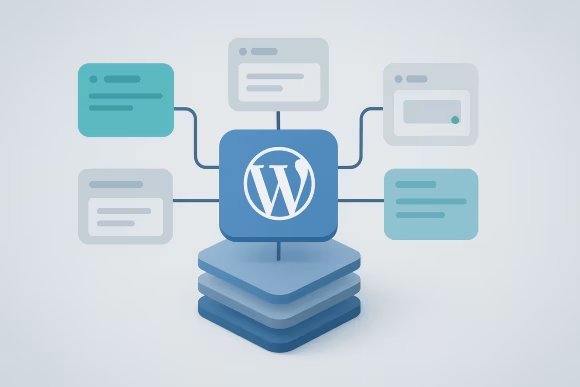
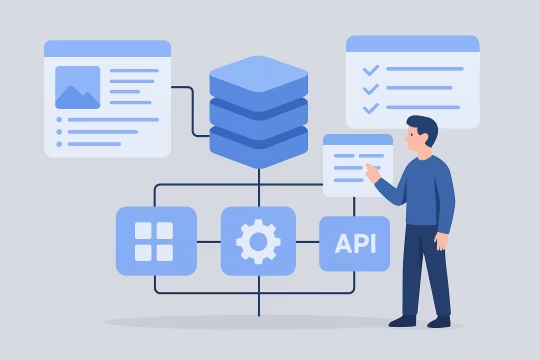
Platform capability assessment
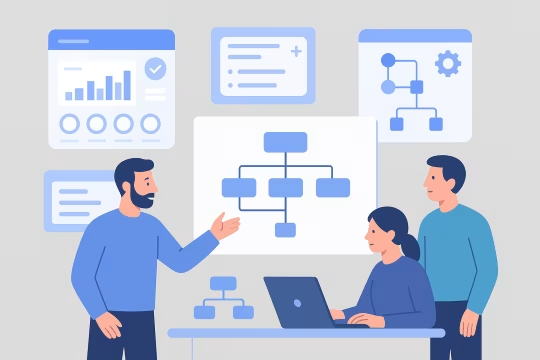
Architecture principles and standards
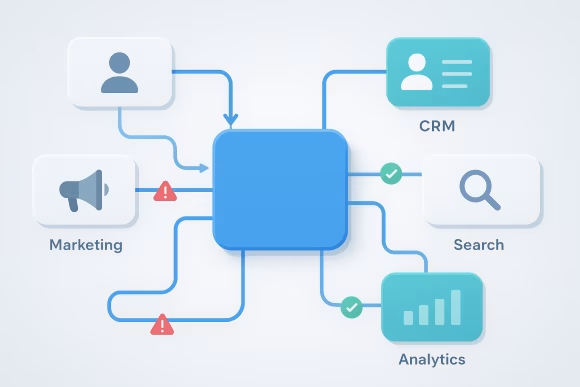
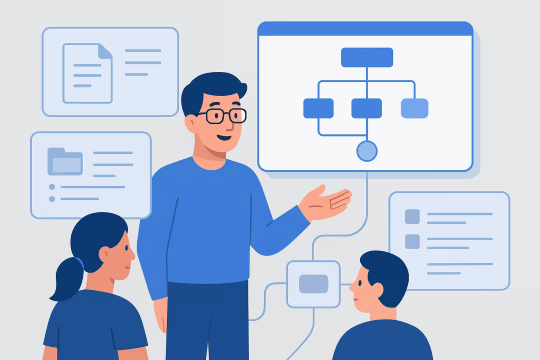
Governance and operating model
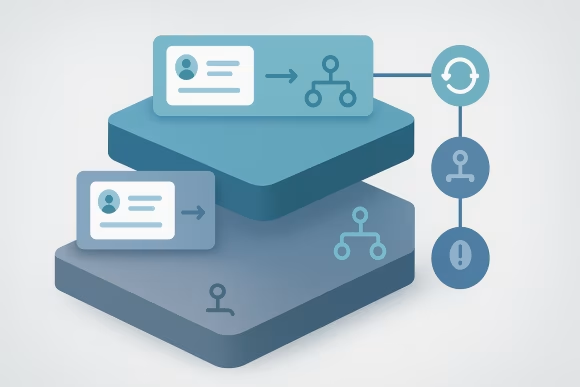
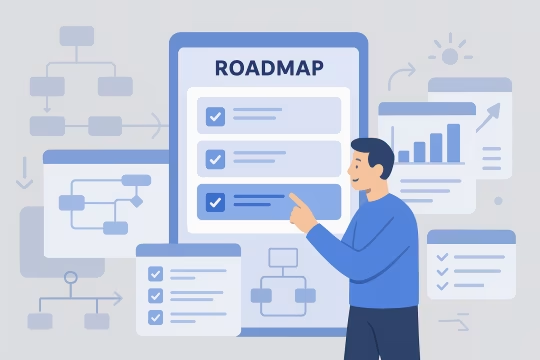
Roadmap and investment sequencing

Best Fit For

  • Multi-brand WordPress estates
  • Distributed delivery teams
  • Regulated content environments
  • Modernization and replatforming programs

Key Outcomes

  • Clear platform decision criteria
  • Reduced architectural drift
  • Predictable delivery planning
  • Lower integration and upgrade risk

Technology Ecosystem

  • WordPress core and multisite
  • Composable DXP patterns
  • Headless CMS options
  • Identity and access management

Platform Integrations

  • CRM and marketing automation
  • Search and indexing services
  • Analytics and consent tooling
  • API gateway and middleware

Unclear Platform Direction Creates Delivery and Risk Debt

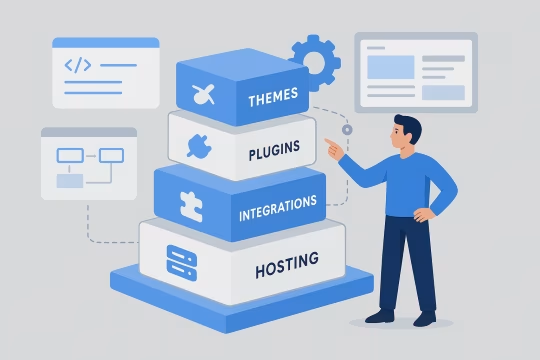
As WordPress estates grow, teams often accumulate inconsistent patterns across themes, plugins, hosting configurations, and integration approaches. Decisions are made per project, resulting in multiple ways to solve the same problem: authentication, content modeling, search, media handling, and deployment. Over time, the platform becomes a collection of site-specific implementations rather than a coherent system.

This fragmentation impacts architecture and engineering operations. Upgrades become risky because dependencies and customizations are not standardized. Security posture varies across sites, and governance is reduced to manual review rather than enforceable controls. Integration work is repeatedly re-designed, and teams struggle to define what belongs in WordPress versus adjacent services (DXP components, headless layers, or shared APIs).

Operationally, the lack of a platform strategy creates delivery bottlenecks and budget uncertainty. Roadmaps compete without a shared prioritization model, and platform work is deferred until incidents or major upgrades force change. The result is higher maintenance overhead, slower onboarding of new brands or products, and limited ability to adopt modern delivery patterns without increasing complexity.

WordPress Strategy Delivery Method

Platform Discovery

Assess the current WordPress estate, delivery workflows, and stakeholder constraints. Capture platform goals, non-functional requirements, and the drivers behind multi-site, composable, or headless adoption.

Capability Mapping

Map required platform capabilities across content, experience delivery, integrations, security, and operations. Identify gaps, duplication, and areas where standards or shared services reduce repeated implementation.

Architecture Principles

Define platform principles and decision criteria for themes, plugins, custom code, and service boundaries. Establish reference patterns for content modeling, API usage, caching, and extensibility to reduce architectural drift.

Operating Model Design

Design how teams collaborate on the platform: ownership boundaries, contribution workflows, and release responsibilities. Define how platform work is funded and prioritized alongside product delivery.

Governance Controls

Specify governance mechanisms that can be enforced: coding standards, dependency policies, security baselines, and review gates. Align governance with CI/CD, environments, and audit requirements where applicable.

Roadmap and Sequencing

Create a prioritized roadmap with initiatives, dependencies, and measurable outcomes. Sequence work to reduce risk early (security, upgrades, observability) while enabling future capabilities (shared components, headless endpoints).

Execution Enablement

Translate strategy into actionable epics, reference implementations, and backlog structure. Provide templates for new site onboarding, integration patterns, and platform documentation to support adoption.

Core Platform Strategy Capabilities

This service defines the technical and operational foundation needed to run WordPress as an enterprise platform. It focuses on architecture principles, governance mechanisms, and roadmap decisions that reduce fragmentation across sites and teams. The emphasis is on repeatable patterns for extensibility, integrations, and delivery workflows, with clear boundaries between WordPress responsibilities and adjacent platform services. The result is a strategy that can be executed incrementally and measured over time.

Capabilities
  • WordPress estate assessment
  • Platform reference architecture
  • Governance and operating model
  • Multi-site and tenancy strategy
  • Headless and composable evaluation
  • Integration standards and patterns
  • Security and upgrade planning
  • Prioritized technical roadmap
Target Audience
  • CTO
  • Digital Platform Leaders
  • Enterprise Architects
  • Engineering Directors
  • Platform and SRE teams
  • Product Owners
  • Security and risk stakeholders
  • Program and portfolio leaders
Technology Stack
  • WordPress
  • WordPress Multisite
  • DXP architecture
  • Platform governance
  • Headless CMS patterns
  • REST and GraphQL APIs
  • CI/CD and environment strategy
  • Identity and access management

Delivery Model

Engagements are structured to produce decision-ready outputs: principles, reference patterns, governance controls, and a prioritized roadmap. Work is collaborative with platform and product stakeholders, and is designed to be executable in increments without blocking ongoing delivery.

Delivery card for Discovery Workshops[01]

Discovery Workshops

Run structured workshops with engineering, product, and operations stakeholders. Capture platform goals, constraints, and non-functional requirements, and document the current state of the WordPress estate and delivery processes.

Delivery card for Current-State Assessment[02]

Current-State Assessment

Review architecture, codebase patterns, plugin usage, hosting and environments, and integration landscape. Identify sources of fragmentation, upgrade blockers, and operational risks that affect reliability and maintainability.

Delivery card for Target Architecture Definition[03]

Target Architecture Definition

Define the target reference architecture and decision criteria for key platform choices. Document service boundaries, content and integration patterns, and the standards required to keep implementations consistent across teams.

Delivery card for Governance Design[04]

Governance Design

Specify governance controls, ownership boundaries, and contribution workflows. Align governance with delivery tooling so standards can be enforced through automation rather than relying on manual review alone.

Delivery card for Roadmap Construction[05]

Roadmap Construction

Create a prioritized roadmap with initiatives, dependencies, and sequencing. Provide a backlog structure that teams can execute, including measurable acceptance criteria tied to platform health and delivery capability.

Delivery card for Enablement and Handover[06]

Enablement and Handover

Deliver documentation, templates, and reference examples to support adoption. Align stakeholders on decision-making forums, reporting, and how platform changes are proposed, reviewed, and released.

Delivery card for Ongoing Advisory (Optional)[07]

Ongoing Advisory (Optional)

Provide periodic architecture reviews and roadmap recalibration as delivery progresses. Support governance adoption, evaluate new requirements, and help teams manage trade-offs as the platform evolves.

Business Impact

A clear platform strategy reduces delivery variability and prevents architectural drift as WordPress usage scales. It improves predictability for upgrades and integrations, clarifies ownership and governance, and enables modernization decisions (including headless) with explicit trade-offs and operational readiness.

Faster Portfolio Delivery

Standardized patterns reduce repeated design and rework across sites and teams. New initiatives start from a known reference architecture and shared integration approaches, shortening lead time for multi-brand delivery.

Lower Upgrade Risk

Governance and dependency policies make WordPress core and plugin upgrades more predictable. Teams can plan upgrade cycles with clearer impact analysis and fewer unknown customizations.

Reduced Operational Variability

A defined operating model clarifies ownership, release responsibilities, and incident response expectations. This reduces the risk created by inconsistent environments and ad hoc release processes across properties.

Improved Security Posture

Security baselines and lifecycle policies reduce exposure from unmanaged plugins and inconsistent configurations. Clear controls support auditability and make remediation work more systematic.

Better Integration Reliability

Repeatable integration patterns improve error handling, observability, and change management for connected systems. This reduces integration regressions and improves supportability across the platform estate.

Controlled Headless Adoption

Decision criteria and reference patterns prevent headless implementations that add complexity without operational readiness. Teams can adopt decoupled delivery where it fits, with clear preview, caching, and governance implications.

Lower Technical Debt Growth

Architecture principles and standards reduce divergence across projects. Platform work becomes planned and measurable, limiting the accumulation of one-off solutions that increase maintenance cost over time.

FAQ

Common questions about enterprise WordPress platform strategy, including architecture decisions, governance, integrations, operational readiness, and how engagements are structured.

What architecture decisions are typically included in a WordPress platform strategy?

A WordPress platform strategy typically formalizes decisions that otherwise get made repeatedly per project. This includes instance topology (multisite vs multiple instances), service boundaries (what stays in WordPress vs external services), and the delivery model (traditional rendering, decoupled, or headless). It also defines reference patterns for content modeling, media handling, caching layers, API exposure, and extensibility (themes, custom plugins, mu-plugins). For enterprise contexts, the strategy usually includes identity and access patterns, environment separation, and how configuration is managed across environments. The goal is not to prescribe a single implementation for every site, but to define decision criteria and constraints so teams can make consistent choices. A good strategy documents trade-offs and “default paths” while allowing exceptions through a governed process. This reduces architectural drift and makes upgrades, security remediation, and integration changes more predictable over time.

How do you decide between WordPress multisite, separate instances, and headless approaches?

The decision is usually driven by tenancy and isolation requirements, editorial workflows, release independence, and operational constraints. Multisite can work well when brands share a common foundation (themes, components, governance) and you benefit from centralized user management and shared services. Separate instances can be preferable when isolation, independent release cadence, or differing compliance requirements outweigh the benefits of shared infrastructure. Headless or decoupled approaches are evaluated based on channel needs, frontend performance requirements, and the organization’s ability to operate a distributed architecture. The strategy should explicitly address preview workflows, caching, API contracts, and failure modes, because these often become the hidden cost of headless adoption. In practice, many enterprises use a mixed model: multisite for closely related properties, separate instances for high-isolation cases, and selective headless patterns where there is a clear product requirement. The strategy defines the criteria and guardrails so the model stays coherent as the estate grows.

What operational topics should be covered to make the strategy executable?

An executable strategy includes the operating model, not just architecture diagrams. Operational topics typically include environment design (dev/test/stage/prod), release processes, incident ownership, and how platform changes are coordinated across product teams. It should also cover dependency management (plugin and theme lifecycle, update cadence, vulnerability response), observability expectations (logs, metrics, tracing where applicable), and performance budgets. For enterprises, access control, auditability, and backup/restore responsibilities are usually part of the baseline. The strategy becomes actionable when these topics are tied to enforceable controls: CI/CD gates, automated checks, configuration management, and documented runbooks. Without this, governance becomes manual and inconsistent, and teams revert to local practices. Operational clarity is what turns a roadmap into a platform program that can be delivered incrementally while maintaining reliability.

How does platform governance work without slowing down product teams?

Governance should define constraints and defaults that reduce decision overhead, not add bureaucracy. The most effective model separates “paved road” standards (approved patterns, dependencies, templates) from an exception process for cases that genuinely require deviation. To avoid slowing teams down, governance is implemented through automation where possible: dependency policies, coding standards, security scanning, and release checks integrated into CI/CD. This shifts governance from meetings to repeatable controls. A lightweight architecture review forum can then focus on exceptions, major changes, and cross-team dependencies. The strategy also clarifies ownership boundaries: what the platform team owns (shared components, base themes, integration libraries, environments) versus what product teams own (site-specific features). When ownership and contribution workflows are explicit, teams can move quickly within agreed constraints while keeping the overall estate maintainable and upgradeable.

How do you approach integration architecture for enterprise WordPress estates?

Integration architecture starts with identifying systems of record and the direction of data flow: identity, CRM, commerce, search, analytics, and marketing automation. The strategy defines which integrations are platform-level shared services versus site-specific integrations, and it establishes patterns for authentication, rate limiting, error handling, and retries. A key part is deciding where integration logic lives. Some logic belongs in WordPress (editorial workflows, content enrichment), while other logic is better handled in middleware, API gateways, or dedicated services to reduce coupling and improve observability. The strategy should define API contract expectations and versioning approaches to minimize breaking changes. Finally, integration patterns must include operational considerations: monitoring, alerting thresholds, and fallback behavior when upstream systems fail. This is what prevents integrations from becoming fragile dependencies that regularly disrupt publishing or site performance.

What changes when WordPress is used as part of a composable DXP?

In a composable DXP, WordPress is one component in a broader platform, so the strategy must define clear service boundaries and responsibilities. WordPress may remain the primary editorial system, while search, personalization, identity, and frontend delivery may be handled by specialized services. This increases the importance of API design, caching strategy, and preview workflows. Editorial preview often becomes the hardest part: the strategy needs a defined approach for draft content, environment routing, and how frontends render previews securely. Content modeling also becomes more deliberate because multiple consumers depend on stable structures. Operationally, composable architectures require stronger observability and change management. The strategy should define how teams coordinate releases across services, how incidents are triaged across boundaries, and what “minimum viable reliability” looks like for each component. Without these controls, composability can increase complexity faster than it increases delivery capability.

What should a WordPress plugin and dependency governance policy include?

A dependency governance policy typically includes an approval process for new plugins, criteria for acceptable maintenance posture (update frequency, security history, support model), and rules for when to build custom functionality instead. It should also define how plugins are versioned, tested, and promoted across environments. For enterprise estates, the policy should cover vulnerability response: how advisories are monitored, how quickly patches must be applied, and what compensating controls exist if immediate upgrades are not possible. It should also include licensing and compliance considerations where relevant. Equally important is lifecycle management: deprecation rules, ownership of plugin maintenance, and how abandoned dependencies are replaced. The strategy should connect this policy to automation (dependency scanning, SBOM where applicable, CI checks) so governance is enforceable and measurable rather than dependent on manual review.

How do you keep architecture standards current as the platform evolves?

Architecture standards need a maintenance mechanism, otherwise they become outdated documentation. The strategy should define a governance cadence: periodic reviews of principles, reference patterns, and approved dependencies based on platform telemetry, incident trends, and upcoming roadmap items. A practical model is to treat standards as versioned artifacts with clear ownership and change control. Updates are proposed through lightweight RFCs, reviewed by a small cross-functional group (platform, security, product), and then implemented through templates and automated checks. This keeps standards aligned with how teams actually deliver. The strategy should also define how exceptions are handled and retired. Exceptions are sometimes necessary, but they should be time-bound and tracked so they do not become permanent divergence. This approach keeps the platform adaptable while maintaining consistency and upgradeability across the estate.

What are the most common risks in enterprise WordPress programs that strategy should mitigate?

Common risks include uncontrolled plugin sprawl, inconsistent customization patterns, and unclear ownership of shared components. These issues increase security exposure and make upgrades unpredictable because the true dependency graph is not well understood. Another frequent risk is adopting headless or composable patterns without operational readiness. This can introduce complex preview workflows, caching inconsistencies, and multi-service incident scenarios that teams are not equipped to operate. Strategy should define decision criteria and minimum operational capabilities before expanding architecture complexity. Finally, integration fragility is a major risk: tightly coupled integrations without observability or fallback behavior can disrupt publishing and degrade site reliability. A strategy mitigates this by standardizing integration patterns, defining operational expectations, and sequencing roadmap work to reduce the highest risks early (security baselines, upgrade paths, and observability).

How does the strategy reduce long-term maintenance cost and technical debt?

Maintenance cost grows when teams solve the same problems in different ways across sites: themes, build pipelines, integrations, and deployment patterns. Strategy reduces this by defining shared foundations (reference architecture, standards, and reusable patterns) and by clarifying what should be centralized versus decentralized. It also introduces lifecycle management: how dependencies are approved, updated, and retired; how upgrades are planned; and how exceptions are tracked. This prevents “temporary” deviations from becoming permanent debt. When combined with automation in CI/CD, governance becomes a continuous control rather than periodic cleanup. Importantly, the roadmap sequences work to reduce debt accumulation. For example, establishing a base theme/component approach and integration standards early can prevent new projects from adding divergent implementations. Over time, the platform becomes easier to operate, easier to secure, and easier to evolve without large remediation programs.

What are the typical deliverables from a WordPress platform strategy engagement?

Deliverables are designed to be directly usable by engineering and leadership teams. Typically this includes a current-state assessment summary, a target reference architecture, and a set of architecture principles with decision criteria for key choices such as multisite, hosting topology, and headless adoption. You also receive a governance model: ownership boundaries, contribution workflows, dependency policies, and the controls that should be enforced through tooling. Integration patterns are usually documented as reference approaches for identity, search, analytics, and other common enterprise systems. Finally, the engagement produces a prioritized roadmap with sequencing, dependencies, and measurable outcomes. The roadmap is often accompanied by a backlog structure (epics and initiatives) and enablement artifacts such as templates, documentation outlines, and reference implementation recommendations. The intent is to make the strategy executable in increments rather than a static document.

How long does a platform strategy engagement usually take, and who needs to be involved?

Duration depends on estate size and complexity, but a typical engagement runs 3–8 weeks. Smaller estates with a single primary platform team can move faster, while multi-brand portfolios with multiple vendors and complex integrations require more discovery and alignment. Key participants usually include platform engineering, a representative set of product teams, operations/SRE (or hosting owners), security, and enterprise architecture. Editorial leadership is often involved to validate workflow implications, especially if headless or composable patterns are being considered. The engagement is most effective when there is a clear decision-making group that can validate trade-offs and approve principles. The work is collaborative: we gather constraints and goals, test assumptions against the current state, and iterate toward a roadmap that teams can execute without pausing ongoing delivery.

How does collaboration typically begin for WordPress platform strategy work?

Collaboration typically begins with a short alignment phase to confirm scope, stakeholders, and the decisions the strategy must enable. This includes agreeing on the WordPress estate in scope (sites, environments, integrations), the target outcomes (roadmap, governance, architecture), and any constraints such as compliance timelines or upcoming upgrades. Next, we schedule discovery workshops and request lightweight inputs: architecture diagrams if available, environment and release process descriptions, dependency inventories, and a list of current pain points and planned initiatives. We also identify a small working group for weekly reviews so decisions are made continuously rather than at the end. From there, we run an iterative cycle: assess current state, draft principles and reference patterns, validate with stakeholders, and convert findings into a prioritized roadmap with clear ownership and next steps. The first milestone is usually a decision-ready set of architecture choices and governance controls that can be implemented immediately.

Define your WordPress platform roadmap

Let’s assess your current WordPress estate, align on architecture and governance decisions, and produce a prioritized roadmap your teams can execute incrementally.

Oleksiy (Oly) Kalinichenko

Oleksiy (Oly) Kalinichenko

CTO at PathToProject

Do you want to start a project?