

 [01]
[01]Discovery and Scope
Confirm platform boundaries, environments, and ownership. Capture current security controls, operational workflows, and constraints so recommendations are implementable within the existing delivery model.
WordPress security
Run a focused Health Check to surface hardening issues, access risks, plugin exposure, and WAF gaps before they turn into incidents.
Built for enterprise WordPress environments with complex access, plugins, and multi-site operations.
No login required. Takes 2–3 minutes.
WordPress Security focuses on WordPress security engineering services that reduce platform risk through practical controls across application configuration, infrastructure boundaries, identity, and operational processes. It covers how WordPress is deployed, how code and dependencies are managed, how administrators and editors authenticate (including OAuth/SSO where appropriate), and how traffic is filtered and observed through WordPress WAF configuration and monitoring.
As WordPress platforms grow, risk increases through plugin supply chain exposure, inconsistent environments, privileged access sprawl, and uneven patching. Security work that is handled ad hoc often results in partial fixes that do not survive releases or team changes.
A structured security capability establishes repeatable baselines: Enterprise WordPress hardening, controlled authentication flows, WAF rules tuned to the application, and audit evidence that maps to enterprise requirements. The result is a platform that can evolve without accumulating hidden security debt or introducing avoidable operational fragility.
Core Focus
Best Fit For
Key Outcomes
Technology Ecosystem
Delivery Scope
As WordPress platforms expand across brands, regions, and teams, security posture often becomes inconsistent. Different environments drift in configuration, plugins are added without a clear risk review, and administrative access grows beyond what is necessary. Over time, the platform accumulates a large and changing attack surface that is difficult to reason about.
These issues create architectural and operational friction. Engineering teams struggle to keep up with patching and dependency updates while maintaining release cadence. Authentication and authorization patterns vary across sites, making it hard to enforce least privilege or integrate enterprise identity consistently. Without well-defined boundaries, WAF rules are either too permissive to be effective or too aggressive and break legitimate user flows.
Operationally, gaps show up as recurring incidents and urgent remediation work that interrupts planned delivery. Audit requests become time-consuming because evidence is scattered across tools and teams. The platform becomes dependent on individual knowledge rather than documented controls, increasing risk during staff changes, vendor transitions, or major upgrades.
Review platform scope, hosting model, traffic patterns, and operational workflows. Collect current configurations, plugin/theme inventory, access models, and existing security controls to establish an accurate baseline for risk assessment.
Map key assets, trust boundaries, and likely attack paths for the WordPress estate. Identify high-impact risks such as admin compromise, supply chain exposure, data leakage, and abuse of public endpoints, then prioritize by likelihood and impact.
Perform configuration and code-level review across WordPress core, plugins, themes, and deployment practices. Validate patch levels, permissions, secrets handling, and logging coverage, producing actionable findings with clear remediation guidance.
Apply hardened configuration, reduce privileges, and standardize environment settings. Implement secure defaults for file permissions, admin access, API exposure, and content workflows, ensuring changes are versioned and reproducible.
Design and implement authentication and authorization controls aligned to enterprise identity. Where applicable, integrate OAuth/SSO, enforce MFA policies through the identity provider, and define role mappings that support least privilege.
Configure WAF rules and rate limiting based on observed application behavior and threat model. Tune protections to reduce false positives, protect login and XML-RPC endpoints where relevant, and establish a process for rule updates during releases.
Verify controls through targeted security testing, regression checks, and operational validation. Confirm that hardening does not break editorial workflows, integrations, or deployment pipelines, and document expected behaviors and exceptions.
Establish ongoing processes for patching, vulnerability intake, access reviews, and incident response. Deliver runbooks, ownership models, and audit-ready evidence paths so security posture remains stable as the platform evolves.
This service builds security into WordPress operations through repeatable controls rather than one-off fixes. It strengthens the platform across identity, configuration, dependency management, and edge protection, while ensuring changes remain compatible with release workflows. The focus is on reducing attack surface, improving detection and response, and maintaining a clear security baseline across environments and sites.

Define a consistent security baseline for WordPress environments, including configuration standards, permissions, secrets handling, and operational requirements. Baselines are expressed in a way that can be applied across multiple sites and environments to prevent drift and reduce configuration-related vulnerabilities.
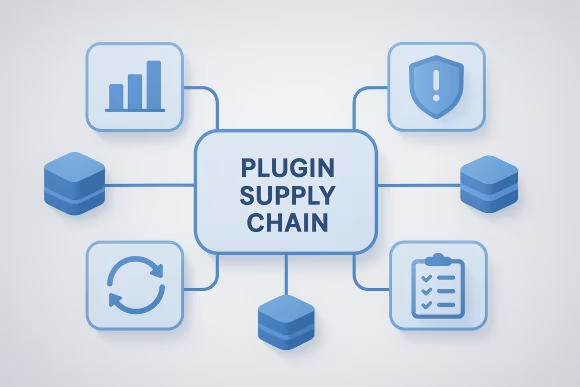
Establish a governance model for plugin and theme selection, updates, and retirement. This includes inventory management, risk classification, update cadence, and exception handling so that dependency decisions are traceable and security exposure from third-party code is actively managed.

Implement least-privilege roles and administrative access boundaries for editors, developers, and operators. Controls include role design, separation of duties, restricted admin endpoints where appropriate, and periodic access reviews to reduce the impact of credential compromise.
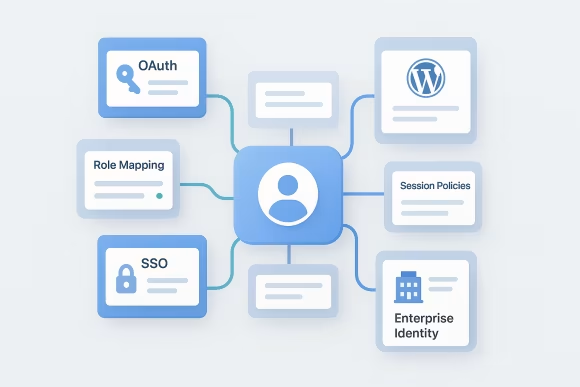
Integrate WordPress authentication with enterprise identity using OAuth-based flows where appropriate. Define role mapping and session policies aligned to organizational standards, enabling centralized access control, improved offboarding, and consistent enforcement of authentication requirements.
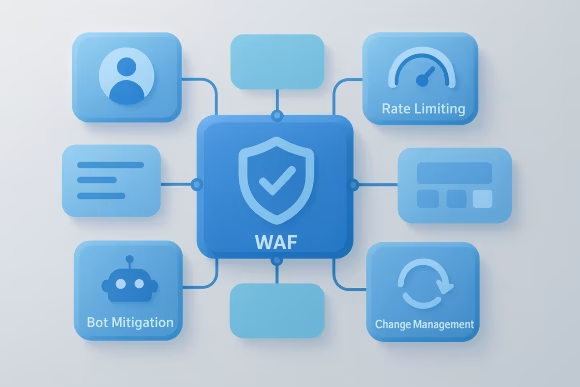
Configure and tune WAF protections to match the application’s real traffic and endpoints. This includes targeted protections for authentication surfaces, rate limiting, bot mitigation strategies, and a change process so WAF rules evolve safely alongside platform releases.

Create an operational workflow for intake, triage, remediation, and verification of vulnerabilities affecting WordPress core and dependencies. The workflow defines ownership, SLAs, patch windows, and evidence capture so remediation is predictable and auditable.

Design logging coverage for authentication events, privilege changes, and suspicious request patterns, and connect signals to alerting. The goal is actionable detection with low noise, enabling faster investigation and clearer incident timelines.
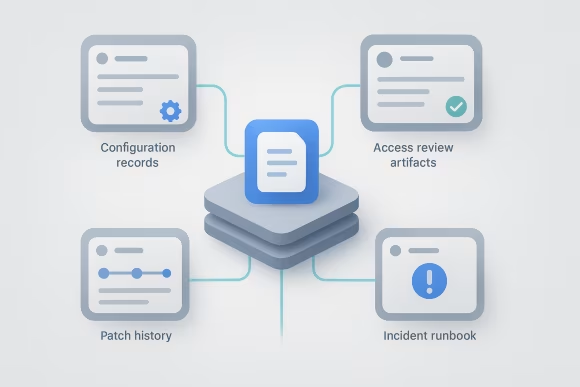
Structure documentation and evidence paths for security controls, changes, and reviews. This includes configuration records, access review artifacts, patch history, and incident runbooks so audit requests do not require disruptive, manual reconstruction.
Use the Health Check to identify weak controls, inconsistent configurations, and remediation priorities across environments.
Engagements are structured to establish a measurable baseline, implement prioritized controls, and leave behind operational processes that keep security stable through ongoing releases. Work is designed to integrate with existing delivery pipelines and platform ownership models.
[01]Confirm platform boundaries, environments, and ownership. Capture current security controls, operational workflows, and constraints so recommendations are implementable within the existing delivery model.
 [02]
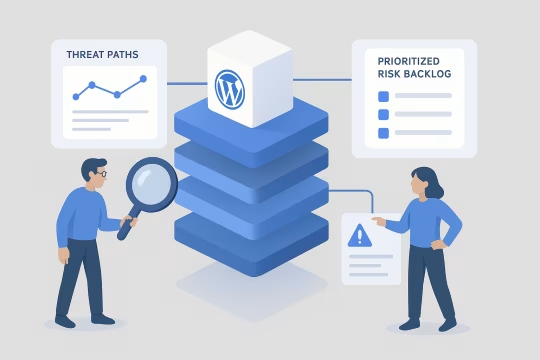
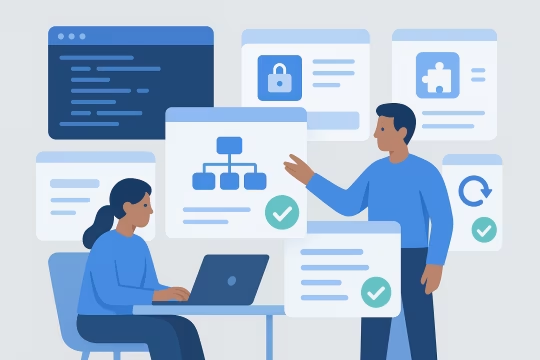
[02]Document trust boundaries, critical assets, and primary attack paths. Translate risks into a prioritized backlog that aligns security work with platform architecture and release planning.
 [03]
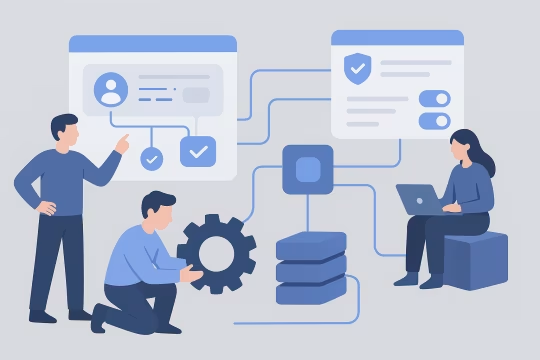
[03]Review configuration, access, plugins/themes, and deployment practices. Produce findings with severity, remediation steps, and verification criteria to support predictable execution.
 [04]
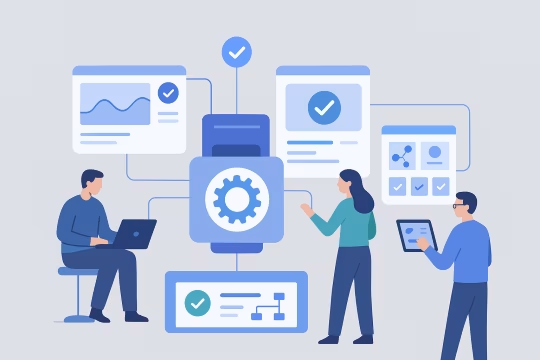
[04]Implement hardening changes, identity integration, and WAF controls in a versioned and repeatable way. Coordinate changes across environments to prevent drift and minimize operational surprises.
 [05]
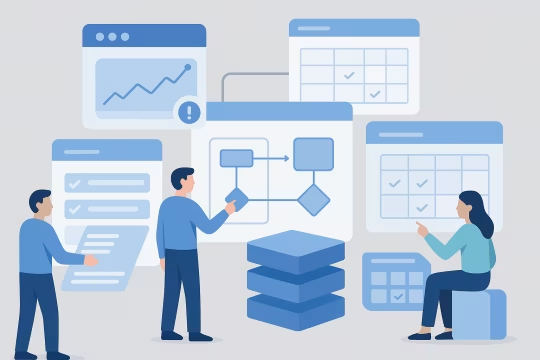
[05]Validate controls through targeted security testing and regression checks. Confirm that editorial workflows, integrations, and deployment processes continue to function as expected.
 [06]
[06]Deliver runbooks, patch workflows, access review processes, and alerting. Align responsibilities across teams so security tasks are owned, scheduled, and measurable.
 [07]
[07]Provide documentation, configuration references, and decision records. Enable internal teams to maintain controls, handle exceptions, and evolve the platform without reintroducing known risks.
 [08]
[08]Establish a cadence for vulnerability review, WAF tuning, and baseline updates. Track security debt and improvements over time so posture remains aligned to platform change.
Security engineering reduces platform risk while keeping delivery predictable. By standardizing controls and operational workflows, teams spend less time on urgent remediation and more time on planned platform evolution, with clearer auditability and ownership.
Reducing common attack paths and tightening access controls decreases the likelihood of account compromise and exploit-driven outages. Better detection and runbooks also shorten investigation time when suspicious activity occurs.
A defined vulnerability workflow and patch cadence turns urgent security work into planned operational activity. Teams can prioritize by severity and verify fixes consistently across environments.
Hardening baselines and controlled configuration changes reduce drift between environments. This lowers the chance that security fixes break production behavior or are lost during deployments.
Evidence paths for access reviews, patch history, and control changes are structured and repeatable. Audit requests become a retrieval task rather than a disruptive, manual reconstruction effort.
Defined responsibilities for plugins, access, and security exceptions reduce ambiguity across teams. Governance prevents risky dependencies and privileged access from accumulating unnoticed.
Security controls integrated into delivery workflows reduce last-minute blockers. WAF tuning and validation steps help avoid production regressions caused by overly broad protections.
Standardized identity integration and environment baselines align multiple sites under the same security posture. This is especially valuable for multi-site estates and distributed teams.
Security debt is tracked as a backlog with priorities and verification criteria. This prevents recurring rework and supports long-term maintainability as WordPress core and dependencies evolve.
WordPress security review
Start with a Health Check, then review the findings with an expert to align hardening, access, and vulnerability priorities.
Adjacent capabilities that commonly extend WordPress security work into performance, delivery automation, and platform architecture.
Upgrade-ready architecture, WordPress CI/CD and DevOps, and operational hardening
WordPress REST API engineering and GraphQL API design
GA4 event tracking WordPress with governed measurement
WordPress lead contact sync with secure lead capture
WordPress integration services for secure API connections
Custom WordPress REST endpoints, schemas, and authentication patterns
WordPress CI/CD pipelines and environment standardization
Multi-AZ WordPress deployment and Kubernetes resilience engineering
WordPress monitoring services: metrics, logs, dashboards, and actionable alerting
Common questions from security, platform, and engineering leaders about architecture, operations, governance, and engagement for securing WordPress at enterprise scale.
We start by defining the estate boundaries: which sites share code, plugins, themes, identity, and infrastructure, and where isolation is required. From there we establish a security baseline that can be applied consistently across environments, including configuration standards, secrets handling, file permissions, and administrative access patterns. For multi-site, we pay particular attention to blast radius. Shared plugins and network-level administration can accelerate delivery but also concentrate risk. We design controls that limit privilege, separate duties, and constrain high-risk capabilities (for example, plugin installation) to controlled workflows. Where isolation is required, we recommend architectural separation at the hosting, database, or deployment level rather than relying only on application-level conventions. Finally, we align edge protections and identity. WAF rules, rate limiting, and login protections should be consistent, but tuned to each site’s traffic profile. Identity integration (OAuth/SSO) is designed once and applied across the estate with clear role mapping and offboarding behavior.
The highest-leverage controls typically fall into four areas: access boundaries, dependency governance, edge protection, and secure configuration. Access boundaries include least-privilege roles, restricted administrative entry points, and strong authentication policies through centralized identity where feasible. Dependency governance covers plugin and theme selection, update cadence, and retirement criteria to reduce supply chain exposure. Edge protection includes WAF rules tuned to the application, rate limiting, and bot mitigation for authentication surfaces and high-risk endpoints. Secure configuration focuses on file permissions, disabling unnecessary capabilities, protecting secrets, and ensuring environments do not drift. We also treat observability as an architectural control. Without reliable logging for authentication events, privilege changes, and suspicious request patterns, teams cannot detect or investigate incidents efficiently. The goal is a coherent control set that can be maintained through releases, not a collection of isolated hardening tweaks.
We implement a workflow that covers inventory, intake, triage, remediation, and verification. Inventory is foundational: you need a current list of WordPress core versions, plugins, themes, and where they are deployed. Intake then defines how vulnerability signals arrive (advisories, scanners, vendor notifications) and who owns initial triage. Triage classifies issues by severity and exposure in your specific context. A critical vulnerability in an unused plugin is different from one in a public-facing authentication path. We define remediation SLAs and patch windows, and we align them to your release process so security fixes can be deployed predictably. Verification includes confirming the patch is applied across all environments and that the fix did not introduce regressions. We also capture evidence: what changed, when it shipped, and how it was validated. This turns vulnerability response into an operational routine rather than repeated emergency work.
We focus on signals that are both high-value and actionable. At minimum, that includes authentication events (successful and failed logins, MFA/SSO anomalies), privilege changes (role updates, new admin users), and suspicious request patterns (high-rate requests, repeated 404/403 patterns, probing of known vulnerable paths). We also recommend monitoring for configuration drift and unexpected changes to plugins/themes, because many incidents involve unauthorized changes rather than a single exploit. Where possible, we correlate WAF events with application logs to reduce false positives and improve investigation speed. Alerting should be tuned to your operating model. A small platform team needs fewer, higher-confidence alerts with clear runbooks. Larger organizations may route events into a SOC workflow with triage queues and escalation paths. The goal is to shorten time-to-detect and time-to-triage without creating noise that teams learn to ignore.
We begin by confirming identity requirements: which identity provider is authoritative, what MFA and conditional access policies exist, and how user lifecycle events (onboarding, role changes, offboarding) should propagate. We then design an authentication flow that fits WordPress usage patterns, including editor access, admin access, and any service accounts used for automation. OAuth/SSO integration is implemented with explicit role mapping and least-privilege defaults. We avoid designs where identity grants broad WordPress admin rights by default. Instead, we define roles aligned to editorial and operational responsibilities, and we document how exceptions are handled. We also validate session behavior, logout semantics, and failure modes. For example, what happens when the identity provider is unavailable, or when a user’s group membership changes. The integration is treated as part of platform architecture, not a one-time plugin configuration task.
We treat WAF configuration as an engineering activity that requires understanding real application traffic. First, we baseline endpoints and behaviors: login flows, admin actions, API usage, and any custom routes introduced by plugins or integrations. We then apply protections in layers, starting with high-confidence rules (rate limiting, bot mitigation, known malicious patterns) before moving to tighter request validation. Tuning is done with feedback loops. We review WAF logs alongside application logs to identify false positives and to confirm that blocked traffic is actually malicious. For high-risk endpoints, we may implement targeted rules rather than broad patterns that can affect unrelated functionality. Finally, we define a change process. WAF rules should be reviewed when new features ship, when plugins change behavior, or when traffic patterns shift. This prevents security controls from becoming stale or disruptive over time.
Governance starts with an inventory and classification model. We define which plugins/themes are approved, which are restricted, and which are prohibited, along with criteria for each category. Criteria typically include maintenance activity, security history, compatibility with your WordPress version strategy, and whether the plugin introduces sensitive capabilities such as authentication, file management, or payment processing. We then define decision and change workflows: who can request a new plugin, who reviews it, how updates are scheduled, and how exceptions are documented. For multi-site estates, we also define where plugins can be activated and who has the authority to do so. The goal is not to slow delivery, but to make dependency decisions traceable and repeatable. When governance is clear, teams can move faster because they know what is allowed and how to get changes approved without ad hoc debate.
We produce documentation that maps controls to how the platform is actually operated. That typically includes a security baseline (configuration standards and rationale), access model documentation (roles, privilege boundaries, review cadence), vulnerability management process (intake, SLAs, verification), and incident response runbooks. For evidence, we focus on artifacts that can be retrieved repeatedly: patch and update history, access review records, change logs for security-relevant configuration, and monitoring/alerting definitions. Where possible, we recommend storing evidence in systems already used for engineering operations, such as ticketing and version control, rather than creating separate manual documents. The intent is to reduce audit overhead. Instead of assembling evidence from scratch each time, teams can point to stable sources of truth that demonstrate controls are implemented and maintained over time.
We address privileged compromise through layered controls: stronger authentication, reduced privilege, constrained admin surfaces, and better detection. Authentication improvements often include integrating with enterprise identity, enforcing MFA through the identity provider, and limiting local WordPress accounts where feasible. We also review how service accounts are used and ensure they have minimal permissions. Privilege reduction includes role redesign, separation of duties, and restricting who can install or update plugins. Constraining admin surfaces may involve limiting access to administrative endpoints by network, applying targeted WAF protections, and reducing exposure of unnecessary interfaces. Detection is critical because no single control is perfect. We ensure logging captures admin logins, role changes, and sensitive configuration updates, and we define alerts with clear runbooks. The result is reduced likelihood of compromise and reduced impact if compromise occurs.
We treat hardening as a controlled change program. First, we baseline current workflows: how editors publish, how developers deploy, and how administrators manage configuration. We then prioritize controls that reduce risk with minimal behavioral change, and we stage higher-impact changes behind validation steps. Implementation is done in environments that mirror production, with regression checks focused on editorial and integration paths. For example, identity changes are validated with real role scenarios, and WAF changes are tested against known legitimate requests to avoid blocking content operations. We also define exception handling. Some controls may require temporary allowances during migrations or major releases. By documenting exceptions and setting expiration criteria, teams avoid permanent weakening of posture. The objective is security that is maintainable within normal delivery, not security that only works in theory.
A typical engagement delivers a prioritized security backlog, implemented controls (hardening, identity integration where applicable, WAF tuning), and operational processes (vulnerability management, access reviews, monitoring and runbooks). We also provide documentation that explains what was changed, why it was changed, and how it should be maintained. Internal teams typically own day-to-day operations after handover: applying routine updates, executing access reviews, responding to alerts, and following incident runbooks. We aim to make these tasks predictable and measurable, with clear ownership and escalation paths. Where organizations prefer shared ownership, we can define a model where internal teams handle routine operations while we support periodic reviews, major upgrades, or security posture assessments. The key is that responsibilities are explicit so controls do not degrade over time.
Collaboration usually begins with a short discovery phase to confirm scope and constraints. We align on which WordPress sites and environments are in scope, how the platform is hosted, what identity systems are available, and what operational processes already exist for releases, patching, and incident response. Next, we request access to the minimum information needed to work effectively: plugin/theme inventory, configuration exports where appropriate, WAF and logging visibility, and a view of current deployment workflows. We also identify stakeholders for security, platform operations, and content operations so decisions can be made quickly. From there, we produce an initial threat model and assessment plan, agree on priorities and sequencing, and establish working practices (cadence, ticketing, change windows, and validation responsibilities). This ensures early work produces a usable baseline and a remediation path that fits your delivery model.
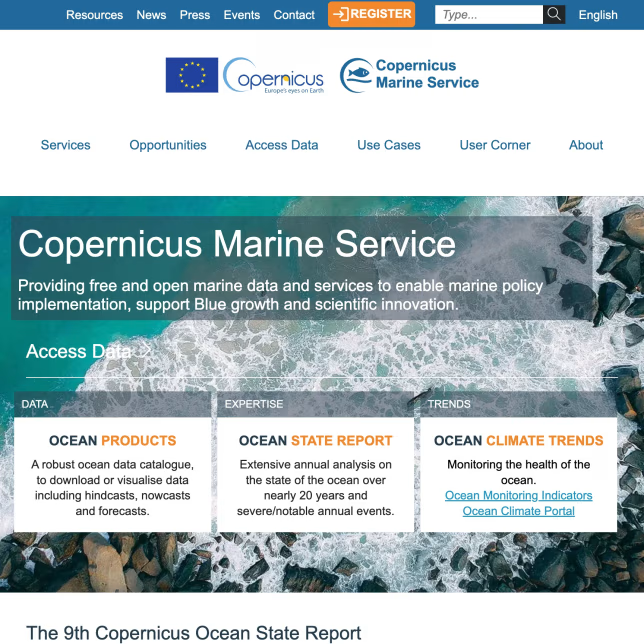
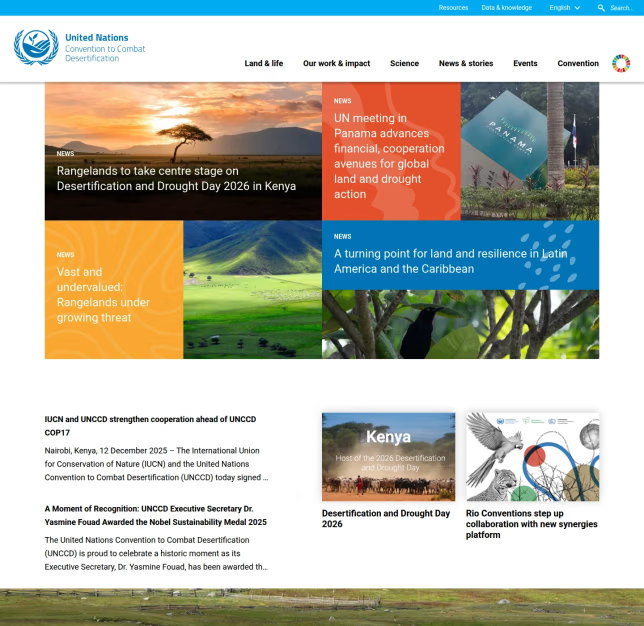
These case studies highlight real-world implementations of secure content platform consolidation, migration from legacy WordPress environments, and governance improvements. They showcase how structured security controls, risk reduction, and operational stability were achieved through platform modernization, secure access integration, and content sanitization. These examples provide practical insights into managing WordPress security risks and establishing repeatable, enterprise-grade security baselines.
The existing marine data portal relied on three unaligned WordPress installations and embedded PHP code, creating inefficiencies and risks in content management and usability.
The new Drupal DXP streamlined content operations and improved accessibility, offering scientists and businesses a more efficient gateway to marine data services.
UNCCD operated four separate websites (two WordPress, two Drupal), leading to inconsistencies in design, content management, and user experience. A unified, scalable solution was needed to support a large-scale CMS migration project and improve efficiency and usability.
The modernization effort resulted in a cohesive, user-friendly, and scalable website, improving content management efficiency and long-term digital sustainability.
It was my pleasure working with Oleksiy (PathToProject) on a new Drupal website. He is a true full-stack developer—the ideal mix of DevOps expertise, deep front-end knowledge, and the structured thinking of a senior back-end developer.
He is well-organized and never lets anything slip. Oleksiy understands what needs to be done before being asked and can manage a project independently with minimal involvement from clients, product managers, or business analysts.
One of the best consultants I’ve worked with so far.

Andrei Melis
Technical Lead at Eau de Web
Oleksiy (PathToProject) is demanding and responsive. Comfortable with an Agile approach and strong technical skills, I appreciate the way he challenges stories and features to clarify specifications before and during sprints.

Olivier Ritlewski
Ingénieur Logiciel chez EPAM Systems
Oleksiy (PathToProject) and I worked together on a Digital Transformation project for Bayer LATAM Radiología. Oly was the Drupal developer, and I was the business lead. His professionalism, technical expertise, and ability to deliver functional improvements were some of the key attributes he brought to the project.
I also want to highlight his collaboration and flexibility—throughout the entire journey, Oleksiy exceeded my expectations.
It’s great when you can partner with vendors you trust, and who go the extra mile.

Axel Gleizerman Copello
Building in the MedTech Space | Antler
These articles expand on the governance, architecture, and operational controls that underpin secure WordPress delivery. They are useful if you want to understand how plugin risk, ownership, multisite boundaries, and ongoing maintenance shape a practical security program.
Share your current architecture, identity model, and operational constraints. We will identify the highest-risk gaps, define a practical remediation backlog, and align security controls with your release and governance processes.