
 [01]
[01]Discovery and Audit
Assess current environments, deployment practices, and operational tooling. Capture constraints such as compliance requirements, traffic patterns, and team ownership boundaries, then prioritize risks and quick wins.
WordPress DevOps
Assess your WordPress delivery pipeline, infrastructure consistency, and operational controls before drift slows releases.
Focused on CI/CD, IaC, Kubernetes patterns, secrets, and observability.
No login required. Takes 2–3 minutes.
WordPress DevOps services establish the operational foundation required to deliver changes safely and repeatedly across development, staging, and production. The work covers WordPress CI/CD pipelines, build and release automation, environment provisioning, configuration management, and runtime observability so WordPress becomes a predictable platform rather than a collection of manually maintained servers.
As WordPress estates grow (multiple sites, plugins, integrations, and teams), ad-hoc deployments and inconsistent environments create drift, outages, and slow recovery. A structured DevOps model introduces versioned infrastructure, automated promotion workflows, and controlled change management. This reduces operational risk while enabling faster iteration.
The capability supports scalable platform architecture by standardizing how WordPress runs (containers and orchestration such as Kubernetes), how it is deployed (CI/CD with repeatable steps, including GitHub Actions deployment workflows where they fit), and how it is operated (monitoring, logging, backups, and incident readiness). It also enables safer rollout patterns such as WordPress blue-green deployments as part of a broader WordPress zero-downtime deployment strategy when the platform and data-change profile allow.
Core Focus
Best Fit For
Key Outcomes
Technology Ecosystem
Platform Integrations
As WordPress platforms expand, operational practices often lag behind product expectations. Environments are created manually, configuration changes are applied inconsistently, and deployments depend on individual knowledge. Over time, development, staging, and production diverge, making defects hard to reproduce and releases difficult to predict.
This drift impacts engineering teams and architecture in several ways. Plugin and theme changes become tightly coupled to specific servers, deployment steps are not versioned, and rollbacks are unreliable. Without a consistent build artifact and promotion strategy, teams cannot confidently validate changes across environments. Operational tooling is frequently fragmented: logs are incomplete, metrics are not actionable, and alerting is noisy or absent.
The result is slower delivery and higher operational risk. Releases require extended maintenance windows, incident response is reactive, and security controls are applied unevenly across the estate. As traffic grows or more sites are added, the platform becomes harder to operate, and the cost of change increases due to manual coordination, repeated troubleshooting, and limited automation.
Review current hosting, deployment steps, environment topology, and operational constraints. Identify sources of drift, bottlenecks in release flow, and reliability gaps across WordPress, PHP runtime, web tier, and data services.
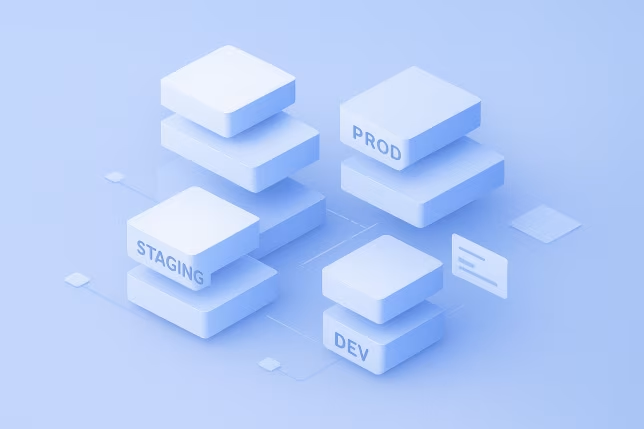
Define the runtime model (containers, orchestration, managed services) and the environment strategy for dev, staging, and production. Establish non-functional requirements for availability, security, performance, and recovery objectives.
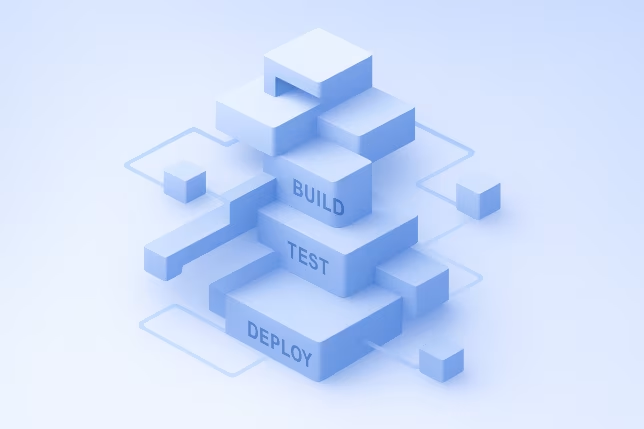
Design WordPress CI/CD pipelines for build, test, packaging, and promotion. Specify artifact strategy, branching and release conventions, and approval gates aligned to risk and governance requirements.
Implement Infrastructure as code for WordPress platforms by creating versioned definitions for networking, compute, storage, and supporting services. Encode environment configuration to reduce manual changes and enable repeatable provisioning and teardown.
Apply operational controls including secrets management, least-privilege access, network policies, and secure defaults. Standardize configuration for PHP, Nginx/Apache, caching layers, and WordPress runtime settings.
Instrument metrics, logs, and traces to support incident response and capacity planning. Establish dashboards and alerting tied to user-impact signals such as error rates, latency, queue depth, and database health.
Run controlled cutovers, validate rollback procedures, and document operational runbooks. Train teams on the new workflow, including environment promotion, incident handling, and routine maintenance tasks.
Introduce ongoing practices for change management, dependency updates, and security patching. Define ownership boundaries, SLO reporting, and continuous improvement cycles to keep the platform stable as it evolves.
This service focuses on the engineering capabilities required to operate WordPress as a controlled, repeatable platform. It strengthens enterprise WordPress operations by standardizing how environments are built and promoted, reducing drift through Infrastructure as code WordPress practices, and introducing operational controls for security and reliability. The emphasis is on predictable releases, measurable runtime behavior, and maintainable operations that scale across multiple sites and teams.
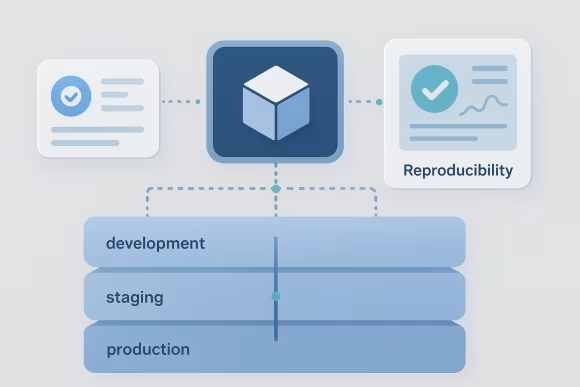
Define consistent runtime environments across development, staging, and production using container images and versioned configuration. This reduces “works on my machine” issues, improves reproducibility of defects, and enables safer promotion of the same build artifact through the delivery chain.
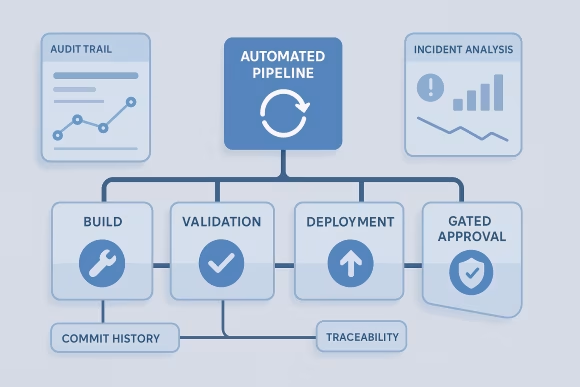
Implement automated WordPress CI/CD pipelines that build, validate, and deploy code and configuration changes with clear promotion rules. Workflows can include GitHub Actions deployment workflows where appropriate, gated approvals where required, automated rollback paths, and traceability from commit to deployment for audit and incident analysis.
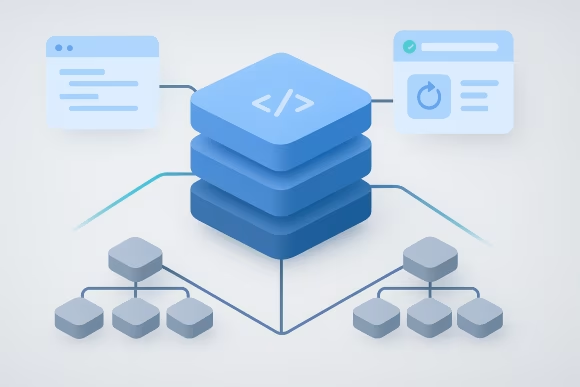
Encode infrastructure and environment configuration as version-controlled definitions to eliminate manual provisioning and undocumented changes. This supports repeatable environment creation, consistent security baselines, and faster recovery by rebuilding known-good infrastructure when needed.
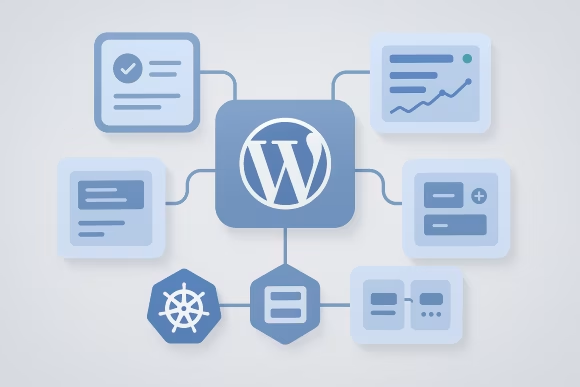
Establish WordPress Kubernetes infrastructure patterns for running WordPress on Kubernetes, including deployment strategies, health checks, autoscaling signals, and configuration injection. The goal is a stable runtime that supports controlled rollouts, predictable resource usage, and clear separation of concerns.
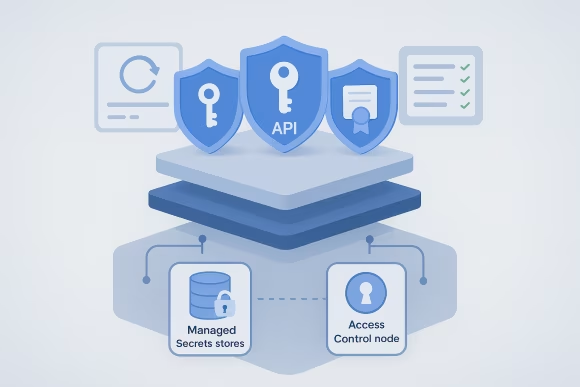
Implement secure handling of credentials, API keys, and certificates using managed secrets stores and least-privilege access. Integrate secret rotation and access auditing to reduce exposure risk while keeping deployment workflows automated and reliable.
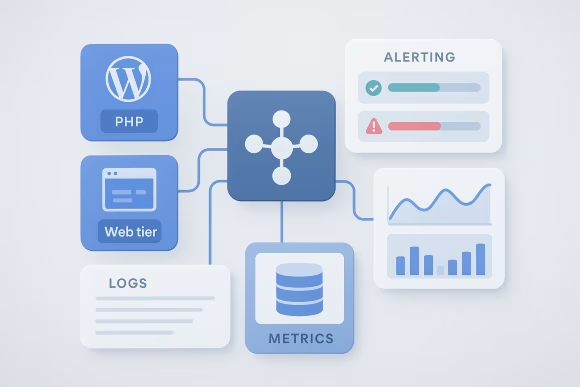
Create actionable monitoring across application, infrastructure, and data layers. Instrument logs and metrics for WordPress/PHP, web tier, caching, and databases, and define alerts tied to user impact and error budgets rather than noisy host-level signals.
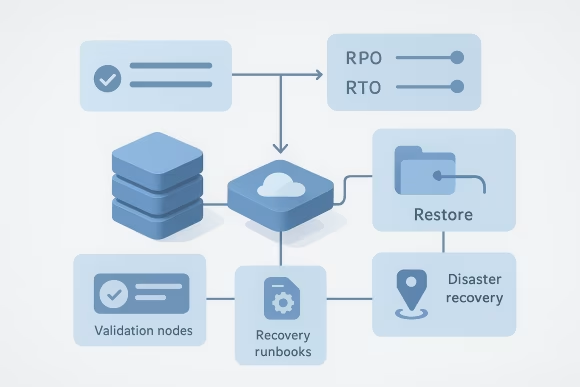
Design backup, restore, and disaster recovery procedures aligned to RPO/RTO targets. Validate restores regularly, automate backup verification where possible, and document recovery runbooks so incidents can be handled consistently under time pressure.
Identify the gaps causing inconsistent environments, fragile releases, and reactive operations.
Engagements follow a clear engineering sequence from discovery and architecture through implementation and operational handover. We establish a stable baseline first, then iterate toward higher automation—such as WordPress CI/CD pipelines and infrastructure as code—alongside security controls and observability. Work is delivered in small, verifiable increments with acceptance criteria for reliability, release repeatability, and safe rollout patterns.
[01]Assess current environments, deployment practices, and operational tooling. Capture constraints such as compliance requirements, traffic patterns, and team ownership boundaries, then prioritize risks and quick wins.
 [02]
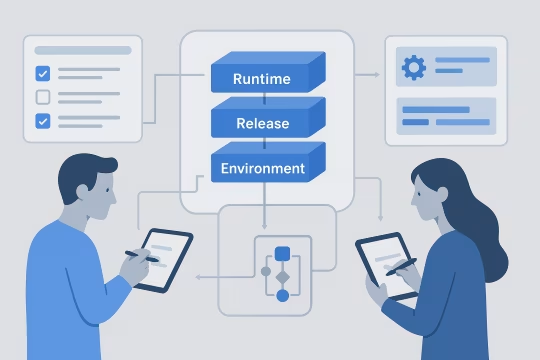
[02]Define the target runtime and delivery architecture, including environment strategy and release controls. Produce an implementation plan that sequences changes to minimize downtime and avoid breaking existing workflows.
 [03]
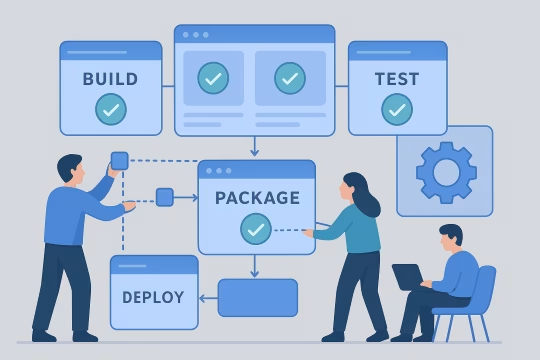
[03]Build CI/CD workflows for build, test, packaging, and deployment. Introduce artifact and promotion conventions, approval gates where needed, and traceability for audits and incident review.
 [04]
[04]Implement infrastructure as code and standardize environment configuration. Provision repeatable environments and reduce drift by moving manual changes into versioned definitions and controlled change processes.
 [05]
[05]Apply secrets management, least-privilege access, and secure network boundaries. Validate patching and dependency update workflows so security improvements can be delivered continuously rather than as disruptive projects.
 [06]
[06]Instrument monitoring, logging, and alerting with dashboards aligned to service health. Create runbooks for incident response, routine maintenance, and on-call readiness to reduce mean time to recovery.
 [07]
[07]Execute controlled releases to the new workflow and validate rollback and recovery procedures. Run parallel verification where appropriate to ensure stability and to build confidence across engineering and operations.
 [08]
[08]Iterate on performance, reliability, and developer experience based on operational data. Establish a cadence for dependency updates, platform upgrades, and governance reviews to keep the system maintainable.
Operational improvements translate into measurable delivery and risk outcomes when they are tied to repeatable processes and observable runtime behavior. For enterprise WordPress operations, the impact is typically seen in release frequency, incident rates, recovery time, and the cost of maintaining multiple WordPress environments. Standardized pipelines and controlled rollout approaches (including WordPress blue-green deployments where appropriate) help reduce downtime risk while keeping change auditable and repeatable.
Automated, repeatable pipelines reduce manual steps and configuration drift. This lowers the probability of release-related incidents and makes changes easier to validate across environments.
Standardized build and promotion workflows shorten the time from approved change to production. Teams spend less time coordinating deployments and more time delivering product improvements.
Health checks, controlled rollout strategies, and actionable alerting improve platform stability. Incidents become easier to detect early and resolve with consistent runbooks and rollback paths.
Centralized secrets management and least-privilege access reduce credential sprawl and uncontrolled access. Security controls become part of the delivery workflow rather than manual operational tasks.
Infrastructure as code and environment standardization reduce time spent on repetitive provisioning and troubleshooting. Operational knowledge is captured in code and runbooks, decreasing reliance on individual expertise.
Traceability from change request to deployment supports governance and compliance requirements. Versioned infrastructure and pipeline logs provide evidence for reviews and post-incident analysis.
A consistent environment strategy supports additional sites, regions, or teams without multiplying operational complexity. Capacity planning and scaling decisions are informed by metrics rather than guesswork.
WordPress infrastructure review
Use the Health Check to uncover pipeline, environment, and observability issues, then review the findings with a WordPress infrastructure specialist.
Adjacent capabilities that extend WordPress operations into performance, security, architecture, and delivery governance.
Upgrade-ready architecture, WordPress CI/CD and DevOps, and operational hardening
Enterprise WordPress network design for multi-site ecosystems
Enterprise WordPress extensibility with controlled dependencies
GA4 event tracking WordPress with governed measurement
WordPress REST API engineering and GraphQL API design
WordPress lead contact sync with secure lead capture
WordPress integration services for secure API connections
Custom WordPress REST endpoints, schemas, and authentication patterns
Multi-AZ WordPress deployment and Kubernetes resilience engineering
Common questions from platform and engineering leaders evaluating DevOps improvements for WordPress estates, including architecture, operations, integration, governance, risk, and engagement.
The runtime model depends on traffic profile, compliance constraints, and team maturity, but the key requirement is environment consistency and controlled change. Common patterns include containerized WordPress (PHP-FPM + Nginx/Apache) deployed to Kubernetes, or managed container platforms with a clear separation between stateless web nodes and stateful services. We typically design around: immutable application images, externalized configuration, managed database services where appropriate, and a shared approach to media storage (object storage + CDN) to keep web nodes stateless. For Kubernetes, we define readiness/liveness probes, resource requests/limits, and rollout strategies (rolling, blue-green, or canary depending on risk). The architecture also includes operational dependencies: secrets management, centralized logging, metrics, and backup/restore. The goal is not “Kubernetes by default”, but a runtime where WordPress can be deployed predictably, scaled safely, and operated with clear observability and recovery procedures.
Parity is achieved by standardizing the runtime and configuration sources, then enforcing promotion rules. We aim for the same container image (or build artifact) to move through environments, with environment-specific values injected at deploy time via configuration and secrets rather than code changes. Infrastructure as code defines networking, compute, and supporting services consistently, while environment overlays handle differences such as domain names, scaling parameters, and external integration endpoints. Database and media handling are addressed explicitly: production data is not copied casually, but we provide safe data refresh approaches (sanitized snapshots, synthetic data, or controlled subsets) so testing remains realistic. We also reduce drift by limiting manual changes in production, using Git-based change control, and ensuring that operational tasks (cache configuration, cron schedules, PHP settings) are versioned. Parity is validated through automated checks in CI/CD and through smoke tests after each deployment.
Effective monitoring combines infrastructure signals with application-level indicators that reflect user impact. At minimum, we instrument request latency, error rates (4xx/5xx), PHP-FPM saturation, queue depth for background work, cache hit ratios, and database health (connections, slow queries, replication lag if applicable). Logs should be centralized and structured enough to correlate requests across layers (edge/CDN, web tier, PHP, database). We typically define dashboards for release verification and incident response, plus alerts that are actionable and tied to thresholds that matter (e.g., sustained elevated error rate, rising latency, failing health checks, backup failures). Operational readiness also includes synthetic checks for critical user journeys, uptime probes from multiple regions, and clear ownership for alert routing. The objective is to reduce noise while improving detection time and enabling faster diagnosis during incidents.
Backup and recovery must cover both data and operational capability. For WordPress, that typically includes the database, media assets, and configuration required to recreate the runtime. We design backups around explicit RPO/RTO targets and validate them through regular restore tests, not just scheduled snapshots. Databases are usually protected with automated snapshots and, where required, point-in-time recovery. Media is handled via object storage versioning or backup replication depending on the storage model. We also ensure that infrastructure as code can recreate the environment, including networking and access controls, so recovery is not dependent on manual reconstruction. Disaster recovery planning includes runbooks, access procedures, and decision points (when to fail over, when to restore). We also address operational dependencies such as DNS, CDN configuration, and secrets. The result is a recovery process that is measurable, rehearsed, and aligned to business tolerance for downtime and data loss.
CI/CD for WordPress needs to treat themes, custom plugins, and configuration as versioned assets with repeatable build steps. We typically package application code into an artifact (often a container image) and run automated checks such as linting, unit tests where available, dependency validation, and security scanning. Configuration is separated from code and injected per environment using config files managed in Git, environment variables, or a configuration management approach suitable for the runtime. Database migrations are handled carefully: we define migration steps, validate them in staging with representative data, and include rollback considerations (which may require forward-fix strategies for certain schema changes). For content changes, we avoid coupling editorial workflows to deployment. Instead, we focus CI/CD on code and infrastructure changes, while content is managed through WordPress itself, with clear boundaries and operational safeguards.
AWS integration is designed around clear responsibility boundaries: compute/runtime, data services, security, and delivery automation. Common building blocks include VPC segmentation, IAM roles with least privilege, managed databases, object storage for media, and load balancing with TLS termination. CI/CD typically uses GitHub Actions to build and test artifacts, then deploy via AWS-native APIs or Kubernetes tooling depending on the runtime. Secrets are stored in a managed secrets service and injected at deploy time. Logging and metrics are routed to centralized services so operational visibility is consistent across environments. We also address edge concerns such as CDN configuration, WAF rules, and rate limiting where needed. The integration approach is documented and versioned so changes to infrastructure and security posture are controlled, reviewable, and reproducible across accounts and regions.
Governance works best when it is encoded into the delivery workflow rather than enforced manually. We implement Git-based change control for infrastructure and deployment configuration, with pull request reviews, automated checks, and environment-specific approval gates aligned to risk. For higher-risk environments, we add controls such as protected branches, signed commits where required, and deployment approvals tied to roles. Auditability comes from pipeline logs, artifact versioning, and traceability between tickets, commits, and deployments. To avoid slowing delivery, we keep the pipeline fast and deterministic, and we separate routine low-risk changes (e.g., documentation, non-production updates) from production-impacting changes. The outcome is a governance model that supports compliance and operational safety while still enabling frequent, predictable releases.
For multisite or large fleets, governance focuses on standardization and controlled variance. We define a baseline platform configuration (runtime, security controls, logging, backup policies) and then allow site-level overrides only where justified and documented. Release management typically uses a shared pipeline with parameterized deployments, ensuring consistent steps across sites while supporting different schedules or approval requirements. Dependency management is critical: we track plugin/theme versions, define update windows, and validate changes in representative staging environments. We also establish ownership boundaries: who can approve platform-level changes, who can manage site-level configuration, and how incidents are triaged across shared components. This reduces fragmentation and prevents “snowflake” sites that are expensive to maintain or risky to update.
Kubernetes can improve consistency and deployment control, but it introduces operational complexity if the platform is not designed for it. Risks include misconfigured resource limits leading to instability, insufficient observability, overly complex networking, and state management issues (uploads, sessions, caching) that can break horizontal scaling. Mitigation starts with a clear stateless design: externalize media storage, avoid local filesystem dependencies, and use appropriate caching strategies. We define health checks, autoscaling signals, and rollout strategies that match the application’s behavior. We also ensure that operational tooling (logs, metrics, tracing) is in place before relying on Kubernetes for reliability. Finally, we keep the cluster footprint appropriate: managed Kubernetes where possible, minimal custom controllers, and documented runbooks for upgrades and incident response. Kubernetes should reduce drift and improve delivery, not become a new source of operational risk.
Rollback strategy depends on what changed: application code, configuration, infrastructure, or data. For code and configuration, we prefer immutable artifacts and versioned releases so the previous known-good version can be redeployed quickly. Deployment strategies such as blue-green or canary can reduce blast radius and provide fast reversal. Data changes require more care. If a deployment includes database migrations, rollback may not be a simple revert; we plan migrations to be backward compatible where possible, and we define recovery steps (restore from snapshot, forward-fix, or controlled feature toggles) based on risk and downtime tolerance. We also implement release verification: automated smoke tests, health checks, and monitoring gates that can halt or revert a rollout when key signals degrade. The objective is a predictable failure mode with clear operator actions, not ad-hoc troubleshooting under pressure.
Long-term operation typically involves a platform owner (or platform team) responsible for the runtime, pipelines, and shared services, plus application teams responsible for WordPress code and site-level configuration. Clear boundaries reduce confusion during incidents and make change control practical. We recommend defined ownership for: CI/CD maintenance, infrastructure as code repositories, secrets and access management, observability tooling, and incident response coordination. Depending on scale, this may be a dedicated SRE/DevOps function or shared responsibilities with clear on-call and escalation paths. We also encourage lightweight governance routines: regular dependency update cycles, security patch windows, and post-incident reviews that feed improvements back into automation and runbooks. The goal is to keep operational knowledge in code and documentation, not in individual heads.
Timelines depend on current maturity and constraints, but most engagements progress in phases. An initial assessment and target design commonly takes 1–3 weeks, focusing on environment topology, risk areas, and the desired release workflow. Pipeline and infrastructure automation then proceeds incrementally, often delivering a first production-ready path within 4–8 weeks. If the platform requires runtime changes (e.g., moving to containers/Kubernetes, reworking media storage, or restructuring environments), the timeline extends based on migration complexity and testing requirements. Observability and governance are typically implemented alongside delivery automation, not after, so operational readiness improves as the new workflow is adopted. We plan for controlled cutovers, parallel validation where appropriate, and team enablement so the organization can operate the model independently. The end state is measured by repeatable deployments, reduced drift, and validated recovery procedures rather than by a single “go-live” date.
Collaboration usually starts with a short discovery focused on operational reality rather than assumptions. We review the current deployment process end-to-end, environment topology, hosting and AWS account structure, access and secrets handling, and existing monitoring and backup practices. We also capture constraints such as compliance requirements, release windows, and team ownership boundaries. From that, we produce a prioritized plan with a target architecture, a recommended CI/CD workflow, and an incremental delivery sequence. Early work typically targets the highest-risk gaps first (e.g., environment drift, lack of rollback, missing backups, or insufficient observability) while establishing the foundations for infrastructure as code and automated promotion. We align on working agreements: repositories and branching strategy, review and approval gates, definition of done for operational readiness, and how knowledge transfer will happen (pairing, runbooks, and handover). This ensures the engagement is measurable and integrates cleanly into your existing engineering processes.
These case studies showcase advanced operational practices including CI/CD pipeline engineering, infrastructure as code, containerization, and Kubernetes deployment architectures. They highlight real-world implementations of automated WordPress environment standardization, secure operational controls, and observability enhancements that align closely with the WordPress DevOps service capabilities. Together, they provide measurable proof of delivering reliable, scalable, and secure WordPress platforms through modern DevOps methodologies.
UNCCD operated four separate websites (two WordPress, two Drupal), leading to inconsistencies in design, content management, and user experience. A unified, scalable solution was needed to support a large-scale CMS migration project and improve efficiency and usability.
The modernization effort resulted in a cohesive, user-friendly, and scalable website, improving content management efficiency and long-term digital sustainability.
It was my pleasure working with Oleksiy (PathToProject) on a new Drupal website. He is a true full-stack developer—the ideal mix of DevOps expertise, deep front-end knowledge, and the structured thinking of a senior back-end developer.
He is well-organized and never lets anything slip. Oleksiy understands what needs to be done before being asked and can manage a project independently with minimal involvement from clients, product managers, or business analysts.
One of the best consultants I’ve worked with so far.

Andrei Melis
Technical Lead at Eau de Web
Oleksiy (PathToProject) is demanding and responsive. Comfortable with an Agile approach and strong technical skills, I appreciate the way he challenges stories and features to clarify specifications before and during sprints.

Olivier Ritlewski
Ingénieur Logiciel chez EPAM Systems
As Dev Team Lead on my project for 10 months, Oleksiy (PathToProject) demonstrated excellent technical skills and the ability to handle complex Drupal projects. His full-stack expertise is highly valuable.

Laurent Poinsignon
Domain Delivery Manager Web at TotalEnergies
These articles expand on the operational patterns behind WordPress DevOps, including observability, release governance, maintenance planning, and platform controls. They are useful for teams evaluating how to standardize deployments, reduce drift, and run WordPress more reliably at scale.
Let’s review your current WordPress delivery workflow, identify operational risks, and design a CI/CD and infrastructure model that supports reliable releases and measurable runtime health.