[01]
[01]Discovery and SLOs
Review current architecture, incident history, and traffic characteristics. Define SLOs, RTO/RPO, and critical journeys to establish measurable reliability requirements and acceptance criteria.
Infrastructure resilience
Check for single points of failure, weak failover paths, and routing risks across your WordPress runtime.
Built for multi-AZ WordPress, Kubernetes, load balancers, caching, and recovery readiness.
No login required. Takes 2–3 minutes.
WordPress high availability architecture is the engineering discipline of designing runtime, data, and operational layers so the platform continues serving traffic during component failures, deployments, and regional degradation. For many teams, this is the practical answer to how to design high availability WordPress architecture across AWS and Kubernetes: Multi-AZ WordPress deployment, Kubernetes WordPress resilience patterns, health-based traffic routing, and caching strategies that reduce dependency on any single node, pod, or availability zone.
Organizations need this capability when WordPress becomes a business-critical platform: multiple brands on one stack, high-traffic campaigns, editorial workflows with strict uptime expectations, or integrations that must remain available. As usage grows, single-instance patterns and ad-hoc scaling create fragile failure modes, unclear recovery steps, and unpredictable performance under load.
A well-structured HA architecture supports scalable platform operations by making reliability explicit: defining SLOs, modeling failure scenarios, implementing automated recovery, and validating behavior through testing and runbooks. The result is an operationally manageable platform where scaling, deployments (including blue-green deployment WordPress patterns where appropriate), and incident response are engineered as repeatable processes rather than manual interventions.
Core Focus
Best Fit For
Key Outcomes
Technology Ecosystem
Delivery Scope
As WordPress platforms evolve from a single site into a shared enterprise capability, reliability issues often emerge from incremental infrastructure decisions. Teams add caching, background jobs, and integrations, but the runtime remains dependent on a small set of nodes, a single database endpoint, or a manually managed failover process. Traffic patterns become less predictable, and deployments start competing with peak usage windows.
Without a deliberate high availability design, failures propagate across layers: a node disruption triggers cascading pod restarts, cache stampedes amplify database load, and health checks route traffic to partially degraded instances. Engineering teams spend time diagnosing symptoms rather than isolating root causes because observability is incomplete and dependencies are not modeled. Recovery becomes a sequence of tribal-knowledge steps, increasing mean time to restore and operational stress.
Operationally, the platform becomes harder to change. Teams avoid necessary upgrades, defer security patches, and limit release frequency because each change carries uncertain risk. Over time, this creates a reliability ceiling where scaling the platform increases incident frequency and reduces confidence in delivery.
Assess current topology, traffic patterns, failure history, and operational constraints. Define availability targets, recovery objectives (RTO/RPO), and critical user journeys to anchor architectural decisions and validation criteria.
Document runtime dependencies across WordPress, PHP workers, storage, database, cache, queues, and external integrations. Identify single points of failure, shared bottlenecks, and failure domains (node, zone, region, third-party).
Design a multi-zone architecture with clear separation of stateless and stateful components. Specify load balancing, health checks, session strategy, cache tiers, and data replication/failover patterns aligned to the chosen AWS and Kubernetes primitives.
Implement Kubernetes deployment patterns, pod disruption budgets, autoscaling policies, and node group strategies. Configure load balancers, readiness/liveness probes, and safe degradation behavior so the platform remains functional during partial failures.
Engineer Redis object caching, cache invalidation behavior, and protection against cache stampedes. Define storage and database availability patterns, backup/restore procedures, and consistency expectations for editorial and transactional workloads.
Instrument metrics, logs, and traces for the critical path: request latency, error rates, saturation, cache hit ratio, and database health. Establish actionable alerts, dashboards, and incident context to reduce diagnosis time.
Run controlled failure tests to validate zone loss, node loss, and component restarts. Produce runbooks, escalation paths, and DR exercises to confirm recovery steps meet RTO/RPO and are repeatable under pressure.
Define change management guardrails: release windows, rollback criteria, capacity review cadence, and SLO reporting. Establish ownership boundaries and documentation so reliability remains maintained as the platform evolves.
This service focuses on engineering the platform capabilities required for WordPress high availability architecture under real-world failure conditions. The work emphasizes explicit failure domains, automated recovery, and predictable scaling behavior across compute, cache, and data layers in Multi-AZ WordPress deployment and Kubernetes WordPress resilience setups. It also establishes the operational controls—observability, runbooks, and governance—that make availability measurable and maintainable over time. The result is an architecture that supports frequent change without turning deployments into reliability events.

Design a runtime layout that distributes stateless workloads across availability zones with controlled failure domains. This includes Kubernetes node group strategy, pod placement constraints, and disruption budgets so routine maintenance and zone-level issues do not remove all serving capacity at once.

Implement load balancer and health checks that route traffic only to healthy, ready instances and support gradual rollout patterns. Configure health checks, timeouts, and connection handling to prevent partial failures from becoming full outages, and to enable safe rollback during releases.

Engineer WordPress/PHP worker deployments to scale horizontally without relying on local state. Define session strategy, media handling, and configuration management so additional replicas increase capacity predictably and do not introduce inconsistent behavior across pods.

Design Redis usage for object caching with clear key strategy, eviction policy, and Redis cache WordPress high availability considerations. Address cache stampede risks, warm-up behavior, and fallback modes so cache degradation increases latency gracefully rather than overwhelming the database tier.

Define backup, restore, and failover procedures for stateful services supporting WordPress. Establish RTO/RPO targets, validate restore paths, and document operational steps so data recovery is tested, auditable, and aligned to platform criticality.

Implement metrics and logs that map directly to SLOs: latency, error rate, saturation, and dependency health. Provide dashboards and alert rules that are actionable, reduce noise, and support rapid triage across application, cache, and infrastructure layers.

Introduce deployment patterns that reduce availability risk, such as progressive delivery, canary analysis inputs, and automated rollback criteria. Align Kubernetes rollout settings and health gates so releases do not proceed when the platform is already degraded.

Create operational runbooks for the most likely failure scenarios, including zone loss, cache instability, and database saturation. Define escalation paths, on-call expectations, and validation steps so incident response is consistent and does not depend on individual knowledge.
Review how traffic routing, scaling, caching, and recovery controls perform under failure conditions.
Engagements are structured as an engineering sequence from discovery through implementation and validation. We move from reliability requirements and dependency mapping to Multi-AZ WordPress deployment and Kubernetes WordPress resilience changes, then verify failover behavior, observability, and WordPress disaster recovery design through testing and runbooks.
[01]Review current architecture, incident history, and traffic characteristics. Define SLOs, RTO/RPO, and critical journeys to establish measurable reliability requirements and acceptance criteria.
 [02]
[02]Map dependencies and failure domains across zones, nodes, and services. Produce a target HA design and a failure-mode matrix that guides implementation priorities and validation tests.
 [03]
[03]Implement Kubernetes and AWS configuration changes required for redundancy and safe scaling. Apply pod placement, autoscaling, disruption budgets, and load balancer settings aligned to the target topology.
 [04]
[04]Configure Redis caching behavior and validate cache failure modes. Establish backup/restore procedures and validate data recovery steps against defined RTO/RPO requirements.
 [05]
[05]Implement dashboards and alerts tied to SLO indicators and dependency health. Ensure logs and metrics provide sufficient context for triage, including correlation across application and infrastructure signals.
 [06]
[06]Execute controlled failure tests for node loss, zone loss, and component restarts. Validate that automated recovery works as designed and that runbooks provide repeatable steps for manual interventions.
 [07]
[07]Document incident procedures, escalation paths, and change management guardrails. Provide checklists for releases, rollbacks, and maintenance windows to reduce operational variance.
 [08]
[08]Establish a cadence for SLO reporting, capacity reviews, and reliability backlog grooming. Iterate on architecture and automation as usage grows and new integrations are introduced.
WordPress high availability architecture reduces downtime risk by making failure behavior predictable and recovery repeatable across Multi-AZ WordPress deployment and Kubernetes WordPress resilience patterns. It improves delivery confidence by aligning deployments (including blue-green deployment WordPress approaches when used), scaling, and incident response to explicit reliability targets and validated WordPress disaster recovery design.
Multi-zone design and health-based routing reduce the likelihood that a single component failure becomes a full outage. Recovery paths are engineered and tested rather than improvised during incidents.
Runbooks, alerting, and validated failover procedures reduce reliance on individual knowledge. Teams can respond consistently under pressure with clearer signals and predefined actions.
Horizontal scaling patterns and caching strategy reduce performance cliffs during traffic spikes. Capacity planning becomes data-driven through saturation metrics and autoscaling policies.
Deployment safety controls reduce the chance that releases introduce extended degradation. Clear rollback criteria and health gates support more frequent change with controlled risk.
Observability aligned to SLOs shortens time to identify the failing dependency and its blast radius. Better context reduces noisy escalations and speeds up restoration decisions.
Reliability requirements force explicit decisions about state, dependencies, and failure domains. This prevents ad-hoc patterns that later require costly rework to stabilize.
Operational governance clarifies responsibilities across platform, application, and infrastructure layers. This improves coordination for maintenance, upgrades, and cross-team incident response.
Reduce downtime risk
Use the Health Check to surface infrastructure weaknesses, then review the architecture changes needed to improve resilience.
Adjacent services that commonly extend WordPress high availability architecture work—supporting platform modernization, multisite scale, DevOps, and monitoring/observability for enterprise WordPress operations.
Upgrade-ready architecture, WordPress CI/CD and DevOps, and operational hardening
Enterprise WordPress network design for multi-site ecosystems
Enterprise WordPress extensibility with controlled dependencies
WordPress REST API engineering and GraphQL API design
GA4 event tracking WordPress with governed measurement
WordPress lead contact sync with secure lead capture
WordPress integration services for secure API connections
WordPress CI/CD pipelines and environment standardization
WordPress monitoring services: metrics, logs, dashboards, and actionable alerting
Answers to common questions on how to design high availability WordPress architecture, including Multi-AZ WordPress deployment, Kubernetes WordPress resilience, WordPress disaster recovery design, and operational governance (SLOs, incident response, and infrastructure as code).
We start by translating business-critical user journeys into measurable reliability objectives. For WordPress, that usually means defining SLOs for request success rate and latency on key endpoints (home, article pages, search, login, checkout if applicable), plus operational objectives for deployments and background processing. We then define recovery objectives for stateful components: RTO (how quickly service must be restored) and RPO (maximum acceptable data loss). These targets influence architectural choices such as multi-AZ topology, database replication/failover approach, backup frequency, and whether certain features can degrade gracefully. Finally, we validate that the targets are observable. If you cannot measure error rate, saturation, and dependency health, you cannot manage availability. The outcome is a small set of SLOs with clear measurement windows, alert thresholds, and an error-budget policy that guides release decisions and reliability backlog prioritization.
A typical multi-AZ design separates stateless and stateful concerns and ensures each layer has redundancy across availability zones. Stateless layers include WordPress/PHP application pods (or instances) distributed across zones, fronted by a load balancer with health checks that only route to ready capacity. Stateful layers require explicit strategy. Redis is commonly used for object caching and should be deployed with a topology that matches your failure tolerance (managed service or self-managed with replication and failover). Persistent storage for uploads and assets is usually externalized to avoid node-local dependencies. Databases require a clear HA and DR plan: replication, automated failover behavior, backup/restore validation, and defined consistency expectations. The design also includes network and security boundaries, scaling policies, and operational tooling: metrics, logs, and runbooks. The goal is not just redundancy, but predictable behavior during zone loss, partial degradation, and rolling deployments.
High availability is sustained by operational discipline as much as by initial architecture. Teams need a defined on-call or incident response model with clear escalation paths, ownership boundaries, and runbooks for the most likely failure scenarios (zone loss, cache instability, database saturation, deployment regressions). Observability must remain aligned to the platform’s critical path. That means maintaining dashboards and alerts tied to SLO indicators (error rate, latency, saturation) and dependency health (load balancer, Kubernetes nodes, Redis, database). Alert rules should be actionable and reviewed regularly to reduce noise and prevent blind spots. Change management is also central: release checklists, rollback criteria, maintenance windows, and periodic DR exercises. Finally, capacity reviews and reliability retrospectives should feed a reliability backlog so improvements are planned rather than deferred until the next incident.
We treat deployments as a reliability event that must be engineered. At the Kubernetes layer, we configure rolling update parameters, readiness gates, and pod disruption budgets so capacity does not drop below safe thresholds during rollout. Health checks are tuned to reflect real application readiness, not just process liveness. At the traffic layer, load balancer behavior is configured to avoid routing to instances that are warming caches, running migrations, or otherwise not ready for production traffic. For higher-risk changes, we introduce progressive delivery patterns such as canary releases or staged rollouts, using error rate and latency signals as gates. We also address WordPress-specific risks: plugin/theme changes, cache invalidation behavior, and database migrations. The objective is a repeatable release process with clear rollback steps and observable criteria for stopping a rollout before it becomes an outage.
CDN and WAF layers can significantly improve availability by absorbing traffic spikes, caching content, and filtering malicious requests before they reach origin. However, they also introduce new failure modes and configuration dependencies that must be modeled. We define cache behavior (TTL, purge strategy, bypass rules) so the CDN reduces origin load without serving stale or incorrect content during releases. For WAF, we establish rule governance and monitoring to prevent false positives from blocking legitimate traffic, especially for login, APIs, and editorial workflows. We also ensure origin health signals are compatible with CDN behavior. Health endpoints should be protected appropriately and reflect real application readiness. Finally, we document operational procedures for cache purges, rule changes, and emergency bypass, because these actions often become critical during incidents.
Redis is commonly used as an object cache to reduce database load and improve response times, which indirectly improves availability by preventing database saturation during traffic spikes. In HA architectures, Redis must be treated as a dependency with explicit failure behavior. We define how WordPress behaves when Redis is slow or unavailable. Ideally, the platform degrades gracefully: increased latency is acceptable within limits, but it should not trigger cascading failures such as cache stampedes that overwhelm the database. Key strategy, eviction policy, and connection handling are tuned to your workload. We also address Redis topology and operations: replication/failover approach, persistence requirements (often minimal for cache), monitoring of hit ratio and latency, and safe maintenance procedures. The goal is performance and resilience without making Redis a single point of failure.
We implement governance by making reliability measurable and tying it to delivery decisions. SLOs define the acceptable level of service for users, and error budgets quantify how much unreliability is tolerable within a period. When the error budget is being consumed too quickly, teams prioritize stabilization work over feature delivery. For WordPress platforms, we typically define SLOs around request success rate and latency, plus supporting indicators such as cache hit ratio and database saturation. Alerts are derived from SLO burn rates rather than raw thresholds to reduce noise and focus attention on user impact. Governance also includes review cadences: monthly SLO reporting, incident postmortems with action items, and a reliability backlog. This creates a feedback loop where architecture and operations evolve based on measured behavior, not assumptions.
Appropriate controls depend on platform criticality, but the baseline is consistent: define who can change what, how changes are reviewed, and how risk is managed during execution. For infrastructure and Kubernetes changes, we prefer infrastructure-as-code with peer review, automated validation, and traceable deployments. For application changes (themes, plugins, configuration), we establish environments and promotion rules so production changes are not made directly. Release checklists should include health verification, cache considerations, and rollback steps. For higher-risk changes, staged rollouts and maintenance windows may be required. We also recommend documenting operational guardrails: maximum acceptable concurrent changes, freeze windows during peak events, and criteria for aborting a rollout. These controls reduce the probability that routine work undermines the availability design.
We start with dependency mapping and failure-domain analysis. This includes the obvious components (load balancer, compute, database, cache) and the less visible ones (DNS configuration, certificate renewal, secrets management, CI/CD runners, third-party APIs, and shared storage). We then evaluate each dependency for redundancy, failover behavior, and operational recoverability. A component is effectively a single point of failure if it lacks redundancy or if failover requires manual, error-prone steps that are unlikely to be executed correctly under pressure. Remediation is prioritized by blast radius and likelihood. Some fixes are architectural (multi-AZ topology, externalized state), while others are operational (runbooks, monitoring, automated backups, tested restore). The goal is not to eliminate all risk, but to make failure behavior predictable and recoverable within agreed objectives.
High availability focuses on staying up during common failures within a region or availability zone, such as node loss, zone disruption, or a failed deployment. It relies on redundancy, health-based routing, and automated recovery to maintain service continuity. Disaster recovery addresses larger-scale events where the primary environment is not usable, such as regional outages, severe data corruption, or security incidents requiring rebuild. DR is defined by RTO/RPO and typically involves backups, restore automation, and validated procedures to bring the platform back in a separate environment. For WordPress, both are necessary for business-critical platforms. HA reduces the frequency and impact of incidents; DR ensures you can recover from the incidents HA cannot cover. We design them together so the operational model is coherent and regularly tested, rather than a document that is never exercised.
A typical engagement starts with a short discovery to define reliability targets and map the current architecture. From there, we produce a target topology and an implementation plan prioritized by risk reduction and operational value. Implementation can be delivered in phases so the platform improves incrementally without requiring a full rebuild. Duration depends on current maturity and constraints. A focused assessment and target design can often be completed in a few weeks. Implementation timelines vary based on the scope: Kubernetes changes, cache and data strategy, observability, and DR validation. If the platform is already containerized and uses managed services, changes can be faster; if state is tightly coupled to instances, more refactoring may be required. We align milestones to measurable outcomes: validated failover behavior, tested restore procedures, and SLO-based monitoring in place.
We integrate with your existing operating model rather than replacing it. Early on, we agree on ownership boundaries (application, infrastructure, data services), working agreements (review process, environments, change windows), and the tooling baseline (IaC, CI/CD, observability stack). Work is typically delivered through shared backlogs and paired implementation. We provide architecture and reliability guidance, implement or co-implement critical changes, and ensure knowledge transfer through documentation and runbooks. Where appropriate, we also help establish SLO reporting and incident review practices so reliability remains managed after the engagement. The collaboration style is engineering-led: design decisions are documented, trade-offs are explicit, and validation is performed through testing and operational exercises rather than assumptions.
Collaboration usually begins with a structured discovery and architecture review. We collect inputs such as current diagrams (or we create them), infrastructure configuration, deployment process, incident history, traffic patterns, and any existing reliability targets. We also identify constraints: compliance requirements, change windows, budget boundaries, and team ownership. Next, we run a dependency and failure-domain workshop with infrastructure, DevOps, and engineering leads. The goal is to agree on what “available” means for your platform, define RTO/RPO, and prioritize the failure scenarios that matter most. From this, we produce a target HA topology, an observability plan aligned to SLOs, and a phased implementation roadmap. The first implementation phase typically focuses on the highest-risk single points of failure and on establishing monitoring and runbooks so improvements can be validated and operated confidently as changes roll out.
These case studies showcase real-world implementations of high availability, scalable architecture, and operational resilience for WordPress and Drupal platforms. They highlight multi-AZ deployments, caching strategies, migration from legacy WordPress setups, and robust infrastructure design aligned with enterprise reliability goals. The selected work demonstrates practical delivery of resilient content platforms with observability, failover planning, and disaster recovery in complex environments.
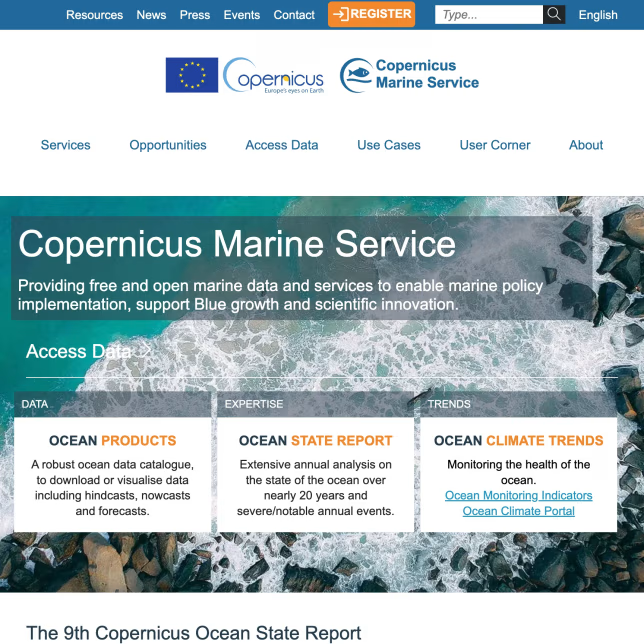
The existing marine data portal relied on three unaligned WordPress installations and embedded PHP code, creating inefficiencies and risks in content management and usability.
The new Drupal DXP streamlined content operations and improved accessibility, offering scientists and businesses a more efficient gateway to marine data services.
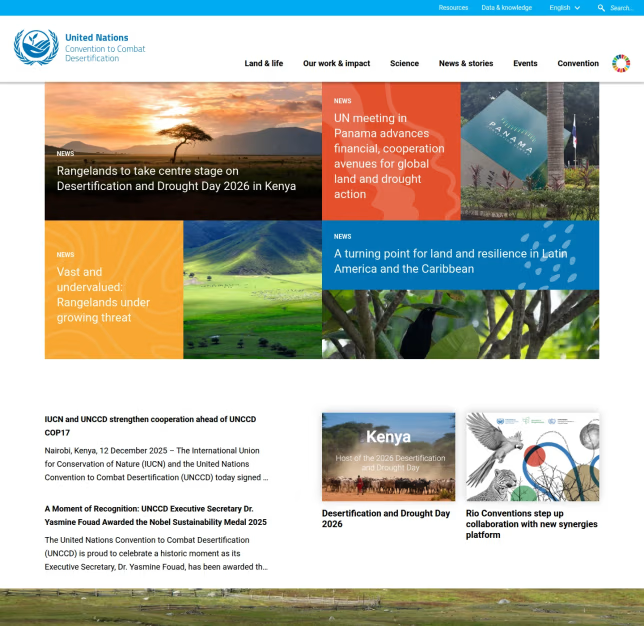
UNCCD operated four separate websites (two WordPress, two Drupal), leading to inconsistencies in design, content management, and user experience. A unified, scalable solution was needed to support a large-scale CMS migration project and improve efficiency and usability.
The modernization effort resulted in a cohesive, user-friendly, and scalable website, improving content management efficiency and long-term digital sustainability.
It was my pleasure working with Oleksiy (PathToProject) on a new Drupal website. He is a true full-stack developer—the ideal mix of DevOps expertise, deep front-end knowledge, and the structured thinking of a senior back-end developer.
He is well-organized and never lets anything slip. Oleksiy understands what needs to be done before being asked and can manage a project independently with minimal involvement from clients, product managers, or business analysts.
One of the best consultants I’ve worked with so far.

Andrei Melis
Technical Lead at Eau de Web
Oleksiy (PathToProject) is demanding and responsive. Comfortable with an Agile approach and strong technical skills, I appreciate the way he challenges stories and features to clarify specifications before and during sprints.

Olivier Ritlewski
Ingénieur Logiciel chez EPAM Systems
As Dev Team Lead on my project for 10 months, Oleksiy (PathToProject) demonstrated excellent technical skills and the ability to handle complex Drupal projects. His full-stack expertise is highly valuable.

Laurent Poinsignon
Domain Delivery Manager Web at TotalEnergies
These articles expand on the operational and architectural decisions that support high availability WordPress platforms. They cover observability, capacity planning, caching, readiness for traffic spikes, and governance patterns that help prevent reliability issues before they become incidents.
Share your current topology and availability targets. We will map failure domains, define practical RTO/RPO, and outline a phased architecture plan for resilient operations on AWS and Kubernetes.