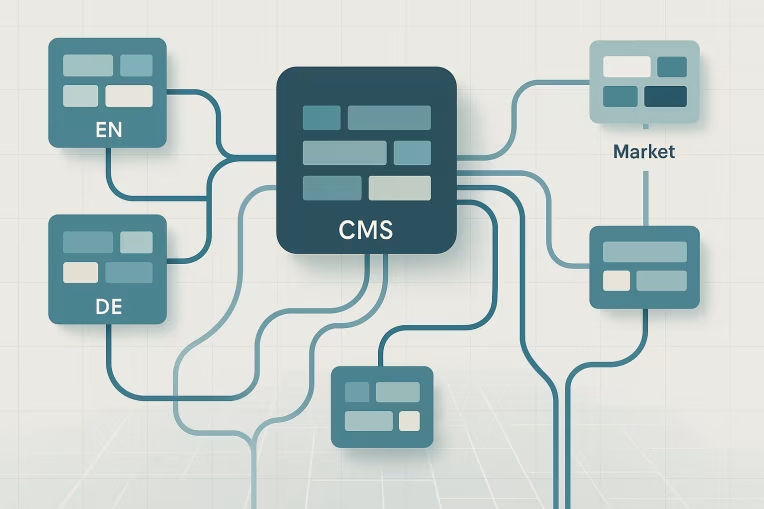
A multi-region platform can look well organized in early delivery phases and still become fragile the moment more markets, more content types, and more publishing teams are added.
That usually happens because fallback behavior was never truly designed. It was assumed.
A team may assume that if French Canadian content is missing, the platform should display French. Another team may expect English Canadian. A frontend developer may build one fallback chain in code, while editors are told something different in the CMS. Legal content may be global in one area, market-specific in another, and nobody can clearly explain which rule wins.
These are not minor implementation details. They are structural publishing decisions.
Fallback rules breaking regional publishing?Run Health CheckWhen localization fallback rules are explicit, teams can expand with more confidence. When they remain informal, the platform starts producing inconsistent regional pages, duplicate editorial effort, and launch-day exceptions that are expensive to unwind.
This article focuses on the modeling and governance decisions that make fallback predictable across structured content platforms.
Why localization breaks after scale, not before launch
Fallback problems often stay hidden during initial launch planning.
At that point, there may be only a few markets, a limited number of content types, and a project team making decisions in one room. Missing content can be patched manually. Editors know the exceptions from memory. Developers can hardcode one or two regional rules without much visible risk.
Scale changes the operating model.
Once a platform supports multiple languages, regional brands, campaign variations, local compliance requirements, and shared global components, fallback stops being a simple convenience rule. It becomes part of the platform's content architecture.
Typical points of failure include:
- localized pages that reference shared components with different fallback behavior than the page itself
- market launches where translated fields exist but linked assets or referenced entries do not
- global teams overwriting content that local teams expected to control
- frontend applications displaying fallback content without clearly signaling that content is inherited
- preview environments showing one fallback chain while production uses another
The root problem is usually the same: fallback logic exists in fragments across content modeling, delivery code, and editorial process.
If a platform is going to support regional growth, fallback cannot be treated as a rescue mechanism for missing translations. It has to be defined as a first-class rule set for content ownership and delivery.
Fallback types: language, market, brand, and shared global content
Many teams talk about fallback as if it were only a language issue. In practice, enterprise platforms often need several distinct fallback dimensions.
Language fallback
This is the most familiar model. If a requested locale is unavailable, the platform falls back to another language or language variant.
Examples include:
fr-CA -> fr -> enes-MX -> es -> en-US
Language fallback sounds straightforward, but it quickly becomes complicated when not every content type should follow the same chain. Marketing copy may allow broader fallback than regulated product instructions or support content.
Market fallback
Sometimes the issue is not language first, but market inheritance.
A regional site may inherit from a parent market or global market structure:
en-AUcontent may inherit from a global English source when local content does not exist- a smaller country site may inherit campaign modules from a regional hub site
- product data may be shared across multiple markets with selective local overrides
Market fallback is common in enterprise delivery because many organizations do not have the operating capacity to fully localize every page for every region.
Brand fallback
Multi-brand organizations often share the same platform while differentiating content ownership and design systems. In those cases, fallback may cross brand boundaries only for selected content domains, such as legal disclosures, investor content, or shared product information.
This needs stronger governance than language fallback because brand boundaries often carry approval, tone, and legal implications.
A useful principle is to treat brand fallback as exceptional rather than default unless there is a clearly governed shared-content model.
Shared global content fallback
Some content is intentionally global: legal notices, policy statements, product specifications, campaign assets, corporate announcements, or reusable UX modules.
The challenge is that "global" rarely means universal in every case. Some globally managed content is mandatory and identical everywhere. Some is global by default but market-overridable. Some is global only until a local team creates a replacement.
That means shared content needs more than a global flag. It needs a defined inheritance model.
A practical way to think about fallback is to classify content into patterns such as:
- global only: always shared, no local override
- global default with local override: inherited unless a market creates its own version
- market required: must exist locally, no fallback allowed
- conditionally shared: can inherit only for approved regions or channels
Without those distinctions, teams end up using one generic fallback mechanism for content that should have very different publishing rules.
Where fallback logic should live: CMS, API layer, or frontend
One of the most important modeling decisions is where fallback is actually resolved.
There is no single universal answer, but there are clear tradeoffs.
Fallback resolved in the CMS
If the CMS natively supports inheritance, locale configuration, or content relationship rules, resolving fallback there can make editorial behavior more visible.
Benefits often include:
- editors can understand inheritance closer to the source content
- preview can reflect actual publishing behavior more accurately
- governance rules are less likely to be reimplemented differently across consuming applications
Risks include:
- fallback behavior may be difficult to customize consistently across all content types
- downstream systems may still need to understand the origin of inherited values
- platform-specific modeling constraints can limit future flexibility
CMS-level fallback is strongest when the platform wants a single source of truth for editorial interpretation.
Fallback resolved in an API or composition layer
An API layer can assemble content from multiple sources and apply consistent resolution rules before data reaches frontend channels.
This pattern is often effective when:
- multiple frontends consume the same content
- a headless architecture requires centralized content composition
- fallback logic depends on market, channel, authentication state, or release context
Benefits include stronger control over cross-source resolution and less duplication in frontend code.
Risks include an additional abstraction layer that editors may not easily see. If preview tooling is weak, teams can struggle to understand why a page rendered inherited content.
An API-layer approach works best when fallback logic must be shared across applications and documented as a platform rule, not an app-level convenience. This is usually where broader content platform architecture decisions start to matter.

Stress-test your localization model
See where fallback logic, ownership, and preview behavior can drift across markets before it creates publishing chaos.
- Audit fallback chains
- Check inherited content visibility
- Spot governance gaps
Fallback resolved in the frontend
Frontend-only fallback can seem attractive because it is fast to implement. A component can simply request the preferred locale and then try alternates.
This is usually the weakest long-term choice if used as the primary fallback strategy.
Problems often include:
- different applications create different fallback chains
- server-rendered, cached, and client-rendered experiences diverge
- preview becomes unreliable
- editors cannot easily see or govern what users will actually get
Frontend fallback still has a role, but usually as a defensive rendering measure rather than the system of record.
A practical principle is:
- define fallback policy in the content architecture
- resolve it centrally in the CMS or API layer where possible
- let the frontend enforce only safe display behavior for known exceptions
That reduces the chance of hidden business logic accumulating inside templates and components.
Modeling localized fields, shared entities, and reusable references
The most common cause of publishing chaos is not the fallback chain itself. It is the mismatch between fallback rules and the underlying content model.
Fallback should be designed at multiple levels of the model, not only at the page level.
Field-level localization vs entry-level localization
Some teams localize entire entries. Others localize fields within a shared entry. Both patterns can work, but each affects fallback differently.
Entry-level localization can make ownership clearer. A market owns its own version of a page or content item. That can simplify approval and reduce accidental cross-market impact.
But it can also create duplication when large portions of content are shared and only a few fields vary.
Field-level localization can reduce duplication and preserve shared structure. It is useful when the same content entity exists globally but contains a mix of shared and localizable values.
But it can create hidden complexity if some fields inherit and others do not. Editors may believe an item is fully localized when several fields are still inherited from a fallback locale.
A good modeling decision is not simply choosing one pattern. It is identifying which content types truly need one or the other.
For example:
- campaign landing pages may need entry-level localization because structure, messaging, and approval vary by market
- product specification modules may work better with field-level localization because many attributes are shared globally
- legal notices may need a strict market-required rule for certain fields while allowing shared fallback for others
Reusable references need their own fallback rules
A page may be translated, but its referenced modules may not be.
This is where many implementations fail. Teams localize the page model but forget that banners, accordions, promo cards, product modules, and footer notices are separate entities with separate inheritance behavior.
Every reusable reference should answer questions such as:
- can this entity inherit across languages?
- can it inherit across markets?
- is fallback automatic or explicitly selected?
- should the consuming page display the shared source transparently, or require a local copy?
If those questions are unanswered, editors will often work around the model by duplicating entries. That usually solves the immediate launch issue while weakening long-term governance.
Shared entities should expose source and override state
When content is inherited, the system should make that state visible.
Editors benefit from signals like:
- source locale or source market
- whether a value is inherited or overridden
- whether the inherited source has changed since local review
- whether an override is partial or complete
These are not cosmetic enhancements. They reduce silent publishing errors.
If local teams cannot see what is inherited, they may approve content they do not actually control.
Avoid unbounded fallback chains
A fallback chain that looks elegant in documentation can become dangerous in practice.
For example, a request could fall back from market-specific content to regional shared content to brand-level defaults to global English. If that chain is too long, the output may be technically available but operationally wrong.
Long chains create risk because they blur accountability.
A useful discipline is to limit fallback depth and define where fallback must stop. Some content should fail clearly rather than render a distant inherited value that appears valid but is misleading in context.
Editorial workflow implications: ownership, translation status, and exceptions
Fallback is not only a data concern. It directly shapes publishing operations.
If ownership and workflow do not align with the inheritance model, the platform will generate confusion even if the technical implementation is sound.
Define ownership at the same level as fallback
If content can be shared globally and overridden locally, ownership must be explicit for both layers.
That usually means clarifying:
- who owns the source content
- who can create overrides
- who approves inherited content for local use
- who is accountable when a global update affects regional pages
The most stable platforms do not leave these decisions to informal coordination.
Translation status should not be the only status
Many organizations track whether content is translated, but that alone is not enough.
A multi-region publishing model often needs to distinguish between states such as:
- not translated
- inherited from fallback source
- translated but awaiting local approval
- locally overridden
- blocked from publishing due to required local content
This matters because a page can be publishable in one market with inherited global content, while another market may require local legal or regulatory sections before launch.
A single translation-complete flag cannot express that nuance.
Exceptions need a governed path
Exceptions are unavoidable.
A campaign may launch globally with one market using temporary fallback copy. A compliance team may require local legal text with no fallback allowed. A brand team may permit shared product content but prohibit shared promotional messaging.
The problem is not the presence of exceptions. The problem is when exceptions bypass the model and live only in email threads or release notes.
Create a governed exception path that records:
- what fallback rule is being overridden
- which content scope is affected
- who approved the exception
- how long the exception remains valid
That keeps temporary decisions from becoming permanent platform behavior.
Centralized and local ownership both have tradeoffs
A centralized model can improve consistency, reduce duplication, and make shared content easier to govern.
But it can also slow markets down and create bottlenecks when local teams need flexibility.
A localized ownership model can improve responsiveness and market relevance.
But it can also fragment governance, increase duplication, and weaken content reuse.
In practice, enterprise platforms often perform best with a hybrid model:
- central teams own foundational content types, shared components, and fallback policy
- local teams own approved override areas and market-required content
- exceptions are managed through transparent governance rather than informal custom behavior
The key is to make ownership visible in the content model, not just in an organization chart.
QA and preview patterns for regional publishing confidence
Fallback rules are only trustworthy if teams can test them in realistic publishing conditions.
Regional QA should verify not just whether content exists, but why a given value appears.
Preview should expose inheritance clearly
A strong preview experience should help editors answer:
- is this content local or inherited?
- which source locale or market supplied it?
- what will happen if the source changes?
- what will happen if this item is unpublished?
Without this visibility, preview may create false confidence.
An editor sees a complete page and assumes the market is ready, while several components are actually inheriting from fallback sources that were never reviewed for that region.
Test the absence cases, not just the happy path
Many teams validate localized pages that are fully populated. That is necessary, but it is not enough.
Fallback design should also be tested against intentional gaps:
- missing localized field values
- missing referenced entries
- unpublished local overrides
- removed shared assets
- partially translated composite pages
These scenarios reveal whether the platform fails safely, inherits predictably, or produces broken experiences.
Include operational QA, not only rendering QA
A page can render correctly and still be operationally unsafe.
QA should also verify:
- whether editorial users can identify inherited content before publish
- whether approval workflows match ownership rules
- whether release teams can predict which regions are affected by a global update
- whether analytics, caching, and preview environments use the same fallback resolution logic
This is especially important in headless environments where delivery logic may be distributed across services. In practice, this often depends on disciplined headless DevOps and environment parity, not just content configuration.
A checklist for redesigning weak fallback rules before a replatform or expansion
If a platform already shows signs of fallback confusion, a replatform or regional expansion is the right time to make the rules explicit.
A practical redesign checklist includes the following questions.
1. Define the fallback dimensions
Document whether fallback applies to:
- language
- market
- brand
- shared global content
- channel-specific variants
Do not assume one hierarchy will suit every content type.
2. Classify content by inheritance behavior
For each major content type, define whether it is:
- global only
- global by default with local override
- market required
- conditionally shared
This prevents teams from applying a generic fallback pattern everywhere.
3. Decide where fallback is resolved
Choose the system of record for fallback policy and the runtime layer that enforces it.
If the CMS, API layer, and frontend each participate, define their responsibilities clearly so they do not compete.
4. Model references deliberately
Audit reusable components and linked entities.
Fallback usually fails at reference boundaries, so each referenced content type should have explicit inheritance and ownership rules. This is exactly the kind of issue that benefits from stronger headless content modeling.
5. Make inherited state visible to editors
If users cannot see source, override status, and change impact, they will publish with uncertainty and create manual workarounds.
6. Align workflow states to publishing reality
Translation status alone is rarely sufficient. Add statuses that reflect inheritance, review, exceptions, and market readiness.
7. Limit fallback where correctness matters more than completeness
Some pages should display inherited content rather than break. Others should block publishing when local content is missing.
Design those thresholds intentionally.
8. Establish exception governance
Create a lightweight but durable process for temporary overrides and special cases.
That protects the platform from undocumented logic spreading over time.
9. Test preview and QA against missing-content scenarios
Do not validate only the content that exists. Validate the rules that apply when content does not.
10. Revisit ownership before expansion
If new markets, brands, or regions are being added, confirm that the ownership model can support them without excessive duplication or central bottlenecks.
Final thoughts
Localization becomes chaotic when fallback is treated as an implicit convenience instead of a designed operating rule.
For enterprise digital platforms, the real question is not whether fallback exists. It almost always does. The real question is whether the platform can explain, govern, preview, and test fallback consistently across content models, delivery layers, and editorial workflows.
Teams that answer that question early tend to avoid the worst expansion surprises. They create content structures where shared material is intentionally reusable, local ownership is clear, and missing content produces predictable outcomes instead of last-minute confusion. Large multi-market programs such as JYSK show how quickly these decisions become platform-level concerns once regional scale increases.
Multi-region content platforms
Find the weak points in localization fallback
Use the Health Check to uncover hidden fallback logic, inconsistent inheritance rules, and workflow risks across your content platform.
That is the real value of well-designed localization fallback rules: not just rendering a page when something is missing, but making regional publishing behavior understandable enough to scale.
Tags: localization fallback rules, Content Operations, multi-region content modeling, multilingual CMS governance, headless localization architecture, enterprise content platform localization