Core Focus

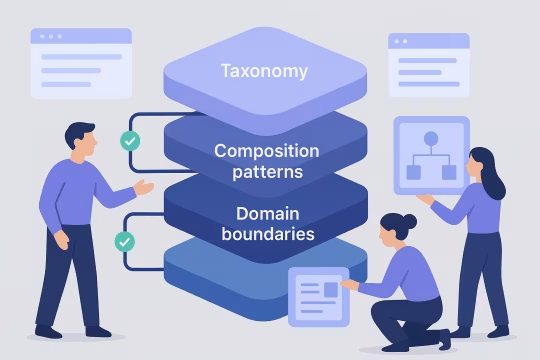
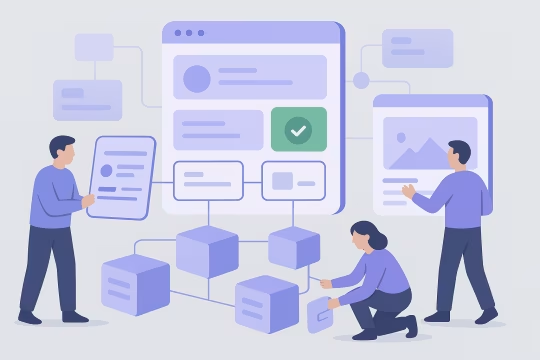
Content types and schemas
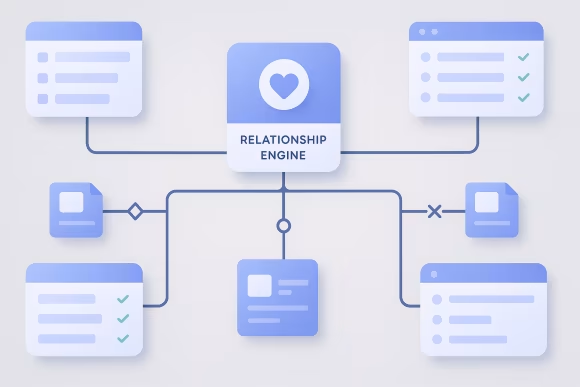
Relationships and references
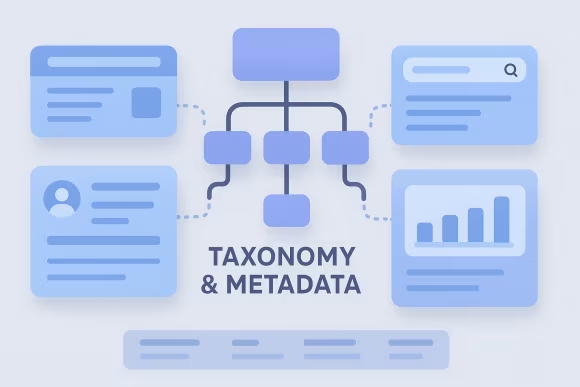
Taxonomy and metadata design
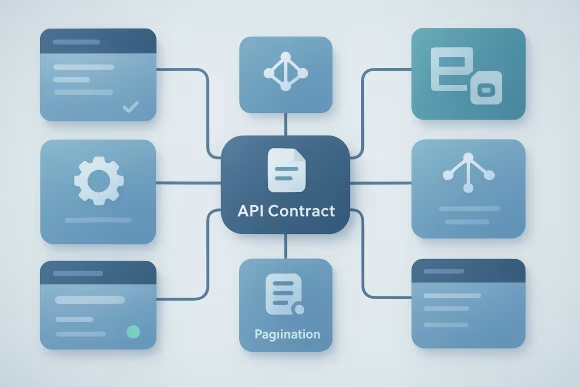
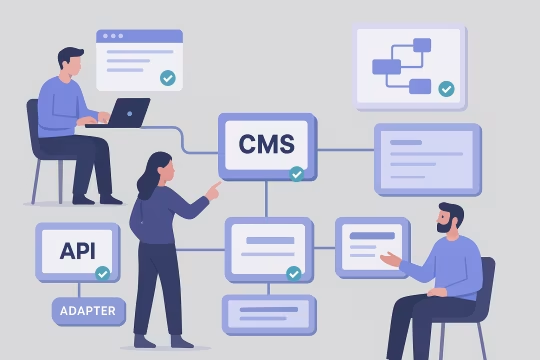
API contract alignment

Best Fit For

  • Multi-channel content delivery
  • Decoupled frontend teams
  • Multi-site platform programs
  • Complex editorial workflows

Key Outcomes

  • Reduced schema churn
  • Predictable API responses
  • Reusable content across channels
  • Lower integration rework

Technology Ecosystem

  • Headless CMS platforms
  • GraphQL and REST APIs
  • Next.js and React frontends
  • Design system alignment

Platform Integrations

  • CDP event and profile mapping
  • Search indexing structures
  • Analytics content identifiers
  • Workflow and translation tools

Unstructured Content Schemas Break API Delivery

As digital platforms grow, content requirements expand faster than the underlying schema. Teams add fields opportunistically, create near-duplicate content types, and embed presentation assumptions into the model. Over time, the CMS becomes a collection of inconsistent structures that are difficult to reuse across channels, regions, and products.

For engineering teams, this creates unstable API contracts and unpredictable payloads. Frontend teams compensate with conditional logic, mapping layers, and one-off transformations. Integrations such as search, CDP, and analytics struggle to rely on consistent identifiers, taxonomy, and metadata. Architecture decisions become reactive because the model does not clearly express relationships, constraints, or ownership.

Operationally, schema changes become high-risk events. Editorial teams lack clear guidance and validation, leading to content quality issues and increased review overhead. Delivery slows as each new feature requires bespoke modeling, migration scripts, and coordination across multiple consumers. The platform accumulates technical debt in the form of brittle content structures that are expensive to refactor without breaking downstream systems.

Headless Modeling Delivery Process

Discovery and Inventory

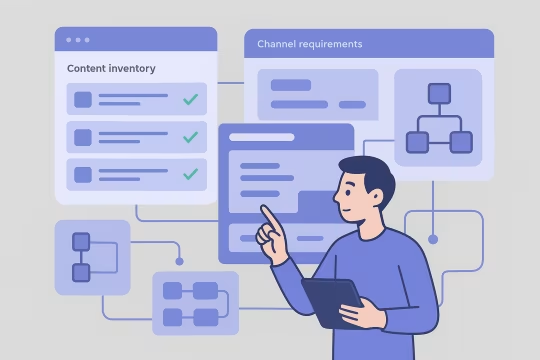
Review current content, channels, consumers, and editorial workflows. Identify duplicated structures, implicit presentation coupling, and integration dependencies. Establish modeling goals such as reuse, localization, and API stability.

Domain and Use Cases

Define content domains, key user journeys, and channel requirements. Translate product needs into model capabilities, including relationships, composition patterns, and lifecycle states that support publishing operations.

Schema Architecture

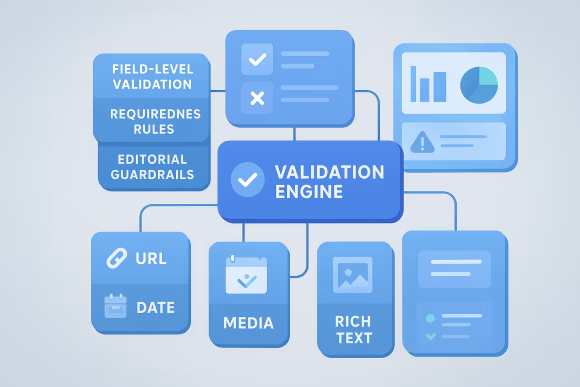
Design content types, field semantics, validation rules, and reference patterns. Define taxonomy strategy, identifiers, and metadata conventions to support search, analytics, and downstream integrations.

API Contract Design

Align the model with REST/GraphQL delivery needs, including query patterns, pagination, and denormalization boundaries. Define response shapes, error handling expectations, and versioning approach for consumers.

Implementation and Migration

Implement the model in the selected CMS, including content types, components, and editorial UI configuration. Plan and execute migrations, mapping legacy fields to the new schema with repeatable scripts and verification steps.

Integration Enablement

Update frontend and integration mappings to the new model. Provide reference queries, sample payloads, and contract tests to reduce consumer ambiguity and prevent regressions during rollout.

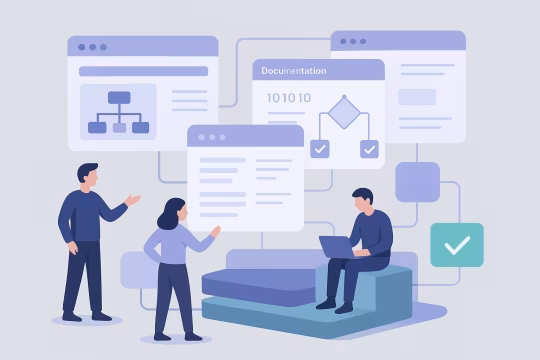
Governance and Documentation

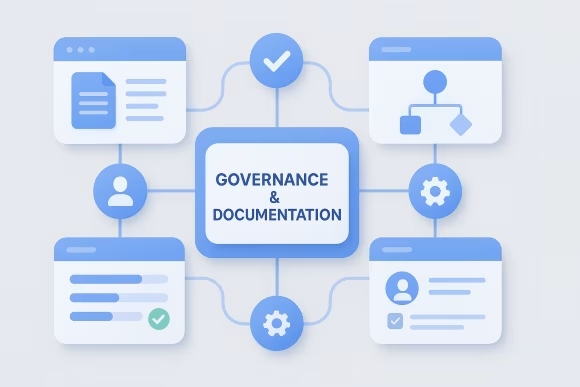
Establish ownership, change control, naming conventions, and review workflows for schema evolution. Produce modeling documentation that supports editors and developers, including examples and anti-patterns.

Evolution and Optimization

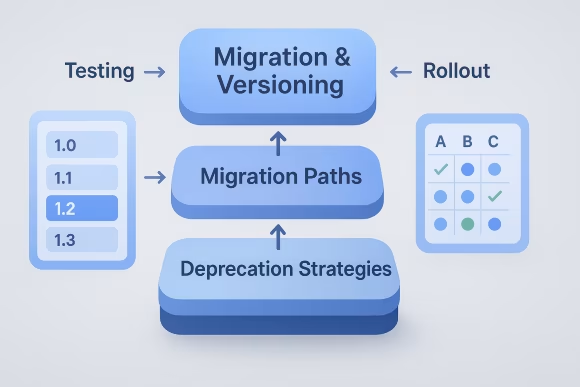
Monitor model usage, API performance, and editorial friction. Iterate on composition patterns, localization rules, and metadata coverage while maintaining backward compatibility through controlled deprecation and versioning.

Core Content Modeling Capabilities

This service establishes the structural foundation for headless delivery by defining schemas that are reusable, composable, and stable for API consumers. We focus on explicit relationships, metadata strategy, and constraints that support editorial quality and predictable integration behavior. The result is a model that can evolve through governance and versioning without breaking downstream systems or forcing frequent frontend rewrites.

Capabilities
  • Content schema and type design
  • Content relationships and composition patterns
  • Taxonomy and metadata architecture
  • Localization and variant modeling
  • API contract and query design
  • CMS implementation and configuration
  • Content migration planning and execution
  • Schema governance and documentation
Who This Is For
  • CTO
  • Product Owners
  • Platform Architects
  • Headless CMS platform teams
  • Frontend engineering leads
  • Content operations and editorial leads
  • Integration and data platform teams
Technology Stack
  • Headless CMS architectures
  • Drupal (headless)
  • WordPress (headless)
  • REST and GraphQL
  • Next.js
  • React
  • Storybook
  • CDP integrations

Delivery Model

Engagements are structured to establish a stable content contract first, then implement and validate it across CMS, frontend, and integrations. We prioritize model clarity, migration safety, and governance so the schema can evolve without repeated rework across consumers.

Delivery card for Discovery[01]

Discovery

Run workshops with product, engineering, and content stakeholders to capture channel requirements and constraints. Inventory existing content types, fields, and integrations to identify duplication, coupling, and high-risk dependencies.

Delivery card for Architecture[02]

Architecture

Define domain boundaries, composition patterns, and relationship rules. Establish naming conventions, identifiers, taxonomy strategy, and localization approach aligned to API delivery and operational workflows.

Delivery card for Implementation[03]

Implementation

Configure the CMS with the agreed schema, including editorial UI structure and validation rules. Create reference content and examples to validate that the model supports real publishing scenarios.

Delivery card for Integration[04]

Integration

Align frontend and downstream consumers to the new model with reference queries and mapping guidance. Where needed, introduce adapter layers or versioned endpoints to maintain compatibility during transition.

Delivery card for Testing[05]

Testing

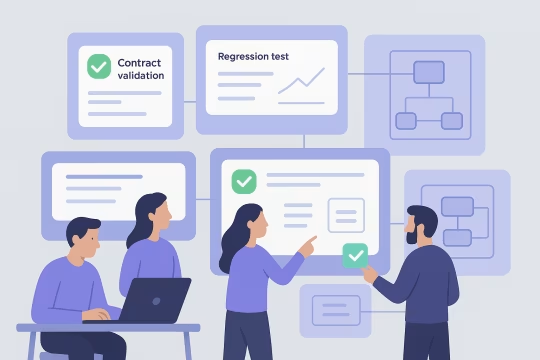
Validate API payloads, query patterns, and edge cases such as missing references and locale fallbacks. Add contract checks and regression tests to detect breaking schema changes early in the delivery lifecycle.

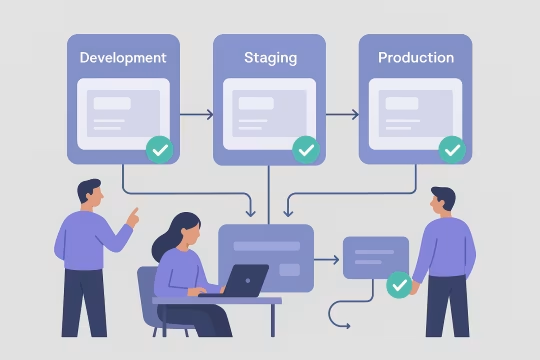
Delivery card for Deployment[06]

Deployment

Promote schema changes through environments with controlled releases and rollback considerations. Coordinate cutover steps for migrations and consumer updates to minimize downtime and content freeze windows.

Delivery card for Governance[07]

Governance

Define ownership, review gates, and documentation standards for ongoing schema changes. Establish a change process that supports multiple teams while keeping the model coherent and API contracts stable.

Delivery card for Continuous Improvement[08]

Continuous Improvement

Monitor model usage, editorial friction, and consumer feedback to refine composition and metadata coverage. Plan iterative enhancements with versioning and deprecation to avoid disruptive platform-wide changes.

Business Impact

Headless content modeling reduces delivery friction by making content predictable for APIs and reusable across channels. It lowers operational risk during platform evolution by introducing governance, versioning, and migration paths that prevent breaking changes and repeated rework.

Faster Feature Delivery

Teams build against stable content contracts instead of reverse-engineering payloads per feature. Reusable structures reduce the need to create new types for each channel or page variant.

Lower Integration Rework

Consistent identifiers, taxonomy, and metadata reduce custom mapping for CDP, search, and analytics. Downstream systems can rely on predictable structures, improving change tolerance.

Reduced Schema Churn

Clear composition patterns and governance reduce ad-hoc field additions and duplicate types. Model evolution becomes incremental and intentional rather than reactive.

Improved API Stability

Contract-aligned schemas reduce breaking changes for frontend and partner consumers. Versioning and deprecation practices make change management measurable and auditable.

Higher Content Quality

Validation rules and editorial guardrails reduce incomplete or inconsistent entries. Better-structured content improves rendering reliability and reduces downstream sanitization logic.

Scalable Localization

Localization-ready modeling reduces rework when expanding to new locales and regions. Explicit fallback and variant rules improve operational predictability for translation workflows.

Better Platform Governance

Ownership, documentation, and review gates make schema changes traceable and consistent across teams. This supports multi-team delivery without eroding architectural coherence.

Lower Long-Term Maintenance

Reduced conditional logic in frontends and fewer one-off transformations decrease technical debt. Over time, the platform becomes easier to extend and safer to refactor.

FAQ

Common architecture, operations, integration, governance, risk, and engagement questions for headless content modeling.

How do you design content models that work across multiple channels and frontends?

We start from content intent and reuse boundaries rather than page templates. The model is organized around domain entities (e.g., article, product, location) and composable components (e.g., hero, CTA, media, FAQ block) that can be assembled differently per channel. We define which parts are canonical and which are channel-specific, and we avoid embedding presentation rules into fields. From an API perspective, we design for predictable query patterns: stable identifiers, explicit relationships, and clear denormalization boundaries. For GraphQL, we control depth and composition to avoid overly nested queries; for REST, we define resource shapes and linking strategy. We also establish conventions for rich text, media, and structured links so rendering logic remains consistent across Next.js/React and other consumers. Finally, we validate the model against real use cases with reference content and sample queries. If a channel needs a different representation, we prefer adapters or view models at the delivery layer rather than forking the underlying content schema.

How do you handle relationships, references, and content composition without creating fragile schemas?

We define relationship patterns explicitly: ownership, cardinality, lifecycle coupling, and requiredness. For example, a page may reference many components, but a component may be owned by a page (embedded) or shared across pages (referenced). We choose the pattern based on reuse needs, editorial workflow, and the impact of changes. To avoid fragility, we limit deep chains of references that create complex query graphs and failure modes when a single node is missing. We introduce constraints and validation to prevent orphaned references, and we define fallback behavior for optional relationships. For shared entities, we establish stable identifiers and clear rules for updates and deprecations. We also document composition guidelines so teams don’t create multiple ways to represent the same concept. When the model must evolve, we plan migrations and versioning so consumers can transition without breaking changes, and we use contract checks to detect schema drift early.

What operational processes are needed to keep a content model maintainable over time?

Maintainability depends on governance and repeatable change processes. We define ownership for domains and shared components, establish naming conventions, and introduce a lightweight review gate for new types/fields. This prevents schema sprawl and ensures changes are evaluated for reuse, API impact, and editorial implications. Operationally, we recommend maintaining a model registry (documentation plus examples) and a change log that records what changed, why, and which consumers are affected. For teams with multiple environments, we align schema changes with release management: promotion rules, rollback considerations, and migration sequencing. We also encourage contract-oriented testing where feasible: sample queries, snapshot payload checks, and integration tests that run in CI. This makes schema changes observable and reduces the risk of breaking frontends or downstream systems. Periodic model reviews (quarterly or per major release) help identify duplication, unused fields, and opportunities to simplify composition patterns.

How do you support editorial teams while keeping the model developer-friendly?

We treat the editorial experience as part of the architecture. A developer-friendly schema can still be difficult to use if field semantics are unclear or if editors must assemble complex structures without guidance. We address this by defining field intent, requiredness, validation, and sensible defaults, and by organizing the editorial UI to reflect real workflows. We also provide examples and patterns: when to create a new entity versus reuse an existing one, how to use shared components, and how to manage media and links consistently. For complex models, we introduce guardrails such as conditional fields, controlled vocabularies, and structured link types to reduce ambiguity. At the same time, we avoid overfitting the model to a single editorial workflow. The goal is a stable content contract for APIs, with an editorial configuration that can evolve independently (labels, help text, grouping) without forcing schema changes that would ripple to consumers.

How do you align content models with Next.js/React frontends and design systems?

We align the model to the frontend’s rendering and composition needs without coupling it to specific layouts. Practically, this means defining component-like content blocks with clear props (fields), predictable optionality, and consistent media/link structures. We map these blocks to design system components (often documented in Storybook) so frontend teams can implement renderers with minimal conditional logic. We also define conventions for structured rich text, embedded media, and call-to-action patterns so content can be rendered consistently across pages and channels. For Next.js, we consider data-fetching patterns (SSG/ISR/SSR), caching boundaries, and query efficiency when designing relationships and payload shapes. Where the frontend needs a tailored view, we prefer a delivery layer (BFF, edge functions, or API composition) that transforms canonical content into view models. This keeps the CMS schema stable while allowing frontend optimization and incremental evolution.

How do you model content for CDP, analytics, and search integrations?

We design metadata and identifiers as first-class parts of the schema. For analytics, we define stable content IDs, canonical URLs, content categories, and campaign-related fields where appropriate, ensuring they are consistent across locales and channels. This enables reliable event attribution and reporting dimensions. For CDP use cases, we model the attributes needed for segmentation and personalization (e.g., topics, audience tags, lifecycle states) using controlled vocabularies and governance. We also consider how content eligibility rules are represented so personalization logic can be implemented outside the CMS when required. For search, we model indexable fields, faceting dimensions, and hierarchical taxonomy in a way that supports predictable indexing pipelines. We define how related content is represented and which fields are authoritative. The goal is to reduce ad-hoc transformations in integration code by making the schema explicit and consistent.

Who should own the content model in an enterprise organization?

Ownership typically sits with a platform team or architecture function, with shared responsibility across product and content operations. The platform owner is accountable for schema coherence, API stability, and change control. Product and content stakeholders provide requirements and validate that the model supports real workflows and channel needs. We recommend defining domain owners for major content areas (e.g., marketing content, support content, product content) and a small review group for shared components and cross-domain fields. This avoids a single bottleneck while preventing divergent modeling approaches. Governance should be lightweight but explicit: naming conventions, criteria for creating new types, rules for reuse versus duplication, and a documented process for proposing and approving changes. When multiple frontends or integrations depend on the model, the governance process should include consumer impact assessment and a plan for versioning or deprecation.

How do you document and communicate schema changes to multiple consumer teams?

We document the model at two levels: (1) conceptual documentation that explains domains, composition patterns, and intended usage, and (2) reference documentation that lists fields, constraints, and example payloads/queries. The conceptual layer prevents teams from inventing new patterns; the reference layer supports implementation and testing. For change communication, we recommend a versioned change log with consumer impact notes: what changed, why, whether it is breaking, and what migration steps are required. For GraphQL, schema diffs can be automated; for REST, we track resource shape changes and deprecation timelines. We also encourage publishing “consumer contracts” such as sample queries and expected response snapshots. When integrated into CI, these contracts provide early warning when schema changes would break a frontend build or an integration pipeline, reducing coordination overhead across teams.

What are the biggest risks when refactoring an existing content model, and how do you mitigate them?

The main risks are breaking API consumers, losing content fidelity during migration, and creating parallel schemas that increase long-term complexity. Refactors often fail when teams change the schema without a clear mapping from old to new, or when they underestimate the number of downstream consumers (frontends, search, CDP, syndication). We mitigate this by starting with an inventory of consumers and critical journeys, then defining a migration plan with explicit mappings, validation checks, and rollback considerations. For breaking changes, we use versioning or compatibility layers so consumers can transition incrementally. We also define deprecation timelines and keep both schemas running only as long as necessary. During migration, we run repeatable scripts and verification steps (counts, sampling, field-level checks) and validate with real rendering and integration tests. The goal is controlled change: measurable impact, predictable rollout, and minimal disruption to publishing operations.

How do you prevent schema sprawl and duplicated content types as teams scale?

Schema sprawl usually comes from unclear reuse rules and lack of review gates. We prevent it by establishing composition patterns (shared blocks, shared entities) and criteria for when a new type is justified. Naming conventions and domain boundaries help teams find existing structures before creating new ones. We also introduce governance mechanisms that are proportional to the organization: a lightweight review for shared components, periodic audits to identify duplicates, and a clear owner for cross-cutting concerns like taxonomy and identifiers. Documentation with examples and anti-patterns is important because it reduces “tribal knowledge” modeling. Finally, we encourage observability of the model: track which types and fields are used, which are unused, and where consumers rely on specific structures. This makes it easier to consolidate safely and to plan deprecations without breaking frontends or integrations.

What does a typical engagement deliver, and how long does it take?

A typical engagement produces a documented target content model, implemented schema configuration in the CMS, and a migration and rollout plan aligned to consumer needs. The documentation usually includes domain boundaries, composition patterns, taxonomy strategy, localization rules, and example payloads/queries. For existing platforms, we also include an inventory of current types and a mapping from legacy to target structures. Timelines depend on scope and platform complexity. A focused modeling engagement for a single domain can take 2–4 weeks including workshops and documentation. A broader enterprise model covering multiple domains, localization, and several consumers often takes 6–10 weeks, especially when migrations and consumer alignment are included. If implementation and migration are in scope, we plan delivery in increments: implement the model, migrate a representative slice of content, validate with frontend/integrations, then scale the migration. This reduces risk and keeps delivery moving while the platform evolves.

How do you collaborate with internal teams during modeling and implementation?

We work as an extension of your platform and product teams. Collaboration typically includes joint workshops for requirements and domain modeling, working sessions with frontend and integration teams to validate API needs, and regular reviews with content operations to ensure the model supports editorial workflows. We prefer to keep artifacts actionable: model diagrams, field semantics, example entries, and sample queries that developers can implement against. For implementation, we can pair with your CMS engineers or deliver configuration and migration scripts directly, depending on access and operating model. We also establish a shared change process early—how decisions are made, who approves shared components, and how consumer impact is assessed. This keeps the model coherent while enabling parallel work across teams and reducing late-stage surprises.

How does collaboration typically begin for headless content modeling?

Collaboration usually begins with a short discovery phase to align on scope, constraints, and consumers. We start by identifying the channels and systems that consume content (frontends, search, CDP, analytics, syndication), then inventory the current content types and pain points. This produces a clear view of where instability, duplication, or workflow friction exists. Next, we run a modeling workshop focused on domains and key use cases. We translate product requirements into schema capabilities—types, fields, relationships, taxonomy, and localization rules—and define initial API contract expectations. We then validate the draft model with representative content examples and sample queries. From there, we agree the delivery plan: what will be implemented in the CMS, what migrations are required, how consumers will transition, and what governance is needed to keep the model stable. This typically results in a prioritized backlog and a timeline for incremental rollout.

Define a stable content contract for your platform

Let’s review your current schema, consumers, and editorial workflows, then design a headless content model that supports predictable APIs and long-term platform evolution.

Oleksiy (Oly) Kalinichenko

Oleksiy (Oly) Kalinichenko

CTO at PathToProject

Do you want to start a project?