Core Focus

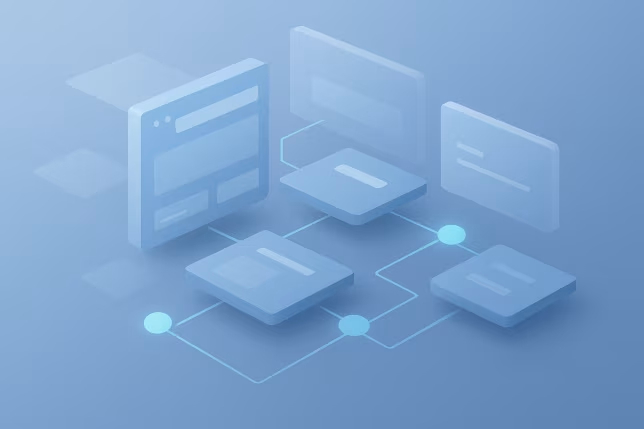
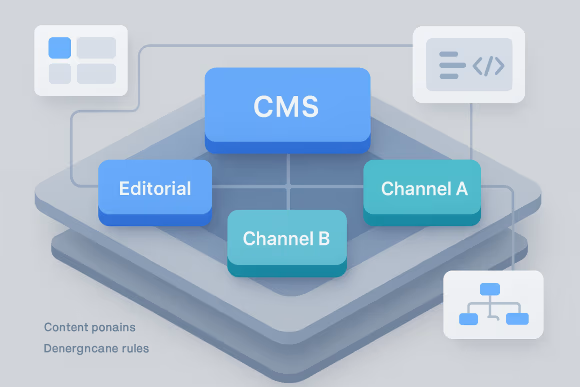
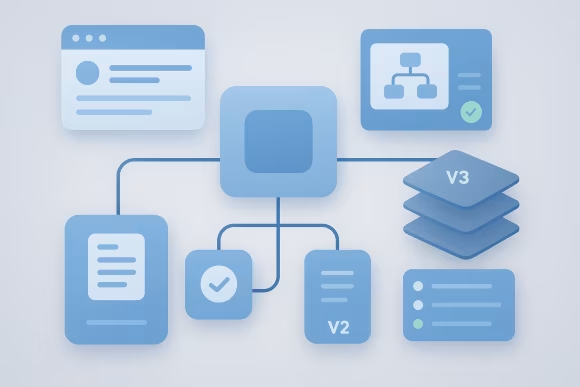
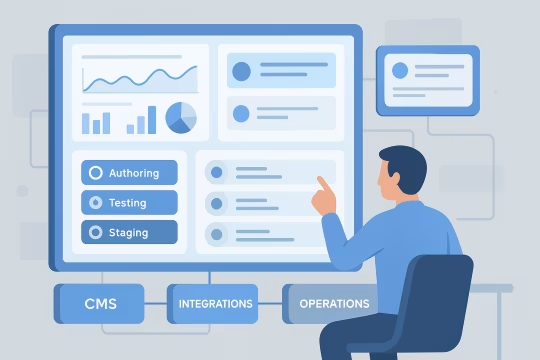
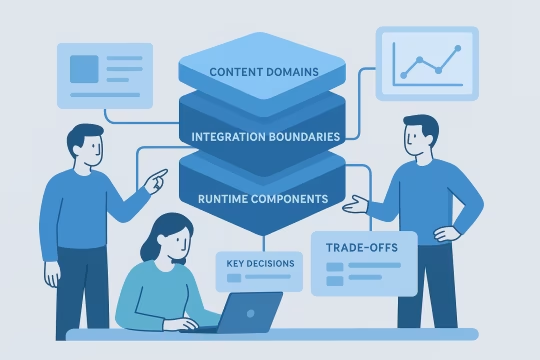
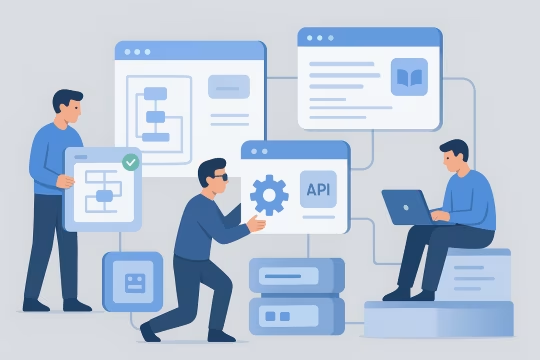
Content domain boundaries
API-first delivery contracts
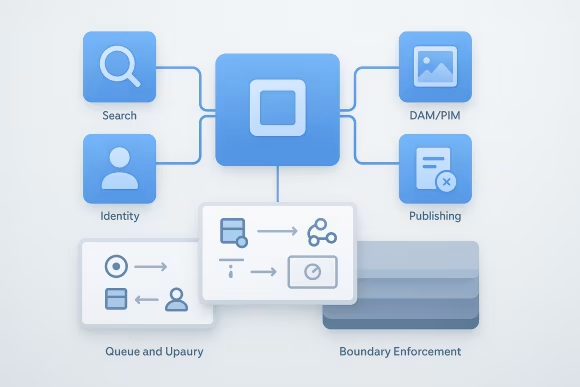
Composable platform topology
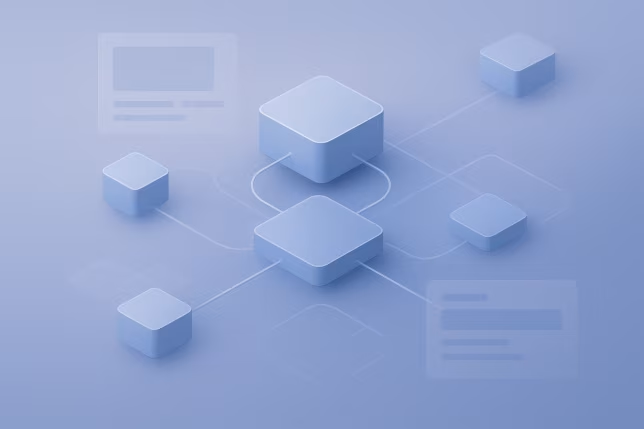
Operational ownership model

Best Fit For

  • Multi-site enterprise ecosystems
  • Multiple consuming applications
  • Distributed product teams
  • Legacy CMS modernization

Key Outcomes

  • Stable integration interfaces
  • Reduced coupling across teams
  • Predictable platform evolution
  • Lower change failure risk

Technology Ecosystem

  • Headless CMS platforms
  • Content APIs and gateways
  • Cloud runtime services
  • Identity and access control

Platform Integrations

  • Search and indexing
  • CDN and caching layers
  • PIM and DAM systems
  • Analytics event pipelines

Unclear Content Boundaries Create Platform Coupling

As content platforms expand beyond a single website, teams often add channels, features, and integrations incrementally. Content types and workflows evolve to satisfy immediate delivery needs, while API surfaces grow organically. Over time, the platform becomes a collection of tightly coupled decisions: content models encode presentation assumptions, integrations depend on undocumented fields, and delivery patterns differ by channel.

These issues surface as architectural friction. Engineering teams struggle to introduce new consumers without breaking existing ones, because API contracts are implicit and versioning is inconsistent. Content teams experience governance gaps: ownership of content domains is unclear, validation rules are duplicated across systems, and workflow states do not map cleanly to downstream publishing requirements. Platform teams inherit operational risk when caching, search indexing, and identity controls are implemented differently across services.

The result is slower delivery and higher maintenance overhead. Small changes require cross-team coordination, regression risk increases, and platform modernization becomes difficult because dependencies are not isolated. Without explicit boundaries and operational responsibilities, the platform cannot evolve predictably as the organization scales.

Content Platform Architecture Methodology

Platform Discovery

Review current CMS landscape, consumers, integrations, and delivery constraints. Capture content lifecycle requirements, non-functional needs (latency, availability, compliance), and existing operational practices to establish architectural drivers and constraints.

Domain Decomposition

Identify content domains, ownership boundaries, and shared concepts. Define which domains belong in the headless CMS versus adjacent systems (PIM, DAM, search), and document responsibilities to reduce coupling and clarify change impact.

API Contract Design

Define API styles and contracts for content delivery and management, including pagination, filtering, localization, and error semantics. Establish versioning and compatibility rules so consumers can evolve independently without breaking changes.

Integration Architecture

Design integration patterns for search indexing, personalization, identity, and downstream publishing. Specify eventing versus synchronous calls, retry and idempotency strategies, and data ownership to avoid circular dependencies and hidden coupling.

Runtime Topology

Define the platform topology across CMS, API gateway, caching/CDN, edge logic, and background processing. Specify scaling characteristics, observability requirements, and failure modes to ensure predictable performance under load.

Security and Compliance

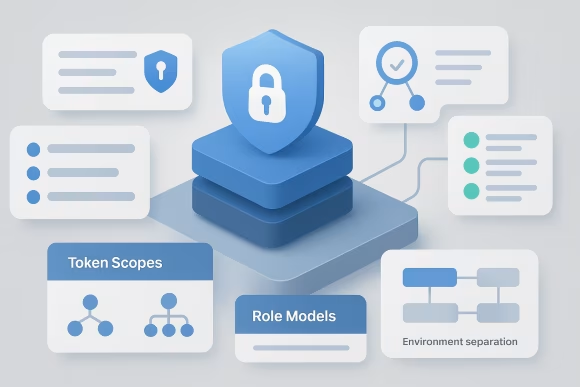
Establish authentication and authorization models for authors, systems, and consumers. Define token handling, least-privilege access, audit requirements, and data classification to meet enterprise security and regulatory constraints.

Governance and Standards

Create standards for content modeling, naming, validation, and documentation. Define review workflows, change control for schemas and APIs, and decision records so architectural intent remains durable across teams and vendors.

Evolution Roadmap

Produce an incremental roadmap that sequences refactors, migrations, and integration changes. Define measurable milestones, deprecation plans, and operational readiness steps to evolve the platform without disrupting delivery.

Core Content Platform Capabilities

This service establishes the architectural foundations required for a headless content ecosystem to scale across channels and teams. The focus is on explicit boundaries, stable interfaces, and operational clarity so content models and APIs can evolve without creating hidden coupling. The resulting platform structure supports consistent delivery patterns, predictable change management, and long-term maintainability across CMS, integrations, and runtime services.

Capabilities
  • Content domain and bounded-context design
  • Headless CMS architecture blueprints
  • API contract and versioning strategy
  • Integration patterns and dependency mapping
  • Caching and delivery topology design
  • Security and access control architecture
  • Observability requirements and SLO definition
  • Governance model for schema evolution
Target Audience
  • Content Architects
  • Enterprise Architects
  • Digital Leaders
  • CTO and engineering leadership
  • Platform and enablement teams
  • Product owners for multi-channel platforms
Technology Stack
  • Headless CMS
  • Content APIs
  • API gateways
  • Cloud platforms
  • CDN and edge caching
  • Eventing and queues
  • Identity and access management
  • Observability tooling

Delivery Model

Engagements are structured to produce actionable architecture decisions and implementation guidance. We align content, engineering, and operations stakeholders, then define boundaries, contracts, and standards that can be implemented incrementally without disrupting delivery.

Delivery card for Discovery and Audit[01]

Discovery and Audit

Stakeholder interviews and platform review across CMS, consumers, integrations, and operations. We capture constraints, risks, and non-functional requirements, and map the current content lifecycle from authoring to delivery.

Delivery card for Target Architecture Design[02]

Target Architecture Design

Define target platform topology, content domains, and integration boundaries. We document key decisions, assumptions, and trade-offs, including runtime components, responsibilities, and failure modes.

Delivery card for Schema and API Specification[03]

Schema and API Specification

Produce modeling standards and API contract guidance that consumers can implement consistently. This includes versioning rules, preview/publish behaviors, and documentation expectations for long-term maintainability.

Delivery card for Security and Compliance Design[04]

Security and Compliance Design

Define identity flows, authorization model, and environment separation for authoring and delivery. We specify audit requirements, data classification considerations, and controls for preview access and administrative operations.

Delivery card for Operational Readiness[05]

Operational Readiness

Specify observability, SLOs, alerting, and runbooks aligned to editorial and consumer workflows. We also define deployment and rollback expectations for schema and API changes to reduce operational risk.

Delivery card for Implementation Enablement[06]

Implementation Enablement

Support teams with reference implementations, integration patterns, and review checkpoints. We help translate architecture into backlog items and acceptance criteria that fit existing delivery processes.

Delivery card for Governance Setup[07]

Governance Setup

Establish governance routines for schema evolution, API changes, and integration onboarding. This includes decision records, review gates, and ownership mapping to keep the platform coherent as teams scale.

Business Impact

A clear content platform architecture reduces cross-team dependency and makes platform change predictable. The impact is primarily realized through lower integration risk, improved delivery consistency across channels, and a platform that can evolve without repeated rework.

Faster Channel Onboarding

New applications and sites can integrate using stable API contracts and documented patterns. Teams spend less time reverse-engineering content structures and more time implementing channel-specific experiences.

Reduced Integration Risk

Explicit boundaries and ownership reduce hidden coupling between systems. Changes to schemas and integrations can be assessed and rolled out with clearer impact analysis and safer deprecation paths.

Improved Platform Scalability

A defined runtime topology and caching strategy supports predictable performance under growth. Scaling decisions become systematic rather than reactive, reducing bottlenecks during traffic spikes and releases.

Lower Operational Overhead

Standardized observability and runbooks make incidents easier to detect and resolve. Operational responsibilities are clearer across CMS, APIs, and background processing, reducing escalation loops.

Controlled Schema Evolution

Governance and change control reduce content model drift across teams. Schema updates become incremental and testable, minimizing regressions in downstream consumers and editorial workflows.

Consistent Multi-Channel Delivery

Shared delivery semantics for localization, preview, and publishing reduce channel-specific inconsistencies. Content teams and engineering teams can align on predictable behaviors across web, apps, and integrations.

Reduced Technical Debt Accumulation

Architecture decisions are documented and enforced through standards, limiting ad-hoc patterns. This reduces repeated rework when integrating new systems or modernizing parts of the platform.

Improved Developer Productivity

Clear contracts, reference patterns, and consistent tooling reduce time spent on integration troubleshooting. Teams can implement features with fewer coordination cycles and more reliable test coverage.

FAQ

Common architecture, operations, integration, governance, risk, and engagement questions for enterprise headless content platforms.

How do you define content domains and boundaries in a headless ecosystem?

We start by mapping the content lifecycle and identifying where meaning, ownership, and change frequency differ. Domains are defined around business concepts (for example, products, locations, policies, campaigns) rather than channels. We then determine which concepts are authoritative in the headless CMS versus adjacent systems such as PIM, DAM, or CRM. Boundaries are made explicit through: (1) schema ownership (who can change what), (2) API contracts (what is exposed and how it is versioned), and (3) integration responsibilities (who publishes events, who consumes, and what happens on failure). We also identify shared concepts that require careful modeling (identifiers, taxonomy, localization) and decide whether they are centralized or federated. The outcome is a bounded-context map and a set of rules for references, duplication, and synchronization. This reduces coupling and makes it possible to evolve one domain without forcing coordinated releases across every consuming application.

When should we choose a composable architecture versus a single headless CMS instance?

A single headless CMS can be sufficient when content domains are closely related, governance is centralized, and the number of consuming applications is limited. A composable architecture becomes valuable when you have distinct ownership boundaries, multiple systems of record, or different runtime requirements that should not be forced into one platform. We evaluate composability using concrete criteria: domain independence (can teams change schemas without coordination), integration complexity (number of downstream consumers and dependencies), non-functional requirements (latency, availability, compliance), and operational maturity (ability to run multiple services with observability and change control). Composable does not automatically mean “more services.” The goal is to place boundaries where they reduce coordination cost and risk. In many enterprises, the right answer is a hybrid: one headless CMS for editorial workflows, plus dedicated services for search indexing, personalization decisions, or content delivery aggregation behind an API gateway.

How do you design for reliability and performance in content delivery APIs?

We design reliability and performance from the delivery path outward: consumer requirements, caching strategy, API topology, and CMS constraints. Key decisions include where caching occurs (CDN, edge, API layer), how cache keys are constructed (locales, segments, query parameters), and how invalidation is triggered (time-based, webhook/event-driven, selective purge). We also define failure modes and fallbacks. For example, if indexing lags, what does the API return; if the CMS is degraded, can delivery continue from cache; and how preview traffic is isolated from published traffic. Background processing (revalidation, indexing, asset transforms) is separated from synchronous request paths to keep latency predictable. Operationally, we specify SLOs, dashboards, and alerts tied to user-facing outcomes: API latency, error rates, cache hit ratio, and publish-to-live time. This makes performance measurable and supports iterative tuning as traffic and content volume grow.

What observability should an enterprise content platform have?

Observability needs to cover the full content supply chain: authoring actions, publishing workflows, delivery APIs, caching layers, and background jobs such as indexing. We typically define a baseline of structured logs, metrics, and tracing across all runtime components, with correlation identifiers that connect editorial events to downstream delivery behavior. Metrics usually include API latency percentiles, error rates by endpoint and consumer, cache hit ratio, queue depth and processing time, webhook/event delivery success, and publish propagation time. For the CMS, we track editorial workflow throughput, validation failures, and permission-related errors that block publishing. We also define operational artifacts: dashboards aligned to SLOs, alert thresholds that avoid noise, and runbooks that describe diagnosis steps and rollback options for schema and integration changes. The goal is not maximum telemetry, but actionable signals that reduce mean time to detect and resolve issues.

How do you integrate a headless CMS with PIM, DAM, and search without tight coupling?

We begin by clarifying systems of record and the direction of truth for each data set: product attributes in PIM, assets in DAM, and editorial narrative in the CMS. Integration design then focuses on stable identifiers, synchronization strategy, and ownership of derived data such as search documents. To reduce coupling, we prefer event-driven patterns where changes in authoritative systems emit events that downstream processors consume to update indexes or derived views. The CMS references external entities via identifiers and minimal metadata rather than duplicating full records. Where synchronous calls are required (for example, resolving a product reference at request time), we define timeouts, caching, and fallback behavior. For search, we typically separate indexing pipelines from delivery APIs. The API can query a search service for discovery and then hydrate results with CMS content, or use a pre-joined index depending on latency and consistency requirements. The key is to keep each system independently evolvable.

How do you handle localization and multi-region delivery in the architecture?

Localization is treated as a first-class architectural concern because it affects schema design, caching, workflows, and API semantics. We define how locales are represented (per-field, per-entry, or per-variant), how fallback rules work, and how translation workflows map to publishing states. For multi-region delivery, we decide where content is replicated and how consistency is managed. Options include a single CMS with regional delivery caches, regional read replicas, or separate spaces/tenants with governance to manage shared content. We also define how region-specific compliance constraints affect storage and access. On the API side, we standardize locale parameters, response shapes, and cache keys so consumers behave consistently. We also define how preview works across locales and regions, and how publish events trigger revalidation or cache purge in the correct geographic scope. This prevents subtle inconsistencies that otherwise appear only in production traffic.

What governance is needed to keep content models stable over time?

Governance needs to balance speed with control by making change visible, reviewable, and reversible. We define ownership for each content domain and establish modeling standards (naming, field types, references, validation) so schemas remain consistent across teams. We also define what constitutes a breaking change for consumers and how those changes are managed. A practical governance model includes: schema change proposals with rationale and impact analysis, review gates involving platform and consumer representatives, and a decision record for major changes. For APIs, we define versioning and deprecation policies, including timelines and communication channels. We also recommend automated checks where possible: linting for schema conventions, contract tests for APIs, and CI checks that detect incompatible changes. Governance is most effective when it is lightweight, embedded in delivery workflows, and backed by clear documentation that teams can follow without relying on tribal knowledge.

How should schema and API versioning work for multiple consuming applications?

We treat schemas and APIs as products with explicit compatibility rules. For APIs, we define what is backward compatible (adding optional fields, adding new endpoints) versus breaking (removing fields, changing semantics, tightening validation). We then select a versioning strategy appropriate to the consumer landscape: URL or header versioning for REST, schema evolution rules for GraphQL, and contract-based documentation for both. For content schemas, we prefer additive evolution and deprecation rather than in-place breaking changes. This often means introducing new fields or types, migrating content gradually, and keeping old fields available until consumers have moved. We define migration tooling and operational steps, including how to backfill content and how to validate completeness. The key is coordination without lockstep releases. Versioning policies, deprecation windows, and consumer communication are defined upfront, and supported by tests and monitoring that detect usage of deprecated fields so teams can plan changes based on real dependency data.

What are the main risks in headless content platform architecture programs?

Common risks include unclear ownership, under-specified contracts, and over-composition. If content domains and responsibilities are not explicit, teams create overlapping models and inconsistent delivery patterns. If API contracts are informal, consumers become tightly coupled to CMS internals and breaking changes occur unexpectedly. Another risk is designing a topology that exceeds operational maturity. Introducing many services, event pipelines, and custom gateways without observability and change control increases incident risk and slows delivery. Security is also frequently underestimated, especially around preview access, token scope design, and administrative operations. We mitigate these risks by grounding architecture in concrete drivers (channels, consumers, compliance, latency), documenting decisions and trade-offs, and defining a minimal viable target architecture that can be implemented incrementally. We also prioritize operational readiness—SLOs, dashboards, runbooks, and rollback plans—so the platform can be safely evolved after initial delivery.

How do you reduce migration risk from a legacy CMS to a headless platform?

We reduce migration risk by separating concerns: content modeling, delivery integration, and editorial workflow change. Rather than a single cutover, we design a phased approach with clear compatibility boundaries. This often includes running legacy and headless in parallel, introducing a delivery API layer that can aggregate sources, and migrating domains incrementally. We start with an inventory of content types, templates, integrations, and editorial processes, then define a target domain model and mapping rules. We also identify “hard dependencies” such as personalization, search, and authentication that can block cutover if not addressed early. Operationally, we define migration tooling, validation checks, and rollback strategies. Content parity is verified through automated sampling and consumer-level tests, not only editorial spot checks. The goal is to maintain delivery continuity while progressively moving ownership and traffic to the new architecture with measurable milestones and controlled deprecation of legacy endpoints.

What deliverables do we get from a content platform architecture engagement?

Deliverables are designed to be implementable by engineering and usable for governance. Typical outputs include a target architecture blueprint (components, responsibilities, topology), a content domain map with ownership boundaries, and integration patterns for key systems such as search, DAM/PIM, identity, and analytics. We also provide modeling and API standards: schema conventions, reference patterns, localization rules, preview/publish semantics, and API contract guidance including versioning and deprecation policies. Operational deliverables include observability requirements, SLO definitions, and runbook outlines for critical workflows like publishing and cache invalidation. Where helpful, we translate architecture into an execution plan: a prioritized roadmap, dependency sequencing, and backlog-ready epics with acceptance criteria. The intent is to leave teams with clear decisions, not just diagrams, so implementation can proceed with reduced ambiguity and lower integration risk.

How do you collaborate with internal teams and existing vendors?

We work as an architecture and engineering partner alongside internal platform teams, product teams, and any incumbent vendors. Collaboration starts by aligning on decision-making: who owns the target architecture, who approves schema and API changes, and how disagreements are resolved. We then establish shared artifacts (domain map, contract docs, decision records) that everyone can reference. Practically, we run structured workshops for discovery and domain decomposition, then move into working sessions with engineers to validate feasibility and operational impact. We review existing implementations and constraints rather than assuming a greenfield environment. When vendors are involved, we define clear interface contracts and responsibilities so delivery is not blocked by unclear handoffs. We also recommend lightweight governance routines—regular architecture reviews, contract change reviews, and operational readiness checks—so collaboration remains consistent after the initial engagement and the platform can evolve without re-litigating foundational decisions.

How does collaboration typically begin for this service?

Collaboration typically begins with a short scoping phase to confirm objectives, stakeholders, and constraints. We start with a focused intake covering current CMS landscape, consuming applications, critical integrations, and non-functional requirements such as latency, availability, compliance, and editorial workflow needs. Next, we run a discovery workshop series with content, engineering, and operations representatives to map the content lifecycle and identify domain boundaries, ownership, and pain points. We also review existing schemas, API usage, and integration dependencies to understand where coupling and operational risk exist today. Based on this, we propose a time-boxed architecture plan: the decisions to be made, the artifacts to be produced (blueprint, domain map, standards, roadmap), and the working cadence with your teams. The first implementation step is usually a thin-slice pilot—one domain and one or two consumers—to validate contracts, governance, and operational patterns before scaling across the broader platform.

Define a scalable content platform foundation

We can review your current headless ecosystem, map content domains and integrations, and produce an implementable architecture plan with clear contracts and governance.

Oleksiy (Oly) Kalinichenko

Oleksiy (Oly) Kalinichenko

CTO at PathToProject

Do you want to start a project?