In enterprise environments, token adoption usually starts with good intentions. A team wants a cleaner theming model, more reusable components, or a better way to support multiple brands across a shared platform. Tokens appear to offer a neat abstraction layer between design decisions and implementation.
That promise is real, but it breaks down quickly when governance is missing.
In a multi-brand setup, tokens are not just a styling artifact. They become part of the delivery contract between design, frontend engineering, component libraries, and product teams. When that contract is vague, every brand team starts solving similar problems in slightly different ways. Some introduce local aliases. Some bypass semantic tokens and reference raw values. Some add one-off component overrides because release timing is tight. Over time, the token model becomes harder to trust than the CSS it was meant to replace.
The challenge is not whether to use tokens. The challenge is how to govern them so they support variation without turning the system into a negotiation on every release.
Why token adoption gets messy in multi-brand environments
Multi-brand platforms have structural complexity that single-brand systems do not.
A shared design system may serve:
- multiple visual identities
- different product maturity levels across brands
- separate release calendars
- varying levels of frontend capability across teams
- different regulatory, accessibility, or content constraints
In that context, token sprawl usually comes from delivery pressure rather than bad intent. Teams are trying to ship. If the central token model cannot absorb a legitimate brand need fast enough, teams create local workarounds.
This often happens when organizations treat tokens as a static design artifact instead of a managed system. A token file may exist, but there is no clear answer to questions like:
- Which token layers are stable versus flexible?
- Who can introduce a new semantic token?
- When should a team create a brand-specific value instead of a new global pattern?
- How are changes tested across apps and component libraries?
- What happens when a brand needs an exception now, but the system should not keep that exception forever?
Without those rules, tokens become an ungoverned API.
Common failure patterns: local overrides, semantic drift, and token duplication
Most token problems in enterprise delivery fall into a few repeatable patterns.
Local overrides are usually the first sign. A brand team cannot wait for a shared update, so they override component styles in the app layer. That may solve the immediate issue, but it weakens the relationship between tokens and components. Future updates become harder to reason about because the real source of truth is now split across the system and the product codebase.
Semantic drift happens when token names stop reflecting consistent meaning. For example, a token such as color-action-primary might mean one thing in one brand and another in a second brand because different teams interpreted the usage differently. The token name remains shared, but its behavioral intent no longer is.
Token duplication shows up when similar values are added under slightly different names to satisfy similar needs. Over time, the system accumulates parallel concepts such as:
spacing-card-padding-mdspacing-panel-padding-mediumspacing-container-default
All may describe near-identical decisions, but now every downstream team has to guess which one is correct.
A fourth issue is leaky abstraction. Teams create semantic tokens, but component implementations still reference primitives directly because it is faster. As a result, theme changes do not propagate cleanly and component behavior becomes uneven across brands.
These are governance issues because they come from unclear controls, unclear ownership, and unclear contribution paths.
Token tiers: primitive, semantic, component, and brand-specific layers
A scalable token architecture usually depends on clear tiering. Not every token should live at the same level, and not every team should contribute to every layer.
A practical model for multi-brand platforms is:
1. Primitive tokens
These are raw decisions such as core color values, spacing scales, typography scales, border radii, motion durations, and elevation values. They should be tightly controlled and rarely referenced directly by application code.
Examples might include:
- color blue 600
- spacing 16
- radius 8
- duration 200
Primitives are useful for system construction, but they are not usually the right interface for product teams.
2. Semantic tokens
These express intent rather than raw value. They represent meaning in the interface, such as:
- text default
- text inverse
- surface subtle
- action primary background
- border muted
This is the layer that usually matters most for multi-brand theming because it allows visual differences without changing component logic. Good semantic tokens describe purpose, not appearance.
3. Component tokens
These map semantic intent into component behavior where needed. For example:
- button primary background
- card border color
- input focus ring color
This layer is useful when a component has styling needs that should remain stable and testable, but should still vary by theme or brand. It also helps prevent product teams from inventing component-level styling conventions ad hoc.
4. Brand-specific tokens
These are controlled brand implementations of approved semantic or component layers. In a healthy model, brand-specific tokens are not arbitrary. They are bounded by the shared architecture.
For example, a brand may set different values for:
- action primary background
- text link default
- surface accent
But it should not casually invent a new system concept unless a governance process approves it.
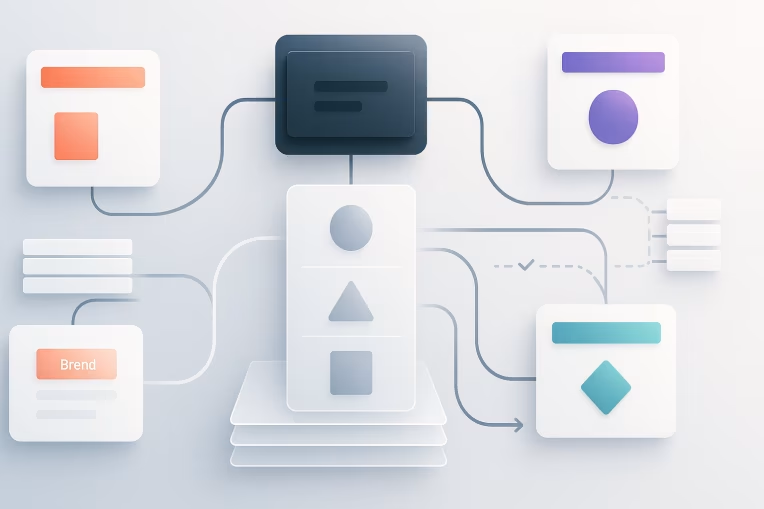
The important principle is separation of concerns. Primitive layers support system construction. Semantic layers express shared meaning. Component layers capture implementation needs. Brand layers apply approved variation.
When teams collapse these layers together, governance becomes nearly impossible.
Ownership boundaries between design, engineering, and product teams
Token governance tends to fail when ownership is either too centralized or too vague.
If one central team controls every change, delivery slows down and brands route around the process. If everyone can add tokens freely, the system fragments. The answer is not generic collaboration. It is explicit ownership by layer.
A workable model often looks like this:
Design system or platform design team
- owns token taxonomy and naming rules
- proposes and reviews semantic token changes
- defines when a new token is warranted versus when an existing one should be reused
- maintains usage guidance and examples
Frontend or UX engineering team
- owns token implementation format and build pipeline
- enforces token consumption patterns in component libraries and apps
- maintains linting, type safety, validation, and release automation where possible
- verifies propagation through Storybook, test environments, and downstream packages
Product or brand teams
- request additions or modifications based on real delivery needs
- apply approved brand-level values within allowed boundaries
- document exceptions and business rationale when the shared model does not yet support a requirement
Governance group or review board
This does not need to be bureaucratic, but it should exist. For token changes with system impact, someone needs to assess:
- whether the change is local or global
- whether it belongs in a semantic or component layer
- whether it introduces naming duplication
- whether it creates migration work for downstream consumers
The goal is not to make every token change heavyweight. The goal is to prevent changes with broad consequences from entering the system without review.
Release management for token changes across apps and component libraries
Many organizations underestimate how operational token changes are.
A token is rarely just a JSON edit. In enterprise platforms, a token change can affect:
- shared component packages
- multiple brand themes
- visual regression baselines
- Storybook documentation
- consuming applications on different release cadences
That means token governance should include release controls, not just naming standards.
A few practices help significantly.
Version token packages intentionally
If tokens are distributed as packages, version them with clear semantic expectations. A renamed or removed token is not a trivial change just because the file is small. If downstream teams consume tokens programmatically, breaking changes should be treated as such.
Classify changes by impact
Useful categories include:
- value-only change with no contract change
- additive token introduction
- deprecation of existing token
- breaking rename or removal
This creates a shared language for release planning and reduces surprises.
Test propagation, not just generation
Generating token output successfully does not mean the release is safe. Teams should verify how changes appear in component libraries and representative app contexts. Storybook can be particularly useful here when themes are previewed side by side.
Document migration paths for breaking changes
If a token is being retired or replaced, downstream teams need more than a changelog line. They need replacement guidance, examples, and a timeline.
Avoid silent cross-brand regressions
A semantic token update that improves one brand may degrade contrast, hierarchy, or spacing in another. Token review should include cross-theme checks and visual validation across a representative sample of components.
In practice, token governance gets stronger when release management treats tokens as a platform dependency rather than a design asset. That is also where design system architecture work often becomes less about component styling and more about versioned interfaces, review paths, and operational guardrails.
Documentation and tooling requirements that make tokens usable
Governance is much easier when the system is easier to use correctly than incorrectly.
That requires more than a token registry. Teams need documentation and tooling that make the model understandable in day-to-day delivery.
Useful documentation typically includes:
- naming conventions with examples of good and bad usage
- token tier definitions and contribution rules
- guidance on when to use semantic tokens versus component tokens
- examples of theme mapping across brands
- deprecation and exception policies
Tooling matters just as much.
Token inspection and discoverability
Teams should be able to see available tokens, their purpose, their current values by brand, and where they are used. If token usage is opaque, duplication becomes more likely.
Validation in the pipeline
Automated checks can catch duplicate naming patterns, invalid references, missing documentation fields, or direct primitive consumption where semantic usage is expected.
Component previews across themes
When Storybook or equivalent tooling shows component states under multiple brand themes, token changes become easier to review in context rather than in isolation. That kind of workflow is often what separates a theoretical governance model from one that teams can actually use, as seen in Arvesta, where Storybook and shared UI governance helped keep cross-repository delivery aligned.
Consumption guidance for frontend teams
React and Next.js teams often need clear implementation patterns, such as whether tokens are consumed through CSS custom properties, JavaScript exports, theme objects, or a hybrid approach. Governance becomes more effective when the expected consumption model is explicit. In larger frontend estates, this usually sits alongside broader headless platform strategy decisions about application boundaries, package ownership, and release sequencing.
Traceability
At enterprise scale, it helps to know why a token was introduced, who approved it, and whether it is still considered strategic or transitional. Even lightweight metadata can improve decision quality later.
The practical test is simple: if a product engineer has a styling need, can they identify the right token path without asking three different teams? If not, governance still depends too much on tribal knowledge.
When to allow exceptions and how to retire them
Strong token governance does not mean banning exceptions. Multi-brand delivery often includes legitimate edge cases.
A campaign-heavy brand may need a temporary visual treatment. A regulated journey may need a stricter contrast treatment than the shared baseline. A migration may require a compatibility layer while older components are phased out.
The problem is not the exception itself. The problem is unmanaged permanence.
A useful exception policy usually defines:
- what qualifies as an exception
- who can approve it
- where it can be implemented
- how long it can remain in place
- what exit criteria will retire it
For example, teams may allow:
- temporary brand-level aliases during migration
- app-level overrides only with documented expiry
- limited component token extensions for validated product requirements
But they should avoid normalizing exceptions as the default path.
One practical approach is to mark exceptions explicitly in the token model or in supporting documentation, then review them on a recurring cadence. If the need has become common across brands, it may justify promotion into the shared semantic layer. If not, it should remain isolated or be removed.
This is where governance becomes an operating rhythm rather than a one-time framework, and where a broader platform governance model can help teams define ownership, change control, and decision boundaries beyond the token files themselves.
A governance checklist for enterprise token systems
For teams evaluating or tightening their current model, the following checklist is a useful starting point.
Architecture
- Are primitive, semantic, component, and brand-specific layers clearly separated?
- Do teams know which layers they are allowed to change?
- Are app teams prevented from depending directly on raw primitives where inappropriate?
Naming and taxonomy
- Do token names describe intent consistently?
- Is there a review process for new semantic concepts?
- Are duplicate or near-duplicate tokens being identified and challenged?
Ownership
- Is there clear accountability for token architecture, implementation, and approval?
- Do brand and product teams have a defined path for proposing changes?
- Are system-impacting changes reviewed by the right people?
Release management
- Are token changes versioned and classified by impact?
- Are downstream apps and component libraries tested across themes?
- Are deprecations accompanied by migration guidance?
Tooling and documentation
- Can teams discover the right tokens easily?
- Are usage rules embedded in docs and validation tooling?
- Can reviewers inspect token effects in Storybook or comparable previews?
Exceptions
- Are exceptions time-bound and documented?
- Is there a review cadence for cleanup or promotion into the shared system?
- Do exceptions stay local unless broader reuse is justified?
If the answer to several of these questions is no, the issue is probably not token format. It is governance maturity.
Final thought
For multi-brand platforms, design tokens work best when they are treated as a managed interface between brand expression and shared implementation. That requires more than naming things well. It requires structure, ownership, release discipline, and a clear policy for variation.
The most effective token systems are not the most rigid ones. They are the ones that define where flexibility belongs, where consistency must hold, and how teams can evolve the model without breaking each other.
That is what allows brands to move independently without turning the platform into a collection of local styling negotiations.
Tags: Design Systems, design token governance, multi-brand design systems, token architecture, frontend theming strategy, design system operations